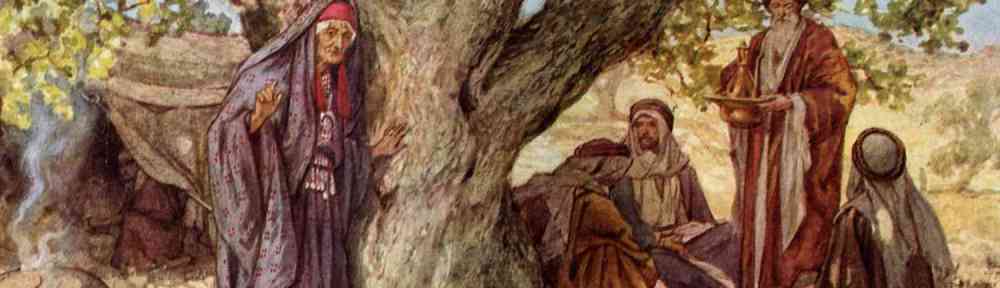
The women in Sidra Vayera cry out to be noticed. We begin with Sarah, inside the tent while her husband sits in the doorway and looks outwards. One of the travelling angels asks the question ו אַיֵּה שָׂרָה אִשְׁתֶּךָ “Where is Sarah your wife?”, and when told she is in the tent makes the prophecy of the child who will be born to them. Where is Sarah? Just like her husband was described at the beginning of the sidra she too is now at the opening of the tent “פֶּתַח הָאֹהֶל”. Abraham looks up and sees, Sarah hides behind the flap of the doorway and hears.
And what is recorded? The view of Abraham who sees men where there are angels; and the speech with its promise to Sarah, followed by her laughter at the news.
But then who does God respond to? To Abraham. With a question about the motivation of Sarah.
God asks Abraham ““Why did Sarah laugh, saying, ‘” I will return to you at the same season next year, and Sarah shall have a son.” – the child of the promise to Abraham is specifically the son of Sarah.
Sarah evidently hears, because she is frightened, and she lies to cover herself- “I didn’t laugh!” only to get the direct reply to her from the divine messenger – “No, you laughed!”
Then follows the famous discussion between God and Abraham about the destruction of Sodom and Gomorrah, after which we have an echo of the meeting of the messengers of God with Abraham at the beginning of the Sidra, when now his nephew Lot urges them to take up his hospitality, makes a feast for them gives them a place to rest.
Lot has two unmarried daughters still living in the family home, as well as his wife. Unlike the story at the beginning of the sidra, these woman are nowhere to be seen or heard. When the inhabitants of the city mob the house and demand the foreign guests be given up to them to be raped, Lot does something I have never been able to make sense of. Yes, hospitality and looking after guests’ wellbeing is exceedingly important in the inhospitable environment of the desert regions, but protection of the guests cannot justify Lot’s proposal to the Sodomites.
Look, I have two daughters who have not known a man. Let me bring them out to you, and you may do to them as you please; but do not do anything to the others, since they have come under the shelter of my roof.” (19:8)
Clearly, the divine messengers are also not happy with this solution. They pull Lot into the house and then send out a bright light that blinds the mob outside. And they tell him:
“Whom else have you here? In-laws, your sons and daughters [themselves]—anyone else that you have in the city—bring them out of the place. For we are about to destroy this place; because the outcry against them before GOD has become so great that GOD has sent us to destroy it.”
Lot goes to the households of his married daughters, but speaks only to the sons-in-law who thought he was playing games with them, or possibly he was drunk. And so, they ignored him. One has to wonder what might have happened had he spoken to his daughters. And there is no record of him speaking to either his wife or his daughters in his own home.
The angels urge Lot to flee the city, but he prevaricates and delays, to the point where the angels take his hand and also the hands of his wife and daughters, taking them outside the city walls. What must his wife and daughters think? These strange men urging them, with physical force, taking them out of their home and out of the city?
The angels leave Lot and his household outside the city walls and tell Lot he must flee to the distant hills to save his life – the language is in the singular, it is Lot they are talking to, not the group. They tell him not to look back, not to stop anywhere, lest he be swept away. Lot chooses this moment to negotiate – asking if he can instead flee to a nearby small town because he fears he will not reach the hills before the calamity would overtake him, and the angels graciously agree. He can go to the small town (Zoar) and it will be spared. The focus in the narrative is entirely on Lot, on saving his life, not that of the family. So it is probably not surprising that Lot’s wife has not heard the instruction not to look back. Sulphurous fire rains down on the cities of the plain, Lot’s wife looks from behind him – an echo of Sarah hidden behind the tent doorway flap behind the messenger – she looks and understands what is happening to the place where she has left her married children and their families – and וַתַּבֵּט אִשְׁתּוֹ מֵאַחֲרָיו וַתְּהִי נְצִיב מֶלַח -we usually read this as she looked behind her and was turned into a standing pillar of salt. But the verb v’tabeit is a hiphil form – she did not merely glance back at the destruction while running. Instead the verb insists that she paid attention to what she was seeing – she considered carefully what she saw– a process that takes time and intention. And then she was not turned into something, she became something – a netziv melach. A standing object that was salty – could it be her tears as she stood and watched and understood the enormity of the destruction? Could she have been transfixed in her grief and her horror, unable to move from her place. Whatever happened – she is no longer a character in the narrative.
Lot and his two daughters very quickly leave Zoar, afraid for their lives. After all they are strangers, and we know what can happen to strangers in these terrible cities of the plain.
There follows the only story entirely directed by women – the two daughters, believing themselves to have witnessed the end of the world, decide to get their father drunk, to procreate with him, and so to continue life in the world. One has to wonder about the inhabitants of Zoar, a city which was protected from the great calamity – but maybe Lot ensured that his daughters were not seen while they were there, and in turn they did not see that other people lived.
The decision of Lot’s daughters has far reaching consequences – this is the origin story of the Moabites (Mei-Av, from my father) and the Ammonites (ben Ammi, son of my people), two tribes who will forever be the enemies of Israelite people.
And now, again, we have a version of the wife-sister story – but this time Sarah does not speak at all, though later Abimelech defends himself by saying not only that Abraham has told him that she is his sister, but that Sarah had agreed that Abraham was her brother. God intervenes in a dream to tell him that she is in fact a married woman and therefore forbidden to him. She is וְהִוא בְּעֻלַת בָּעַל׃ the property of her master, she is אֵשֶׁת־הָאִישׁ the man’s wife. Abraham claims that Sarah is indeed his sister, through another mother, and Abimelech seems to accept this when he tells Sarah he will give a thousand pieces of silver to “her brother”.
And now the focus changes again. Sarah does indeed bear a child, whom Abraham names Isaac – meaning “he will laugh”. Sarah contextualises the name by saying – “God has brought me laughter; everyone who hears will laugh for me.”
But at his weaning feast Sarah notices the son of Hagar the concubine – Ishmael – מְצַחֵק. It could mean laughing with Isaac, but it could mean making sport of him, toying with him, mocking him…. Whatever Ishmael is doing, Sarah will not allow him near her boy and demands that Abraham send Ishmael and Hagar away. Abraham is distressed, but God reassures him, telling him both that “whatever Sarah tells you, do as she says, for it is through Isaac that offspring shall be continued for you.” And that “As for the son of the slave-woman, I will make a nation of him, too, for he is your seed.”
Hagar and Ishmael are sent away into the desert with food and water, but when the water runs out Hagar put her child under a bush and moved away some distance, unable to bear the sight of her child’s death. The text tells us that Hagar cries bitterly, but that God hears the voice of the boy. To make the point it repeats it. That God hears the cry of the boy, and then Hagar is told that God hears the cry of the boy. The voice of Hagar is evidently unheard. Ishmael and Hagar survive, he grows up to be a skilled hunter, and his mother gets him a wife from Egypt – from her own people.
After another encounter with Abimelech, the sedra ends with the story of the Akedah. Sarah has quite vanished from the narrative, instead we hear that Abraham’s brother Nahor has eight sons from his wife Milcah, one of whom, Betuel, will become the father of Rebecca, and that his concubine Reumah, has borne him three sons and a daughter, whose name is Maacah.
So we end with the birth of a daughter and many sons to Abraham’s brother. Who is Maacah? It is hard to say, the name appears in bible at least nine times, belonging to nine different people. But maybe we should just note that this daughter, the child of a concubine rather than a wife, who is the first bearer of the name, exists. All the more so since the verbal root from which the name is derived means “crushed” or “oppressed”
A fitting end to a sidra where many women are crushed or oppressed, where their voices are rarely heard, and where their bodies are offered by their own male relatives to other men, in order to smooth their path.
Maybe the text is trying to tell us something – that it notices all these women, that it hears and sees them, and that their attempts to be heard, their feelings and their very existence, will not be lost for those who look for them.

