Chayei Sarah – The complex life of a matriarch

The sidra Chayei Sarah, which begins with the death of Sarah, focuses initially – and in great detail, on Abraham’s purchase of a burial place for her in Hebron. Abraham then sends his servant on the quest to find a wife for Isaac, and we are introduced to Rebecca, who fulfils Eliezer’s requirement for God to show him a sign that he has met the right woman for his master’ son by offering water not only to him but to his camels. She marries Isaac, comforts him for the loss of his mother, takes on the role of the matriarch

And then “Abraham took another wife, whose name was Keturah. She bore him Zimran, Jokshan, Medan, Midian, Ishbak, and Shuah. Jokshan begot Sheba and Dedan. The descendants of Dedan were the Asshurim, the Letushim, and the Leummim. The descendants of Midian were Ephah, Epher, Enoch, Abida, and Eldaah. All these were descendants of Keturah. Abraham willed all that he owned to Isaac; but to Abraham’s sons by concubines Abraham gave gifts while he was still living, and he sent them away from his son Isaac eastward, to the land of the East.” (Genesis 25:1-6)

Next we are told of the death of Abraham at the great age of 175,his burial by Isaac and Ishmael in the family tomb in Hebron where Sarah is already interred, and then the text rather dispassionately tidies up the family history by listing the descendants of his son by Hagar, Ishmael:

“This is the line of Ishmael, Abraham’s son, whom Hagar the Egyptian, Sarah’s slave, bore to Abraham. These are the names of the sons of Ishmael, by their names, in the order of their birth: Nebaioth, the first-born of Ishmael, Kedar, Adbeel, Mibsam, Mishma, Dumah, Massa, Hadad, Tema, Jetur, Naphish, and Kedmah. These are the sons of Ishmael and these are their names by their villages and by their encampments: twelve chieftains of as many tribes.— These were the years of the life of Ishmael: one hundred and thirty-seven years; then he breathed his last and died, and was gathered to his kin.— They dwelt from Havilah, by Shur, which is close to Egypt, all the way to Asshur; they camped alongside all their kin. (Gen 25:12-18)

At least three family deaths are recorded in this sidra, as well as the births of many more sons of Abraham by other women, and even some of Abraham’s grandchildren from these sons. Bible records their names and the fact that Abraham gives them gifts and sends them off eastward to live in places well away from where Isaac was living in the Negev.  Isaac is clearly  marked out as the sole heir to Abraham and the covenant.  Isaac marries Rebecca, the daughter of Abraham’s nephew Betuel, and the stage is set for the next chapter.

I described the final verses of genealogy and geography as “tidying up” the family tree before moving on to focus on the central characters going forward. It is important to acknowledge Hagar and Keturah, the wife/concubines of Abraham who between them provide him with seven sons and twenty two grandchildren at the time of recording. It is important to note that all the children of Abraham have value and their names recorded. The listing provides a genealogical base for the future – perhaps the most famous being the Midianite tribes and the those of Ashur.

But something else happens as a result of the recording of the names of these descendants –  we are left in no doubt that Isaac is different. He alone is to receive the covenant God had promised long before his birth. The text is making very clear that being a son of Abraham was insufficient qualification for this covenant.  It was a necessary one, but what was also necessary was that the covenant was to be continued through a son of Sarah.

Keturah is a mysterious figure. Unlike the narrative that immediately precedes her marriage to Abraham – the marriage negotiated between Rebecca and Isaac – we know nothing about Keturah  – not where she comes from, not who her family might be, not how Abraham chose her to be his wife. She does not speak. We don’t know her age, or whether she predeceases Abraham or lives on after his death. We don’t know where she is buried.  Some traditions suggest she is Hagar, married to Abraham after the death of Sarah. Rashi, quoting Midrash Bereishit Rabbah (61) says “This is Hagar. She was named Keturah because her deeds were as beautiful (sweet) as incense (Ketoret)”. Targum Jonathan also says “And Abraham added and took a wife, and her name was Keturah; she is Hagar, who had been bound to him from the beginning.”. Whereas Ibn Ezra says “Keturah is not to be identified with Hagar because Scripture explicitly states, But unto the sons of the concubines (pilagshim), that Abraham had, Abraham gave gifts (v. 6)” whereas Keturah is described as “isha” – a wife. (However in the first book of Chronicles  (1:32 – 33), Keturah is described as a פִּילֶגֶשׁ אַבְרָהָם – Abraham’s concubine.

The life that Keturah and Abraham have together is glossed over, only the sons seem to matter. And while the text is silent about Keturah, we may not notice immediately that it is silent also about Abraham – apart from the work he does to ensure that all his other sons have an inheritance and are sent out into the world away from Isaac.  Abraham lives almost forty years after the death of Sarah – yet we learn nothing of his life in that time, there are no more encounters with God, no relationship with any of his sons, no travelling or meeting others….

Our patriarchal tradition usually names people according to their father’s name, and ignores that of their mother.  Whether it be the Hebrew name for the purposes of ritual, or the secular tradition of taking one’s father’s surname as the default, the primacy of the male line is underscored in so many ways. Yet here the bible is reminding us of the deep importance of the mother.

There is a mystical tradition in Judaism that the essence of a person’s soul is shaped by the mother.  The spiritual identity of the mother directly influences her child’s soul from the time of conception and beyond the birth. This tradition is one of the reasons sometimes given for the matrilineal principle of Jewish status being conferred by the mother.  And this tradition bases itself on the importance of it being Sarah’s child – not Hagar’s, not Keturah’s – who is the one to take up and inherit the covenant promise.

There is a lot to be said about the women’s who bear the children of Abraham – Sarah, Hagar and Keturah. None of them have an easy life, each hopes to protect her sons from a father whose focus on God’s promise of descendants and homeland must have made him a somewhat difficult life partner.   Each of them seems to be a lonely and isolated figure – Sarah who has left Ur Chasdim with Abraham, leaving her family behind; Hagar the Egyptian concubine who will later find a wife for Ishmael from her own people; Keturah whose homeland and family is not mentioned at all. But that is for another day. 

Parashat Vayera – from Sarah to Maacah, who are the women behind the famous stories?

The women in Sidra Vayera cry out to be noticed.   We begin with Sarah, inside the tent while her husband sits in the doorway and looks outwards. One of the travelling angels asks the question ו אַיֵּה שָׂרָה אִשְׁתֶּךָ  “Where is Sarah your wife?”, and when told she is in the tent makes the prophecy of the child who will be born to them. Where is Sarah? Just like her husband was described at the beginning of the sidra she too is now at the opening of the tent “פֶּתַח הָאֹהֶל”.   Abraham looks up and sees, Sarah hides behind the flap of the doorway and hears.

And what is recorded?  The view of Abraham who sees men where there are angels;  and the speech with its promise to Sarah, followed by her laughter at the news.

But then who does God respond to?  To Abraham. With a question about the motivation of Sarah.

God asks Abraham  ““Why did Sarah laugh, saying, ‘”  I will return to you at the same season next year, and Sarah shall have a son.” –  the child of the promise to Abraham is specifically the son of Sarah.

Sarah evidently hears, because she is frightened, and she lies to cover herself-  “I didn’t laugh!” only to get the direct reply to her from the divine messenger – “No, you laughed!”

Then follows the famous discussion between God and Abraham about the destruction of Sodom and Gomorrah, after which we have an echo of the meeting of the messengers of God with Abraham at the beginning of the Sidra, when now his nephew Lot urges them to take up his hospitality, makes a feast for them gives them a place to rest.

Lot has two unmarried daughters still living in the family home, as well as his wife.  Unlike the story at the beginning  of the sidra, these woman are nowhere to be seen or heard.  When the inhabitants of the city mob the house and demand the foreign guests be given up to them to be raped, Lot does something I have never been able to make sense of. Yes, hospitality and looking after guests’ wellbeing is exceedingly important in the inhospitable environment of the desert regions, but protection of the guests cannot justify Lot’s proposal to the Sodomites.

Look, I have two daughters who have not known a man. Let me bring them out to you, and you may do to them as you please; but do not do anything to the others, since they have come under the shelter of my roof.”  (19:8)

Clearly, the divine messengers are also not happy with this solution. They pull Lot into the house and then send out a bright light that blinds the mob outside.  And they tell him:

“Whom else have you here? In-laws, your sons and daughters [themselves]—anyone else that you have in the city—bring them out of the place. For we are about to destroy this place; because the outcry against them before GOD has become so great that GOD has sent us to destroy it.”

Lot goes to the households of his married daughters, but speaks only to the sons-in-law who thought he was playing games with them, or possibly he was drunk. And so, they ignored him. One has to wonder what might have happened had he spoken to his daughters.   And there is no record of him speaking to either his wife or his daughters in his own home.

The angels urge Lot to flee the city, but he prevaricates and delays, to the point where the angels take his hand and also the hands of his wife and daughters, taking them outside the city walls. What must his wife and daughters think? These strange men urging them, with physical force, taking them out of their home and out of the city?

The angels leave Lot and his household outside the city walls and tell Lot he must flee to the distant hills to save his life – the language is in the singular, it is Lot they are talking to, not the group. They tell him not to look back,  not to stop anywhere, lest he be swept away. Lot chooses this moment to negotiate – asking if he can instead flee to a nearby small town because he fears he will not reach the hills before the calamity would overtake him, and the angels graciously agree. He can go to the small town (Zoar) and it will be spared.  The focus in the narrative is entirely on Lot, on saving his life, not that of the family. So it is probably not surprising that Lot’s wife has not heard the instruction not to look back. Sulphurous fire rains down on the cities of the plain, Lot’s wife looks from behind him – an echo of Sarah hidden behind the tent doorway flap behind the messenger – she looks and understands what is happening to the place where she has left her married children and their families – and  וַתַּבֵּט אִשְׁתּוֹ מֵאַחֲרָיו וַתְּהִי נְצִיב מֶלַח  -we usually read this as she looked behind her and was turned into a standing pillar of salt.  But the verb v’tabeit is a hiphil form – she did not merely glance back at the destruction while running.  Instead the verb insists that she paid attention to what she was seeing – she considered carefully what she saw– a process that takes time and intention. And then she was not turned into something, she became something – a netziv melach. A standing object that was salty – could it be her tears as she stood and watched and understood the enormity of the destruction?  Could she have been transfixed in her grief and her horror, unable to move from her place. Whatever happened – she is no longer a character in the narrative.

Lot and his two daughters very quickly leave Zoar, afraid for their lives. After all they are strangers, and we know what can happen to strangers in these terrible cities of the plain.

There follows the only story entirely directed by women – the two daughters, believing themselves to have witnessed the end of the world, decide to get their father drunk, to procreate with him, and so to continue life in the world. One has to wonder about the inhabitants of Zoar, a city which was protected from the great calamity – but maybe Lot ensured that his daughters were not seen while they were there, and in turn they did not see that other people lived.

The decision of Lot’s daughters has far reaching consequences – this is the origin story of the Moabites (Mei-Av, from my father) and the Ammonites (ben Ammi, son of my people), two tribes who will forever be the enemies of Israelite people.

And now, again, we have a version of the wife-sister story – but this time Sarah does not speak at all, though later Abimelech defends himself by saying not only that Abraham has told him that she is his sister, but that Sarah had agreed that Abraham was her brother.   God intervenes in a dream to tell him that she is in fact a married woman and therefore forbidden to him. She is וְהִוא בְּעֻלַת בָּעַל׃ the property of her master, she is אֵשֶׁת־הָאִישׁ   the man’s wife.   Abraham claims that Sarah is indeed his sister, through another mother, and Abimelech seems to accept this when he tells Sarah he will give a thousand pieces of silver to “her brother”. 

And now the focus changes again. Sarah does indeed bear a child, whom Abraham names Isaac – meaning “he will laugh”.  Sarah contextualises the name by saying – “God has brought me laughter; everyone who hears will laugh for me.”

But at his weaning feast Sarah notices the son of Hagar the concubine – Ishmael – מְצַחֵק. It could mean laughing with Isaac, but it could mean making sport of him, toying with him, mocking him…. Whatever Ishmael is doing, Sarah will not allow him near her boy and demands that Abraham send Ishmael and Hagar away. Abraham is distressed, but God reassures him, telling him both that “whatever Sarah tells you, do as she says, for it is through Isaac that offspring shall be continued for you.” And that “As for the son of the slave-woman, I will make a nation of him, too, for he is your seed.”

Hagar and Ishmael are sent away into the desert with food and water, but when the water runs out Hagar put her child under a bush and moved away some distance, unable to bear the sight of her child’s death.  The text tells us that Hagar cries bitterly, but that God hears the voice of the boy. To make the point it repeats it. That God hears the cry of the boy, and then Hagar is told that God hears the cry of the boy.  The voice of Hagar is evidently unheard.  Ishmael and Hagar survive, he grows up to be a skilled hunter, and his mother gets him a wife from Egypt – from her own people.

After another encounter with Abimelech, the sedra ends with the story of the Akedah. Sarah has quite vanished from the narrative, instead we hear that Abraham’s brother Nahor has eight sons from his wife Milcah, one of whom, Betuel, will become the father of Rebecca, and that his concubine Reumah, has borne him three sons and a daughter, whose name is Maacah.

So we end with the birth of a daughter and many sons to Abraham’s brother. Who is Maacah? It is hard to say, the name appears in bible at least nine times, belonging to nine different people. But maybe we should just note that this daughter, the child of a concubine rather than a wife, who is the first bearer of the name, exists. All the more so since the verbal root from which the name is derived means “crushed” or “oppressed”

A fitting end to a sidra where many women are crushed or oppressed, where their voices are rarely heard, and where their bodies are offered by their own male relatives to other men, in order to smooth their path.

Maybe the text is trying to tell us something  – that it notices all these women, that it hears and sees them, and that their attempts to be heard, their feelings and their very existence, will not be lost for those who look for them.

Toledot

Parashat Toledot is the one time that we focus on the life of the adult Isaac. His parents, Abraham and Sarah are dead and buried. He is married to Rebecca, whom his father’s servant has brought back from their ancestral homeland for this purpose. He is in love with her and faithful to her and she is apparently barren. So Isaac entreats God on her behalf and she conceives his children Jacob and Esau, twins whose struggle begins even in the womb.  Isaac is set up to follow his father, and to become the Patriarch of the next generation – a man who speaks to God and is heard by God, who is the head of a large household and the father of sons. One would expect now that the stories of this new Patriarch would take us further into our history, give us new aspects to consider.  And this does happen, but in a somewhat unusual fashion.

Following the birth of the children and the parental choices that will forever mark the relationship of Esau and Jacob, Isaac and Rebecca go on to repeat the journey taken by Abraham and Sarah. They go to escape the effects of famine just as Abraham and Sarah did, but theirs is not simply a physical journey – by virtue of the repetition something extra happens and defines the process by which Isaac becomes himself.   Isaac and Rebecca have almost the exact same experience in the same city of Gerar as did his parents, Abraham and Sarah, and its effect creates something quite new.

The famine is described to us as being a famine Bilvad hara’av harishon asher haya bimei Avraham – not the same famine as before, that happened in the days of Abraham, so we are already conscious once more of the journey that Abraham took in his response to the famine. On this journey however, God appears and warns Isaac not to leave the land, not to follow his father’s example and go to Egypt.

          Isaac goes to Abimelech, the king of the philistines, in Gerar, according to tradition the very same Abimelech that Abraham and Sarah encountered all those years before.  There he tells king Abimelech that Rebecca is his sister and not his wife, just as Abraham had done with Sarah in Genesis, chapter 20. Of course this caused problems in both cases as the king was taken with  first Sarah and later Rebecca. Abimelech is very upset when he discovers that these women are none other than wives, not sisters. Can this really be the same king? one would have thought would have learned his lesson! But that is exactly what this week’s parasha is about. Lessons learned and lessons not learned; encountering the same thing again and again, and responding to it differently or not.

We see this story as a slightly weak repetition of the Abraham stories, and might be led into thinking of Isaac as somehow a weak and uncreative man. He is indeed often described as being the middle link, the son of a famous father and father of a famous son who himself has no claim to fame except as the link between the two. But we can look at this story in yet another way. We might see that Isaac, as patriarch of the next generation, must first walk in the footsteps of his father in order to make his journey grounded. He has to plumb the depths of his father’s experiences in order to move on and to make meaning for himself and his family, develop the traditions of his growing tribe. When confronted with similar moments in time, the choices that Isaac will make will not only shape him but shape generations to come. He has lessons to learn. Will Isaac learn from these lessons? Will he miss them and miss how they relate to incidents in his own life? And how will we, the readers, know?

Though Isaac may once have fled from a father he may have feared, (after the Akedah on the mountain top Isaac is not mentioned as returning with is father and we later see him come together with Ishmael to bury Abraham – neither of them seem to have had an adult experience with Abraham the patriarch), he now meets him in a different way, by re-living similar experiences.

We learn about our ancestors when we have to grapple with similar decisions and incidents. We gain valuable insights into who they were and their character. What we could not understand as children or earlier in our lives, we understand differently when placed in similar situations. It is often only when we become parents that we understand better the feelings our parents must have had toward us. Only when we have to bury a parent or care for a sick spouse that we truly understand what an earlier generation must have gone through.

This repetition of the story of Abimelech and the wives/sisters is a vital requirement for Isaac if he is to grow into being his own person, no longer overshadowed by his father.  By reliving some of the major events in the story of his father’s life, he will have to respond to many similar choices.

Isaac was almost sacrificed on the altar by his father in response to the command of God. His father apparently was fulfilling a divine call. Isaac will do the same to his son Esau when he gives Jacob the blessing even as he senses that Jacob is masquerading as Esau. And though Isaac won’t literally hold a knife over Esau’s head, he will sacrifice him and his future in a different way. Sometimes we repeat our parent’s mistakes; sometimes we are able to amend them. Sometimes we repeat our own mistakes, sometimes we are able to learn from them.

          The sedra concludes with Rebecca helping Jacob to receive the blessing by apparently deceiving the blind and dying Isaac. It is never clear quite whether she does so because she remembers the divine prophecy about the older child serving the younger when her pregnancy was so painful she too enquired of God; it is never clear if this prophecy was the reason she so favoured her son Jacob over her son Esau. But it is clear that she will act to achieve the succession for her favoured younger son Jacob, just as her mother in law Sarah acted in order to achieve the succession for her child, Abraham’s younger son Isaac.

With the help of the manipulation and skills of his mother, by the end of the sidra the focus is on Jacob, who has received the blessing of the heir from his father. Esau returns from his mission to get something special for his dying father and cries out in terrible pain “Have you but one blessing, Father? Bless me too Father (27:36).  He receives a blessing from his father which is perhaps more than Ishmael ever did, but not the blessing he so craved.

When we look at these stories of Isaac acting out the life of his more colourful and confident and arrogant father we see that Isaac does indeed walk in his father’s footsteps, and not only as a pale shadow. We see that Isaac was his father’s son, able to understand more about his father than perhaps he realized, able to repair some of the mistakes at least a little.

As we read his story in Toledot, maybe it will cause us to reflect a bit about ourselves, for perhaps all of us walk in our parents’ footsteps more than we would like to acknowledge, and maybe we have a chance to repair some of the damage done, rather than pass it on to the next generation.

Parashat Pinchas: #Girlpower; Or: The real stars of the sidra are the five women siblings who transform society and create justice.

‘Va’tikrav’nah b’not Zelophehad’ – the daughters of Zelophehad approached …. so begins one of the most intriguing stories to take place in the wilderness, a story where the bones of the developing society are laid bare for us to see, a rare narrative of the evolution of the legal code, and of the organising principles of our ancestral community.  And how much richer and more rewarding a text than we might imagine – it begins with this proactive and dynamic move – the daughters of Zelophehad, a man whom we have never heard of up until now, a man who is distinguished at this point only through his death – approach Moses and demand what they see to be their, and their father’s right – inheritance of land for them, and continuation of name and memory for  him.

The very first word on the story is unusual – the feminine plural form of any verb is a rarity in biblical Hebrew grammar, which defaults into the masculine with even a hint of testosterone, however many women there are involved.  And this is an active verb – the action of drawing close to another, used routinely in the search for God with the ritual of korbanut – of offering something precious to God as a sacrifice.  The verb one might expect – of simply coming to speak to Moses, is rejected in favour of injecting a sense of closeness – even of implying relationship.  These are no supplicant outsiders, but people whose perception of themselves is of being at the core of the community, who are able to treat Moses with proper respect but without needing to beg.

Machlah, Noa, Hoglah, Milcah and Tirzah are clearly of interest to the biblical narrator – not only are all their names recorded, but in the book of Joshua they appear again – and once again all the names are listed – to demand that what God had commanded Moses here in the wilderness was honoured once the people reached the land.  They obviously made a huge impression in their determination to inherit the land of their father, and in their determination to work together – five women, siblings, jointly fighting for their principles and their rights.  Given the terrible sibling stories in the bible – the first murder is fratricide and takes place in the very first generation to be born into the world – the relationships each of the patriarchs had with this brothers and the behaviour of Joseph’s older brothers towards him – you might think that it wasn’t even possible to get along with, let alone work with, your peer generation relatives!  There is a vestige of a hint that sisters might get along as long as they weren’t interested in the same man, in the midrash on Leah and Rachel, but actively co-operating with each other for joint good – that is unique I think to these five women.  Small wonder they are remembered with such particular definiteness.

Machlah, Noa, Hoglah, Milcah and Tirzah break the mould of sibling relationships – but they break other moulds too.  Up until this point no-one has come along with their own interpretation of Torah – God has simply given out commandments, either at reaching a new geographical place or during a social crisis.  At no point has anyone so much as solicited a legal opinion from God on a matter God has not yet discussed, let alone come up with their own innovation.  This is something entirely new in the narrative – for someone to come to Moses with a principled resolve based on what they understand to be the right thing to do, and a clear vision of what a Godly society should do.

Rather than merely following rules which have been transmitted to them, these women are willing to innovate, to change the world in accordance with their own principles.  As other women have done before them:– Sarah persuading Abraham to have a son by Hagar, Rebecca disguising the young goat as venison so as to claim the birthright blessing for her favourite son Jacob – the daughters of Zelophehad have taken matters into their own hands and changed the course of history.  This is a radical shift in the development of the Jewish people.  While one can make the case that since Eve in the Garden of Eden, men have tended to follow the rules which are laid down (or at best to interpret them within a narrow focus), women have brought about disjunction and change, this is the first time that the women’s behaviour has been given the imprimatur of God – ‘ Kein b’not Zelophehad dovrot – the daughters of Zelophehad speak right’  – there is divine approval for the different model of approaching the world, that of creating something new that is not connected with what was already in place, of breaking new ground because one is driven to do so by a sense of justice, of the absolute rightness of the new action.

The story of the daughters of Zelophehad is a story designed to remind us to stand up for rights, even if they are not yet perceived to be rights;  it is a story to remind us that all things might be possible, even with a God who seems to have it all sorted out already, even in a wilderness where the right might seem to be too abstract or too unfulfillable to be relevant.

The daughters of Zelophehad did groundbreaking work, which emerged from their confidence in themselves and the justness of their cause, from their supportive relationship with each other, from the need to link the past with the future and identify themselves within that future.  They established a legal presence and right for themselves and for all women in the future – the right to control their own economic provision.  We know that later on the right was constrained to daughters who married within their own tribe, that while they achieved economic power for women they were still kept away from the more potent power of the time – that of religious decision making – at least within the public and recorded sphere, but that should not change how we view this radical model of behaviour – you  still have to stand up and claim your rights and responsibilities even if you don’t immediately or easily achieve them – you need to challenge even God if necessary, to battle for what you believe to be important, to make your mark upon the world by fighting to make the world a better place.

The world hasn’t changed since the days of Machlah, Noa, Hogla, Milcah and Tirzah – it still seems that generally speaking men tend to operate by following or implementing the rules  and that women work by transforming them.  You only have to look at the impact women have had on the rabbinate to see that generality in action!   The question we need to be asking ourselves is not ‘why is the world so unfair’ but ‘in what way will I change the world because of what I believe in, because of my own faithfully held principles?’

(Adapted from the sermon for my daughter’s batmitzvah parashat Pinchas 2000 – a true disciple of the b’not zelophechad school of women fighting for social justice. Dedicated to the formidable Charlotte Fischer)


Tamar: taking her destiny in her own hands she will enable the messiah. Parashat Vayeshev

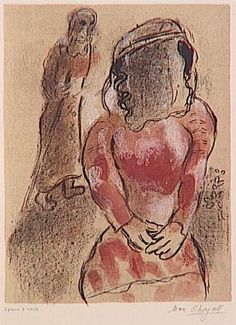
judah-and-tamar-chagallInserted into the Joseph narratives that take up much of the last half of the book of Genesis, is a chapter about Judah and about his family. It is also a chapter about the actions of a woman who is determined to right a wrong and how she achieves this goal. Situated as it is so discordantly in the Joseph narrative it is easy to turn the page, to ignore the text as we continue to read about Joseph’s troubles and his subsequent elevation. Because it deals with sexual acts, and with apparent impropriety, it is studied much less than it should be. The lens of the narrator is narrow, detail is sparse, but it is a text worth a great deal of attention, for it reminds us that in bible the women were actors in the story and not observers, they were out in the public space, their behaviour often created pivots in the chronicle. The story of Judah and Tamar shouts out “notice me” – the sons of Jacob are yet again challenged by a woman and this time they cannot cheat her or hide from her or marginalise her. Tamar is a risk taker while all the time behaving within the law. She is a model for modern Jewish women, her story reminds us our destiny is in our own hands.

Judah leaves his brothers and marries a Canaanite woman, the unnamed daughter of Shua, and has three sons: Er, Onan and Shelah.  Without comment from the narrator, time passes and he takes a wife for his first born son -Tamar. What do we know about her? Her antecedents are shrouded in mystery though we may assume that she was also a Canaanite woman. There is one tradition that suggests that she is the daughter of Malchitzedek, King of Shalem and Priest to the Most High God, and certainly she behaves in a way that bespeaks confidence and determination to get her rights fulfilled.

Tamar is married to Er, who was “wicked in the sight of God, and God killed him” (38:8). She was then married to his younger brother Onan, specifically (and anachronistically) for him to perform the act of yevamah, to provide a child who would legally be the child of the dead and childless Er.

But Onan knew that the child would not be formally his, as so when he went to her he deliberately spilled his semen on the ground rather than create a child who would inherit the portion of his dead brother, and the bible tells us “Vayera b’eynei Adonai asher assah vayamet gam oto: The thing that he did was evil in the sight of God, and he killed him too” (v10)

What did Er do that was so wicked he deserved to die? Bible doesn’t tell us. While there is a strand of tradition that suggests that the boys die as punishment for the wickedness of their father, so that he should feel the pain of the death of a child as he had caused his father to feel that grief when he did not protect Joseph, the general consensus of tradition is that the sin must have been Er’s and must have been similar to that of his brother. Hence one Midrash suggests that he did not want Tamar to spoil her beauty by becoming pregnant and therefore his relations with her were designed to prevent pregnancy. This I think tells us much more about the commentators than it does about the text, but the reality is that he does not provide a child for his wife before his sudden death.

Onan’s wickedness however is clear, and it is not the sin that bears his name. It is not the spilling of the seed that was the real problem in God’s eyes, it was the fact that he did not want to give his dead brother a stake in the future, a child who would inherit both the name and the material benefit that would have belonged to Er. He denied his dead brother an heir and he denied his wife the protection that having the child would give her.

What we are told and what we are not told in this text is fascinating. The bible is keen to make sure we know that Judah has left his brothers, that he has built a deep friendship with Hirah an Addullamite (va’yet). It tells us of his Canaanite wife bat Shua and his children with her. It tells us that the action takes place in Chezib – and here is the clue to the whole sorry tale, for the name Chezib comes from the root-verb כזב (kazab), meaning to lie, to disappoint, to fail. As an idiom the word is also used to describe a brook or stream that has dried up – a river that disappoints, rather than one that will provide water. Judah has three sons, and yet the likelihood of his having descendants after them diminishes as the disappointment and the lies build up.

The bible signals that the story is about deceptions and disappointment, and Judah as the fourth son of Jacob and Leah is born into deception and disappointment, even while he will ultimately become the ancestor par excellence, the tribe from whom we will descend.

After the deaths of the two older sons, Judah tells Tamar to “stay a widow in the house of your father until Shelah my son grows up” Assuming the practise of yevamah, this appears to be a reasonable request, though why Tamar is kept in her father’s house rather than that of her in-laws bears further examination. But it seems that he is trying to keep her at a distance, for bible continues that same verse with the words “Lest he also die like his brothers”.

The superstition that a woman who loses more than one husband is somehow responsible is dangerous and a killer of men who come close to her has deep roots. It is a classic example of blaming the victim. Widows were economically and socially vulnerable, classed in bible along with orphans and strangers in the land/refugees. There are many exhortations to protect the widows in biblical texts, but in this story in the first book of Genesis, before Torah had been given and before its challenge to established norms, the superstition drives Judah, and sadly his behaviour means that the idea of the “black widow” has permeated into our awareness too.

Widowed now himself, Judah goes to see his great friend Hirah in Timnah. We do not know how much time has passed but Tamar is able to observe for herself that Shelah has grown up and that he has not been given to her as a husband in order to both provide a child in his brother’s names. Tamar is trapped in a situation that does not allow her to marry within the family of Judah nor to marry anyone else. She must feel desperate.

Judah doesn’t tell Tamar that he is travelling near to where she is. He has left her exiled in her father’s home living as a widow and he seems to have no communication with her, nor any interest in her continued well-being.  Someone unnamed tells her that Judah will be travelling through and Tamar takes her chance.

She removes the widow’s weeds she is wearing and covering herself with her veil she sits “petach Einayim” – which could mean “at the entrance to Einayim” but which also means “at the opening of the eyes”. This is a pivot in the story. There has been up till now lies and deception, the suppressing of the reason that God found Er wicked, the betrayal by Onan of his brother’s rights to the future.   Tamar has been hidden from sight in the household of her father, there is no communication between the two households, she is out of sight and out of mind. But here she is, sitting by the roadway Judah will travel, determined to be noticed, to open Judah’s eyes to the injustice done to her.  Her action is eye opening.

Judah certainly sees her. He notices her. At least, he notices there is a woman there and he makes the assumption that she is a prostitute. And the reason for this? Because her face is covered.  Think about this. He reaches his conclusion that this is a woman available for hire for sexual relief because her face is covered. In today’s world a veiled face is supposed to designate modesty, protecting the beauty of the woman from the crassness of the world – yet here in bible the clear assumption is that the veiled face designates woman only as object. She stops being a person. She doesn’t exist as living breathing yearning thinking woman. She is a prostitute, available for the pleasure of men who pay. There is at least some honesty in this approach – the reality of the woman is unimportant in the world of the biblical text, who she is is irrelevant to the man who buys her. In today’s world of extreme tzniut used to oppress women in some communities, the deception is back. Telling women that their covered state and hiddenness from the public space is a way of increasing their holiness, protecting their modesty etc is a lie to hide the fact that their very self is being controlled by others, to keep them as possessions and as subjects rather than as active and authentic people with their own agency.

Judah is polite, he speaks to her with courtesy, not knowing who she is at all. The same verb is used as with his relationship with Hirah – vayet eleha – he turns to her. This could be the beginning of a real connection, but it is not because he does not see someone with whom connection can be made. He sees only the possibility of a sexual moment and this is what he asks for. So she begins the negotiation “what would you give me in payment for sex?” He offers her a future payment, a young kid from the flock, and she counters with the request for a pledge that she can keep until such time as the payment is made. It seems that Judah is unused to this type of negotiation. He asks her what such a pledge should be and she requests three deeply personal and unique items that will be recognisable and indisputably his.  Having given them to her, they have intercourse and Tamar conceives at last.

The interlude over, she leaves and removing the veil she puts on her widows weeds once again. Judah keeps his promise, sending the animal as promised with Hirah his friend, and expecting the return of his pledge, but she is gone, and when Hirah asks around where the prostitute who had been sitting there was, the response is that there had been no prostitute. This he relays to Judah, who doesn’t seem to be at all perturbed by the woman’s disappearance with his personal possessions, and seems rather to hope that by ignoring what has happened he will escape any shame. But how can he just leave his pledge, his signet, cords and staff, as if nothing has happened?  These days we might call it identity theft, we would desperately search for our missing items and try our best to make good the loss. Judah’s response “tikach la, pen nihyeh lavuz” is more than laconic, it is negligent and it is fearful of any shame attaching to him and his friend. Why?

Three months later the news reaches Judah that Tamar is pregnant, and the assumption is that she has prostituted herself. No communication has happened between the two as yet and when she is brought to Judah in order to be punished by burning, she still does not immediately identify the father by name. Instead there is a sort of choreography – she is brought to the household of Judah from her father’s house. She does not appear to meet Judah, instead she sends the pledged items he had given her and says “Clarify please whose are these tokens? The signet the cords and the staff?” It is of course a rhetorical question but it is a dangerous one. For a man who had been trying to avoid shame, Judah could have taken and sequestered the items. She would have been burned to death along with her unborn children. But instead he acknowledged them and speaks of the justice and rightness of Tamar’s act – she had simply been trying to fulfil the requirement for a child for his two dead sons, and in doing that to protect her own vulnerable situation too.

Like Rebecca, Tamar has twins. Like her too the birth is eventful – the first child puts out a hand and then withdraws it but not before a scarlet thread has been tied around it, the second child is then born, and the elder one is fully born second. Their names are given, but not it seems by Tamar. The elder child is named Zerach which means brightness or shining. The younger is Perez – meaning to burst forth, to breach. There are many echoes of Rebecca here, the colour red, the description of the older child in terms of his appearance and the younger in terms of his actions.  There is a clear subtext that these children were designed to be born, they are necessary in terms of the biblical narrative. They would not have been born had Judah followed his plan to keep Tamar in purdah to protect his one surviving son from what he saw was her danger – a superstition roundly exploded in the story, for Judah is not endangered by his encounter with Tamar.

The story is tidied up – both dead brothers have a child to take their place in history. Tamar does not need to marry again, her status is established. Judah has come to realise that his behaviour was not as righteous as that of his Canaanite daughter in law and has acknowledged this.  But the questions arising from the story only multiply. Why this story at all? Why put it here in the Joseph narratives? Why did the children need to be born?

One question is partially answered in the genealogical line given in the book of Ruth, the Moabite woman who also took her status as childless widow into her own hands and had a child by a family member of her dead husband in order both to honour his future and to protect her own vulnerable status. We will learn from this genealogy that King David will descend from the line of Perez – that both Tamar the Canaanite woman and Ruth the Moabite woman will pivot history in order to bring about the birth of the messianic line.   But why does King David and why will his messianic descendant need to be born of such deceptive sexual encounters orchestrated by the women? This is a question yet to be satisfactorily answered.

Why is it in the Joseph narrative? With the themes of clothing to hide identity, of deception and betrayal, of promises made and not kept and of the painful loss of children, with mis-communication and with the lack of communication, with fear and shame and hopelessness and exile –  there is much to connect these narratives.  But Tamar herself is not echoed in the Joseph stories, except maybe in parody when the wife of his master desires him and lies that he tried to sleep with her. Tamar stands alone in these narratives, a woman who is married twice to unworthy and wicked men yet who retains her own integrity and keeps her eye on the future. Blamed as a husband killer when we know from bible that God kills the men because of their wickedness, exiled to her father’s house and marginalised from the narrative, she uses her marginal status and plays out the scene whereby she becomes not-woman, a body, a prostitute for hire at the roadside, and moves her descendants into the centre of the narrative.

One of my favourite lines of any film comes in “My big fat Greek Wedding”. It tells the story of a woman of Greek descent trying to find herself and her place in society outside her father’s home and the struggles she endures as she grows. Her father makes a decree about her future and she is despondent. Her mother tells her that indeed she must obey, the father is the head of the house. In their culture, his word is law. But the mother goes on to say, the father is the head but the mother is the neck, and the head points whatever way the neck dictates.  It speaks to me of biblical narrative, when the men make the decisions and hold the power, but with great regularity the women subvert that decision making, and from Sarah, Rebecca, Rachel and Leah onwards they gently manipulate in order to produce the desired outcome. The list of these women in bible is long, yet often they escape our attention as they escape the attention of the men with whom they live. Tamar is a rare exception – by getting herself noticed she will disrupt the course of the narrative and change history.
Toledot: there are more generations and more branches in our family tree than we notice – meet Mahalat bat Ishmael the fragrant bringer of hope

וַיַּ֣רְא עֵשָׂ֔ו כִּ֥י רָע֖וֹת בְּנ֣וֹת כְּנָ֑עַן בְּעֵינֵ֖י יִצְחָ֥ק אָבִֽיו: ט וַיֵּ֥לֶךְ עֵשָׂ֖ו אֶל־יִשְׁמָעֵ֑אל וַיִּקַּ֡ח אֶת־מַֽחֲלַ֣ת ׀ בַּת־יִשְׁמָעֵ֨אל בֶּן־אַבְרָהָ֜ם אֲח֧וֹת נְבָי֛וֹת עַל־נָשָׁ֖יו ל֥וֹ לְאִשָּֽׁה:

“And Esau saw that the daughters of Canaan were displeasing to Isaac his father. So Esau went to Ishmael and he took Machalat the daughter of Ishmael son of Abraham, sister of Nevayot over his women/ in addition to his other wives, for a wife for himself.”

So ends the sidra of Toledot. It began with Isaac marrying Rebecca and pleading with God for her to have children. Having conceived twins who are struggling within her, Rebecca is informed that she will give birth to two nations who would be not be equal. The firstborn, Esau, was red and hairy. The second born was holding on to his brother’s heel so they named him Jacob (heel). Esau became a skilled hunter and was the favoured child of his father, but Jacob remained close to home and his mother. The bible recounts the story of Esau coming home famished after a hunting trip and selling his birthright blessing for some of the delicious red stew that Jacob had made.

The narrative continues with the story of a famine and Isaac goes to the Philistine King Abimelech for support, having been told by God to not leave the land as his father had done. Isaac settled in Gerar, and for fear of being killed because of Rebecca’s beauty, he follows the example his parents had given and told Abimelech that Rebecca was not his wife but his sister. Abimelech however found the lie out, and in order not to attract punishment from God, warns the Philistines not to mistreat the couple.   Isaac grows wealthy and the Philistines begin to hate and envy him to the point where he is unsafe. Isaac moves his household away to Rechovot, and then has an encounter with God at Beersheva where he receives the covenant of blessing. Abimelech, understanding that Isaac is the heir to his father’s relationship with God seeks a peace treaty with him which is sealed with a feast.

Now we return our focus to the family. Esau married two Hittite women, Judith bat Be’eri and Basemat bat Elon, and Isaac and Rebecca are bitterly upset.

Now we come to the last phase of Isaac’s life. He is old, his sight is poor, he knows it is time to give the blessings to his sons. He asks Esau to hunt and prepare a dish of his game for him after which he will bless him. Rebecca overhears, and, when Esau is gone, she instructs Jacob to bring her young goats in order for her to make a meal for Isaac that Jacob can take him and receive the blessing. Jacob does not think this will work- Esau is hairy, Jacob is not. Isaac on touching his son will understand the deception and may curse him. Rebecca responds by taking the curse upon herself, and demands that Jacob do as she has told him. She makes coverings from the skins of the goats and food from the flesh, dresses Jacob in Esau’s clothing and sends him to his father. The text is ambiguous as to whether Isaac recognises which of his sons is with him, but he goes with the flow, blessing Jacob with the special blessing. Esau returns, discovers his blessing is already given to his brother and in his distress asks his father for another. Isaac blesses him with abundance, but also with the hope that he will one day break the yoke of subservience to his brother. Esau’s fury is a danger to Jacob and so his mother arranges that he is sent to safety with her family under the pretext that this will keep him away from Canaanite women and help him to marry within the family group.  Esau hears this, understands that his first two choices of wife were not acceptable to his parents, and so he goes to Ishmael his uncle in order to marry Machalat, his cousin, the daughter of Ishmael.

Machalat is family. She is the daughter of Ishmael the beloved son of Abraham and of Hagar, whom God comforts when she and her son are near to death in the wilderness having been expelled from the camp. Hagar is the first person who is recorded as giving a name to God.   We are told that “she called the name of the Eternal who spoke to her, You are El Ro’ee (a God of seeing)” (Gen 16:13)  So Machalat is the grandchild of a woman who encountered God.

There are two biblical texts naming the wives of Esau, and they do not exactly coincide. One tells us the three wives are Yehudit bat Beeri, Basemat bat Elon and Mahalat bat Ishmael (Gen 26) whereas the second tells us they are Adah bat Elon, Basemat bat Ishmael and Oholivamah bat Anah (Gen 36).  The gemara resolves the problem by saying that Basemat/Machalat were the same woman, and whereas the name Basemat means fragrant, Machalat comes from the same root as forgiveness – mechilah – and that in marrying her all the sins of Esau were forgiven (JT Bikkurim 3:3)This would explain how, when the brothers meet up again years later, Esau is warm and welcoming, having given up the bitterness and anger caused by his brother’s betrayal, he too, having been forgiven, is able to forgive.

Basemat, whose name implies great sweetness, gives Esau a son and names him Re’u-El –friend of God. Is it accident that the name plays with and even seems to echo the name her grandmother gave to God – El-Roee? What is clear is that while Esau has many other children, only this son is named with a reference to God.

It feels like a hint – Hagar and Basemat were not destined to be part of the main thread of the narrative, but they were important nevertheless, they had their own very good relationship with God and their lives impact upon our history.

The bible may not be focussed on these women, or on this lateral branch of the family tree, but it considers them important enough for them and their descendants to be recorded. We know about Rebecca, her initial infertility and her later challenge to God once her difficult pregnancy was begun. We know how she took care to direct the narrative so that Jacob would become the link in the chain of tradition. We know about Sarah, her initial infertility and her derisive laughter in responding to God’s telling her that she would yet bear a child to be the link in the chain of tradition. But the bible reminds us there were other women who also had encounters with God, yet who did not go on to become matriarchs in our tradition.

Our historic commentators do not much notice these women, and if they choose to do so it is usually to make a point about the men they are connected with, and to be honest, they are not often kind to the women nor interested in them and their experience. But now we have a different set of lenses, modernity chooses to unpeel the layers of patriarchy and look again at the unvarnished text. Machalat the daughter of Ishmael appears to be a woman who, like her grandmother, knows God. Her marriage to Esau seems to change him, their son is a friend of God, the same God who appeared to abet Esau’s trauma. She brings forgiveness – mechilah – and she brings hope. Hope for the brothers who were destined to be in an unequal power relationship but whom we see later in life are both wealthy, settled family men. And in bringing the hope that transforms the relationship of brothers born to struggle against each other, surely she can be the touchstone for us in our generation when we know we are not forced or destined to hate each other. Machalat bat Ishmael, she brings the fragrance of hope and optimism. She deserves to be noticed.


https://s-media-cache-ak0.pinimg.com/564x/56/dd/4b/56dd4b96809fb5e941fcbd8129daae88.jpg


Image is “Mahalat” [Yishmael’s daughter, Esav’s wife] by Siona Benjamin

Sarah, a matriarch whose multifaceted life gives us all something to live up to.

The Matriarch Sarah is the only woman for whom a sidra, the weekly torah reading, is named.  The first wife of Abraham, the mother of Isaac, she is the also the first of the four biblical matriarchs. What do we know about her? No genealogy is given for her when we first meet her as the wife of Avram living in Ur of the Chaldees, although Avram does at a later point say she is his half-sister. (Gen 20:12). Her name when we first meet her is “Sarai” which may be a name derived from the goddess Ishtar who was also called “Sarrat”, and although scholars also suggest it may be a name meaning priestess of that pagan cult, we tend to assume her name comes from the Hebrew for prince or leader –S.R.R.  making Sarah a princess of our people.

The first thing we know about Sarah is that she is unable to conceive a child, and so when she does so at the age of 90, her husband being one hundred years of age, this is clearly because of divine intervention and both parents laugh in disbelief when God tells them. Abraham asks God to give Ishmael the role of heir (Gen 17:17-19) but God is very clear – the covenant with Abraham will be passed down through a son he shall have with Sarah. She is an important and necessary figure in the divine covenant and as proof of this her name is to be changed along with Avram’s and she too is blessed in similar language to the blessing given to Abraham.

The change of names must catch our attention. When Abraham’s name is changed it is to clearly alter his destiny. God tells him “your name will no longer be called Avram (exalted father) but your name shall be Avraham because I have given to you the fatherhood of a multitude of nations”. The letter ‘hei’ has been added to Avram’s name – and this letter, with the numeric value of 5 which is the magical number for protection, is also a letter which symbolically denotes the name of God.

Sarah’s name change is rather different. God speaks not to her but to Abraham, saying “You shall not call her name Sarai, because her name is Sarah. And I will bless her and also give you a son with her. And I will bless her….”

Sarah is already her name – there is no change except that now Abraham will call her by her name. There is no added letter to her name – instead one could argue that part of her name has been taken away, the yod (numerical value ten, symbolically used for the name of God) has transmuted into the letter hei. It has been halved, and one half given to Avram in order to fit him for the role he is to take on. You could say that Sarah is diminished in order to enrich her husband.  Some of her divine spark is taken in order to build him up. She is the woman whose descendants will gain the eternal covenant. She has a special relationship with God – the only woman in torah to whom God talks directly – it is through the merit of Sarah that Abraham is able to achieve his destiny.

Another way of reading what happens to Sarah’s name is that the yod is turned into a hei by the addition of the letter dalet – when a scribe writes the letter hei in a torah scroll, it is by the combination of a yod and a dalet. So while at the same time as creating two hei letters from the yod, one could reason that Sarah had the letter dalet added to her name. The letter dalet is an ideogram for a doorway, as the Hebrew word delet reminds us. So knowing that she is Sarah means that Abraham begins to understand that she is the doorway and the gatekeeper to a deeper spirituality, a way to connect with God not just for himself but for the generations to come. Sarah emerges as liminal, as the connector between two worlds, a woman who transcends experienced reality.

Sarah’s relationship with God is defined by the phrase we use in liturgy – “pokeid Sarah”.  The verb p.k.d has a number of meanings: to attend to, to visit, to muster, to remember, to account, to command.   God remembers Sarah’s desire for a child, God visits Sarah to announce that she will have a child, God appoints Sarah to be the matriarch of peoples, God pays attention to her and tells Abraham to do the same.

Abraham and Sarah were said to have been noticeably hospitable, open and inclusive. Sarah’s tent was said to be open on all sides to welcome desert travellers needing a warm welcome. The midrash (Bereishit Rabbah 60:16) tells us also that as long as she lived the Shechinah hovered over her tent, her challah dough was blessed and her Sabbath lights lasted the entire week until the next Shabbat.

She was also a notable prophet – the Talmud (Yerushalmi Sotah 7:1) tells us that her prophecy was greater than that of Abraham , and that God was referring to her prophetic power when telling Abraham “whatever she tells you, do as she says” (BT Sanhedrin). It also lists her among the seven women prophets (BT Megillah 14a)

Sarah lived to the age of 127, and the way the bible describes this implies she lived a number of different lives in these years. She was a woman of great complexity, a woman of great strength who was destined to become the progenitor and matriarch of many peoples.  It took time for this to be revealed – she is a woman both hidden in the tent and open to the world; a wife who travelled with her husband wherever he went at some real inconvenience to herself and a wife who was living in a different city from him when she died. Her relationship with Isaac was a strong bond – she ensured his protection when she saw that Ishmael was assuming a position of power that might damage him, and he was comforted for her death by the love of his wife Rebecca, a touching phrase which tells us a great deal about the bond between them.

Sarah’s relationship with Isaac is at the core of the text. The covenant of blessing is destined to be the given to the child of both Abraham and Sarah, but Abraham is clearly fond of both boys, even suggesting to God that rather than have another child, Ishmael could take the role. So it is Sarah who must protect Isaac, who must shape and form him ready to take on his destiny. It is Sarah who engineers the removal of Ishmael from the scene, and who having protected her son from a potential rival retires from the fray.

But her protective action did not end the danger. God appears to ask Abraham to offer up Isaac on a specific mountain and Abraham does not argue but takes the boy on the journey, prepares him for his fate and is ready to slice the knife into him as a bound offering to God, only stopped by the urgent cry of an angel of God at the very last moment.

Because of the story of the death of Sarah being reported in bible immediately after this terrible text of the binding of Isaac, the midrash links the two, saying that Satan tricked Sarah into believing that Abraham had indeed killed their only son, and the soul of Sarah flew out of her body in her deep distress as she wished to live no longer. Another somewhat less believable version is that she died of happiness when she realised that she had been tricked and her son was still alive. (Pirkei d’R.Eliezer 32/ Ginzburg Legends of the Jews)

Either way, her life ends much sooner than that of Abraham who goes on to marry Keturah and have more sons, but who has become irrelevant to the purpose of the biblical narrative after that moment on Mount Moriah – except to buy the land in Hebron for her final resting place, the Cave of Machpela which will become the family mausoleum to this day.

The text moves on to focus on Isaac, son of Sarah and Abraham. Isaac will marry Rebecca and he will love her till his death. The love of his mother has made him who he is, a strong but unobtrusive figure perfectly placed between his famous father and his famous son, providing stability and warmth and entrenching the place of the covenant of blessing into the family firmly and steadfastly. The legacy of Sarah provided many things in rabbinic tradition – land properly bought within Israel, many converts to the one God, hospitality, steadfastness, divine merit, but for me her best legacy is Isaac. Often misunderstood and seen as less important than his colourful father and sons, he is a man who has shown himself to be so well loved that he can overcome the trauma of near filicide to build a relationship of love and trust with wife and sons, and to put down roots and live alongside the other tribes. That, I am sure, is the inheritance he got from Sarah. That, and the covenant of blessing which is usually – wrongly – ascribed to Abraham alone. but which was given to him only because of the merit of Sarah. I used to have a fridge magnet that said “behind every successful man is an exhausted woman” – certainly the aphorism that most fits our first and most wondrous matriarch.

Toledot: Rebecca resurfaces

It has always interested me that Isaac went to supplicate God after twenty years of childless marriage. (We are told in v20 that Isaac was 40 when he married Rebecca and in v26 that he was 60 at the birth of the twins).  What was he doing in the intervening years? And why did he go ‘lenochach ishto” a phrase that is almost always translated as “on behalf of his wife”, yet which only here is translated in this way – for le’nochach actually means to be “in front of/ straight/ before”.

Rashi picks up the point, but with a sharp twist. He understands the phrase to mean not that Isaac supplicated on behalf of Rebecca, but together with her, saying that “this is to be interpreted as ‘opposite’, i.e. he stood in this corner and prayed and she stood in the other corner and prayed”, but then adds an acid comment to the rest of the verse “God let Himself be entreated of him” : “but not of her”

What are we to make of this? It seems that the text is telling us that Isaac is pleading with God in the presence of his wife, but our usual reading of the text does not place her in the action but rather she is the passive object of her husband’s beseeching prayer. When we do see Rebecca it is some months later, clearly in pain, and she does not hesitate to go to God,  and her stance is not to implore but “lidrosh” to ask, to find an answer.

                It seems that not only at the end of his life is Isaac a weaker and less assertive person than his wife. When Rebecca cooks a kid for Jacob in the style of Esau’s venison, so that her favoured child will be the beneficiary of the special blessing for the firstborn, she is true to her character.  She is an equal with her husband and decision making for the family belongs also to her. When Rebecca goes to God and says “im ken, lamah zeh anochi” – if it is to be like this, why am I?” she is asking for a reason for her suffering. And God takes her seriously and tells her of the two nations in her womb, and most critically, that the older shall be subservient to the younger. In view of this knowledge it is no surprise that she manipulates who shall be the recipient of the blessing – it was decided all those years earlier before the boys were born.

I always used to be a little irritated that it looked like Isaac was the one who begged God for a child without consultation with Rebecca, but studying more closely I can see that not only was Rebecca there, she was powerfully present, and integral to the process of the transmission of the blessing. And if Rashi wants to score a little point that it wasn’t her prayer for a child that was answered, well, that is ok by me, it even makes me smile. And it makes me wonder if that great biblical scholar who lived in a house with his wife and three daughters maybe needed to assert himself a little to show that his prayer counted too.