Chayei Sarah, the value of each of her lives as seen from the perspective of her death

      Sarah’s death is recorded unemotionally and briefly – her age, her location, and then the focus is on Abraham who came to mourn her and to bury her appropriately

      More interesting is that it her death is recorded in the context of her life. We are told
“And these were the lives of Sarah. A hundred years and seven years and twenty years were the years of the lives of Sarah. And Sarah died in Kiriat Arba–the same is Hebron–in the land of Canaan; and Abraham came to mourn for Sarah, and to weep for her.” (Gen 23:1-2)

      Linguistically this announcement is a strange construction, and we can’t help wondering about it, and seeing it in its immediate context of the story of the binding of Isaac – that Sarah’s reaction to Abraham’s treatment of Isaac, her only son whose wellbeing meant everything to her, was to be living away from Abraham and ultimately to die of her distress.

      It may be that Sarah did die of the heartbreak occasioned by learning of the Akedah, of what Abraham was prepared to do to Isaac in order to pass a test of loyalty from God. But her death is of much less relevance here than her life – more specifically in the Hebrew text, her lives.

      Rashi tells us that this odd construction means that at one hundred years old Sarah was like she was at twenty in respect of sinning, (meaning that she did not sin till she was one hundred, since before the Torah God did not punish the sins of those under 20 years) and at twenty she was as beautiful as an innocent and perfect young girl of seven. And Rashi further tells us that the repetition of the word “years” indicates that all the years of her life were equal in value. (Rashi, Tractate Shabbat 89b).

      This may not exactly resonate with us, but the thought behind it does – that Sarah’s life was made up of different segments, and each period, though maybe not quantitatively long, is of equal value to other times of our lives. Also, that we carry elements of each episode of our lives with us, building up a portfolio of memories and experience to contribute to who we become.

      Sarah was a woman who lived a long and complex life. Married to a half brother with an orphaned nephew (Lot) to bring up, she travelled extensively away from Ur of the Chaldees through Canaan to Egypt, then back, and seems to have live in Philistine territory and also in Beer Sheva and finally Hevron. She wanted a child but did not conceive until old age, and then she fought hard for that child (Isaac) to receive his inheritance. Twice she entered the harem of the ruling king in order to protect Abraham from death, and twice she was returned to him. She was clearly not a doormat however – It was Sarah who decided to bring God’s prophecy about by giving Hagar to Abraham in order for him to conceive a son. Sarah was the one who told Abraham then to remove that son Ishmael from proximity to their own child Isaac, and an unhappy Abraham, protesting to God, was told to obey her. Sarah was a woman fully in control of her own life and pretty controlling of others lives too. By the time of her death the only thing she did not seem to have, was a relationship to Isaac, possibly because in her destroying the relationship between the two half brothers, she also destroyed the trust between herself and her son.

      But her life was clearly full and fulfilled. While not perfect, she was a woman who contributed to her world extensively – one might also note here that when Abram and Sarai had their names changed in order to signify their new position in relation to God, Abram had the letter ‘hay’ added to his name to make it Abraham, and to add the letter used to describe God to his own name, whereas Sarai had the ‘yod’ in her name removed and a ‘hay’ returned. in effect a letter worth the numerical value of ten was removed, half was given to her husband and half to her (‘hay’ has the numerical value of five) – from which one might deduce that all the godliness that came into Abraham’s life came to him from Sarah, who had a surfeit.

     Be that as it may, Sarah’s life was made up of a number of lives, and each of them had value and impact. Each of us too has a number of lives, as children, in different work or leisure roles, in different family constructions and so on. For some of us we go on and on, adding shorter and longer sections to the span of our time on earth, for others that span is cut short through illness or accident or war. But what is important is not the quantity of years we live, but the quality and richness of the experiences we have while we are living. Our lives are not to be measured and judged simply by length of time, but about how we live the years given to us. A shorter but well lived life is a triumph and a complete whole in itself.

Parashat Vayera: Is anything too hard for God?

Parashat Vayera 2013     “Is anything too hard for God?”

The narrative tells of an encounter in the desert between three travelling men and Abraham, who welcomes them into his tent and gives them hospitality. At the end of the story we read the following conversation: (Genesis 18) “And they said to him, “Where is Sarah your wife?” and he said “There, in the tent” and He said “I will certainly return to you when the season comes around, and behold, Sarah your wife will have a son.” And Sarah heard from the doorway of the tent which was behind him. Now Abraham and Sarah were old, well stricken in age; it had ceased to be with Sarah after the manner of women. And Sarah laughed within herself saying, “After I have grown old shall I have pleasure? My husband being old also?” And God said to Abraham “Why did Sarah laugh, saying “Shall I really bear a child, who am old?” “Ha’yipalei mei’Adonai davar?”  (Which is generally translated as “Is anything too hard for God?) At the set time I will return to you when the season comes round, and Sarah shall have a son”.

Then Sarah denied saying “I laughed not” for she was afraid. And God said “No, but you did laugh” (Gen 18:9-15)

This announcement of the forthcoming birth of Isaac is, in biblical terms, a long and complicated piece. We begin with the placing of Abraham and Sarah, he outside, serving the three men/angels who are visiting, she inside the tent and hidden. Suddenly the person speaking changes from the plural to the singular, presumably from the men/angels to God, and the person being spoken to is no longer defined. From the three men/angels speaking to Abraham since the beginning of the sidra, we have God saying, with no room for doubt, that Sarah will produce a son. There is no response from Abraham to this, indeed we are not told that God is speaking to him or even that he hears the remark, but there is a response from Sarah. She hears, and her response is to laugh and to question in rather earthy terms both her and her husband’s ability to produce a child. But in between God’s statement and Sarah’s response the Torah interjects. We are told that both Abraham and Sarah are old, and specifically that Sarah is post menopausal.

Now God speaks, asking Abraham why Sarah had laughed, and quite kindly translating her doubt about both her and Abraham’s potency into a questioning only of herself. And then God speaks again, with a rhetorical question whose answer can only be in the negative, a technique found repeatedly within this sidra….”Ha’yipalei mei’Adonai davar? Is anything too hard for God?”

This question is then followed by a repetition that Sarah shall give birth, and the whole scene is concluded with a conversation between Sarah and God – she denies laughing and Torah tells us it is because she is afraid. God tells her, quite kindly I always feel, that her denial is untrue. She did laugh.  There is so much in this one interaction, but I should like to focus on God’s question “Ha’yipalei mei’Adonai davar?” 

It is a difficult question to translate and yet so critical to much theological thought. The root of the verb yipalei, peh.lamed.alef, is not really about something being too hard, more about being ‘hidden’, or ‘covered’, ‘beyond’, or even ‘separate’, although one commentator suggests that one could read it as ‘great’, so the question could be read as “is anything beyond God?” or “is anything hidden from God?” or “is anything separate or covered from God?” Or even “is anything greater than God?”

Rather like the meaning of this verbal root, the question asked by God is difficult, hard to unravel. For the God we have speaking here in Vayera is the same God who must ask themself only a few verses after this event whether to hide what is to be done to Sodom from Abraham, the same God to whom Abraham asks “Will You sweep away the innocent along with the guilty?…Shall not the Judge of the earth deal justly?”, the God who is losing the negotiation to save Sodom and walks away from Abraham. This God of the Hebrew bible is not yet the all powerful being for whom nothing is too difficult, but the Creator of all, the unifier of all, who is coming to terms with exactly what has been created, for made in the image of the Creator it is complex, adaptive, learning, curious; not something to be easily known.

The Talmud tells us that “everything is in the hands of heaven except the fear of heaven” (Berachot 33b) – in other words human beings have freedom of will, and the freedom also to impact upon God, and so while I am happy to live with the understanding that God is unknowable, that we cannot encompass what God is, or what God can do, I do so on the understanding also that God responds and reacts to us, self-limits divine action with regard to strict justice in order for us to continue in the world, limits what is possible for God in order to be in relationship with us.

For us to have freedom of will, for us to make choices in our lives, then God has to cede power. It seems a reasonable exchange in order to have a relationship with us.

So back to the question – is anything hidden from God? Well probably not, if we believe in the Creator of all, then it is reasonable to consider that nothing is covered up and beyond the gaze of God. Is anything too hard for God – well, again, probably not, for the same reasons as above. But is anything impossible for God? This is where I part company from what is sometimes taught as traditional Judaism – given the relationship within which we operate, given the freedom of will given to us as to the choices we make, and the ceding of power from God in order to make the relationship between Creator and Creation, then God makes some things impossible for God, a willing and loving self-limitation, and it means that as a consequence we have to take up the slack.

If God cannot dictate good in the world, only teach and hope that we will bring it about, then we should stop blaming God for everything that goes wrong and live as best we can in our imperfect world, doing what we can to perfect it.

There is a view attributed to the 4th Century BCE Athenian Agathon, that God cannot change the past, what is done is done; But I would add to that view it is also not for God to create the present or the future. That is in our hands to do and is not for God.

Sarah laughed and then denied that laughter when God asked Abraham about it. Traditional texts tell us that she laughed at the news that she, past the age of fertility, would bear a child. But I wonder if her laughter was not something more – God asks Abraham the rhetorical question “Ha’yipalei mei’Adonai davar?” but he does not say it to Sarah. For Sarah may know the answer is not as some may like it to be, and if some things are off-limits for God to intervene in, then the consequences for us are frightening.

Rosh Hashanah: look closely and see the feminine aspects

There is a long standing tradition that Rosh Chodesh is a woman’s festival.  In honour of women who did not want to give up their jewellery to create the golden calf, their female descendants were allowed to take time for themselves every month at the new moon.

Rosh Hashanah is a new moon par excellence.  Both the first day of the new month of Tishri, and the new year for the counting of years (the first of Nisan is the beginning of the year itself), so how important must Rosh Hashanah be for women?

Unlike the month of Nisan when the year begins with a frenzy of house cleaning and the nearest experience of slavery most women ever encounter as they prepare their home for Pesach, Rosh Hashanah has a gentler and sweeter feel to it.  A month of preparation in Ellul focuses on inner rather than outer cleansing, as we spend the time contemplating our lives, reflecting on how we are using our time in this world, and carefully repairing the mistakes in our relationships. Ellul is the time for introspection, for healing the soul and for readying ourselves for a new beginning.  There is, I always feel, a rather feminine character to this time, as God is traditionally said to be close by, ready to help us in our approach back to the relationship we want and need..  There is a feeling of openness, a sense of nurturing and of creating space to live in, with God as the caring and warm parent who wants us to be more fully ourselves.  During the month preceding Rosh Hashanah, the shechinah (the feminine indwelling presence of God) seems to be gently nudging us to be the best people we can be, to seek and to offer forgiveness for the many small hurts and the lack of proper attention we gave during the year.

The service for Rosh Hashanah itself is more majestic – God is repeatedly described in terms of masculine power in the liturgy, crowned as king of the world again and again – yet we know that this is only one facet of the day, and that God as nurturer, as giver of second chances, as open armed receiver of returning souls is still there under all the pomp and circumstance of the liturgy. 

Rosh Hashanah has a variety of different customs, many of them dedicated to the sweetness of continuing life.  From the roundness of the challah to the apple and honey, the symbolism is comforting and somehow integrally female.  The tradition to eat foods with many small components – be they pomegranates or cordon bleu baked beans – symbolises fertility and plenty. 

Rosh Hashanah is underrated as a female festival.  We can get so mesmerised by the strident masculine sound of the Shofar that we are in danger of forgetting the balancing silent gently insistent pull of the new moon as it leads us into yet another cycle, a new beginning, rebirth.

Leading up to Tisha b’Av, the choices we make

women against women

Today is Rosh Chodesh Av, the month we will see the commemoration of the destruction of both Temples in Jerusalem, which we will remember on Tisha b’Av, the culmination of a three week period of mourning, which began with the Fast of the 17th Tammuz, commemorating the first breach in the walls of Jerusalem which led to the destruction of the First Temple.  

In the Mishnah (Ta’anit 4:6) we read that “Five things happened to our ancestors on the 17th Tammuz, and five on the 9th Av (Tisha B’Av). On the 17th of Tammuz the tablets [containing the Ten Commandments] were broken; the daily sacrifice was discontinued; the walls of Jerusalem were breached; Apustamus, a Greek officer, burned a Torah scroll; and an idol was erected in the sanctuary of the Temple. On the Ninth of Av it was decreed that the generation of the desert would not enter the Land of Israel; the first temple was destroyed; the second temple was destroyed; Betar, (the last Jewish stronghold after the destruction of Jerusalem), was conquered; and Jerusalem was ploughed under. When the month of Av enters we diminish our joy.”

It is quite a list. The tradition is to cluster bad things together on one date, rather than to spread the pain of Jewish history throughout the year, colouring all our days with mourning. So there are texts that tell us that on Tisha B’Av the First Crusade began, Ferdinand and Isabella expelled the Jews from Spain, and to bring us more up to date the First World War broke out on Tisha b’Av. There is a good case for observing Yom HaShoah on this date in years to come, adding the cataclysm of our times to the tragedies of our ancestors.  Others would like to explicitly add Kristallnacht, which took place on the 9th of November, the ninth day of the eleventh month, a sort of secular resonance with the 9th day of Av.

We need a day to focus on our mourning, a day for remembering the violence and pain of our history. And one day each year is really enough, it contains what would otherwise be uncontainable and which could overlay our national narrative and suffocate us with grief. As a Reform Jew for whom the traditional yearning for the return of the Temple with its associated priestly and sacrificial system of worship is problematic, I find the best way to deal with Tisha b’Av is to place it in the context of the three weeks of increasing sadness known as “bein ha-metzarim” – being within a narrow and constrained place, and then to reflect on our history, remember, acknowledge, and move on. It is no surprise to me that the 7 weeks of haftarah readings from Tisha b’Av towards Rosh Hashanah are all about hope, about return to God, about opening out to possibility and the future – we move from between the straits (bein ha-metzarim) into the wide open space of freedom to think, feel, remember and explore . Then comes Rosh Hashanah, time to make a new start, a new promise to our best selves, a new commitment to the future.

The Talmud asks the question: “Why was the First Temple destroyed?” and it answers itself thus: “Because of three things that occurred in it: Idolatry, immorality, and bloodshed…” But then it goes on to develop its thought -“the Second Temple, where they occupied themselves with Torah, Commandments and acts of kindness, why was it destroyed? Because there was a prevailing practice of baseless hatred (sinat chinam). This teaches that baseless hatred is equated with three sins: idolatry, immorality and bloodshed.” (Yoma 9b)

Sinat Chinam is equivalent to three huge sins together. It caused the destruction of the Temple and the expulsion of the Jewish people from their land for almost two thousand years. So what do we do about the hating without cause, the prejudging of others, the gratuitous dislike of the other.

This is not necessarily an overpowering feeling that we are in thrall to, a visceral and ancient reflexive response that we can do nothing about. The responsa indicate that sinat chinam can be about simple ignoring of the humanity of the other, about not bothering to talk to them, to meet with them, to find out about them. Through sinat chinam we diminish the goodness in the world, as we refuse to recognise the goodness in each human person, to see them as valuable and possessing intrinsic worth. We have just over eight weeks now to reflect on how we treat others, both those we know and those we share our living spaces with – be it on the daily crowded train commute or the queue at the till, the person at the other end of the telephone or member of our own circle.

Today is Rosh Chodesh Av, and in Jerusalem this morning right on the site of the Temple precinct we have truly seen a demonstration of “sinat chinam” leading literally to “bein ha-metzarim.” Women of the Wall, a group who come together to pray together each Rosh Chodesh at the Western Wall that retains the Temple Mount, have once again found themselves the target of those who try to prevent them praying in tallit, speaking and singing their prayers out loud, and reading the Torah scroll in their service.  Ultra Orthodox girls were bussed in to the area on the orders of their rabbis in order to crowd out other women who come to pray there. These girls were used as bodies in order to create a physical shortage of space, bein ha-metzarim. They were not primarily coming to pray, though some of them may well have done so, they were coming primarily to deny others their chosen prayer. Early photos and video show some faces contorted with hatred and anger, some comments on the Facebook page are vitriolic, for me the saddest photo is of an older woman, all her hair modestly covered in a blue scarf, blowing a whistle while staring balefully at the Women of the Wall in order to disrupt their prayers.  

We have seven weeks after Tisha b’Av to try to notice the humanity of each person we meet, and so to think about how we behave towards them. This is good work of teshuvah, for in meeting the other and recognising the spark of God within them, we become ready to face the spark of God within ourselves, the voice that reminds us that on Rosh Hashanah and Yom Kippur we will stand in the presence of the heavenly court as we judge our lives so far, and the perspective of that court will be mediated with our own attempts to be the best person we can really be.


Parashat Pinchas: the Daughters of Zelophehad

Image

There is a maxim I learned at the Leo Baeck college whose truth has sadly been borne out many times in my career as a rabbi  – “where there is a will, there is a “broyges” (a Yiddish word meaning anger/ dispute)

Inheritance can be one of the most fraught areas of family relationships.  Even the best regulated and most even tempered families can discover the pain of frustrated expectation, begin to equate inheritance with love, fall out with each other and end relationships of decades standing once a death has occurred. 

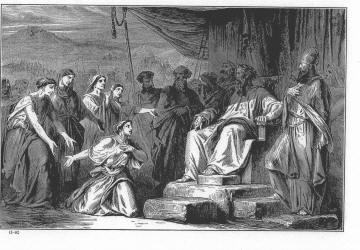
The daughters of Zelophehad were the first people in the biblical narrative to query the inevitability of inheritance, though not the first to be upset about what they did or did not receive. 

These five women feel the injustice of their father’s lack of legacy strongly, they want his name to continue into the future, and it matters to them that the physical legacy he left was to be diverted to people who were not his direct descendants, simply because of gender.  They band together and approach Moses with their case, and Moses is perplexed – what should he do in the face of this determined group of improbable heirs?  As we know, he approached God with his problem and is told that the daughters of Zelophehad speak well, they should indeed inherit their father’s estate, and his name should be allowed to be remembered. 

So they inherit, but soon, as we learn in Deuteronomy and later in the book of Joshua, limits are afterwards put upon the inheritance of daughters, the old need for land to stay within the tribe takes precedence, and the case law established by these five brave women is constrained, though not repealed.

          Inheritance is a strange phenomenon. I think of Abraham, the Ur-ancestor, who tells God that there is no point making a covenant with him because he is childless and his estate will all go to a member of his household, Eliezer of Damascus.  This text made so much more sense to me once I too became a parent – somehow life focuses more when there is a child to pass on to.  And it doesn’t really matter in what area the transmission takes place – tradition, values, wealth, family stories, family name – simply knowing that someone will take it into the next generation makes a difference. 

Yet of course there are many ways of ensuring an inheritance besides that of having a child.  Alexander Pope spoke of his books embodying his legacy. Teachers know that the impact they make on students can reverberate into the next generations, and the Talmud tells us that when a student recalls a teaching in the name of their teacher, it is as if that teacher’s lips move in the grave.  (BT Yevamot 97a)

Anyone who makes a relationship of trust with another knows that the legacy of that relationship will continue until the end of the life of the partner – and maybe even for longer.  What we do, and how we behave with other people, has a lifetime far longer than we expect or think about, the impact of our actions resonates for far longer than we can imagine.

          Inheritance is a strange phenomenon.  It is one of the defining things to give meaning to our lives and at the same time can rupture our connection with the future and the past if not properly organised.  It is something we would do well to consider deeply, to make serious plans about, and to consider the impact and the consequences of what it is we bequeath to the world as a result of our life.

          We are used to the idea of making wills – documents which record what we want to happen to our possessions after our death.  Many of us have made a will and have found that contrary to superstition the making of a will has not somehow brought about our untimely demise. 

But there is more to think about than who gets the jewellery and who gets the house and car. Inheritance is far bigger than possessions – it is, as the daughters of Zelophehad so rightly recognised, what we bequeath about with how we lived our lives and how what we learned or made sense of is transported into the world where we no longer will be. 

There is in Judaism the tradition of making a regular and updated ethical will. The idea is simple yet so important – besides worrying about who gets what of our material possessions, we spend the time thinking about what values we want to transmit, what lessons we have learned that we want our chosen beneficiaries to understand, what was really of importance in our life that we want not to be lost along with the trivia.  It is a valuable exercise, to create an ethical will, in which we put down in black and white what really has mattered to us, be it simple good behaviour or the imperative to tzedakah; be it the need for the discipline of a prayer life, or the permission to doubt God as much as one likes, as long as you still engage in the doubt. 

There is a powerful tradition of writing the personal ethical will as part of the preparation for the High Holy Days – in other words to begin to do so at this time of year, as we take stock of our lived life and try to make judgements about it, and create a framework for the future in order to live a life more in harmony with what is important to us. 

It gives us the space to think about ourselves. Not simply as amassers of material goods, nor as people who just get on with life without much thought for any deeper purpose than to live well enough and be successful and good enough – but as human beings who consider that our lives must have meaning and that that meaning is something to be nourished and cherished and transmitted into the future. 

I heartily recommend that you consider what it is you want your legacy to be. I recommend that you not only make a will, but that you tell your children what that will contains, so that you minimise the broyges after your departure from the scene. 

I also recommend that you consider what you want your spiritual legacy to be – not something unattainable or perfect and not something that you yourself don’t actually manage to do – but that you distil your values, your belief system, your sense of who you are and why you exist, and write on a plain sheet of A4 some of the truths you have learned which have sustained you on your journey through life, and which you would like to project through your nearest and dearest into the future.

What will your legacy be?

Will it be one of infighting for your possessions, of indifference to your existence on this world?

 Of minor irritations or major frustrations? 

Will your legacy be framed in such a way that people will recognise your contribution to the world, or will it simply be a dividing up of the goods?

I have always been so impressed with Zelophehad and with his daughters.  What he owned is irrelevant to me, that his name continued is one of indifference, but the fact that he and his wife bred 5 such superb daughters, who had confidence and tact, who held together to fight for what they felt to be right – that is a legacy to be proud of, an inheritance for which he – and his wife – deserve to be remembered.


Naso: the strange ordeal of bitter water

Moses informs the people that when a husband is jealous and suspects his wife of unfaithfulness, but there is no witness to prove his accusation, she is to be brought before the sanctuary priest.  He will uncover her head and ask her to place her hands upon the altar of the meal offering.  He is then to prepare a mixture of water, earth, and ashes from the meal offering, then say to her: ‘if no man has had intercourse with you, and you have not been unfaithful to your husband, be immune from this water of bitterness. If you have been unfaithful, then may God curse you with sagging thighs and belly”  and she must say ‘amen’. After the priest writes the curse and washes the ink into the water, the woman will drink the waters of bitterness and if she is guilty then her body will change as described. If it does not, then she is declared innocent.

            What do we make of such a piece of Torah?  Leaving aside the inherent sexism of a ritual reserved for women suspected of adultery, and not for their husbands, we are still faced with what appears to be less a piece of legislation for societal stability, than the practice of sympathetic magic.

            The real issue here is not the woman’s adultery, but the husband’s jealousy and suspicion, and because there are no witnesses or evidence, and yet this suspicion cannot be allowed to fester, the situation is cleared by deferring to divine judgment through the ritual of ordeal. 

            The ritual of ordeal is well known to us in various forms. The ducking of witches in this country is a good example – if she floated she was guilty and if she drowned she was innocent.  The Babylonian Code of Hammurabi (@1750BCE) states that a wife who is suspected by her husband of infidelity is to prove her innocence by throwing herself into a rapidly flowing river – if she survives she is deemed innocent, if not then she was guilty.  Then there was the ancient ordeal by fire, where the accused’s tongue would be touched with red hot iron tongs, and guilt would be proved by the presence of a burn.  Trial by ordeal always placed great odds against the proof of innocence.  Yet the ordeal of the Sotah is something else – dirty inky water may not be pleasant to drink, but was not likely to actually cause her harm . 

            So what is the ordeal really about?  There are those who say that it was never meant to be an actual physical test, but a devastating experience during which the guilty woman would be unable to hide her guilt, and would give herself away in some way.  This must be the origin of the infamous statement by Rabbi Eliezer in the Talmud (Sotah 20a)  that the man who taught  his daughter torah was teaching her lechery (tiflut) – that in other words if she knew that the water of bitterness was simply dust, ink and water, she would know that there would be no reason to give herself away. 

Another possibility is that the insignificance of the actual physical ordeal is intended in order to practically guarantee that the woman could prove her innocence.  In other words the real purpose of the ritual would not be to convict adulterous women who were able to hide their wrongdoing, but to create a way for women to clear themselves of any such suspicion.  “Suspicion of adultery in a close knit community would be almost impossible to dispel and could easily lead to ostracism and perhaps violent revenge.  The ordeal of the bitter water allows a fairly simple safe way for a woman to clear her name with divine approval, sanctioned by the priest and the Temple ritual. If this is the case we have a kind of inverted institution here: the trial by ordeal is transformed from a formidable test weighted toward guilt to an easy one, strongly biased in favour of demonstrating innocence.  The ordeal is changed from a measure threatening women to a mechanism for their protection.” (Rachel Adler quoting Jacob Milgrom).

            Whatever the ordeal of the Sotah meant, it is clear that by Talmudic times the rabbis had no historical memory of the ordeal being practiced.   It is even possible that by the time it was recorded in the book of Numbers, it was already archaic.   But it is interesting to note how the disappearance of the trial of the Sotah was explained n Mishnah and Gemara – “when the adulterers increased in number, the bitter waters ceased. And Rabbi Yochanan ben Zakkai discontinued the practice….. 

When the adulterers increased in numbers: our rabbis taught “and the husband shall be guiltless” At a time when the husband is guiltless the waters test his wife, if the husband is not guiltless the waters do not test his wife… (Sotah 47a-b)

The efficacy of the ordeal of the bitter water depended on the accusing husband’s innocence. Very early on it seems, the law decided that one could not assume that the accusing husband had no guilt in the matter, and so the ordeal of the Sotah was dropped from the live legislation.  So too was the sentence of capital punishment to deal with the guilty, as the deterrent power was transferred to the consequences in the community for the adulteress.

            So what do we make of the passage – ambiguous and obscure as it is? And what do we make of its disappearance into history?   It is hedged about with conditions: – for example the husband must have warned the wife in the presence of two witnesses about meeting secretly with a man. There must be two witnesses who testify that she secretly spent time with the named man; the case cannot be held in a local court but only by the Supreme Court (Sanhedrin) in Jerusalem – the ordeal of the Sotah seems to be a way to protect women from the injustice and the fury of jealous husbands.  But what a way to go about it!  Why not legislate against men who will not bother to control their fantasies or who allow them to spill over into real life?  The list of these is endless – for example forcing the separation of men and women in synagogues (or at the Western Wall); silencing the voices of women; curtailing the freedom of women to move around in the public domain or showing the images of women in advertisements or newspapers.. 

This Jewish law may have been designed to protect women from weak or resentful husbands, but the way to do it is not to put the constraints on the women whose very existence is said to drive men to uncontrolled frenzy.  The way to do it is to teach men and women that such a frenzy is unacceptable.  It is time to give up all the well meaning circuitous judgments may help the individuals but will never change society.  The law of the Sotah is one such, where the reason it fell into disuse is more useful to us than the reason why it was first instituted.     


Seventh Day Pesach and the Song of Miriam

The preparations for Pesach begin in earnest at Purim. Any Jewish homemaker will tell you of the frenzy that begins to build from then, the cleaning out of cupboards, then whole rooms; the growth of boundaries within the house, the diminishing places to eat. The culmination of the whole activity is seder, then the week falls into a rhythm of its own, the hard work done for a little while. The festival at the end of the week has a different flavour, somehow more relaxed and reflective – before the work of packing away the Pesach artefacts and recreating ordinary life.

The exodus from Egypt may be acted out in the animated engaging ceremonies at the beginning of the week, but personal redemption for many of us is experienced more in the unassuming days that follow, and particularly in the service of the seventh day when the Song at the Sea is read from sidra Beshallach.

There are apparently two songs in this sidra – the one known as song of Moses, and then a fragment or apparent echo of it which is known as the song of Miriam. But modern scholarship suggests that the texts we have may not be given the correct ascription, that the songs of Miriam and Moses were one choral piece, different perspectives on the same event sung both antiphonally and together. Writings found in Qumran uncover another seven lines of Miriam’s song, and when these are put together with the unusual pattern of the words in the scroll, we find that a commentary on the main text emerges.  Miriam addresses her words to the whole community, focussing on the contemporary experience of the miracle, and bringing them into dialogue; Moses’ words are about his own understanding, his own leadership and strength.

The beginning of Pesach sometimes feels to be all about Moses, the upfront miraculous power of leaving Egypt in the chaos and turmoil of the exodus. But the ending of Pesach is about Miriam’s way of being – the quieter underpinning of experiencing change, of weaving it into normality, the import of the story and not the headline.

Miriam involves the whole community, singing to them of their history. While each of us must feel that we too came out from Egypt, how much more important is it to us that we did not come out alone, but as part of a people, and that our history is not just great events or great individuals, but a fabric made up of the lives of us all. Redemption is to be found in the quieter, deeper spaces of our tradition.

 Image

Wearing Tallit

When I place my tallit around my body and say the blessing “lehitatef batzitzit – to wrap myself in the tallit”, a number of feelings wash through me changing my sense of self. To begin with, putting on tallit is a marker in time – with this action I am letting go of the mundane, of the worries and the niggles of my ordinary life and I am entering demarcated and focussed prayer time. Secondly, there is a marker of change in my emotional state – The feeling of being wrapped in the tallit provides a sense of warmth, comfort, separation from surroundings and connection to a different sphere, as the weight on my shoulders reminds me of the expectations and obligations I have taken upon myself as a religious Jewish person. And finally, the putting on of tallit creates a marker in space – my tallit provides a tangible boundary between my internal world and the outer one.

The tallit is so much more than a shawl traditionally worn while praying the morning service. It is a both creator and signifier of disconnection and reconnection.

I have never known a barmitzvah boy think twice about receiving and wearing his tallit. It is just something that they do, something they expect to do, for them it is a right and an obligation to wear the symbols of obligation and rights. I have never known a batmitzvah girl (or any woman) take on tallit without much soul searching and some anxiety. Are they ready to take on all that tallit means? Does the wearing of tallit give the proper statement about their religious observance and worth? Is it saying something more than they are able to do or be?

While it is often said to be that the tallit is a male garment, this view dates only from medieval times and came into being as a way of underpinning the growing move towards prohibiting women from wearing it. And women did, we know, wear tallit and they were explicitly permitted to do so in a number of early rabbinic responsa and even Talmud (Menachot 43a) tells us that “Our Rabbis taught: All must observe the law of tzitzit, priests, Levites, and Israelites, proselytes, women and slaves” and gives us two examples of Sages who attached tzitzit to the clothing of the women in their households – Rabbi Judah ( Menachot 43a) and R. Amram the pious (Sukkah 11a). The reason given for women being exempt from this mitzvah (not, note, prohibited) is that it is a positive time bound mitzvah and the rule of thumb was understood to be that women were exempt from having to perform mitzvot that were bound to fixed times – except of course, when they were not exempt, such as lighting the Shabbat candles, making Shabbat kiddush, lighting the chanukiah, prayer….. And the idea of the garment to which tzitzit are attached being strictly male – well, Bedouin to this day wear the four cornered cloak described in our texts (the abaya)– and both men and women wear it.  

Only in the thirteenth century did Rabbi Meir of Rothenberg begin to overturn the practise of generations and his view was promulgated by Isserles in the 16th Century who wrote that the wearing of tallit by women might be a sign of religious arrogance or self righteousness (Yuhara), although even he admitted that a woman could wear tztitiz, it was her intention that mattered, not the wearing per se . But since this medieval onslaught against the presence of women in the public space, the practise has dwindled to the point where it is barely remembered, until in our days a critical mass of women have once more decided to take on the wearing of tallit as a mitzvah.  

The variety of journeys that women take to adopt for themselves the mitzvah of tallit is extraordinary and salutary. I know of women who choose to wear the tallit of a deceased husband, father or grandfather as a mark of respect and love, and a desire to be close in prayer to those who gave meaning to their lives. I know of women who studied hard in order to make their own tallit and who choose to weave extraordinary moments and memories into the fabric, building a sort of physical memory of their spiritual life into the tallit. I know of women who wear the tallit of Women of the Wall as their choice of garment in order to additionally show their support for other women practising this mitzvah wherever they may be in the world. I know of women who wear ‘feminine’ tallit and women who wear ‘traditional’ designs always for particular reasons, and of women who wear both at different times in their prayer lives. I have never yet met a woman who thoughtlessly puts on tallit, or who sees it as her religious right that she must display to others, or sees the wearing of it as an act of rebellion or arrogance or in-your-face piety.

The arguments against women wearing tallit seem to hang on either it being a male garment (easily circumvented should one buy this argument by the plethora of feminine talliot that can be purchased) or that exemption should be extended to prohibition on the somewhat shaky ground that women only wear tallit to be arrogant (something that can be easily disproved by talking to -and listening to -women who choose to wear tallit.) The arguments for women wearing tallit is that we find it an aid to prayer, a ritual that increases our kavannah – our focus and concentration on our relationship with God as we pray. It creates special time, special space, a deposit of memory on which we can build and from which we can grow, a custom that deepens and warms our religious attachment. It provides a much needed boundary between the mundane and the sacred in our busy lives, it signifies our detachment from the unimportant and our attachment to our Creator in prayer.  If you haven’t yet explored the possibility of this mitzvah, I encourage you to do so. Male or female, we all have much we can gain from it.


Vayeshev

Two different approaches to life can be found in this sidra – the first being when Joseph is seeking his brothers in Shechem, “And a man found him and he was wandering in a field, and the man asked him: ‘what are you looking for?'” (Gen 37:15). Had he not met this person and been told that his brothers had moved on to Dotan, he would have returned safely to his father and his life in Canaan would have continued uneventfully, though with continued sibling friction we assume. Having met him however, the train of Joseph’s life was inevitably altered, he went down to Egypt and so opened the way for the whole people of Israel to travel to Egypt and to settle there.

 Who was the man he met who so changed the course of Israelite history? Rashi (Rabbi Solomon ben Yitzchak (1040 -1105) suggests that this pivotal figure must have been important and suggests it is the Angel Gabriel. Ibn Ezra (1089-1164) is more pragmatic and suggests that this is truly an ordinary passer-by who just happened to be there with information at a critical moment. And Ramban (Moses ben Nachman 1194-1270) beautifully marries the two ideas by suggesting this is truly an ordinary human being, but acting as a messenger of God, a malach (the Hebrew word for messenger, also used for describing what we might call a divine messenger or angel).  So possibly this could be the divine plan in action, or it could be a coincidence with ramifications, but either way, Joseph is the passive recipient of the event – his life is radically transformed without any active intention of his own.

The second approach to life can be found in the actions of Tamar who, through no fault of her own, finds herself waiting for release from her status of childless widow.

 When it becomes clear that the family who can liberate her are choosing not to do so, she takes matters into her own hand. Never mind that she has to dress as a prostitute, nor that she has to waylay her own father in law in order to progress her cause. Never mind that she suffers the charge of adultery when her condition becomes known – Tamar chooses this path rather than find her life unfairly stopped by the refusal of others to do what is required. And she succeeds in her task, eventually acknowledged as a woman who has behaved with righteousness What can we learn from the two stories? – that sometimes our lives can be changed by random events, that we may have no power over what happens to us sometimes, but the outcome of these events IS still something we can exercise control over. Whether we choose to see the turning points at all, whether we choose to see them as entirely random or as part of a divine plan is up to us, but either way Joseph uses his talents to make a success of his life in Egypt having arrived there in very unpromising circumstances, and we too can turn discouraging experiences into better ones by using the various skills we each possess. And sometimes life is unfair and people are obstructive to what should rightly happen, and then we have to be more proactive ourselves, as Tamar risked everything to be.

 It so happens that Joseph is the precursor of the leader to be known as the Mashiach ben Yosef, while Tamar’s twins include Perez the ancestor of David and of the Mashiach ben David. (see Babylonian Talmud Sukkah 52a) Whatever these leaders known as ‘messiah’ may also be, they embody between them righteous behaviour and good leadership.  Rav Kook (1865-1935) described them as the universal and the particular leaders, Joseph took care of the physical needs of the people and spoke the languages of the world, whereas Judah was responsible for the special holiness of the Jewish people. We need both aspects – the universal and the particular, the making the best of what we have and the go-getting to make the best world we can – in order to fulfil our lives and make them the richest we can.

Chayei Sarah

I cannot read the story of Sarah, her life and death and subsequent burial arrangements, without sadness. I want to ask about her – who was this woman? She had been moved from her homeland without the experience of hearing God’s command to support her. She had been infertile in a time when fertility meant status and her husband was expecting myriad descendants.  Twice she had had to pretend that her husband was not her husband in order for him to survive (and consequently be taken into the harem of Abimelech king of G’rar, and also into that of the Pharaoh). She had taken matters into her own hands by offering her maidservant Hagar to her husband in order for him to bear a son, and was humiliated and embittered by the experience, causing her eventually to send Ishmael away from the family.  The longed for child she finally bore in old age, Isaac, was traumatised by his experiences with his father on a mountain top, and was not present either at her death or her funeral arrangements.  Poor Sarah. Living apart from her husband in Kiryat Arba Hebron while he was in Beer Sheva, a woman one might say who loved too much for her own good.

But it is her last days and her burial arrangements that have extended into our own times, and some of the bitterness and humiliation and tragedy still stalk us. Why was she living in Kiryat Arba, the City of the Four, rather than with her husband and son?  Who were the Four to which the name refers? And why is she to be buried in this cave in Hebron belonging to Ephron the Hittite? A cave whose name, Machpelah, means ‘doubled’?

It is almost as if the idea of plurality is embedded in this text – Kiryat Arba meaning “the city of the four”, Machpelah meaning ‘doubled’ or ‘a couple’, Hevron meaning ”joined/or the place of friendship/relationship”.

The loneliness of the woman living away from her family, somehow estranged from the events that had happened within it, is mirrored with the words to do with ‘two’ or ‘couple’ or even ‘twice coupled’. It is as if we are looking at parallel universes, at the individual and the communal, at being alone and isolated – and at having friends and connections.

Sarah dies alone, without her husband or son, in a place called ‘friendship’. It is a painful and horrible irony. Her husband buries her alone, in a cave called ‘couple’, and goes on to remarry a woman called Keturah (fragrant), though his two sons come and bury him with his first wife in Machpelah when his time comes. As if, after death, everything comes right and husband and wife are reunited. But we know, of course, that we should be putting things right before death comes to us, that behaving well in life is a far greater act than making atonement after the event.

Hevron today is a tragic place; a catastrophe doubled and doubled again, a place not of friendship but of tears and fearfulness. One can almost hear the cries of our mother Sarah who lies at the centre of a town filled with anxiety, where everyone feels alone and isolated, afraid of each other, afraid of what they themselves might do. There is no plurality there at all, just different communities each wishing the others didn’t exist.

I spent a day there a few years ago and was horrified at what I saw, tearful and shaken at how this town I had remembered in the 1980’s as bustling and thriving had become empty and watchful. The tension in the air was palpable, the tension in the people horribly clear. Shuhada Street, a main thoroughfare which led down to what had been the central market area is, in army parlance, ‘sterilised’, meaning it is closed to Palestinians – even those whose front doors open onto it.

The isolation of Sarah, and the tragic events in her life that led up to it, can be felt today in Hevron. All the missed connections, the lack of understanding of human feelings and needs that seem to underpin her life can be felt in modern Hevron.

The support that Sarah gave to Abraham was given at enormous personal expense to – and distortion of -herself, and ultimately they were driven apart by her giving more than she could, and him taking without apparently appreciating what it was that he received. While he mourned her death he did not celebrate her life, he did not seem to know her, or to understand what motivated her or to appreciate her. He was focussed on his religious belief – leave the land they knew to go to another place, offer his son to God on a mountain – to the exclusion of his wife.

“What if” is not usually a productive game to play, but given that it was to be the son of Abraham AND Sarah who was to inherit the promise and the covenant, what if Abraham had worked together with Sarah to share the burden? What if he had understood the price she paid for him to become the wealthy and powerful patriarch he did? What if he had supported her too, so that she did not suffer at the hands of Hagar and retaliate against Ishmael?

And what if Hevron could finally become a place of friendship rather than antagonism, where both parties could share the space and the place, where both could worship at the ancestral graves, where both could live lives of fulfilment and peace, thinking about the needs and feelings of the other and appreciating their difference?

Sarah’s final days and her burial could be a lesson to us in so many ways, the plurality of the names of Machpelah and Kiryat Arba, the relationship and sense of connection implicit in the name Hevron. And the stark reminder that all of us are mortal, that sometimes it is too late to make up again, that then we can only mourn.