Rosh Chodesh Ellul: time to prepare, time to pardon

One of the first words you might hear in Israel – particularly if you mix among the anglo saxim, is the phrase “s’licha” – roughly translated as ‘please’, or ‘I beg your pardon”.  Well, maybe not one of the first, but if you stay in Israel long enough someone, hopefully, will use it after they push past you in a bus queue or tread on your toe in the market.

At this time of year, it is time for us to use the word too – as we pray the Selichot – the petitionary prayers that prepare us for the season of teshuvah – repentance. Tradition teaches that the month of Elul is a particularly good time for repentance, and the mood builds throughout Elul to the period of Selichot – the prayers that are read late on the Saturday night before Rosh Hashanah and continue to be read every morning until the very end of Yom Kippur.

Our tradition teaches us that prayer requires preparation, and for most of us the marathon that is Yom Kippur certainly requires training– both the physical preparation such as reducing our caffeine intake to ward off the Yom Tov headaches, and the spiritual preparation to make sure we do more than simply regret past actions, or make ineffectual attempts at damage limitation. Maimonides in his laws of Repentance laid out what might be called the three ‘R’s of the work – Regret, Rejection and Resolution – and this process clearly takes much more time than even a well focused day of contemplation. Hence the build up to the work of the Yamim Noraim – the Days of Awe – so that when we arrive at shul on Yom Kippur we really are ready for it.   There are many variations of selichot services, though they almost always include a recitation of the thirteen attributes of God, and reading Psalm 27 – and portray of God of mercy and compassion. But also a God of whom we should be in awe.  We are told that when Rabbi Yochanan ben Zakkai lay dying his disciples asked him for a blessing. He replied “May you fear God as much as you fear human beings”. They asked him – “what, no more than that?” to which he answered that that was enough. “do you not know that when we are about to commit a transgression, we forget about God and hope only that no human eye will see us”

As part of the prayers of pardon and petition, we add into the text of the Amidah on Rosh Hashanah and on Yom Kippur a prayer to help us learn to be in awe of God. We tend to fear the opinion of other people far more than we worry about what God might think of us, and we behave accordingly.  The two themes – of a forgiving and compassionate God who is only waiting for us to return, and of a God who is to be held in awe and revered – are not mutually incompatible. The liturgy of this time weaves them in and out of our consciousness – the God who sees and remembers everything we do, both good deeds and bad; and the God who is just waiting for us to say “selicha” – “forgive me” so that we can move on into our lives, lessening the alienation and anomie we feel.

Glorious summer – time to think of my soul as life begins over again

Summertime is always a quiet time in the life of a synagogue.  The families with children are away on holiday, the classes and courses stop for the duration, the long evenings and good weather tempt people to venture further away from home, and an atmosphere of indolence and tranquillity reigns. Well, almost.  Because while there may be fewer people around and routine committee meetings and classes take a break, the summer is in fact a time of frenetic activity.  It is just that the activity is ‘behind the scenes’ that it can go unnoticed.

There are a variety of levels of summertime behaviours in the Jewish world.  There is of course all the hard work that goes into making sure that the Autumn festivals – what one colleague calls the “Autumn manoeuvres” go well.  The choir and musicians rehearse their set pieces till souls soar on hearing them.  The administration sends out numerous letters and tickets, the wardens plan mitzvot and page numbers, the security people organise rotas, parents organise children’s services and activities, crèches and rooms, the Chair considers charities and writes the Kol Nidrei appeal, the Rabbis plan sermons and readings…. A beehive would look like a slothful place in comparison to the work that goes on behind the scenes planning for these special days.  And whatever date the services fall upon, they still seem to take us by surprise – have we notified the schools that our children wont be in? Have we invited people to break the fast with us? Is our sukkah still in working order or was last year’s rickety effort the final time it could be constructed? The list seems to grow longer the harder we work….

But there is other work to be done in preparation for these awesome days, and the work needs to also be planned and executed in these lovely summer days – that is the work of the soul, the taking stock of our lives and our selves in the bright yet warm light of God’s overseeing judgement. 

Many years ago I took a December holiday in the Southern hemisphere. Sitting on a beach and watching the people frolicking in the water, my mind kept wandering to phrases from the Machzor for the Yamim Noraim – the high holy day prayer book. Whole chunks of liturgy inserted themselves into my head, the Avinu Malkenu which begs God not to let us go empty handed, the Vidui – confessional prayers. The rather ominous image of the Master of the House who was waiting….  It was all so incongruous and rather disturbing.  Here I was some three months after the introspective fest, had celebrated Sukkot and danced at Simchat Torah – yet the powerful awareness of the days of Awe was pulling at me again.  And suddenly it clicked – it wasn’t that I was spiritually out of synch. but that I was temporally so – the change in hemisphere brought about a lurch in the seasons, and my whole body was geared to summer time means preparation, introspection, consideration of my life.  It was then that I realised just how much we are attuned to the cycle of nature in order to be attuned to our festivals.  Spring time means crocus, daffodils and matza. Dark evenings mean chanukiot and doughnuts. Summer time is the time to begin the work so that when we arrive at Rosh Hashanah and Yom Kippur are already engaged in the process that those festivals will clarify and enable.  Rosh Hashanah and Yom Kippur often surprise us simply because we haven’t begun the work early enough.  Then suddenly it is time to stop and think, and there is too much to do, too little time.

F Scott Fitzgerald wrote in the Great Gatsby “And so with the sunshine and the great bursts of leaves growing on the trees, just as things grow in fast movies, I had that familiar conviction that life was beginning over again with the summer.”  

So this summer, while the weather is glorious and the temptation is to slow down and relax a little, do just that, but remember too that this is the signal to begin the preparation if you are to get the most out of the solemn period that constitutes the yamim noraim, the days of awe and repentance.

Leading up to Tisha b’Av, the choices we make

women against women

Today is Rosh Chodesh Av, the month we will see the commemoration of the destruction of both Temples in Jerusalem, which we will remember on Tisha b’Av, the culmination of a three week period of mourning, which began with the Fast of the 17th Tammuz, commemorating the first breach in the walls of Jerusalem which led to the destruction of the First Temple.  

In the Mishnah (Ta’anit 4:6) we read that “Five things happened to our ancestors on the 17th Tammuz, and five on the 9th Av (Tisha B’Av). On the 17th of Tammuz the tablets [containing the Ten Commandments] were broken; the daily sacrifice was discontinued; the walls of Jerusalem were breached; Apustamus, a Greek officer, burned a Torah scroll; and an idol was erected in the sanctuary of the Temple. On the Ninth of Av it was decreed that the generation of the desert would not enter the Land of Israel; the first temple was destroyed; the second temple was destroyed; Betar, (the last Jewish stronghold after the destruction of Jerusalem), was conquered; and Jerusalem was ploughed under. When the month of Av enters we diminish our joy.”

It is quite a list. The tradition is to cluster bad things together on one date, rather than to spread the pain of Jewish history throughout the year, colouring all our days with mourning. So there are texts that tell us that on Tisha B’Av the First Crusade began, Ferdinand and Isabella expelled the Jews from Spain, and to bring us more up to date the First World War broke out on Tisha b’Av. There is a good case for observing Yom HaShoah on this date in years to come, adding the cataclysm of our times to the tragedies of our ancestors.  Others would like to explicitly add Kristallnacht, which took place on the 9th of November, the ninth day of the eleventh month, a sort of secular resonance with the 9th day of Av.

We need a day to focus on our mourning, a day for remembering the violence and pain of our history. And one day each year is really enough, it contains what would otherwise be uncontainable and which could overlay our national narrative and suffocate us with grief. As a Reform Jew for whom the traditional yearning for the return of the Temple with its associated priestly and sacrificial system of worship is problematic, I find the best way to deal with Tisha b’Av is to place it in the context of the three weeks of increasing sadness known as “bein ha-metzarim” – being within a narrow and constrained place, and then to reflect on our history, remember, acknowledge, and move on. It is no surprise to me that the 7 weeks of haftarah readings from Tisha b’Av towards Rosh Hashanah are all about hope, about return to God, about opening out to possibility and the future – we move from between the straits (bein ha-metzarim) into the wide open space of freedom to think, feel, remember and explore . Then comes Rosh Hashanah, time to make a new start, a new promise to our best selves, a new commitment to the future.

The Talmud asks the question: “Why was the First Temple destroyed?” and it answers itself thus: “Because of three things that occurred in it: Idolatry, immorality, and bloodshed…” But then it goes on to develop its thought -“the Second Temple, where they occupied themselves with Torah, Commandments and acts of kindness, why was it destroyed? Because there was a prevailing practice of baseless hatred (sinat chinam). This teaches that baseless hatred is equated with three sins: idolatry, immorality and bloodshed.” (Yoma 9b)

Sinat Chinam is equivalent to three huge sins together. It caused the destruction of the Temple and the expulsion of the Jewish people from their land for almost two thousand years. So what do we do about the hating without cause, the prejudging of others, the gratuitous dislike of the other.

This is not necessarily an overpowering feeling that we are in thrall to, a visceral and ancient reflexive response that we can do nothing about. The responsa indicate that sinat chinam can be about simple ignoring of the humanity of the other, about not bothering to talk to them, to meet with them, to find out about them. Through sinat chinam we diminish the goodness in the world, as we refuse to recognise the goodness in each human person, to see them as valuable and possessing intrinsic worth. We have just over eight weeks now to reflect on how we treat others, both those we know and those we share our living spaces with – be it on the daily crowded train commute or the queue at the till, the person at the other end of the telephone or member of our own circle.

Today is Rosh Chodesh Av, and in Jerusalem this morning right on the site of the Temple precinct we have truly seen a demonstration of “sinat chinam” leading literally to “bein ha-metzarim.” Women of the Wall, a group who come together to pray together each Rosh Chodesh at the Western Wall that retains the Temple Mount, have once again found themselves the target of those who try to prevent them praying in tallit, speaking and singing their prayers out loud, and reading the Torah scroll in their service.  Ultra Orthodox girls were bussed in to the area on the orders of their rabbis in order to crowd out other women who come to pray there. These girls were used as bodies in order to create a physical shortage of space, bein ha-metzarim. They were not primarily coming to pray, though some of them may well have done so, they were coming primarily to deny others their chosen prayer. Early photos and video show some faces contorted with hatred and anger, some comments on the Facebook page are vitriolic, for me the saddest photo is of an older woman, all her hair modestly covered in a blue scarf, blowing a whistle while staring balefully at the Women of the Wall in order to disrupt their prayers.  

We have seven weeks after Tisha b’Av to try to notice the humanity of each person we meet, and so to think about how we behave towards them. This is good work of teshuvah, for in meeting the other and recognising the spark of God within them, we become ready to face the spark of God within ourselves, the voice that reminds us that on Rosh Hashanah and Yom Kippur we will stand in the presence of the heavenly court as we judge our lives so far, and the perspective of that court will be mediated with our own attempts to be the best person we can really be.


Bemidbar: the richness of the wilderness

This week we begin to read the fourth book of the five books of Moses, the one whose title in English is known as ‘Numbers’ because of the censuses which take place within it, but which in Hebrew is ‘Bemidbar – in the wilderness’.

It is in the wilderness that most of the story told in the scroll is set. It is in the wilderness that most of the people meet God. It is in the wilderness that Revelation takes place – in ownerless and structureless land.  The midrash tells us that wilderness is a necessary condition for every revelation: “Whoever would wish to acquire Torah must make themself ownerless like the wilderness”(Bemidbar Rabbah).  In other words it is important to be able to cast off the set ways of thinking, to free oneself from the patterns and rat runs of our usual thought processes, and open ourselves up to the new world, new directions and also maybe even to an apparent lack of direction.

The midbar, the wilderness of ownerless land, is the space that exists in both place and time in which we too can search for revelation. Unlike the more frequent use of the image as being dry, arid and hostile to life, the midbar is a place full of potential, where anything can and does happen. Far from being deadening and moribund, it is a challenging place, complex and spacious, with freedom to explore in any direction. Midbar is a place of preparation and encounter, the niggle on the tip of our tongue and the nagging sense of connection we can’t always quite identify that hands on the edge of our consciousness. It is the meeting point with the unknown, the place of encounter with the divine.

            We all live within a web of socially conditioned thinking and perceiving.  We learn to see the world just like everyone else sees the world, to understand what is going on around us according to a limiting set of rules and agreed vocabulary.  It is a rare human being who is able to rise above the received wisdom of the surrounding community, and to shift the perspective, to see the world with fresh and untutored eyes. But the wilderness provides the space and the impetus to enable us to see the world differently.  It subverts the settled society and reminds us again and again that we have merely made one choice from among an infinite number of choices, that we have been influenced by the surroundings in which we live, the other people and cultures and philosophies we encounter, yet it is always possible to strip away those influences, and find the core of our human existence, the spark that animates our humanity. One just has to go into the space, to create the midbar, the place of freedom and possibilities. 

It sounds simple, to strip away all the outside influences which have formed our thought and our behaviour. It sounds simple, and of course it isn’t.

But it is possible. 

The mechanisms we use in the Jewish tradition are found within the revelation given in the desert – the mechanisms of mitzvot and of prayer.  We create a structure of behaviour – the mitzvot are purely a way of behaving (almost without thinking about it), in an ethical and socially enabling way.  The fact that tradition sees them as coming directly from God, the commander or Metzaveh, gives them a weight of authority and validity, but of course one doesn’t have to believe in God to do the mitzvot – rather the mitzvot may have the effect of leading to a belief in God.  Meanwhile one behaves appropriately.

Prayer on the other hand is a way of reaching out to God as an individual, and to do it one has to try to create the space, the wilderness, in which one is ownerless.  Influenceless, standing alone before God has the effect of de-socialising us. When we pray we are releasing our consciousness of our own behaviour, not thinking about other people or how we are relating to them, or of ourselves and how we look in the eyes of those around us. 

            In prayer we break the norms of social behaviour.  We step outside the civilising influences of our society, We use language in a different way, we may speak in complete silence, or sing or move about or listen to someone or something else.  We may move our lips with no sound, or shout out loud – there are no rules, that is the main rule of prayer.  Only a sincere striving, a creating of space which we can then occupy without anyone else but God.  It doesn’t really matter how we create the space, as long as we do.

The midrash teaches “whoever would wish to acquire Torah must first make themselves ownerless like the wilderness”  It doesn’t mean that we must remove ourselves from all the civilizing influences upon us, or from our responsibilities to each other, but that we should be aware of them and be able to release ourselves from what controls us and stifles us so we can encounter and become, rather than close ourselves down and starve our being and bImageecoming.

International Holocaust Remembrance Day

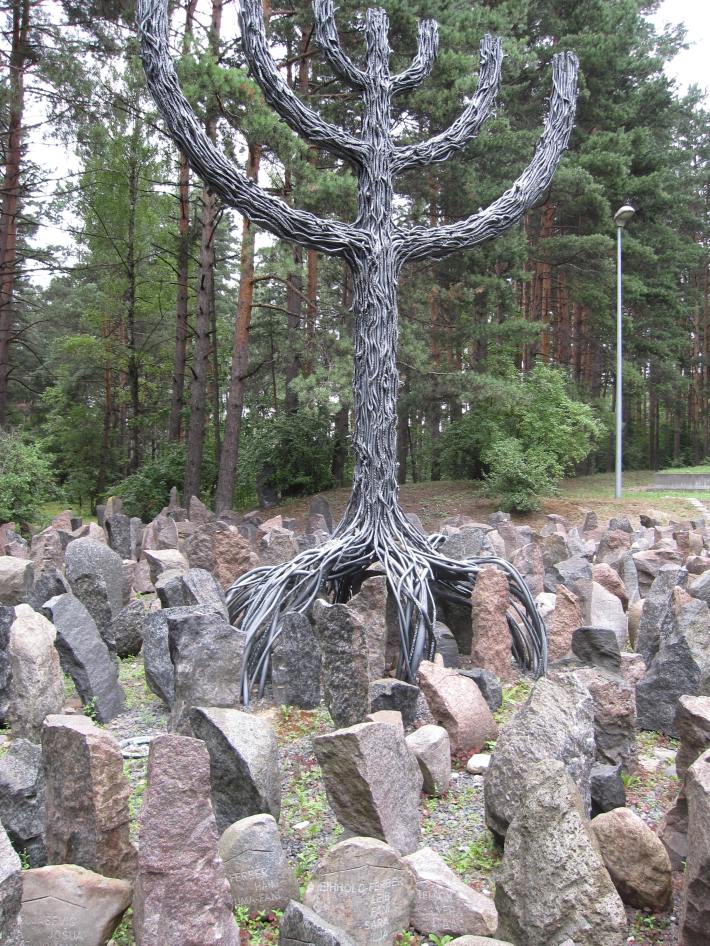
Two years ago I visited the Rumbula Forest, near Riga in Latvia, where nearly 28 thousand Jews were killed in just two days in November and December 1941, and where a heartbreaking memorial to them is hidden among the trees. Some of my own family, the brothers and sisters of my great-grandfather and their children are buried in the mass graves marked out on the forest floor. Only three people survived the murder that took place here.

The visit was poignant and it was also infuriating. One reason it had taken so long to build anything here as a memorial is that the inscription on the memorial had become an issue when some Riga officials wanted language that would have obscured Latvian complicity. Eventually an agreed inscription meant the memorial could go ahead

HERE, ON NOVEMBER 30 AND DECEMBER 8 OF 1941 THE NAZIS AND THEIR LATVIAN COLLABORATORS SHOT TO DEATH MORE THAN 25,000 JEWS WHO WERE PRISONERS OF THE RIGA GHETTO – CHILDREN, WOMEN, ELDERLY MEN, AND APPROXIMATELY 1000 JEWS WHO HAD BEEN DEPORTED FROM GERMANY. IN THE SUMMER OF 1944 HUNDREDS OF JEWISH MEN FROM THE “RIGA–KEISERWALD” CONCENTRATION CAMP WERE ALSO KILLED HERE.

And the memorial was finally dedicated on November 29, 2002, more than sixty years after the terrible events it bespoke.

Why so long after the event? Because it was supposed to be forgotten. There was no one who wanted to remember what had happened in Riga, and in many many other places just outside villages and towns in Latvia, Lithuania, and other countries. No one wanted to remember, no one wanted to think about it.

Our guide told us something else about why it took such a long time to build a memorial there – the story was not entirely forgotten, but the exact place in the forest had been lost. No one could admit to knowing where it might be. It took the efforts of an interested botanist, who found plants in a particular area of the forest that needed the kind of nutrition only a well blood-soaked soil could provide, to identify the place of the murder of so many innocent people. Once he had found it, the mass grave pits were identified.

Eyewitness accounts are horrific: On this particular day (30 November 1941), the air temperature in Riga was -7.5C at 7:00a.m. and 1.9 degree C at 9:00 RM. On the previous evening, 29 November 1941, there had been an average snowfall of seven centimetres. On 30 November between 7:00 A.M.  and 9:00 p.m. it did not snow.

“The Mass Shootings outside Riga, 30 November and December 1941.                               

The  actual site of execution lay about five miles outside  Riga in  the direction of Duenaburg [Daugavpils], between the highway and  the railroad, both of which connect Riga and Duenaburg. The railroad tracks and the road there run a near-parallel  course, with  the railroad tracks running to the north of the road.  The site lies in the vicinity of the railroad station at Rumbuli; its  terrain  is sandy and slightly hilly, sparsely wooded,  and forms part of the Rumbuli Forest.

In the centre of this site was a densely forested area; this was the location of the actual execution site, with prepared pits designed to accommodate about thirty thousand bodies.  The approaching  columns of Jews coming from Riga along the  highway between  Riga  and Duenaburg had to turn left from  the  highway onto  a dirt track which led up to the small patch of woods.  In the process they were funnelled into a narrow cordon, which  was formed by SS units, a contingent of the Special Task Unit  Riga, and Latvian units.

 The  columns of Jews advancing from Riga, comprising  about  one thousand  persons each, were herded into the cordon,  which  was formed  in  such a way that it narrowed greatly as it  continued into the woods, where the pits lay. The Jews first of all had to deposit their luggage before they entered the copse; permission to carry these articles had only been granted to give the Jews the impression that they were taking part in a resettlement.  As they  progressed, they had to deposit their valuables in  wooden boxes,  and, little by little, their clothing – first overcoats, then suits, dresses, and shoes, down to their under clothes, all placed in distinct piles according to the type of clothing.

 Stripped down to their underclothes, the Jews had to move forward along the narrow path in a steady flow toward the pits, which they entered by a ramp, in single file and in groups often.  Occasionally the flow would come to a standstill when someone tarried at one of the undressing points; or else, if the undressing went faster than expected, or if the columns advanced too quickly from the city, too many Jews would arrive at the pits at once.  In such cases, the supervisors stepped in to ensure a steady and moderate flow, since it was feared that the Jews would grow edgy if they had to linger in the immediate vicinity of the pits….

 In the pits the Jews had to lie flat, side by side, face down. They were killed with a single bullet in the neck, the marksmen standing at close range-at the smaller pits, on the perimeter; at the large pit, inside the pit itself-their semi-automatic pistols set for single fire. To make the best of available space, and particularly of the gaps between bodies, the victims next in line had to lie down on top of those who had been shot immediately before them. The handicapped, the aged, and the young were helped into the pits by the sturdier Jews, laid by them on top of the bodies, and then shot by marksmen who in the large pit actually stood on the dead. In this way the pits gradually filled.” (Gerald Fleming, pp78-79 in Hitler and the Final Solution, University of California Press 1984)

As I walked around the memorial, which includes stones on which are marked the streets from the ghetto that victims had come from, and stones with the names of some of the victims, I found the names of my grandfather’s cousins, and a stone inscribed with the name of the street in the ghetto which I had visited only an hour or so earlier and from which my great grandmother had emigrated in 1892 to escape a bad marriage and grinding poverty. I called over my sister and cousin and overcome with emotion we stood in silence thinking of those people, named and unnamed, who had died here so horribly, whose story had very nearly been hidden away so that their very existence would have been lost. And then we said the Kaddish prayer.

Looking at the stones inscribed with my maternal family name, it became clear that, while this had begun as a journey to find our roots and see for ourselves the “old country” our family had left, the experience in the forest was also a way of directly encountering what our own past would have been had my great grandmother taken a different route. Going to the forest to see for ourselves was initially part of the search for family, to honour those we had not known, to connect with a community which had once thrived and whose roots were entangled with ours. Yet it was also so much bigger an experience than connecting with a personal past.

We mourned for family we never knew who had died in that strange place in the forest, but this could not only be a personal ache as our visits to other family places had been – our grief and prayers encompassed everyone who had died in that place because of their Jewish heritage.  And even this was not enough to say – the place of the industrial scale process of murder with its belated yet extraordinary memorial prompted us to pray for all victims of genocide. In fact I think it was the story of the large quiet forest and the botanist who identified this site through the nutrient rich soil, and the so-careful wording of the plaque, as well as the long period of time between the event and its public recognition that so powerfully drove us to understand something more about the dirty secrets of genocide wherever it occurs. It is always a dirty secret hiding in full public view, an enormity sitting in plain sight and this is one reason it is perpetuated.

In our siddur is a prayer written for specifically for Yom HaShoah. It includes the lines “we mourn for all that died with them, their goodness and their wisdom which could have saved the world and healed so many wounds. We mourn for the genius and the wit that died, the learning and the laughter that were lost. The world has become a poorer place and our hearts become cold as we think of the splendour that might have been.” (Rabbi Lionel Blue in Forms of Prayer pub Movement for Reform Judaism p388)

This visit might have been a profoundly family moment, a coming face to face with branches of my family tree that had been torn from life and from the future, and it was indeed that, but it was also a profoundly human moment – everyone in such a situation deserves our thoughts, our prayers, our determination never to let anyone have to be in this situation ever, ever again and to do that we have to tell the stories, we have to remember.

While visiting the memorial in the place in the forest so nearly lost forever, I thought of the Chasidic story about remembering:

“When the great Rabbi Israel Baal Shem-Tov saw misfortune threatening the Jews it was his custom to go into a certain part of the forest to meditate. There he would light a fire, say a special prayer, and the miracle would be accomplished and the misfortune averted. Later, when his disciple, the celebrated Maggid of Mezeritch, had occasion, for the same reason, to intercede with heaven, he would go to the same place in the forest and say: “Master of the Universe, listen! I do not know how to light the fire, but I am still able to say the prayer.” And again the miracle would be accomplished. Still later, Rabbi Moshe-Leib of Sasov, in order to save his people once more, would go into the forest and say: “I do not know how to light the fire, I do not know the prayer, but I know the place and this must be sufficient.” It was sufficient and the miracle was accomplished.

Then it fell to Rabbi Israel of Rizhyn to overcome misfortune. Sitting in his armchair, his head in his hands, he spoke to God: “I am unable to light the fire and I do not know the prayer; I cannot even find the place in the forest. All I can do is to tell the story, and this must be sufficient.” And it was sufficient.”  Elie Wiesel, The Gates of the Forest, introduction.

And I thought too of Simon Dubnow, the great historian and scholar murdered in the Riga ghetto, who is said to have said “If you survive, never forget what is happening here, give evidence, write and rewrite, keep alive each word and each gesture, each cry and each tear.”

Today, International Holocaust Remembrance Day, we do that, and more, we remember all who have been persecuted for their religion, their politics, their sexuality, their ethnicity. We weep for them all. And more than that, we affirm our commitment to combating such persecutions, such demonising of the other, such monstering of other human beings that hides in plain sight in our own world, in our media and our social networks, in the communities where we live and in our wider human society.

From Wikipedia

International Holocaust Remembrance Day, 27 January, is an international memorial day for the victims of the Holocaust, the genocide that resulted in the annihilation of 6 million Jews, 2 million Gypsies (Roma and Sinti), 15,000 homosexual people and millions of others by the Nazi regime and its collaborators. It was designated by the United Nations General Assembly resolution 60/7 on 1 November 2005 during the 42nd plenary session. The resolution came after a special session was held earlier that year on 24 January 2005 during which the United Nations General Assembly marked the 60th anniversary of the liberation of the Nazi concentration camps and the end of the Holocaust. 27 January is the date, in 1945, when the largest Nazi death camp, Auschwitz-Birkenau, was liberated by Soviet troops.
Image

As For me, I am a Prayer. Creating Prayer and Rituals for Ourselves

 Two verses from the book of Psalms are potent markers in our services.  They come from different psalms and epitomise an important view about prayer in Judaism. 

We begin our services with the line “Va’ani tefilati lecha Adonai eit ratzon”(psalm 69:14), and we preface the Amidah with the verse ‘Adonai sefatai tiftach u’fee yageed tehilatecha” (psalm 51:17). 

The first literally translates as – “And as for me, I am a prayer for You God at a proper time”; the second reads “God, open my lips and my mouth will tell of Your praises”.  Both work from the premise that the individual is the prayer as well as the pray-er, that the words are already present in the person – only their mouth needs to be opened for the prayer to emerge. It is a longstanding tradition, yet seems to have been lost in our age of the professional leader of prayers, the black words inscribed on white pages of the siddur, the distancing from established Judaism of many of its adherents. These days we feel more comfortable mouthing the words of long dead sages, allowing the rhythm and familiarity to lull us – and apart from the spontaneous prayer in a time of crisis most of us find it hard to put into words the feelings and ideas and needs which are part of our everyday world.

            But the psalms remind us – we can be our own prayers, we have it within ourselves to be able to speak to God.  Surely it is about time to take up the challenge and create prayers and liturgies that speak to our own situation, our own lives and times? 

            It is true that the prayers in our books are polished by the recitation over time, have the patina of holiness acquired through their meaningful longevity. It would be hard to reproduce the depth of spirituality in some of them.  But that shouldn’t stop us creating new prayers, the sometimes raw expression of the soul in search of God.  Every prayer we have began life at the interface of someone’s religious need and mind.  It is overdue that we build such a library for ourselves and maybe for our children.

When we try to tease out the parameters of creating new Jewish prayer and ritual we can see that the three most basic components of Jewish prayer are:

That it is most powerfully done within the context of a community;

That there are rhythms which place you in the world, then draw you in to a special liminal space, and finally bring you safely to rest back in the world in your new state;

And that Jewish prayer almost always operates along a spectrum of tension between two states – for example the universalist with the particular, the immanent with the transcendent, the creation with the revelation……” 

           Many new rituals and liturgies have already been created in recent times. Some are to mark events not already marked in Jewish tradition, others pose different and maybe more meaningful ways of responding to our situation than those already on offer in the prayer book.  For these new prayers to acquire the sanctity of older prayers they need use and they need time.  History will choose what enters the prayer life of later generations.  But for now if we share our prayers and rituals, consult with each other and give each other the tools and the confidence to build Jewishly religious expressions of the cries of our souls we will be taking our place in the process of Jewish prayer. We will become what the Psalmist wanted us to be – our own prayers; our mouths will declare what our souls already know.