When God re-enters history to bring the children of Israel back to their own land, as was promised in the covenants made with Abraham, Isaac and with Jacob, the relationship between humankind and God is altered for all time.
In the book of Genesis, when the first human beings freely disobeyed Gods orders and ate from the tree of knowledge of good and evil, the result was that they acquired divine characteristics, and so, in case they would go on to acquire the ability to surmount life and death and become immortal, they had to go. Thrust out of Eden, humankind had to get on with looking after itself, with only the gifts God gave them to survive and to thrive.
Later, when Abraham met God and began to understand something about the nature of the absoluteness of God, a different relationship developed – one of mutual obligation – a covenant. This relationship was passed down from father to son through the particular blessing, and “Covenant” became a particular family characteristic, shared through the generations and eventually the many and diverse descendants. For the family we know from the Book of Genesis grew, and over the generations became “the children of Israel” who were not so much a family, not so much a tribe, as a people, bound together by blood and name, but also by circumstance.
As slaves in Egypt they had a shared experience far more powerful than the stories they shared of common ancestry. As an oppressed foreign labour force they shared humiliation and pain and they shared dreams of freedom too. The notion of a Creator of the Universe who cared about them as individuals must have seemed very far-fetched – a figure of legend rather than a real presence. Yet they clung on to the stories and the traditions, they knew their yichus, their family background stories and narratives that gave them identity, and they knew about the Covenant and the Promise that they would one day return to their own land, and be free.
When God re-entered history, and re-entered the relationship between the descendants of Abraham, Isaac and Jacob, it was to fulfil the conditions of the covenant made all that time ago, and to bring about real human freedom. The story of the exodus reads as one of liberation from oppression, but scratch the surface a little and the liberation is a far greater one. It is the story of the true freedom – the freedom to be.
One of the most difficult ideas which confronts the reader of this narrative is that of Gods hardening the heart of Pharaoh. It just doesn’t seem fair that Pharaoh is manipulated in this way; that he can’t back down and give up. To the unwary reader God is portrayed as an unforgiving and devious God, barely giving the Pharaoh a chance to repent and change his mind.
But look at the whole story a little closer and something else emerges.
Pharaoh operates on the assumption that not only can he refuse Gods requests, but that he can overrule God. He assumes that his is the greater power; that the world operates on his say-so. Any other ‘god’ is simply a less superior being than himself. The battle that is waged between Pharaoh and God has to be one which destroys that assumption for all time: – as we pray at the end of the Aleinu “The Eternal shall be as a monarch over all the earth, On that day the Eternal shall be One and known as One”.
It is the absoluteness of the Diving Being that must be recognised as this story unfolds, and with that recognition will come real understanding and hence real freedom.
Pharaoh’s heart is hardened, his will is strengthened – he is empowered to act out fully his self-perception of his divinity, and no human weakness will prevent him from engaging in the battle between himself and God. Each time he begins to falter, he is buoyed up again by thinking himself in charge, in control of the world around him. He offers freedom and then rescinds his offer when the immediate threat is removed. He feels himself to be in a position to negotiate; he thinks he holds all the cards and that is opponent will bend to his will. His whole world view is cut off from the reality that we see the rest of Egypt begin to understand – his power is increasingly seen as irrelevant.
Yet still he carries on until his apparent divinity and power is shown up for what it is, he cannot keep his people safe, he cannot overpower his opponent in the battle for supremacy, he and his people are mortal.
After the terrible night that saw the deaths of the first born children and animals in all of Egypt, the children of Israel are sent on their way, thrust out yet again into an unknown future, yet this time at least they had a leader with a direct line of communication with God.
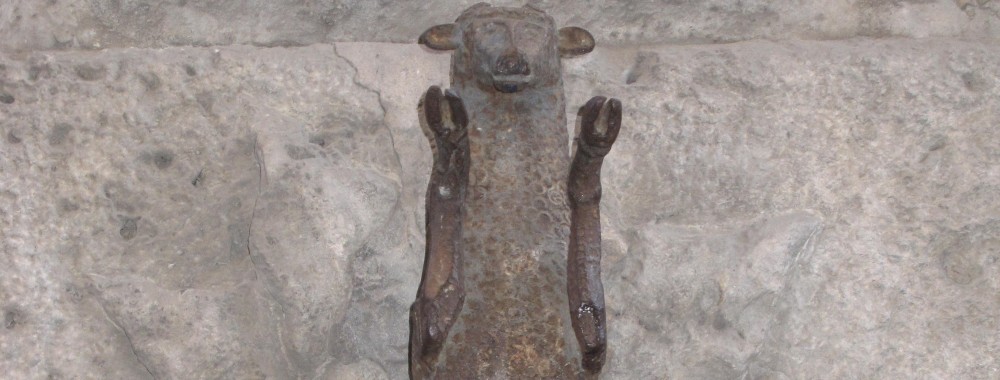
The text tells us that before that final night and climactic terrible plague of death, the children of Israel had to do something for themselves in a very public way – they had essentially to demonstrate their own confidence in God, and their contempt of Egyptian theology, by daubing their doorposts with blood from a newly slaughtered lamb, and many understand that the symbolism of this was huge – the lamb was one of the most powerful symbols of divinity used in Egypt. Those who did this brave act were spared the effects of the passing over them of the Angel of Death; those who were not brave enough or sure enough to do so were treated like the rest of the Egyptians among whom they had chosen to stay, and their first born sons and animals were also killed.
The Israelites were learning about real freedom throughout the plagues that were around them, they were learning that real freedom is in the self, and is not given – cannot be given – by another person. They had light while the Egyptians had a deep darkness.
So by the 10th plague the Israelites had learned about the freedom to be themselves and not be afraid of other people, and the Egyptians had apparently learned that what they assumed was their birthright to control their world did not in fact stand up. They were not free to decide how the Israelites should live; they were not free to do exactly as they pleased at the cost of other people’s lives and with the consequent effacement of God.
One might assume that liberation had truly been effected – both the physical and the mental and spiritual liberation of the exodus from Egypt. But the story goes on, describing exactly the human ability to disbelieve, to take refuge in habitual lines of thought. For soon after the Israelites had left Egypt – an Egypt in mourning, devastated and destroyed by what had happened within its boundaries, the pharaoh picked himself up – no hardening of the heart this time – and sent an army with horsemen and chariots after them to bring them back. And the Israelites, finding themselves between this army and the sea, feared greatly that the whole liberation was false, that they would be forced to return to slavery in Egypt. What happened then is a story everyone knows – the Israelites jumped into the water, the sea parted and the Israelites passed through but the Egyptians who followed were drowned. Only when Pharaoh had lost his army, and all trappings of control, would he finally come to realise that he was not all powerful. Only when the children of Israel took the plunge (if you’ll pardon the pun), and do what they had to do, and took a risk, did they come to believe in their own abilities to survive, in their own freedom. The Song at the Sea begins with a telling phrase: ”When the people saw all that God had done, then they believed in the Eternal and in Moses God’s servant”.
It took a huge amount of effort to force the Pharaoh and the Egyptians to realise that their economic and military control of the region did not in the end guarantee their freedom, and it took some huge risk taking on the part of the Israelites before they realised that their freedom lay within themselves, that it is not an external force at all. All of the drama that went on in Egypt merely dressed the stage and acted as backdrop for the realisation that the freedom could have been found all along. It just took someone with a willingness to take a risk, and with a vision of freedom being available, for the whole scenario to play itself out. From the expulsion from Eden through the repeated covenant relationship with Abraham Isaac and Jacob, God was there and waiting for the next stage. The story moved on with our willingness – or lack of willingness – to grasp freedom for ourselves, to recognise our role in creating freedom for ourselves and for others.
With all its obligations and responsibilities, its terrors and its pleasures, its risks and its rewards, freedom is scary. But unless we grasp it and work to keep it, and ensure that others are also able to enjoy it, we are not fulfilling our role in the world. As Rabbi Mordechai Kaplan, the founder of Reconstructionist Judaism recognised, “It is much harder to live a life of freedom and self-rule than to be ruled by others”. Yet this is the choice we must make, and Bible reassures us that in making it we will find we are not alone at all.
 rabbisylviarothschild