Toledot: lessons on the control of resources and why we should resist the power

 046-welfare-state

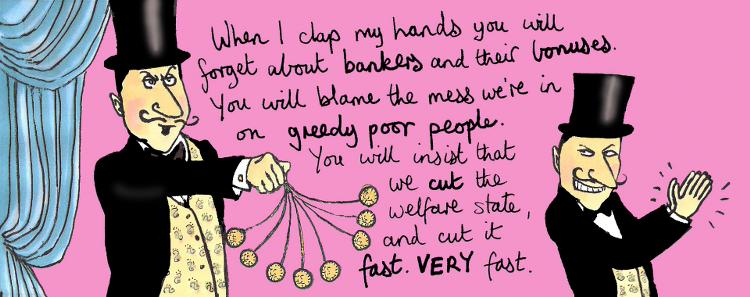
Within the powerful narrative of sibling rivalry and family betrayal of parashat Toledot there runs another, equally powerful and important theme – the control of resources of food and water and how the manipulation of this control distorts everything around it.

Two stories of deception and duplicity frame this sidra, both pivot on the manipulation of food and drink. In Genesis 25:27-34 we have the story of Esau coming in hungry from his venison hunting, and selling his birthright blessing to Jacob for the red lentil stew that Jacob has cooked and whose savoury smell tempted Esau whose appetite was so sharp he felt he would die if he did not eat it. In Genesis 27 we have the story of the blind and ailing Isaac asking Esau to go and hunt him a last meal of venison, after which he would give him the blessing of the firstborn before he died. The same motifs and words come up again and again: blessing; death; venison; In one story food is withheld until the blessing sworn over, in the other the blessing is withheld until the food is eaten. The stories play with each, resonate and mirror each other, but each of them uses food and the control of resource to put one party at a disadvantage to the other.

In the middle of these two stories of blessing and feasting, of manipulation and betrayal comes quite a different narrative. In Chapter 26 we have a story that begins with famine, specifically a new famine that is not the one faced by Abraham and Sarah, and Isaac and Rebecca go to the Philistine Abimelech king of Gerar to find food. God tells Isaac not to leave for Egypt as his parents had done in the previous famine, but to stay on the land and the blessing first given to Abraham would be his. Isaac stays in Gerar, but in a parallel to the story of his parents he tells everyone that Rebecca is his sister rather than his wife, as he clearly fears for his life should the truth be known. Abimelech notices the relationship between Isaac and Rebecca and chastises Isaac – someone could easily have taken Rebecca for a wife and the community would have been punished, and Abimelech places his protection on the couple. The result was that Isaac sowed the land and immediately reaped “me’ah she’arim” a hundredfold return on his work, and God blessed him and all his work. He became richer and richer, with huge flocks and herds, a great household, and this drew the envy of the surrounding Philistines.

I must confess that I find this extraordinary – why should he reap so much for his work? Surely enough would have been enough, and it would surely have been inevitable that such astonishing wealth would attract the unwelcome interest of those who had less than he, but let us pass on for now…

There follows a rather sad narrative of Isaac and the herdsmen of Gerar fighting for the wells that had belonged to Abraham and should therefore now belong to his son. Bible rather laconically tells us that “All the wells which his father’s servants had dug in the days of Abraham his father, the Philistines had stopped them, and filled them with earth”. It is not clear if this was an earlier event to prevent others taking the water after Abraham had left, or if this was a reprisal motivated by jealousy of Isaac’s wealth, or even if this was an attempt to erase any historical roots that Isaac would have had to the area. The wells don’t seem to have been taken over, strange in a world where water is so precious, but filled in – at least until re-dug by Isaac’s men when the fight over the water between the herdsmen became serious. Finally Isaac moved far enough away – first to Rehovot (meaning wide or spacious) and then to Beersheba (meaning 7 wells) – and an uneasy truce prevailed, cemented by Abimelech making a treaty with him having seen that God was with him – a curious treaty hedged with diplomatic ambiguity, asking that Isaac not hurt the people of Gerar, “as we have not touched you and as we have done you nothing but good, and have sent you away in peace…..” (v29)

In this curious narrative, resonant of the earlier stories of Abraham and Sarah, showing Isaac as both a hungry frightened migrant and as a wealthy possessor of animals and land, and finally as a synthesis of these – wealthy but insecure on the land and moved on further and further into the desert, we have the crux of the story. Control of necessary resources is everything. It doesn’t matter how much you possess if you don’t possess the basics of food, water and space to live on. You can be manipulated and dealt out of your rights by the person or group who has control over these, and who can take everything else of value from you. For all that Isaac reaped a hundredfold from his first planting, his wealth meant nothing as long as he was not secure for his immediate needs. Ultimately we are all in thrall to our basic needs. Bible already recognises what Abraham Maslow later put into his theory of the hierarchy of needs – that to live our lives fully we must first meet certain criteria: his first two sets are “Biological and Physiological needs – air, food, drink, shelter, warmth, sex, sleep.” And when these are met, then “Safety needs – protection from elements, security, order, law, stability, freedom from fear.” Only then are we in a place where we can grow well.

Why does bible frame the narrative of the Philistine King Abimelech and Isaac between the two stories of family manipulation and betrayal which both use food and immediate desire/need to control events?

One can only guess at the mind of the editor of the text. But in my mind I see that controlling others through controlling the access to resources they need is a human behaviour done to both those we are in close relationship with and those with whom we do not have such relationship. It is an atavistic strategy hard-wired into us, presumably for survival, but it is not a laudable strategy, and it seems to me that the structure of the biblical narrative is trying to remind us of this. The alienation of Jacob and Esau is painfully intensified through this behaviour. The pain between Isaac and Rebecca, and each of the participants in the deceptions reverberates through the text, as does the frustration and impotence of Isaac trying to claim his father’s wells and being chased off his land with violent encounters. There is nothing good to come out of this story except by negative example. We who control resources may wish to use them to control the behaviour of others, but we should think hard and long about giving in to this strategy. For history teaches that empires come and empires go, that there is a turning and a spinning of the world, and that what is in our grasp now may not be in our grasp in the future. How would we want those who control the resources to behave to us? As the famous first century rabbi Hillel framed the golden rule ‘That which is hateful to you do not do to your neighbour. This is the whole of the Torah, The rest is commentary. Go forth and study.’ (BT. Shabbat 31a)

alice2

both cartoons by the wonderful Jacky Fleming

Chayei Sarah: Sarah Imeinu, a flawed and powerful matriarch

The death of Sarah so soon after the binding of Isaac by his father, is ascribed in the midrash as the result of the shock Sarah experienced when she became aware that Abraham had been prepared to sacrifice their son Isaac in order to demonstrate to God his total loyalty, and that God had been prepared to test Abraham with such an ordeal.

God had said to Abraham: take your son, your only one, whom you love…” but the truth is that Isaac was not Abraham’s only son, though he was Sarah’s, HER only one. Abraham still of course, had Ishmael.

sarah

Isaac was her miracle child, born to her after years of infertility had merged into menopause, prophesied to her by God, a boy whose name meant laughter, but whose life in the event seemed to have had very little joy in it.

Isaac was the boy who was born to fulfil the promise of huge numbers of descendants. In procuring a son, any son, for Abraham, Sarah had tried to make sure that promise was fulfilled, but in the process had given herself a life with very little laughter and a great deal of unhappiness. She had given her handmaid Hagar to Abraham, but the son born from that union had then had to leave the family as she understood that he presented a danger to Isaac and to his inheritance. Then too, the relationship between Abraham and Sarah was clearly not all it might have been.  We know that Abraham was not with Sarah when she died, and more than that, that they had separate households in separate cities. The Midrash also suggests that love had died between them before the Akedah, when it allows us read that famous command from God as “Take your son, the only one you love, take Isaac…”

Sarah lived for 127 years, and the content of her life was the launch pad for much of later Jewish history.  Her death gives us a stake in the future too, for the negotiations between Abraham and Ephron the Hittite to buy her gravesite provide us not only with an insight into such transactions, but give documentary credibility to the attachment of the Jewish people to the land.  Many is the scriptural literalist who points to this passage and declares – “see we bought this land all this time ago, it is ours.”

It seems to me horribly appropriate that it should have been for Sarah that the land was purchased and the transaction so scrupulously recorded, for it is Sarah who took matters into her own hands when she procured a son for her husband via her handmaid Hagar, and set up a chain of painful rejection and destruction that has never quite been dealt with by any of the protagonists or by their descendents.

It was Sarah who couldn’t wait; who caused the birth of Ishmael and who had him sent away to what she assumed would be his death. It was Sarah whose sad and ironic laughter prefigured the lack of any real laughter in Isaac’s life.

Sarah is a figure who comes from nowhere – her genealogy is not given (exceptional in the biblical context) except for the defensive statement by Abraham that she is his sister.  She is however included in the covenant promise  given to Abraham – it will be her child with him, not Hagar’s to whom the covenant will apply. She is beautiful enough to be wanted by Kings, yet her barrenness makes her beauty somehow irrelevant, and her beauty is seen by Abraham mainly as a threat to his own life should anyone more powerful than him desire her.

Her life is full of journeying, her relationships full of misplaced love, manipulation and pain.

Sarah’s death leaves unfinished and painful circumstances. There is a great hole in the life of her son, who does not meet her again after the terrifying experience with his father, and who later takes his own bride into his mother’s tent, (not his father’s), to be comforted for the loss of his mother. Her husband also mourns her, but having honourably buried her, swiftly remarries, fathering children who will be the ancestors of the surrounding tribes with which Israel will have to deal.  Intriguingly, Keturah, the second wife of Abraham, is equated in the Midrash with Hagar, the repudiated handmaid of Sarah, a way no doubt of dealing with the discomfort of the rabbis with the behaviour of Sarah and Abraham towards this innocent Egyptian maid, yet a resolution which essentially betrays Sarah.

Sarah’s death is too soon, despite her 127 years of full life. She bequeathed a series of family behaviours that took generations to deal with, if not to fully conclude.  Her son was left emotionally disabled by his upbringing, her grandchildren spent years unable to see past their own senses of injustice and betrayal.

Yet for all of this Sarah was a matriarch, she ordered and she sorted and she gave unquestioning loyalty to Abraham and to his perceived destiny.  She travelled with him, leaving her home and her background just as surely as Abraham had done.  She nourished and cared for him, she understood prophesy and indeed is seen as a prophet in her own right, her gifts in that field considered to be greater even than Abraham’s. She heard God’s voice and she spoke with God and she even had the confidence to laugh at God.

The rabbis say that Sarah’s death is announced in such a way (“The lives of Sarah were..and Sarah died”) to bring home the lesson that her life was fully lived and that that was the important thing about her – her death was inevitable but it was her life that counted.  As we remember the stories about her, the bold actions she took on behalf of those she loved, the meddling in history and the protecting of her own, we can begin to understand her and to some extent understand the choices she made. She was matriarch, wife, part of the chain of the covenant; she loved fiercely and maybe acted on that love unwisely. She was sometimes a problem for herself and for those around her, but her life remains a story worth telling from which we can learn. Sarah Imeinu, a brilliant and determined woman whose life was full and complex and left its mark on her descendants, and whose death has also impacted on our history up to the present time.

(image an embroidery of Sarah’s tent on Torah binder by Caroline Ingram)

Va’yera: the multiplicity of ways our world appears to us, the many lenses through which we choose to view it (or not)

So much happens in sidra Va’yera that it is almost impossible to focus in on it, yet could it be that this rich multiplicity of stories is designed to catch our attention by its very unusual amount of action? Right from the first sentence we are being shown more than one reality, and this is captured in the name of the sidra – Va’yera – meaning “and he appeared”.

The narrative begins with God deciding to appear to Abraham, but as soon as we are privy to that information the perspective changes, and through Abraham’s eyes we see three ordinary men travelling in the desert, and requiring hospitality.

Are they divine messengers? Angels? Ordinary people who somehow will carry out a special function?

And where are they? Standing right over him or at a distance which forces him to run over to them to offer this hospitality?

The confusion carries on right through the narratives here. One verse begins with the three speaking, the next has one (human) voice, the one after is clearly described as the speech of God. Sarah, on hearing the news, laughs inside, yet God hears her… Always a multiplicity of perspectives are woven into the story telling, a little like seeing an event through a variety of cameras, in real time and in flashback, from one angle and then another.

Why is the bible telling these stories in this way, sometimes slowing down the motion so we get almost every footstep of the journey to Mt Moriah and the verbatim conversation between father and son, sometimes speeding up so between Hagar leaving her son at a distance so she could weep, and the angel hearing the voice of the boy, there is barely a blink of the eye?

The Torah readings for Rosh Hashanah are both taken from this sidra – the first day’s text being the story of the abandonment of Hagar and Ishmael at the insistence of the frightened and jealous Sarah; while on the second day we read of Abraham taking of her own son Isaac up Mt Moriah in a terrifying ceremony apparently done at the insistence of God, after which we find that Isaac never speaks to either parent again. What messages are being conveyed in these choices of torah reading? Why are both taken from Vayera?

Could it be that we are being reminded of the many perspectives involved in understanding an event, that sometimes things are hidden and sometimes they are not; sometimes we understand and sometimes we simply don’t; sometimes people do things for the best intentions and get the worst outcome, and sometimes we do things not with good intentions but because we are afraid or territorial or jealous or determined to second guess God.

Could the rabbis who chose these two contiguous chapters have done so to remind us not only of the close relationship we have with Ishmael, but also of the fact that our perspective is not the only one that is important in the story of who inherits the Covenant God made with Abraham. Indeed that God promises Abraham that he should follow Sarah’s demand because “of the son of the bondwoman I will make a nation, because he is your seed.”(21:13)

The more that we read this sidra, the more the puzzlement grows. What is the sin of Sodom? Why does Lot behave as he does when the visitors come? What do Abraham and Sarah see and understand when the three strangers visit them? Why is God telling Abraham of his intentions with regard to Sodom and allowing Abraham to bargain him out of the plan – but only insofar as God allows. Why does God ‘test’ Abraham with the threatened sacrifice of his remaining son, and does Abraham pass the test or does he fail it?

There are so many perspectives given in this sidra, yet we still cannot encompass what is going on – only become aware of the multiplicity of viewpoints, and the complexity of relationships. Maybe that is the lesson in itself – as we form a view of our world and our role in it, we shouldn’t let ourselves look for simple answers, but always be aware of the many threads in the weave, each holding a truth of its own. And each action we take – be it the frankly terrifying decisions that Abraham makes for his sons, or the tragic actions of Lot’s daughters – each action has a consequence and leads to yet more complexity. On Rosh Hashanah it is important we come face to face with our own history and with the multiplicity of perspectives and lenses through which to view it. The rest of the year we shouldn’t lose the lesson – religion isn’t a matter of good versus bad, there isn’t a battle between the forces of light and those of dark, but in each of us there is a complex mixture of views and perspectives, and the choices that emerge from how we value those views will dictate whether our future will be one of resolution and peace or of continuing struggle. We tell ourselves a story about what is happening in the world or in our lives on a daily, even hourly basis. We should remember in our story telling that ours isn’t the only way to tell the story.

Blind-Men-and-The-Elephant

Parashat Vayera: Is anything too hard for God?

Parashat Vayera 2013     “Is anything too hard for God?”

The narrative tells of an encounter in the desert between three travelling men and Abraham, who welcomes them into his tent and gives them hospitality. At the end of the story we read the following conversation: (Genesis 18) “And they said to him, “Where is Sarah your wife?” and he said “There, in the tent” and He said “I will certainly return to you when the season comes around, and behold, Sarah your wife will have a son.” And Sarah heard from the doorway of the tent which was behind him. Now Abraham and Sarah were old, well stricken in age; it had ceased to be with Sarah after the manner of women. And Sarah laughed within herself saying, “After I have grown old shall I have pleasure? My husband being old also?” And God said to Abraham “Why did Sarah laugh, saying “Shall I really bear a child, who am old?” “Ha’yipalei mei’Adonai davar?”  (Which is generally translated as “Is anything too hard for God?) At the set time I will return to you when the season comes round, and Sarah shall have a son”.

Then Sarah denied saying “I laughed not” for she was afraid. And God said “No, but you did laugh” (Gen 18:9-15)

This announcement of the forthcoming birth of Isaac is, in biblical terms, a long and complicated piece. We begin with the placing of Abraham and Sarah, he outside, serving the three men/angels who are visiting, she inside the tent and hidden. Suddenly the person speaking changes from the plural to the singular, presumably from the men/angels to God, and the person being spoken to is no longer defined. From the three men/angels speaking to Abraham since the beginning of the sidra, we have God saying, with no room for doubt, that Sarah will produce a son. There is no response from Abraham to this, indeed we are not told that God is speaking to him or even that he hears the remark, but there is a response from Sarah. She hears, and her response is to laugh and to question in rather earthy terms both her and her husband’s ability to produce a child. But in between God’s statement and Sarah’s response the Torah interjects. We are told that both Abraham and Sarah are old, and specifically that Sarah is post menopausal.

Now God speaks, asking Abraham why Sarah had laughed, and quite kindly translating her doubt about both her and Abraham’s potency into a questioning only of herself. And then God speaks again, with a rhetorical question whose answer can only be in the negative, a technique found repeatedly within this sidra….”Ha’yipalei mei’Adonai davar? Is anything too hard for God?”

This question is then followed by a repetition that Sarah shall give birth, and the whole scene is concluded with a conversation between Sarah and God – she denies laughing and Torah tells us it is because she is afraid. God tells her, quite kindly I always feel, that her denial is untrue. She did laugh.  There is so much in this one interaction, but I should like to focus on God’s question “Ha’yipalei mei’Adonai davar?” 

It is a difficult question to translate and yet so critical to much theological thought. The root of the verb yipalei, peh.lamed.alef, is not really about something being too hard, more about being ‘hidden’, or ‘covered’, ‘beyond’, or even ‘separate’, although one commentator suggests that one could read it as ‘great’, so the question could be read as “is anything beyond God?” or “is anything hidden from God?” or “is anything separate or covered from God?” Or even “is anything greater than God?”

Rather like the meaning of this verbal root, the question asked by God is difficult, hard to unravel. For the God we have speaking here in Vayera is the same God who must ask themself only a few verses after this event whether to hide what is to be done to Sodom from Abraham, the same God to whom Abraham asks “Will You sweep away the innocent along with the guilty?…Shall not the Judge of the earth deal justly?”, the God who is losing the negotiation to save Sodom and walks away from Abraham. This God of the Hebrew bible is not yet the all powerful being for whom nothing is too difficult, but the Creator of all, the unifier of all, who is coming to terms with exactly what has been created, for made in the image of the Creator it is complex, adaptive, learning, curious; not something to be easily known.

The Talmud tells us that “everything is in the hands of heaven except the fear of heaven” (Berachot 33b) – in other words human beings have freedom of will, and the freedom also to impact upon God, and so while I am happy to live with the understanding that God is unknowable, that we cannot encompass what God is, or what God can do, I do so on the understanding also that God responds and reacts to us, self-limits divine action with regard to strict justice in order for us to continue in the world, limits what is possible for God in order to be in relationship with us.

For us to have freedom of will, for us to make choices in our lives, then God has to cede power. It seems a reasonable exchange in order to have a relationship with us.

So back to the question – is anything hidden from God? Well probably not, if we believe in the Creator of all, then it is reasonable to consider that nothing is covered up and beyond the gaze of God. Is anything too hard for God – well, again, probably not, for the same reasons as above. But is anything impossible for God? This is where I part company from what is sometimes taught as traditional Judaism – given the relationship within which we operate, given the freedom of will given to us as to the choices we make, and the ceding of power from God in order to make the relationship between Creator and Creation, then God makes some things impossible for God, a willing and loving self-limitation, and it means that as a consequence we have to take up the slack.

If God cannot dictate good in the world, only teach and hope that we will bring it about, then we should stop blaming God for everything that goes wrong and live as best we can in our imperfect world, doing what we can to perfect it.

There is a view attributed to the 4th Century BCE Athenian Agathon, that God cannot change the past, what is done is done; But I would add to that view it is also not for God to create the present or the future. That is in our hands to do and is not for God.

Sarah laughed and then denied that laughter when God asked Abraham about it. Traditional texts tell us that she laughed at the news that she, past the age of fertility, would bear a child. But I wonder if her laughter was not something more – God asks Abraham the rhetorical question “Ha’yipalei mei’Adonai davar?” but he does not say it to Sarah. For Sarah may know the answer is not as some may like it to be, and if some things are off-limits for God to intervene in, then the consequences for us are frightening.