Chanukah Readings: It is better to light a candle than to curse the darkness

Bible tells us that the first thing that God did having created the heavens and the earth was to utter the words “Let there be light”, and there was light. God saw the light was good, and God divided the light from the darkness, and so began the ordering of a world which would ultimately sustain and nourish humanity, and they in turn would work with God to continue the process of perfecting creation.

Chanukah, the Jewish festival of lights, comes to remind us of the need to continue that work, even though it might sometimes seem that the darkness is all enveloping, and the world has reverted to the state of primordial chaos filled with terrifying uncontrolled forces that is contained in the phrase “tohu va’vohu”

Just as light was the catalyst for the world to develop into a place where we could live and thrive, so too light is the response we must make when faced with a darkening world. Just as bible commands that a light was to be continually burning in the tent of meeting outside the veil of testimony, and the priesthood had to tend to it evening and morning in order to keep it in good order as an eternal statute for the generations, (Exodus 27:20 and Lev 24:2) so too we need our ner tamid, our continually tended and burning light, to remind us not only of God’s compassionate and watchful presence in the world, but also of our obligation to bring God’s presence further into the world. As the book of Proverbs tells us,” Ki ner mitzvah, v’torah or : the commandment is a lamp and torah is light” – to act as God wishes us to act brings light into our world. (6:23)

Chanukah, like all festivals of light, comes in the winter darkness to remind us that the glow of even a small candle can alleviate the deep darkness, and as the Talmud reminds us “the candle of one person can bring light to many people” (Shabbat 122a)

There are many small candles lit in the world, many people doing good work in creative and imaginative ways, tending to the ner tamid, keeping the light of hope alive. Our High Holy Day confession includes the phrase “Al cheit she’chatanu lefanecha b’tim’hon ley’vav – For the sin we have committed before you by giving in to despair” and I must confess that each time I read the news of what is happening in the world, the way so many people are terrorised and terrified, violently murdered or imprisoned or forced to live hand to mouth, treated without compassion or empathy, uprooted and fleeing for their lives or stuck in a societal stratum below any human dignity, I give in, for a while, to despair. And when I see how governments oppress and harass their own people whom they are supposed to protect and support, close their eyes to the pain of their public and to the social justice values of civil society I succumb to frustration and fury that “they” are misusing their power so freely, unchallenged and unrestrained. And I come close to despair.

But then I remember those many people and organisations, those many small candles lit and tended to, which challenge the dejection and despondency and allow me to hope, to connect, to believe that the prophetic values of the Hebrew bible are not only alive and well, but are fighting back hard to be heard and to be seen, to bring light back into the world

So here are eight organisations of civil society in Israel who bring me hope. Eight organisations in whose light we see God’s light, who speak out for justice because, like Rav Kook, they do not have the power to keep silent. One for each of the nights of Chanukah: as you light the small flame of each candle, remember the words of Isaiah “I will make darkness light before them, and crooked things straight. These things will I do for them, and not forsake them.” (42:16)


First Night of Chanukah:   Tag Meir – The Tag of Light

Founded in Jerusalem in 2011 in response to Tag Mechir (price tag), this is the largest grassroots organisation in Israel that works against hate crime and religious racism in Israel. Transcending religious divides, Tag Meir is an umbrella organisation for a coalition of groups who support and campaign for democratic and Jewish value of justice for all the people. It protests violence and responds to victims of violence. Tag Meir’s mission is to connect different groups in Israeli society in the battle to eradicate racism and violence, and to educate for tolerance and empathy, as well as creating public events to raise and amplify the voice of those committed to democratic values. They offer Israelis the chance to voice their opposition to violence, to publicise it to all who need to hear, from Government to the victims themselves. They hold demonstrations and vigils, they pay condolence calls to victims of terror, they repaint over racist graffiti, they offer material support to religious places defaced. They meet with politicians and decision makers to end incitement and inflammatory rhetoric. Their motto : Or Bimkom Terror – Light instead of terror.http://www.tagmeiren.media-sb.co.il/


tag meir

Second night of Chanukah :   The Sir Charles Clore Jewish-Arab Community Centre in Akko

The vision and life’s work of Mohammed Fahili, this is the only Jewish- Arab Community Centre in Israel. It began in 1985 as a simple after-school club run by volunteers and located in the communal bomb shelter of a poor neighbourhood, this was part of an effort by the local Jewish and Arab residents to improve their living environment.  In 1991 the Clore Israel Foundation funded the construction of a purpose-built community centre.

The Centre’s aim is to provide high-quality, low-cost activities for Akko’s residents regardless of ethnicity or ability to pay. It functions as an important part of the community, offering enrichment programmes from infants to pensioners, allowing the people of Akko to meet over shared interests and needs, informally connecting people and building strong relationships. Many of the children that they cater for are from large, poor families and are vulnerable to the dangers of street life.  They help combat school drop-out by offering extra-curricular activities and programmes, nurturing Akko’s children to help them achieve a future. They also offer vital programmes for women and a cultural club for pensioners from the Former Soviet Union.

The Centre is an independent, voluntarily funded, not-for-profit, non-political and unaffiliated organisation.  It is funded almost entirely by voluntary donations from people who believe in the importance of their work in creating a better future in the region.


Fahili himself is an inspiration a candle in a dark room. With courage, humility and perseverance he has created an oasis of hope, a meeting place, a model for how Israeli society can be. http://ajcenter.org.il/

fahili


Third night of Chanukah:  Hiddush For Religious Freedom and Equality

Founded in 2009, Hiddush works through advocacy and public education to strengthen Israel as a Jewish and democratic state. Taking as its platform the 1948 Declaration of Independence, which states “”The State of Israel … will ensure complete equality of social and political rights of all its inhabitants irrespective of religion … it will guarantee freedom of religion and conscience” Hiddush is a partnership between Israeli Jews and World Jewry to ensure that this guarantee remains at the centre of the Israeli Government’s policy.
www.hiddush.org


Fourth Night of Chanukah:  YTheater Project Jerusalem

Founded in September 2009 in Jerusalem, this is the Israeli-Palestinian Community Theatre for a Change. YTheater engages Israelis and Palestinians together in a creative process of empowerment and responsibility. Using activist community theatre methods, it builds relationships, nurtures civic virtues, and helps the participants to work together strategically. YTheater runs workshops for Jewish, Arab, and Anglo youth and young adults to empower leadership.


“We are Palestinians and Israelis. Our lives and world-views usually exclude one another. We agree about almost nothing.   We are positioned in opposition. Our souls are on the line. We burn with the passion of the Middle East. We grope for new pathways – to break through impasses, to un-lock the grid of violence, and to mend what is broken. Creating theatre is our shared language; the stage is our meeting point. We are Muslims, Jews, Christians and Druze who collaborate. We struggle, we do not whitewash. We face difference and difficulty with caring and respect. Awe for life feeds our commitment to persevere, to create, to pry open our own hearts and the hearts of our audiences and participants. YTheater Project Jerusalem explores, interprets and innovates. We delve deeply into our behaviour, traditions, and societies.  We critique, provoke, and even, humbly, propose.In a region raw with conflict and pain, we rehearse for better life together. We are contributing to the infrastructure for better Palestinian and Israeli civil society.  YTheater builds relationships that heighten confidence and active will toward peace.”       Website    http://ytheater.org


Fifth night of Chanukah:        The Hotline for Refugees and Migrants

The Hotline for Refugees and Migrants, founded in 1998, is Israel’s leading organization protecting the rights of refugees, migrant workers and victims of human trafficking. For over 15 years Hotline staff and volunteers have been visiting Israel’s immigration detention centres to monitor conditions, meet with detainees and provide paralegal intervention and legal representation. We represent some of the most vulnerable people in Israel and advocate for government policies consistent with a just, equal and democratic Israel.

By combining client advocacy with impact litigation, policy initiatives and public outreach, we aim to achieve broad-based, systematic improvements in policies and practices ensuring that the human rights of migrants in Israel are respected.

Their main activities are Crisis Intervention, Legal Action and Public Policy and Education.       Website http://hotline.org.il/en/about-us/

Sixth Night of Chanukah: The Negev Coexistence Forum for Civil Equality

In 1997, a group of concerned Arab and Jewish residents of the Negev (the southern desert region of Israel) established the Negev Coexistence Forum for Civil Equality to provide a framework for Jewish-Arab collaborative efforts in the struggle for civil equality and the advancement of mutual tolerance and coexistence. The Forum, also known as “Dukium” in Hebrew, is unique in being the only Arab-Jewish organization established in the Negev that remains focused solely on the specific problems confronting the Negev.

The Forum’s activities and projects are based on the principle of Arab-Jewish cooperation and among their members are leaders of the Negev Arab community and academics. As a joint Jewish-Arab group we maintain a balance and equal partnership in the bodies of the organization as well as in the decision-making processes.

NCF is engaged in a wide range of grassroots activities. They have worked with community leaders in “unrecognized” Bedouin villages to deliver vital basic services to their communities. In the spirit of coexistence, Bedouin residents and Jewish volunteers work together to provide clean water, nursery schools, access roads and rubbish removal systems to over a dozen villages.

In collaboration with other NGOs, the NCF has filed legal petitions against discriminatory practices affecting Bedouin communities in the Negev. For example, as a result of a joint petition submitted to the Israeli Supreme Court in 2005, the government agreed to properly dispose of sewage flowing through Um Batin. Other petitions have led to the establishment of health clinics in ten unrecognized villages and to the prohibition of toxic crop spraying.   Website www.Dukium.org

Seventh Night of Chanukah:    Breaking the Silence

“Breaking the Silence is an organization of veteran combatants who have served in the Israeli military since the start of the Second Intifada and have taken it upon themselves to expose the Israeli public to the reality of everyday life in the Occupied Territories. We endeavour to stimulate public debate about the price paid for a reality in which young soldiers face a civilian population on a daily basis, and are engaged in the control of that population’s everyday life.

We collect and publish testimonies from soldiers who, like us, have served in the West Bank, Gaza and East Jerusalem since September 2000, and hold lectures, house meetings, and other public events which bring to light the reality in the Territories through the voice of former combatants. We also conduct tours in Hebron and the South Hebron Hills region, with the aim of giving the Israeli public access to the reality which exists minutes from their own homes, yet is rarely portrayed in the media.

Founded in March 2004 by a group of soldiers who served in Hebron, Breaking the Silence has since acquired a special standing in the eyes of the Israeli public and in the media, as it is unique in giving voice to the experience of soldiers. To date, the organization has collected testimonies from over a 1,000 soldiers who represent all strata of Israeli society and cover nearly all units that operate in the Territories.”


Eighth Night of Chanukah:        Shomrei Mishpat: Rabbis for Human Rights

“Founded in 1988, Rabbis for Human Rights is the only rabbinic voice in Israel that is explicitly dedicated to human rights. Representing over 100 Israeli rabbis and rabbinical students from different streams of Judaism, we derive our authority from our Jewish tradition and the Universal Declaration of Human Rights. Our mission is to inform the Israeli public about human rights violations, and to pressure the State institutions to redress these injustices. In a time in which a nationalist and isolationist understanding of Jewish tradition is heard frequently and loudly, Rabbis for Human Rights give expression to the traditional Jewish responsibility for the safety and welfare of the stranger, the different and the weak, the convert, the widow and the orphan.

RHR works primarily in the following 4 fields:

Socioeconomic Justice Work in Israel:

Rights of the Poor: RHR focuses on raising awareness and lobbying the Knesset for better economic rights for impoverished Israelis at the national level. At the local level, our Rights Centre in Hadera helps hundreds of Jews and Arab citizens obtain socioeconomic rights that have been denied to them, and run empowerment and advocacy groups of local Arab and Jewish citizens  from the Hadera area who focus and advocate for policy changes of their choosing.

Rights to Public Housing: RHR provides legal representation for public housing tenants in Beit She’an, Beersheva, and Hadera whose housing does not meet their needs or who are facing eviction.


Human Rights Work in the Occupied Territories: For example the Olive Tree Campaign: RHR works year round with Palestinian farmers from several dozen villages in the Occupied Territories, to ensure that they can regularly access their agricultural lands, often denied to them because of their proximity to Israeli settlements.. During Tu B’shvat, we purchase and bring hundreds of Israeli and international volunteers together with Palestinians to plant some 2,500 olive trees in areas where settlers have cut, uprooted and/or burned trees in acts of vandalism and arson.

Challenging Land Confiscation in the Occupied Territories: RHR works to legally prevent or reverse the takeover of Palestinian lands in Area C, and ensure that Palestinian farmers can safely access those lands. We continually monitor the implementation of previous rulings on land access issues.

Promoting Human Rights Education in Israel: RHR works in 12 pre-military academies, exposing every year some 600 young Israelis to our human rights teachings based on our rabbinic interpretation of Israel’s Declaration of Independence. We believe that teaching human rights to young people who then continue onto their army service better equips them to deal humanely with the realities on the ground.


Human Rights Yeshivas: For more than a decade, RHR has been teaching about human rights and Judaism to Israeli university students. We currently run 2 human rights yeshivas, with a total of 40 participants. Students who participate in the program receive a stipend, and intern in a human rights or social change organization in order to understand more deeply the challenges facing Israeli society.”


RHR_logo_for-Site


LIGHTING THE CHANUKAH CANDLES: BLESSINGS

Candles are added to the Chanukiah from right to left but are lit from left to right.

(On the Shabbat of Chanukah, light the Chanukah lights first and only then the Shabbat candles)

Light the shamash first, then use it to kindle the rest of the Hanukkah lights. As you do, say or sing:

Baruch atah Adonai ,Eloheinu Melech ha’olam, asher kid’shanu b’mitzvotav, v’tsivanu l’hadlik ner shel Chanukah   Blessed are You Adonai our God, Sovereign of the universe, who makes us holy through doing the mitzvot, and commands us to light the lights of Chanukah.

Baruch atah Adonai Eloheinu Melech ha’olam, she-asah nissim la’avoteinu bayamim ha’hem Baz’man hazeh. Blessed are You Adonai our God, Sovereign of all, who performed wondrous deeds for our ancestors in days of old at this season.


And on the first night only, add the blessing:

Baruch atah Adonai, Eloheinu Melech ha’olam, she’hecheyanu v’kiy’manu v’higianu laz’man hazeh.

Blessed are You Adonai our God, Sovereign of all, for giving us life, for sustaining us, and for enabling us to reach this season.


As you light the other lights (or after you have finished lighting) recite the following:

Hanerot halalu anu madlikin / Al ha’te’shu’ot v’al ha-nissim v’al ha’nifla’ot, Sheh’aseeta la’avoteinu bayamim ha’hem biz’man hazeh/ Al y’dei kohaneh’cha ha’kedoshim; V’chol sh’monat Y’mei Chanukah Hanerot halalu kodesh hem, V’ein lanu reshut le’hishtameish ba’hen/ Ela lirotan bilvad, k’dei lehodot ul’haleil le’shimcha hagadol Al nisse’cha Ve’al niflotecha Ve’al yeshu’ote’cha.

We kindle these lights to commemorate the saving acts, miracles and wonders which You have performed for our ancestors, in those days at this time, through Your holy priests. Throughout the eight days of Chanukah, these lights are sacred, and we are not permitted to make use of them, but only to look at them, in order to offer thanks and praise to Your great Name for Your miracles, for Your wonders and for Your saving acts.


Eight Other Readings about Light and Mitzvot


“We live in a dark time. In a world ravaged by war, prejudice, disease, and now, an economic crisis that will put hundreds of thousands of people at risk of suffering. We need to bring more light. And to bring the light, we need to become the Maccabees- a people of faith who believed that liberty is worth fighting for, that human dignity is worth fighting for, and that justice is worth fighting for.” (Rabbi Sid Schwarz)


“If you offer your compassion to the hungry and you feed the famished creatures, then your light will shine in the darkness and your gloom will be like noonday” Isaiah 58:10


“When you think about someone or something that inspires you, the expression with the word נֵר would be Ner Le-Raglav- נֵר לְרַגְּלָיו. Literally, the expression means “a candle by his leg” but the contextual English translation for this expression would be “guideline” or “guiding principle.” I would add to this the meaning of “someone that you can follow”,  as it appears in Psalm 119:105 “Your word is a lamp to my feet, and a light to my path.” “נֵר-לְרַגְלִי דְבָרֶךָ; וְאוֹר לִנְתִיבָתִי.”


“According to the Created Worlds and Destroyed Worlds interpretation of the Bible, the passage in Genesis follows a major destruction of the world previous to our own. The light mentioned in Genesis 1:3 was a supernatural light that had the power to repair elements of the previously destroyed world. Day one of creation records the day when this supernatural light of repair was introduced into our current world. Day two records the start of the repair of the atmosphere and water. Day three describes the completion of the repair of the atmosphere and water and the repair of plant life. Day four describes the repair of the Earth’s relationship to the Sun, Moon, and stars. Day five describes the repair of marine life and winged creatures. Day six describes the repair of land animals and man.


“The people who walked in darkness have seen a great light; those who dwelt in a land of deep darkness, on them has light shined.” (Isaiah 9:2)


But the path of the righteous is as the light of dawn, that shines more and more unto the perfect day. (Proverbs 4.18)


“The Holy One said to Israel “My children, since My light is your light and your light is My light, let us, you and I go and give light to Zion. Arise, give light, for your light has come (Isaiah 60:1)” (Pesikta de Rav Kahana 21:1)


A beautiful Muslim Prayer for Peace

MinabLogoWeb

This prayer deserves to be read and shared as widely as possible. And with a few appropriate edits of the language, we may all add our voices in prayer

The Mosques and Imams National Advisory Board call on our members and their affiliates across the United Kingdom to adopt the “Prayer for the Nation” as part of their services and sermons, on Friday 20th November 2015.
One of the first and most fundamental ways Muslims show feelings of commonality and brotherhood is through prayer.

Imam Shahid Raza OBE, Chairman, Mosques and Imams National Advisory Board said:
“The prayer is thought to be an opportunity for British Muslims to express a national identity in their own way. The prayers ask God to keep Britain a harmonious nation that protects the marginalized, upholds strong moral values and to promote loyalty among our diverse communities.”
“My colleague and I have given our full support to establish the “Prayer for the Nation”, and through our network of 1500+ faith leaders across the UK, we will be launching the Prayer at our sermons on Friday 20th November, but not exclusively our attention will also be at those who may not regular visit the Mosque, we will share on our Facebook, Twitter and WhatsApp Accounts, we will get our young people to share on Instagram and SnapChat.”
“The prayer is not exclusive to faith leaders. We encourage it to be recited at our homes, madrassahs, community events, social gatherings and in our hearts and minds. We hope this will help nurture future generations of believers and contribute positively to the wider British society.”

Mustafa Field MBE, the Director of the Faiths Forum for London, said:
“The prayer could perhaps cultivate and give a voice to sentiments of amity and fraternity with British society at large.”
“The notion of citizenship revolve not only around moral values and legal obligations, but also around cultural narratives about identity and loyalty.”
“The concept of Britishness is fluid, but is based on our consensus around our shared values, and as a spiritual identity that favours cultural inclusiveness as an antidote to narrow nationalism.”
“The “Prayer for the Nation” is a contribution to the strengthening the sense of citizenship the holds our nation together.”


Prayer For The Nation

Oh Allah, our lord, unite our nation around the principles of justice, peace, love and faith.

Put peace and love in our hearts for the diversity that makes our country so beautiful

Oh Lord, most Strong, Give us the strength to protect and care for our neighbours.

Oh Lord, we pray for our nation, the United Kingdom. to remain loving, compassionate, remove prejudice from our hearts, and enable us to love our brothers and sisters of all faiths and none

Make our hearts and minds aware of our heritage, fulfilling duties and responsibilities as a citizen of our country!

Allah, Most Merciful, allow us to show kindness to those most vulnerable in society.

Protect us from evil, inspire and guide us in defending those open to abuse.

Lord, Most Generous allow us to give in charitable activity, and to help those most in need.

Lord give our Government vision and wisdom, as they take decisions affecting peace in our world.

Allah, our Sustainer, allow us to care for our environment and sustain this world for future generations.

Lord, Most merciful, Most Generous, please give us the patience to continue to learn from one another and work towards a more peaceful and kind world.

Make true in our nation the ideas of freedom and justice and brotherhood for all those who live for them.

Make our hearts generous so that we may treat others as we wish to be treated ourselves. Help us to share that which we have with others, for your sake. Strengthen us, love us and be kind to us all.

For media enquiries email mustafa@faithsforum4london.org or call 07946 515 987

Anti Slavery Day – the trading and trafficking of people is flourishing in 2015

This coming Sunday sees Anti-Slavery Day, a reminder that slavery is alive and well, a major global business exploiting vulnerable people and causing untold misery. Whether for sexual exploitation, forced labour, or people trafficking, it’s estimated that 800,000 people are traded annually.

In the ancient world slavery was unremarkable, and Hebrew bible is concerned only to regulate fair treatment of slaves, a view further developed in the rabbinic codes and responsa. While one cannot say bible condemns slavery, it does not condone the abuse of power by one person over another, and in Exodus we read “one who steals a person and sells them… shall surely be put to death. (Exodus 21:16) Modern day slavery steals people and traffics them for profit.   Globally there are estimated to be 27 million people treated in this way. What are we doing to address the abuse of so many people?

Heschel wrote that “Judaism is forever engaged in a bitter battle against a deeply rooted belief in fatalism” and suggested that our natural human state is of inertia, rather than of actively confronting social, moral and spiritual wrongs. He taught Judaism wants us to emulate Abraham, not in terms of faith, but in terms of his not conforming when something was wrong, but instead to “keep the way of God by doing righteousness and justice” and possibly even more importantly, to instruct his household and his descendants to do the same (Genesis 18:19)

I recognise the inertia; when we see such a complex and horrible problem as modern slavery we simply cannot begin to comprehend it, relying on our politicians or various institutions to deal with it on our behalf. And I see that those to whom we have delegated responsibility are also overwhelmed, and so slavery and trafficking and exploitation of vulnerable people far from home is able to flourish. Even here, in the UK; even now in 2015.

STT_HAND_super_low_res

The biblical “people stealer” is still with us.  Why are we, the Jewish community, whose foundational texts these are, not doing more to stop people trafficking, forced labour, and the sexual exploitation of vulnerable people? We are commanded to protect the powerless. So let’s fight the inertia and act!

image from http://www.stopthetraffik.org/uk

Shabbat Bereishit: the yahrzeit of Rabbiner Regina Jonas

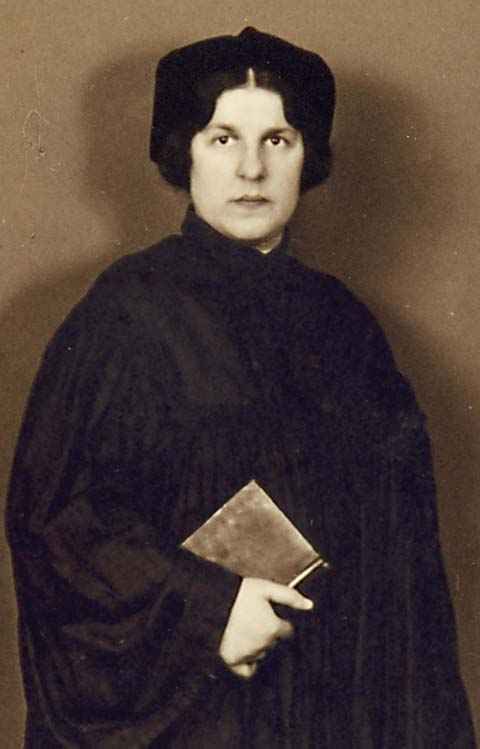
Fraulein Rabbinerin Regina Jonas, the first woman to be ordained Rabbi in modern times, was murdered in Auschwitz in 1944 and her name and story submerged until the fall of the Berlin Wall meant that some of her papers were retrieved and studied.

Jonas-Regina

Her story is a complex one. We know tantalisingly little about her; there are some basic facts about her birth and parentage. She grew up in a poor part of Berlin, and after the early death of her father when she was only eleven years old, she, her older brother and her mother became ever poorer. She lived amongst Jews from Eastern Europe, whose religious practise was orthodox (as was hers). In her teens she found the comfort of the synagogue, and never really left. The rabbi helped her to take her Jewish studies to a level where she could make a living teaching, and so she supported her widowed mother and herself as best she could, and she continued to study, and she dreamed of rabbinic ordination, writing her thesis on the subject “Can Women Serve as Rabbis?” and proving to her own satisfaction that according to Halachah the answer was ‘yes’

While her thesis was sound, academic scholarship was no match for centuries of misogyny and custom. Her teachers would not ordain her as a Rabbi. She was the victim of a collision of circumstances- her teachers did not want to cause a problem in the wider Jewish community by going outside of orthodox tradition and ordaining a woman. The conditions in Germany in 1933 were preoccupying the German Jewish world as they cast about looking for a rational response to an insane situation. More than that, she was an orthodox woman studying at a Liberal institution. She was widely perceived as being ‘strange’, a woman who did not care about her looks, an academic whose mind did not deal with frivolity, a radical and transgressive figure who yet wore the clothes of convention and tradition. She challenged many social and religious norms, demanding her right and coping with what was clearly some hostility towards her. She was said to be a good teacher, a good pastoral worker, yet even with the dwindling number of rabbis in Germany she could not find a community willing to take her. Her work took place in the old age homes and the hospitals – the traditionally gendered “caring” roles.

Regina Jonas comes across as an isolated and lonely figure, a trailblazer and pioneer who did not however achieve a following in her lifetime. Yet she did not give up. She worked wherever she could, and before deportation to Theresienstadt she ensured that her papers would be lodged in the archive from where some fifty years later they would emerge. She deposited photos of her in her rabbinical gown, her ordination certificate and some press cuttings. She held on to a hope that she would be remembered, not go nameless and forgotten into the future.

She worked in Theresienstadt for two years, teaching, giving a series of lectures, acting pastorally and rabbinically and working in the team of the famous psychoanalyst Viktor Frankel – her job was to meet the trainloads of shocked and frightened Jews transported to the ghetto and to try to comfort them. She worked hard and with great dedication for two years until she too was sent to Auschwitz where she was later murdered.

Her date of deportation was 12th October 1944. It was Shabbat Bereishit, the first Sabbath after Simchat Torah, when we finish the book of Deuteronomy with the death of Moses and the transition in leadership to Joshua and we immediately begin to read the book of Genesis with its universal story of the creation of the world.

On Shabbat Bereishit we learn that leaders die but leadership goes on. That ideas are stronger than individuals. That out of endings come new beginnings.

We don’t really know very much about Regina Jonas except what we can try to piece together from scant evidence and tiny remnants of memory. Having been officially forgotten from 1942 until the early 90’s she has re-emerged, as ambiguous and as perplexing as she seems to have been in life.

We progressive women rabbis have taken her for a standard. She has become “the first woman rabbi”. Her story reads as a cautionary tale for the rest of us – will we too disappear after working so hard to achieve, after caring so much, after labouring at the coal face of the community rabbinate?

Anger has been expressed at her ‘disappearance’ from the narrative when so many who knew her or knew of her never bothered to pass the information on to the next generation of women studying rabbinics who felt so lonely, so trailblazing, so exposed. There is the sense that if only we had known about her when studying ourselves, we would have been able to speak of her and so be comforted by her earlier initiatives. She would have stood between us and the void of women rabbis in history.

We have taken her for a standard, and now we have adopted Shabbat Bereishit for her yahrzeit, the probable date of her death. In Bereishit we read the two stories of creation – the first where women are created equal to men and at the same time as them; the second where woman is created from the side of the first man to become ezer k’negdo, a help and an opposition to him.   Regina Jonas’ life expresses so many ideas in this Torah reading, read both on Simchat Torah and the following Shabbat – it is almost as if it were bashert. The way she lived her life demands of us that we take seriously the questions she posed to the conventions and community of her time as we look at how those questions are asked and answered in our time and communities.    But maybe we should also be more honest and say that Regina Jonas is not the forerunner of women in the non-orthodox rabbinate – she is really the forerunner of women in the orthodox rabbinate. That now there are women with orthodox semicha is exciting, though there is still a long way to go for them to be much more accepted than Regina Jonas was when she finally received her semicha eighty years ago.

Eighty years – twice times 40, the signifier of “a long time”. Eighty years, the biblical length of a long life. And so much has happened since her ordination. The number 80 is signified by the letter Peh. It is an explosive sound. It means an opening or a mouth. The Torah is both written text (bich’tav) and oral (she’b’al peh). It give me some satisfaction that at 80 years since ordination there are women rabbis in every stream of Judaism. Regina Jonas’ mouth continues to open and to teach, and each of us embroiders what we hear.

After prayer, introspection, critique and teshuvah, the time for action is now

The Jewish year has a number of cycles, and one cycle has just concluded – from the seventeenth Tammuz which happens three weeks before Tisha b’Av in the early summer time, till Shemini Atzeret /Simchat Torah, the conclusion of the Yamim Noraim, more than thirteen weeks later, we have been focusing on how our behaviour impacts upon the world, how what we do really matters. The destruction of the Temple and the Exile from Israel in the year 70CE was caused, according to our tradition (and firmly based in the historical narrative) on “sinat hinam” – acts of causeless hatred, where Jews betrayed other Jew; Individuals did not value others; Greed and selfishness overtook care and compassion. With the effects of the destruction of Jerusalem resonating in our souls we go through the summer and on to the high holy days mindful of the words of Talmud Sanhedrin 37a    “Whoever destroys a soul, it is considered as if they destroyed an entire world. And whoever saves a life, it is considered as if they saved an entire world.” The text goes on to make clear that the destruction and the saving are not necessarily of the life itself, but of the quality of that life.

Simchat Torah ends this particular cycle – while of course also beginning another, that of the weekly progression of readings from the scroll. But Simchat Torah now also marks for us the greater focus on the outcomes of the Yamim Noraim – the importance of repairing the world, of righteous behaviour and of acts of compassion – the three Jewish principles of Tikkun Olam, of Tzedek and of Gemilut Hasadim.

For a quarter of the year, from the middle of Tammuz, through Av, Ellul and more than half of Tishri we have been prompted through liturgy and festivals to consider repeatedly about how we are behaving in the world, reminded again and again that there are consequences and impacts arising from our choices. We have drilled down from the sweep of Jewish history into the capacities of each individual soul to enact change both for themselves and for the world. And now, with Simchat Torah and the return to the beginning of bible, which reminds us of our universalistic beginnings, of God as Creator of the whole world, interested in every person and every action, it is time to change our focus back to the wider world in which we live. We have thought hard about our own failings and tried to make ourselves better, now it is time to try out our newer better selves, to go into the world and try to make a difference. As the new year of Torah readings begins, they nudge us to find something new and pertinent in the familiar. There is much to do close to home – be it working for our communities so that everyone feels valued and becomes connected. Be it working for more fairness in the workplace, for the safety and security of those who find themselves lost or in poverty, or homeless. And from within our own community we can also work to help those further away, the refugees currently risking their lives while fleeing terrible circumstances in their own country, the dispossessed and isolated because of war or disease. We can add our voices to those who protest where humanity is cruel or thoughtless to others, we can demand of our leaders that they behave according to the values they say they espouse.  We remind ourselves of the teaching in the Talmud Sanhedrin 37a    “Whoever destroys a soul, it is considered as if they destroyed an entire world. And whoever saves a life, it is considered as if they saved an entire world.” The text goes on to make clear that the destruction and the saving are not necessarily of the life itself, but of the quality of that life.

olive harvest rhr

The time for contemplation is over, the time for action is now

image from rabbis for human rights co-ordinating volunteers to help Palestinian farmers harvest their olives.

VOLUNTEERS NEEDED THIS WEEK FOR THE OLIVE HARVEST IN THE OCCUPIED TERRITORIES!
We need folks to sign up to join us for the harvest THIS Wednesday, Thursday and Friday. For those of you who have already signed up, now is the time for you to work with our office to specify a date. Please email info@rhr.israel.net or call 02 678 3876 to sign up. Dates are also available until Nov 6th.

Her Britannic Majesty’s Secretary of State requests …..

At the age of ten I went to live with my grandmother in Switzerland for a year. I can still remember handing over to her my shiny new stiff covered blue and gold British passport for safekeeping. She took it and held it, stroked its cover and opened it to the page which informed the world that Her Britannic Majesty requested my safe passage in the world. She told me how lucky I was to possess such a wonderful document and how I must never do anything to lose it.

I remember the scene vividly. We were standing together in her bedroom by the elegant Venetian writing desk she kept there. I remember her voice, the urgency of her words, and something else: something that communicated itself to me and resonates within me almost fifty years later.

At the time it seemed an important conversation and one I should pay attention to but I didn’t really understand why or what it was she was trying to communicate.

Now I do. My grandmother, the pampered only child of wealthy Berlin parents who grew up with all the advantages that money could buy in that cultured elegant world of the late 1800’s fell in love with and married a Jewish lawyer from Hannover in late 1922. With a young son, my father, born in 1924 they should have been set to live a comfortable and happy life together. My grandfather rose in the ranks of the legal system and was becoming a respected Judge, but within ten years of their marriage their idyll was ended as the political situation in Germany worsened and the Nazis, having come to power in January 1933 began to implement their policy of removing all Jews from public office and public service. My grandfather had no job, no position, and life became intolerable. They moved within Germany to another family home in Baden-Baden, suffering a kind of internal exile. My father was sent away to school first in Switzerland and then in the UK and on 9th November 1938 as the synagogue was destroyed by fire on Kristallnacht, and the men of the community humiliated in public, my grandfather was arrested and sent to Dachau concentration camp.

The story continues – of my grandparents fruitless attempts to protect extended family from being transported to the gas chambers. Of my grandmother’s extraordinary efforts to protect her husband and bring him to a family home in Switzerland which she achieved in 1939.Because of this they were stripped of their German nationality and became officially stateless. There are intrigues and horrors galore in the family archives, but the upshot was this. They left Germany having bribed and paid heaven knows what kinds of fines in money and kind, my grandfather desperately ill after the various arrests and incarcerations and beatings, my grandmother frantically learning how to deal with a world she had not been brought up to even imagine, and they ended up in French Switzerland living on favours from friends and from various refugee agencies, moving to ever cheaper accommodation, often with barely enough to eat or to warm themselves with, let alone pay the necessary medical bills. All the time they were uncertain as to how long they could take shelter in Switzerland, their papers were endlessly circulated among bureaucrats, their permissions to stay always temporary and for short periods. The last letter refusing any more extension of permission to stay arrived only two or so days before my grandfather died in 1950. His death certificate describes him as “sans papiers” – a man without papers, with no nationality or right to stay as citizen or even as refugee. His grave, provided by the Jewish community of Lausanne, is so modest that currently even his name is worn away.

My grandmother eventually took Swiss nationality, helped by the fact of a family home and presence in the country. She was grateful to Switzerland for giving her this eventual security. She was desperately grateful that her son had settled in England, been given British nationality and that his children too were under the protection of Her Britannic Majesty’s Government. She wanted me to know, without telling me any details of the story which we only fully uncovered years after her death, that the most basic security that had been denied to her and my grandfather was beyond precious. To be a refugee, a seeker of asylum running from a chaotic government that seeks your destruction is to have nothing and nowhere. It is destabilising, it prevents any normal development or relationship in life, it causes your family to scatter or worse, it means you scream in your sleep as you remember what your waking mind suppresses. To be a refugee and seeker of asylum is to be the most vulnerable kind of human being it is possible to be. Just holding onto identity, to remember the person inside you, not to fall apart into a dislocated existence takes all the energy and resilience one has.

Yesterday I took part in a day of study and prayer with imams and rabbis and priests, in a tent close to Harmondsworth detention centre. We called in Abraham’s Tent. We looked at the texts of our tradition that speak of caring for the vulnerable, the stranger, the one whose world has fallen apart and who looks for help from others. Yesterday we fasted, the coincidence of both Muslim and Jewish fast days with the concomitant introspection they call for gave us yet another dimension in common. I was proud to join with the others to draw attention to the conditions facing many of those who seek asylum in the UK and who find they can be detained indefinitely in what is essentially a high security prison, while the process to accept or reject their application grinds on. They are there not because of any criminal activity or intent, but because they have fled their own country, requested asylum in the UK, and their papers are not in order. We are the only country in Europe with no time limit on how long someone can be kept in detention while the process takes place. The treatment of vulnerable people, many of whom are already traumatised by earlier experiences that caused them to flee their own countries, is against the British values my grandmother so idolised. Tens of thousands of people are put into detention each year, with 30,902 entering detention in 2014 and the rate is increasing.

I am proud to hold a British Passport, and I am grateful. My grandfather died without any passport at all, despite having been an upholder of Justice all his life. I understand what my grandmother wanted me to know – to be stateless and without official identity or secure place to live is to truly have nothing, to be at the mercy of everyone and to feel no mercy at all. Surely in the UK it is time to treat all people with dignity and respect whether they ultimately receive the right to remain or not. It is time to limit indefinite detention to the all-party parliamentary group recommendation of 28 days and to remember that everyone in this system is a fellow human being.

http://www.appgmigration.org.uk/news       #Time4aLimit

packing abrahams tent

Shemini: When Silence is the only response

One of the saddest moments in bible is found in Shemini – Aaron and his sons have just been inaugurated as priests in a week long ceremony and now the tent of meeting is being dedicated. The first offering is given by Aaron and is accepted as a fire descends from the heavens to consume it. The people bow down and worship. And then Nadav and Avihu the two older sons of Aaron offer a strange fire before God and the fire descends once more from the heavens – to consume their lives.

Aaron’s response – “va’yidom Aharon” – is to be silent. How can this be? To have finally reached the climax of priesthood only to see two children of your children destroyed by the object of that ministry. To be a father twice bereaved yet not to protest and shout out. Why does Torah tell us that Aaron, the man whose speech was smooth and fluent and who would act as the mouthpiece of his brother Moses in Egypt, had no words at this moment?

Words can be so healing – we are taught always to express clearly what we need in order to communicate with others, to use words to acknowledge our feelings be they painful or joyous. From private prayer to modern psychotherapy we are taught about the power of words to change or to complete us. Creation begins with words: God speaks and creation comes about. We transmit our tradition in storytelling, we see ourselves as a people who argue with God, who are not ever silenced – we are a noisy, challenging people who will argue with a text, giving voices to the long dead sages of our tradition. Yet “Aaron was silent” (Lev. 10:3). And this silence is seen in our tradition as a right and proper response – the Midrash Leviticus Rabbah comments on this verse: “Aaron was rewarded for his silence.” Clearly we have to look deeper. Why is the silence of a man so unfairly hit by tragedy seen in our tradition as a response to be rewarded? Why should he not be crying out against a God who did not protect the young men whose only wrong seems to have been an excess of religious fervour, who certainly did not deserve to die?

In the Talmud we find the statement that “the world is preserved only because of those who stop themselves from speaking out in difficult moments of strife” (B.T. Hullin 89a). We also find that it is an attribute of God to be seen to be silent at such times, – a rereading of the verse ‘mi chamocha ba’elim Adonai’ is understood not as “who is like you amongst the Elim – the mighty gods of other peoples”, but rather as “Who is like You, able to be silent?” – “Ilmim” (BT Gittin 66a). Sometimes silence is the only response. Anything else would diminish the enormity of the experience.

In Jewish tradition one does not speak to a mourner until the mourner speaks to you. It is a tradition that understands the depth of grief. When grief is intense any statement is bound at best to be irrelevant and at worst a serious intrusion. That is not to say we ignore a mourner or their grief, we do not cross the street to avoid meeting them nor leave them in their pain – but there is a communication that surpasses language, which any words would disrupt or divert. In mourning that may be simply sitting with and being with the mourner, in shared silence. It may be a warm embrace or a fleeting touch of the hand. It may be a meeting of the eye, a moment of contact which says “I am here and I care”. There is nothing more to offer than the compassionate presence – certainly there is nothing further to say.

There are times in our history when words are not just unhelpful – they might be actively destructive, causing a break in the relationships between us or between us and God. And these are the times when the silence of Aaron becomes understandable.

The text emphasizes that Aaron’s two elder sons were acting “before the Eternal.” Both the offerings they made and their death were “before the Eternal.” The plain sense of the text indicates that, apparently moved by religious fervour, they added an extra incense to the usual incense offering without having been commanded to do so. That is all. One would have thought this is no great crime for young men who have just finished their priestly training and are one day into the work. They are simply intoxicated with the role, acting out of extraordinary piety to add yet more offerings to God. At most they are guilty of what we are told in a later passage in Leviticus – that “They drew too close to the presence of God” (Leviticus 16:1). Surely we could expect for Aaron to respond to their violent and sudden deaths by arguing with God, just as Moses had done on several occasions before this. Surely Aaron could justify the actions of his sons to God and demand some compassionate – even miraculous – response. But Aaron was silent. He made no attempt to communicate his anguish – and surely his anger – to God.

This is unusual in our picture of Aaron, which has been improved in rabbinic teachings so that he becomes an active pursuer of peace (Avot 1:12 etc), a man who advocates peace and who is the earliest practitioner of what we now call “shuttle diplomacy. Yet in this situation his skills are redundant. There is nothing to do, nothing to say. His tragedy is too raw, too personal, too much. Should he speak what could he say? If he is able to put into words even the smallest part of his pain he would surely only create a rift between himself and God – how could he not? And what benefit would his speech produce? God is clearly not going to perform a miracle, turn back time, resurrect his dead. There is nothing, nothing at all, he can say.

This week we will be commemorating an event as raw, as incomprehensible, as painful as the event in Shemini – it will be Yom HaShoah and we will be coming together to be with each other in order to remember. But what will be able to say in the face of the enormity, the singular extra-ordinary time when our people were persecuted and destroyed with terrifying efficiency on a grand scale by national governments? There are those who railed against God, whose words led them to a permanent rift, losing their faith and any possibility of comfort from our Jewish God. There are those who attempted to make sense, who spoke of the implicit guilt of the victims – just as there are those who say that Nadav and Avihu must have been guilty of arrogance or even idolatry. And those whose attempts to make sense of the Shoah lead them to see the State of Israel as having emerged from it as a sort of divine compensation. There are those who are able to forgive God for the silence in the Shoah, but will never forgive people and so live lives of alienation and bitterness. But any response is too small, too diminishing of the event, pointless. Some things require us not to understand, not to argue against, not to justify nor to console – they are things about which the only response is a silence in which we can be. Not a silence that suppresses or ignores, but a silent being together.

During the service of brit milah (circumcision) there is a verse taken from the book of Exodus about the blood of the Passover lamb – God says “va’omar lach b’damayich chayee” –I say to you by your blood you shall live. The Dubner Maggid asks – why the extra word – lach – for you? And answers his own question – this is about the precious blood that is spilled – God will respond, will not leave you in despair. But B’damayich chayee can also be translated a different way – damayich does not have to mean ‘your blood’ but ‘your silence’. Sometimes it is only with silence that we can go on – any other response would be too destructive to us, would drag us into a vortex of pain from which we would be unable to emerge.

I cannot find it in me to believe that the shedding of blood is the call to which God will always respond, regardless of the teachings of our tradition. But I can understand the need for silence, that silence sometimes is the only thing that will allow us to go on, to not be desperately searching all the time for an elusive explanation, for a response that will make sense, for a grand plan in which such terrible sacrifice is given honourable meaning. Like Aaron knew, some things are beyond words, beyond reason, beyond our ability to contain or order their meaning. Sometimes you just have to simply be, to witness, to remember, and to be with the people who themselves experienced the horror in compassionate wordless togetherness.

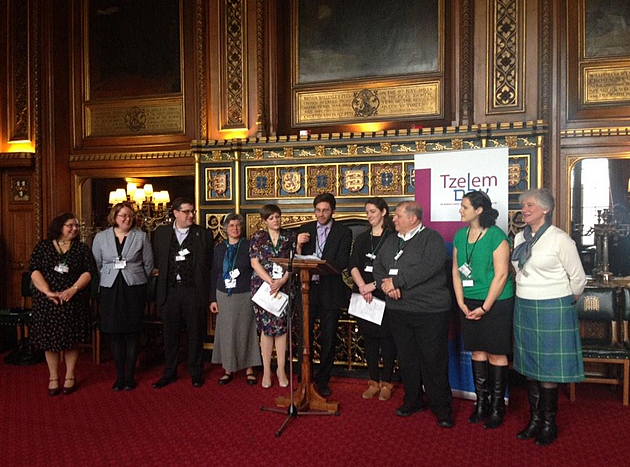
The Launch of Tzelem at the Speaker’s Rooms 28th January 2015

http://static.wixstatic.com/media/79c59a_82884f3f11aa41e2874a41b3d97566d5.png_srz_p_630_467_75_22_0.50_1.20_0.00_png_srz

In the beautiful and opulent surroundings of the State Rooms of the Speaker’s Apartment in Westminster over 60 Rabbis and Cantors from the different Jewish streams in the UK came together to launch a new organisation: Tzelem- the Rabbinic  Voice for Social and Economic Justice in the UK.

Founded on the Jewish principle that we are all created in the image of God (b’tzelem Elohim), Tzelem builds on the prophetic tradition of the Hebrew bible which speaks of the vital importance that social and economic justice is available for everyone.  Jewish tradition has long advocated the rights of the marginal and the powerless, and our teachings are rich in texts calling for us to take part in asserting those rights, and standing up in the face of the powerful in order to achieve them.

It is the purpose of Tzelem to continue this tradition by critiquing the issues at the root of our society that keep the vulnerable and powerless exposed and helpless.  We aim to take action in order to change the structures that maintain the marginality of the weakest in society, and to change the way they are viewed.

Four Rabbis spoke from their own close experience of mental illness, child poverty, homelessness and immigration. It was a sobering experience made even more poignant in the surroundings in which we heard it, to be told that one in four children in Britain do not have adequate nutrition. It was painful to hear stories of the rapidly downward cycle into homelessness that left people without hope for the future, or so ill after exposure to the elements that their whole self fragmented. It was moving to see a colleague speak of his own struggle with bipolar disorder and the depression that accompanied it made all the more difficult because of the fear of stigma, disapproval and rejection.

 Rabbis and Cantors, like other clergy, see every strata of society and this is one of our strengths and one of the reasons we must be a driving force in contributing to a fairer society. Our texts and tradition demands it of us, and so does the lived experience of our role. We see what is often hidden from other members of society – the desperation, the poverty, the lack of hope, the pain and the willingness to ignore the weak and vulnerable in the busyness of life. Tzelem has come like a ray of hope into the worlds of many colleagues. We have watched other faith traditions step forward and demand justice and economic security for all members of our society and we spoke out as individuals each in our own milieu, but the creation of this platform with rabbis and cantors from across the spectrum of observance has given us energy and hope that our voice will be amplified, that together the voice of Judaism and its demands for justice for all will be heard in all the corners of the United Kingdom.

At our launch we reminded ourselves of what our tradition demands of us, and we reminded ourselves of the poverty and the pain that exist within the communities in which we live. We cannot stand by while the pain of our fellow human beings calls out to be addressed and ameliorated. As Hillel wrote two thousand years ago “If I am not for myself, who will be for me? If I am only for myself then what am I? And if not now, when? (Avot 1:14)

For more on the texts of the launch and on Tzelem, see http://www.tzelem.uk/#!Launch-Resources/c14bu/7293522D-5710-49E6-BA0A-8E5986FA912A

Women’s Voices and the Public Space:Tradition and Texts that must not disappear

I am increasingly convinced that unless women know the texts of our own tradition, we will be at the mercy of the interpretations of those who wish to keep women’s voices from the public sphere. The tension that exists between those who wish to shut women up and the rights and desires of women to speak and be heard has been around for hundreds, even thousands of years. And yet the texts upon which our tradition actually stands are unaware of such tension. It is clear that women and men both had a voice that must be heard, there is no cognizance or pattern in bible of women being silenced. Indeed the voices of the matriarchs are powerful drivers of the narrative, their needs are documented, their feelings acknowledged. Indeed one of my favourite overlooked verses in bible is when Abraham is told to listen to the voice of Sarah: “And God said to Abraham: ‘Let it not be grievous in your sight because of the lad, and because of your bondwoman; in all that Sarah says to you, hearken to her voice; for in Isaac shall seed be called to you.” (Genesis 21:12)

I am well aware that in Genesis 3: 17 God punishes Adam, apparently because he listened to his wife’s voice: “And to Adam God said: ‘Because you have hearkened to the voice of your wife, and have eaten of the tree, of which I commanded you, saying: You shall not eat of it; cursed is the ground for you sake; in toil shall you eat of it all the days of your life.” But these two verses do not need to be in opposition. In the story of the eating of the fruit of the tree, the words “because you have listened to the voice of your wife” are apparently superfluous in that Adam also ate of the fruit of the tree. So what is the problem here? Chaim ibn Attar (known as the Or ha-Ḥayyim) a prominent 18th century Moroccan Rabbi suggests that the problem is that Adam listened to his wife but did not engage her in conversation and so did not understand the provenance of the fruit that she was giving him. If we extend this argument to the verse where Abraham is told to listen to Sarah, his listening (presumably a more dynamic and thoughtful listening than that of Adam) leads him to do what God wants. The point is that both voices in active conversation, with active listening to the other, are required, and not the one way control where women are instructed by the voice of men to keep their voices silent. That way lies the fate of Adam, cast out of the garden because he did not actively converse with his wife.

The classical world did not appreciate the voice of women in public space, and it seems to me that Judaism (along with other traditions and cultures) have whole heartedly adopted the mores of the Greek and Roman worlds where it comes to the voices of women. Mary Beard wrote a wonderful treatment of women’s voices in this classical world which you can access here http://www.lrb.co.uk/v36/n06/mary-beard/the-public-voice-of-women and I recommend that you do so in order to see just how much syncretism has gone on in order to suppress the sound of women’s voices. She speaks not only of the systematised disempowerment of women in the classical world but also of the thinking behind it, writing that “to become a man – and we’re talking elite man – was to claim the right to speak. Public speech was a – if not the – defining attribute of maleness. A woman speaking in public was, in most circumstances, by definition not a woman.”

But in the world of bible the genders were not so defined, though certainly the rabbinic literature is influenced by the view of women as being of lower status that threads through the law and customs from the Roman world. The rabbis might have absorbed this view, but it comes to them from a world view outside the ur-texts of our tradition.

So here is a list, not exhaustive and not definitive, of the voices of women singing and dancing and loudly celebrating in the presence of – indeed alongside – the men.

The songs (and dances) of Women

  1. Miriam dances and sings with timbrels in a victory song Exodus 15: 1-3, 20 – 23

א אָ֣ז יָֽשִׁיר־מֹשֶׁה֩ וּבְנֵ֨י יִשְׂרָאֵ֜ל אֶת־הַשִּׁירָ֤ה הַזֹּאת֙ לַֽיהֹוָ֔ה וַיֹּֽאמְר֖וּ לֵאמֹ֑ר אָשִׁ֤ירָה לַּֽיהוָֹה֙ כִּֽי־גָאֹ֣ה גָּאָ֔ה ס֥וּס וְרֹֽכְב֖וֹ רָמָ֥ה בַיָּֽם: ב עָזִּ֤י וְזִמְרָת֙ יָ֔הּ וַֽיְהִי־לִ֖י לִֽישׁוּעָ֑ה זֶ֤ה אֵלִי֙ וְאַנְוֵ֔הוּ אֱלֹהֵ֥י אָבִ֖י וַֽאֲרֹֽמְמֶֽנְהוּ: ג יְהוָֹ֖ה אִ֣ישׁ מִלְחָמָ֑ה יְהוָֹ֖ה שְׁמֽוֹ:

“Then sang Moses and the children of Israel this song unto the Eternal, and spoke, saying: I will sing unto the Eternal, for God is highly exalted; the horse and his rider God has thrown into the sea. The Eternal is my strength and song, and God is become my salvation; this is my God, and I will glorify Him; my father’s God, and I will exalt Him. The Eternal is a man of war, The Eternal is God’s name.”

כ וַתִּקַּח֩ מִרְיָ֨ם הַנְּבִיאָ֜ה אֲח֧וֹת אַֽהֲרֹ֛ן אֶת־הַתֹּ֖ף בְּיָדָ֑הּ וַתֵּצֶ֤אן ָ כָל־הַנָּשִׁים֙ אַֽחֲרֶ֔יהָ בְּתֻפִּ֖ים וּבִמְחֹלֹֽת: כא וַתַּ֥עַן לָהֶ֖ם מִרְיָ֑ם שִׁ֤ירוּ לַֽיהוָֹה֙ כִּֽי־גָאֹ֣ה גָּאָ֔ה ס֥וּס וְרֹֽכְב֖וֹ רָמָ֥ה בַיָּֽם:   ס   כב וַיַּסַּ֨ע מֹשֶׁ֤ה אֶת־יִשְׂרָאֵל֙ מִיַּם־ס֔וּף וַיֵּֽצְא֖וּ אֶל־מִדְבַּר־שׁ֑וּר וַיֵּֽלְכ֧וּ שְׁלֹֽשֶׁת־יָמִ֛ים בַּמִּדְבָּ֖ר וְלֹא־מָ֥צְאוּ מָֽיִם: כג וַיָּבֹ֣אוּ מָרָ֔תָה וְלֹ֣א יָֽכְל֗וּ לִשְׁתֹּ֥ת מַ֨יִם֙ מִמָּרָ֔ה כִּ֥י מָרִ֖ים הֵ֑ם עַל־כֵּ֥ן קָֽרָא־שְׁמָ֖הּ מָרָֽה:

“And Miriam the prophetess, the sister of Aaron, took a timbrel in her hand; and all the women went out after her with timbrels and with dances. And Miriam sang to them: Sing ye to the Eternal, for God is highly exalted: the horse and his rider God has thrown into the sea. And Moses led Israel onward from the Red Sea, and they went out into the wilderness of Shur; and they went three days in the wilderness, and found no water. And when they came to Marah, they could not drink of the waters of Marah, for they were bitter. Therefore the name of it was called Marah.”

Many scholars are of the opinion that the whole hymn in Exodus was originally led by Miriam, not just the verse above (v21) that mirrors Moses in verse 1. It was known that women would lead victory songs and dancing (see 1 Samuel 18:6-7 below)

A separate song of Miriam has survived in part in a Qumran text (4Q365 fragment 6a and 6c). The seven lines which expand the song and are preserved here indicate that Miriam was considered in the ancient Jewish text as an appropriate singer of songs, an autonomous figure with her own song of triumph which, while it repeats some of the features of the Mosaic song recorded in Exodus has other material not so recorded.

Certainly Jewish tradition contains a number of statements that refer to the song of Miriam and to the way her voice was heard at the Reed Sea. Philo of Alexandria (also known as Philo Judaeus) (20 BCE- 50 CE) suggests that the men and women sang together. Rashi, citing the Mechilta (ad loc), comments that “Moses sang the song to the men; he sang the song and they responded after him, and Miriam sang the song to the women (and they responded after her, as it is written ‘Sing’ [Shiru]).”

Malbim (Rabbi Meir Leibush Weiser, 1809-1879) also assumes that the women sang, because they could claim that the redemption from Egypt only took place because of their merit as women had saved Moses as a baby and the midwives Shipra and Puah had defied the Pharoah in order to deliver baby Jewish boys. Indeed he says that they sang separately from the men so that their voices would be heard clearly, as they had had such a share in the miracles. And other commentators suggest that the men and women sang polyphonically, with the men initiating song and the women responding by repeating it, both parts equally important.

The song of Miriam as a response to military victory with dancing and the beating of drums, is part of a strand of women’s singing that can be found as a victorious celebration by women throughout bible (see also Judges 11:4; Jer.31:3; Psalm 68:26; Judith 15:12-13)

  1. Deborah the prophetess sings her song of victory

א וַתָּ֣שַׁר דְּבוֹרָ֔ה וּבָרָ֖ק בֶּן־אֲבִינֹ֑עַם בַּיּ֥וֹם הַה֖וּא לֵאמֹֽר: ב בִּפְרֹ֤עַ פְּרָעוֹת֙ בְּיִשְׂרָאֵ֔ל בְּהִתְנַדֵּ֖ב עָ֑ם בָּרְכ֖וּ יְהֹוָֽה: ג שִׁמְע֣וּ מְלָכִ֔ים הַֽאֲזִ֖ינוּ רֹֽזְנִ֑ים אָֽנֹכִ֗י לַֽיהֹוָה֙ אָֽנֹכִ֣י אָשִׁ֔ירָה אֲזַמֵּ֕ר לַֽיהֹוָ֖ה אֱלֹהֵ֥י יִשְׂרָאֵֽל: ד יְהֹוָ֗ה בְּצֵֽאתְךָ֤ מִשֵּׂעִיר֙ בְּצַעְדְּךָ֙ מִשְּׂדֵ֣ה אֱד֔וֹם אֶ֣רֶץ רָעָ֔שָׁה גַּם־שָׁמַ֖יִם נָטָ֑פוּ גַּם־עָבִ֖ים נָ֥טְפוּ מָֽיִם: ה הָרִ֥ים נָֽזְל֖וּ מִפְּנֵ֣י יְהֹוָ֑ה זֶ֣ה סִינַ֔י מִפְּנֵ֕י יְהֹוָ֖ה אֱלֹהֵ֥י יִשְׂרָאֵֽל: ו בִּימֵ֞י שַׁמְגַּ֤ר בֶּן־עֲנָת֙ בִּימֵ֣י יָעֵ֔ל חָֽדְל֖וּ אֳרָח֑וֹת וְהֹלְכֵ֣י נְתִיב֔וֹת יֵלְכ֕וּ אֳרָח֖וֹת עֲקַלְקַלּֽוֹת: ז חָדְל֧וּ פְרָז֛וֹן בְּיִשְׂרָאֵ֖ל חָדֵ֑לּוּ עַ֤ד שַׁקַּ֨מְתִּי֙ דְּבוֹרָ֔ה שַׁקַּ֥מְתִּי אֵ֖ם בְּיִשְׂרָאֵֽל: ח יִבְחַר֙ אֱלֹהִ֣ים חֲדָשִׁ֔ים אָ֖ז לָחֶ֣ם שְׁעָרִ֑ים מָגֵ֤ן אִם־יֵֽרָאֶה֙ וָרֹ֔מַח בְּאַרְבָּעִ֥ים אֶ֖לֶף בְּיִשְׂרָאֵֽל: ט לִבִּי֙ לְחֽוֹקְקֵ֣י יִשְׂרָאֵ֔ל הַמִּֽתְנַדְּבִ֖ים בָּעָ֑ם בָּרְכ֖וּ יְהֹוָֽה: י רֹֽכְבֵי֩ אֲתֹנ֨וֹת צְחֹר֜וֹת יֹֽשְׁבֵ֧י עַל־מִדִּ֛ין וְהֹֽלְכֵ֥י עַל־דֶּ֖רֶךְ שִֽׂיחוּ: יא מִקּ֣וֹל מְחַֽצְצִ֗ים בֵּ֚ין מַשְׁאַבִּ֔ים שָׁ֤ם יְתַנּוּ֙ צִדְק֣וֹת יְהֹוָ֔ה צִדְקֹ֥ת פִּרְזֹנ֖וֹ בְּיִשְׂרָאֵ֑ל אָ֛ז יָֽרְד֥וּ לַשְּׁעָרִ֖ים עַם־יְהֹוָֽה: יב עוּרִ֤י עוּרִי֙ דְּבוֹרָ֔ה ע֥וּרִי ע֖וּרִי דַּבְּרִי־שִׁ֑יר ק֥וּם בָּרָ֛ק וּֽשֲׁבֵ֥ה שֶׁבְיְךָ֖ בֶּן־אֲבִינֹֽעַם:Judges 5

Then sang Deborah and Barak the son of Abinoam on that day, saying: When men let grow their hair in Israel, when the people offer themselves willingly, bless the Eternal. Hear, O ye kings; give ear, O ye princes; I, to the Eternal will I sing; I will sing praise to the Eternal, the God of Israel. Eternal, when You went forth out of Seir, when You did march out of the field of Edom, the earth trembled, the heavens also dropped, yea, the clouds dropped water. The mountains quaked at the presence of the Eternal, even Sinai at the presence of the Eternal, the God of Israel. In the days of Shamgar the son of Anat, in the days of Jael, the highways ceased, and the travellers walked through byways. The rulers ceased in Israel, they ceased, until you did arise, Deborah, that you did arise a mother in Israel. They chose new gods; then was war in the gates; was a shield or spear seen among forty thousand in Israel? My heart is toward the governors of Israel, that offered themselves willingly among the people. Bless ye the Eternal. Ye that ride on white asses, ye that sit on rich cloths, and ye that walk by the way, tell of it; Louder than the voice of archers, by the watering-troughs! there shall they rehearse the righteous acts of the Eternal, even the righteous acts of God’s rulers in Israel. Then the people of the Eternal went down to the gates. Awake, awake, Deborah; awake, awake, utter a song; arise, Barak, and lead your captivity captive, you son of Abinoam”.

3.Jeptha’s Daughter Judges 11:34ff meets her victorious father with timbrels and dancing

לד וַיָּבֹ֨א יִפְתָּ֣ח הַמִּצְפָּה֘ אֶל־בֵּיתוֹ֒ וְהִנֵּ֤ה בִתּוֹ֙ יֹצֵ֣את לִקְרָאת֔וֹ בְתֻפִּ֖ים וּבִמְחֹל֑וֹת וְרַק֙ הִ֣יא יְחִידָ֔ה אֵֽין־ל֥וֹ מִמֶּ֛נּוּ בֵּ֖ן אוֹ־בַֽת: לה וַיְהִי֩ כִרְאוֹת֨וֹ אוֹתָ֜הּ וַיִקְרַ֣ע אֶת־בְּגָדָ֗יו וַיֹּ֨אמֶר֙ אֲהָ֤הּ בִּתִּי֙ הַכְרֵ֣עַ הִכְרַעְתִּ֔נִי וְאַ֖תְּ הָיִ֣יתְ בְּעֹֽכְרָ֑י וְאָנֹכִ֗י פָּצִ֤יתִי־פִי֙ אֶל־יְהֹוָ֔ה וְלֹ֥א אוּכַ֖ל לָשֽׁוּב: לו וַתֹּ֣אמֶר אֵלָ֗יו אָבִי֙ פָּצִ֤יתָה אֶת־פִּ֨יךָ֙ אֶל־יְהֹוָ֔ה עֲשֵׂ֣ה לִ֔י כַּאֲשֶׁ֖ר יָצָ֣א מִפִּ֑יךָ אַחֲרֵ֡י אֲשֶׁ֣ר עָשָׂה֩ לְךָ֙ יְהֹוָ֧ה נְקָמ֛וֹת מֵאֹיְבֶ֖יךָ מִבְּנֵ֥י עַמּֽוֹן: לז וַתֹּ֨אמֶר֙ אֶל־אָבִ֔יהָ יֵעָ֥שֶׂה לִּ֖י הַדָּבָ֣ר הַזֶּ֑ה הַרְפֵּ֨ה מִמֶּ֜נִּי שְׁנַ֣יִם חֳדָשִׁ֗ים וְאֵֽלְכָה֙ וְיָרַדְתִּ֣י עַל־הֶֽהָרִ֔ים וְאֶבְכֶּה֙ עַל־בְּתוּלַ֔י אָנֹכִ֖י וְרֵעֹיתָֽי [וְרֵעוֹתָֽי]: לח וַיֹּ֣אמֶר לֵ֔כִי וַיִּשְׁלַ֥ח אוֹתָ֖הּ שְׁנֵ֣י חֳדָשִׁ֑ים וַתֵּ֤לֶךְ הִיא֙ וְרֵ֣עוֹתֶ֔יהָ וַתֵּ֥בְךְּ עַל־בְּתוּלֶ֖יהָ עַל־הֶהָרִֽים: לט וַיְהִ֞י מִקֵּ֣ץ ׀ שְׁנַ֣יִם חֳדָשִׁ֗ים וַתָּ֨שָׁב֙ אֶל־אָבִ֔יהָ וַיַּ֣עַשׂ לָ֔הּ אֶת־נִדְר֖וֹ אֲשֶׁ֣ר נָדָ֑ר וְהִיא֙ לֹא־יָדְעָ֣ה אִ֔ישׁ וַתְּהִי־חֹ֖ק בְּיִשְׂרָאֵֽל: מ מִיָּמִ֣ים ׀ יָמִ֗ימָה תֵּלַ֨כְנָה֙ בְּנ֣וֹת יִשְׂרָאֵ֔ל לְתַנּ֕וֹת לְבַת־יִפְתָּ֖ח הַגִּלְעָדִ֑י אַרְבַּ֥עַת יָמִ֖ים בַּשָּׁנָֽה:

And Jephtha came to Mizpah to his house, and, behold, his daughter came out to meet him with timbrels and with dances; and she was his only child; beside her he had neither son nor daughter. And it came to pass, when he saw her that he rent his clothes, and said: ‘Alas, my daughter! You have brought me very low, and you are become my troubler; for I have opened my mouth to the Eternal, and I cannot go back.’ And she said to him: ‘My father, you have opened your mouth to the Eternal; do to me according to that which has proceeded out of your mouth; forasmuch as the Eternal has taken vengeance for you of your enemies, even of the children of Ammon.’ And she said to her father: ‘Let this thing be done for me: let me alone two months, that I may depart and go down upon the mountains, and bewail my virginity, I and my companions.’ And he said: ‘Go.’ And he sent her away for two months; and she departed, she and her companions, and bewailed her virginity upon the mountains. And it came to pass at the end of two months, that she returned to her father, who did with her according to his vow which he had vowed; and she had not known man. And it was a custom in Israel that the daughters of Israel went yearly to lament the daughter of Jephtha the Gileadite four days in a year”

4.The women of the Cities of Israel sing their song of victory with dancing and timbrels   1 Samuel 18:6-7

     ו וַיְהִ֣י בְּבוֹאָ֗ם בְּשׁ֤וּב דָּוִד֙ מֵֽהַכּ֣וֹת אֶת־הַפְּלִשְׁתִּ֔י וַתֵּצֶ֨אנָה הַנָּשִׁ֜ים מִכָּל־עָרֵ֤י יִשְׂרָאֵל֙ לָשִׁ֣ור [לָשִׁ֣יר] וְהַמְּחֹל֔וֹת לִקְרַ֖את שָׁא֣וּל הַמֶּ֑לֶךְ בְּתֻפִּ֥ים בְּשִׂמְחָ֖ה וּבְשָׁלִשִֽׁים: ז וַתַּֽעֲנֶ֛ינָה הַנָּשִׁ֥ים הַֽמְשַֽׂחֲק֖וֹת וַתֹּאמַ֑רְן ָ הִכָּ֤ה שָׁאוּל֙ בַּֽאֲלָפָ֔ו [בַּֽאֲלָפָ֔יו] וְדָוִ֖ד בְּרִֽבְבֹתָֽיו:

“And it came to pass as they came, when David returned from the slaughter of the Philistine, that the women came out of all the cities of Israel, singing and dancing, to meet King Saul, with timbrels, with joy, and with three-stringed instruments. And the women sang one to another in their play, and said: Saul has slain his thousands, and David his tens of thousands”

5.Psalm 68 vv26-27 the women sing and dance and play timbrels

 כו קִדְּמ֣וּ שָׁ֭רִים אַחַ֣ר נֹגְנִ֑ים בְּ֖ת֥וֹךְ עֲלָמ֣וֹת תּוֹפֵפֽוֹת: כז בְּֽ֭מַקְהֵלוֹת בָּרְכ֣וּ אֱלֹהִ֑ים יְ֝הֹוָ֗ה מִמְּק֥וֹר יִשְׂרָאֵֽל:

 “The singers go before, the minstrels follow after, in the midst of damsels playing upon timbrels. ‘Bless ye God in full assemblies, even the Eternal, ye that are from the fountain of Israel.’”

  1. Judith 15: 8-13

Then Joachim the high priest, and the ancients of the children of Israel who dwelled in Jerusalem, came to behold the good things that God had showed to Israel, and to see Judith, and to salute her. And when they came to her, they blessed her with one accord, and said to her, You are the exaltation of Jerusalem, you are the great glory of Israel, you are the great rejoicing of our nation:  You have done all these things by your hand: you have done much good to Israel, and God is pleased therewith: blessed be you of the Almighty God for evermore. And all the people said, ‘So be it’.  And the people spoiled the camp the space of thirty days: and they gave to Judith Holofernes, his tent, and all his plate and beds and vessels, and all his stuff: and she took it and laid it on her mule; and made ready her carts, and laid them thereon.  Then all the women of Israel ran together to see her, and blessed her, and made a dance among them for her: and she took branches in her hand, and gave also to the women that were with her.  And they put a garland of olive upon her and her maid that was with her, and she went before all the people in the dance, leading all the women: and all the men of Israel followed in their armour with garlands, and with songs in their mouths.

A talk given at Stand Up to Racism, Unite against Fascism

Michael Rosen wrote a poem called Fascism: I sometimes fear…

“I sometimes fear that people think that fascism arrives in fancy dress 

worn by grotesques and monsters

as played out in endless re-runs of the Nazis. 

Fascism arrives as your friend. 

It will restore your honour, 

make you feel proud, 

protect your house, 

give you a job, 

clean up the neighbourhood, 

remind you of how great you once were, 

clear out the venal and the corrupt, 

remove anything you feel is unlike you…

 It doesn’t walk in saying, 

“Our programme means militias, mass imprisonments, transportations, war and persecution.”

I am the child of a man displaced in childhood by the holocaust, the grandchild of a man who died from the results of his treatment in Dachau, a member of a family dislocated from its various places of origin, washed up as refugees a number of times in recent history. My known and documented roots go back in over 600 years to Byeloruss, Latvia, Lithuania, Germany, France and Spain, and each time the family story of leaving is one of trying to escape irrational ethnic and religious hatred with only a handful of possessions to start again.

One thing I have learned is that history does repeat itself, and that much as we may protest ‘never again’, the reality is that genocides continue, that racism continues, that hatred for the other continues. I am not a believer in the idea that the more we explain why we shouldn’t be doing it, the more people will stop doing it. It doesn’t happen in campaigns to promote healthy behaviour; it doesn’t help in campaigns against damaging behaviours.

The Talmud asks the question: “Why was the First Temple destroyed?” and it answers itself thus: “Because of three things that occurred in it: Idolatry, immorality, and bloodshed…” But then it goes on to develop its thought -“the Second Temple, where they occupied themselves with Torah, Commandments and acts of kindness, why was it destroyed? Because there was a prevailing practice of baseless hatred (sinat chinam). This teaches that baseless hatred is equated with three sins: idolatry, immorality and bloodshed.” (Yoma 9b)

Essentially this 5th Century Document collecting much earlier traditions is telling us that baseless hatred of the other is worse than the three most appalling behaviours it can imagine, all put together – and it destroys everything of value if we allow it to take root.

Abraham Isaac Kook (1865–1935), the first Ashkenazi chief rabbi of British Mandatory Palestine, commented on this teaching : “If we were destroyed, and the world with us, due to baseless hatred, then we shall rebuild ourselves, and the world with us, with baseless love — ahavat chinam. (Orot HaKodesh v.3)

It is one of his most famous teachings and is often quoted – if we only treat the world with love that has no base in reason but is simply freely offered, then we will rebuild it and challenge the irrational hatred by our love for the other.

But there is something rather deeper in his work that is not as often explained. He asks why it is that people have an unreasonable and irrational hatred of the other, and goes on to explain that is not, as we commonly assert, because of the behaviour of the other, but the reason and source of our hatred is firmly rooted in our own selves. All of our own selves.

He teaches that while we may give ourselves reasons for why we do not trust others, or hate them, (their clothing, their cooking, their keeping themselves to themselves, their strange belief system, whatever….) actually these are simply created to comfort ourselves and to distract ourselves from a hard truth.

The source of our hatred comes, he teaches, from our own fundamental life force, which is both the important force for our growth and development, and which we need in order to flourish and to thrive – but which is also an important element in our desire to survive, and hence it opposes everything that it experiences as different and therefore potentially threatening to our own ability to succeed in life. In other words, our baseless hatred of the other is inherent in our humanity, a perversion of a necessary trait for our survival.

At first sight this is dispiriting, but it is not impossible to deal with once we decide to recognise it. For the reality is that the fear or hatred of the other which fuels all the racism we see in the world, shares a root with our life force, which includes the love of life, the desire to thrive, to live in a good and nurturing world. They are two sides of one coin, and it is possible to transmute the hatred by seeing the good in what we default to as negative or dangerous, by seeing the humanity in the other.

Elsa Cayet was the only woman killed at Charlie Hebdo, killed because she was Jewish, albeit not a conventionally practising Jew, and while she was not religiously observant, she followed in the tradition of challenging everything she encountered, and demanded an intellectual analysis and response.

Her final article, published posthumously in the magazine, declared:

“Human suffering derives from abuse. This abuse derives from belief—that is, from everything we have had to swallow, everything we have had to believe.”

The point she is making is that all too often we simply swallow the words of others, the perspectives that difference equals danger, or at least a different practise has less value than our way, a person not like us has less humanity than us. She goes on to remind the reader that we have to confront our primal fears and certainties, have to think about them, critique them, take responsibility for them, and not allow them to shape us, to sentence us to unthinking assumptions that may well lead us to hatred of the other.

I stand here, the child of a family whose paternal generations just before mine were almost entirely murdered, because of causeless hatred or indifference to suffering because of a refusal to see the ‘other’ as part of the same life force that supports everyone; whose maternal ancestry experienced the same hatred in other parts of the world in earlier times. I stand here a Rabbi who has worked within the Jewish community, active in interfaith work and intercommunity meetings, because, in part, one of my teachers truly believed (along with Rav Kook) that if we encounter the other in ordinary situations we begin to realise that their humanity is identical to ours, that the conclusion of our life force that difference is dangerous, cannot survive the meeting with such difference. I stand here to say that in our own lifetimes and our own towns and cities, the words “never again” are being drowned out once more by fear and hatred of people who are swallowing the beliefs of their deepest survival instincts without any examination of them. And we must speak out. We must insist that we look for the good, for the shared humanity, rather than focus on the different and see only that which scares us. We must demand that the values of Life – of a commitment to freedom, of valuing difference and diversity, of the inclusion of all peoples in our society, of causeless love rather than causeless hatred take precedence in our worlds.

We stand together against all who cause divisiveness amongst our communities, who shout a rhetoric of hatred, who use the fears and anxieties of people against us and our shared interest. And we stand together against those who seek to control the hatred for their own interests. Let us take on board the teaching of Rav Kook and remind ourselves that we can neutralise the damage working together with causeless love.

Talk Given at Stand up to Racism event at House of Commons 29th January 2015