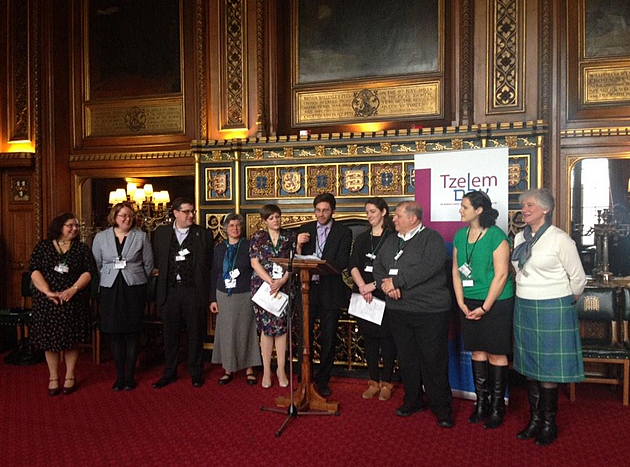
The Launch of Tzelem at the Speaker’s Rooms 28th January 2015

http://static.wixstatic.com/media/79c59a_82884f3f11aa41e2874a41b3d97566d5.png_srz_p_630_467_75_22_0.50_1.20_0.00_png_srz

In the beautiful and opulent surroundings of the State Rooms of the Speaker’s Apartment in Westminster over 60 Rabbis and Cantors from the different Jewish streams in the UK came together to launch a new organisation: Tzelem- the Rabbinic  Voice for Social and Economic Justice in the UK.

Founded on the Jewish principle that we are all created in the image of God (b’tzelem Elohim), Tzelem builds on the prophetic tradition of the Hebrew bible which speaks of the vital importance that social and economic justice is available for everyone.  Jewish tradition has long advocated the rights of the marginal and the powerless, and our teachings are rich in texts calling for us to take part in asserting those rights, and standing up in the face of the powerful in order to achieve them.

It is the purpose of Tzelem to continue this tradition by critiquing the issues at the root of our society that keep the vulnerable and powerless exposed and helpless.  We aim to take action in order to change the structures that maintain the marginality of the weakest in society, and to change the way they are viewed.

Four Rabbis spoke from their own close experience of mental illness, child poverty, homelessness and immigration. It was a sobering experience made even more poignant in the surroundings in which we heard it, to be told that one in four children in Britain do not have adequate nutrition. It was painful to hear stories of the rapidly downward cycle into homelessness that left people without hope for the future, or so ill after exposure to the elements that their whole self fragmented. It was moving to see a colleague speak of his own struggle with bipolar disorder and the depression that accompanied it made all the more difficult because of the fear of stigma, disapproval and rejection.

 Rabbis and Cantors, like other clergy, see every strata of society and this is one of our strengths and one of the reasons we must be a driving force in contributing to a fairer society. Our texts and tradition demands it of us, and so does the lived experience of our role. We see what is often hidden from other members of society – the desperation, the poverty, the lack of hope, the pain and the willingness to ignore the weak and vulnerable in the busyness of life. Tzelem has come like a ray of hope into the worlds of many colleagues. We have watched other faith traditions step forward and demand justice and economic security for all members of our society and we spoke out as individuals each in our own milieu, but the creation of this platform with rabbis and cantors from across the spectrum of observance has given us energy and hope that our voice will be amplified, that together the voice of Judaism and its demands for justice for all will be heard in all the corners of the United Kingdom.

At our launch we reminded ourselves of what our tradition demands of us, and we reminded ourselves of the poverty and the pain that exist within the communities in which we live. We cannot stand by while the pain of our fellow human beings calls out to be addressed and ameliorated. As Hillel wrote two thousand years ago “If I am not for myself, who will be for me? If I am only for myself then what am I? And if not now, when? (Avot 1:14)

For more on the texts of the launch and on Tzelem, see http://www.tzelem.uk/#!Launch-Resources/c14bu/7293522D-5710-49E6-BA0A-8E5986FA912A

Parashat Terumah: Building the space for a non incarnate God to not dwell – the elevation of giving

In parashat Terumah we are given the instructions for building a sacred place, and a very detailed directive it is. Almost an architect’s blueprint. It seems all the more strange that such a clear and comprehensive picture is drawn for the building in which a totally abstract and absolutely non incarnate God may (or may not) dwell.

The sacred place is described as “mishkan”, the place of dwelling, yet that is decidedly what it is not. It is, instead, a signal to remind the Israelites that God is among them – and God makes this clear in the instructions for the Children of Israel to build the sanctuary – “Make a mishkan so that I will dwell among them.”

The Torah makes clear that this mishkan is to be symbol and metaphor of the relationship between God and the people who are in covenant bond with God. It is to describe, in a variety of different ways, the relationship between them; it will even in some way create the relationship, it will certainly make clear some of the central requirements.

To begin with, God involves and obliges the whole people. “Daber el bnei Yisrael va’yikhu li trumah me’eyt kol ish asher yid’vennu libbo, tikhu li et trumati – Speak to the Israelite people and accept for Me gifts; you shall accept gifts for Me from every person whose heart so moves them” (Ex25:2) Because the mishkan is to serve the entire community, it must also be constructed through the involvement of the entire community. But this is not a tax on the people; instead Moses is to accept the free will offerings of the people. The Terumah is specifically something set aside by its owner and dedicated for sacred use.   In other words, the people must be in the habit of thinking of their property not as theirs alone, but as something over which they have current charge – much, I suppose, as we are encouraged to think of our children. The use of this property therefore is to do the best we can with it – it is only a loan to us, not our exclusive asset. For the people to give a portion of their property to a sacred purpose, willingly and with the intention of creating a better world, is an implicit assumption behind the building of the mishkan.

The word Terumah is an interesting one. Its root is from RAM – to lift up, to elevate. Presumably it derives from the physical act of lifting up that which is offered to God, but there are Chasidic teachings that the act of offering a gift to God elevates not so much the gift as the giver. We are told that those who collect for charitable purposes must ensure that they have pure intentions before they start, but those who give to charity don’t have to be so worthy – the act of giving purifies them ( (Levi Yitzchak of Berditchev/ Shalom of Kaminiki).

So the giving must be from everyone, it must be offered willingly with the understanding that God is the source of all, as part of the working construct that we must acknowledge God’s place in our world.

The mishkan is also the demonstrable proof that the agreement at Sinai is working. When Moses repeated to the Children of Israel all the commands of God and all the rules, at the theophany at Mt. Sinai, we are told that they replied “All that the Eternal has spoken, we will faithfully do” (Ex24:3,7etc) The phrase ‘na’aseh v’nishma’ – ‘we will do and we will understand’ – the literal response of the people, is borne out here in the building of a sacred space which is both the dwelling place and emphatically NOT the dwelling place of God. . In building the mishkan they will take the step into putting into material practise what has only now been a verbal agreement.   In building the mishkan they will learn much more about God.

When people built holy places in the ancient world, they were constructed to house the image of the deity to whom they were dedicated. This holy place was different, for there was to be no image at all. It is – if you will pardon the expression – a graphic representation of the non-representation of the Jewish God.

However there was something in the mishkan, and that something was the Ark, the first of the furniture of the mishkan to be described, and lovingly detailed. The Ark and its cover were explicated carefully, and the Torah instructed the people that the ‘Edut’ the witnessing, was to be placed in the Ark. Quite what was it that was to go into the Ark? Edut is an ancient word meaning covenant or treaty – and it seems that what went into the Ark was the physical container of that treaty – the tablets of the brit (covenant), the stones on which were written the ten commandments.

cherubimIn the ancient Near East, there would be boxes placed under the throne of the ruler, and in those boxes would be placed the laws of the land, and the treaties made with other peoples. In effect, the foundation of the throne of the monarch was a box which stored the laws.

The Ark contained the Edut, the treaty of the children of Israel with God. It is, in effect, the box at the base of the throne of the divine monarch. It would have been very clear to the people of the time that the presence of the Ark pointed up the absence of the throne above it – a clear symbol of the abstractness, yet absolute monarchy of God. Above the Ark was the kapporet, the cover made of a flat sheet of gold, from whose two ends rose two cherubim. God told Moses that he would meet Moses there “I will speak to you from above the kapporet, from between the two cherubim” (Ex 25:22). There is no description of the cherubim, though one can safely assume that they were not the chubby figures of gently winged angelic babies we see depicted in religious art. It may be that they are related in some way to the verb karov, to be near, the word which we use to denote the way of prayer (drawing near) implicit in the making of sacrifice. It may be that they are related to the Akkadian word ‘kuribu’ originally meaning ‘to pray’, but also used to describe creatures which were part human, part bird and part beast, and which would guard the entrance to pagan temples and petition the deities on behalf of the worshippers.

Whatever the cherubim were, they were clearly of significance, not the least being that they symbolised the difference of this understanding of God from any other – they could not petition a deity for there was none in the holy place to petition. Instead they highlighted the abstract nature of the Jewish God, the absence of a discernible throne, the absence of a depiction of the deity. The book of psalms (99:1) describes God as one who is yoshev ha kruvim – the one who rests upon the cherubim. The cherubim, like the Edut, represent the base of the throne of God – a throne which is not built, a throne which will remain empty.   When God speaks, it is from above the Ark, from between the cherubim, from a place outside of space.

When all the people willingly bring their offerings to create the place that represents an understanding of God they are still finding difficult (witness the golden calf episode that began this enterprise); when they elevate themselves by giving, when they demonstrate their understanding that God is the source of their wealth and their possessions, when they deliberately build a shrine that is to remain empty, a throne that does not exist, then God dwells among them. The building of the mishkan teaches us so much about Jewish values and Jewish community, and it points out to us the limit of our understanding of God.

Shekalim: The imperative to never diminish people by reducing them to numbers on a list

“The ETERNAL spoke to Moses, saying: ‘When you take the sum of the children of Israel, according to their number, then shall they give every man a ransom for his soul to God, when you number them; that there be no plague among them, when you numbers them. This they shall give, every one that passes among them that are numbered, half a shekel after the shekel of the sanctuary–the shekel is twenty gerahs–half a shekel for an offering to the ETERNAL. Every one that passes among them that are numbered, from twenty years old and upward, shall give the offering of the ETERNAL. The rich shall not give more, and the poor shall not give less, than the half shekel, when they give the offering of the ETERNAL, to make atonement for your souls. And you shall take the atonement money from the children of Israel, and shall appoint it for the service of the tent of meeting, that it may be a memorial for the children of Israel before the ETERNAL to make atonement for your souls.'(Ex 30 11-16)”

Shabbat Shekalim comes around the beginning of the new month of Adar, in order to give a good month’s notice of the beginning of the month of Nisan, the month in which Pesach falls at the full moon. It is also read at this time because, according to tradition, the census of which it speaks was taken on the first of Nisan, so the reading is also acting of a reminder of that census and its purpose. The passage reminds us of the census taken in the wilderness through the donation of a half shekel coin, given not apparently only for the purpose of counting people, but also as a kind of sacrifice to offer atonement for sin, and also to provide for the maintenance of the Tent of Meeting – the forerunner to Temple and Synagogue as the space which reminds the people that God is among them. On Shabbat Shekalim, we also read a haftarah portion from 2 Kings which also makes reference to the census money and the use of it for Temple maintenance.

It is a complex text raising a lot of questions. What is the atonement being offered? What plague is being avoided? What could possibly be the difficulty with a census, a direct count of the military age men? There seems to be an ancient taboo against counting people which operates still today. By tradition one never counts people – when checking that there are ten people for a minyan a verse from the psalms is read “Hoshia et amekha, u’varekh et nahalatekha, ur’em v’nas’em ad ha’olam” [Save Your nation and bless Your inheritance, tend to them and raise them up, forever – Psalm 28:9]. It has ten words, each used to check off the people until it is clear that there are ten or over.

So why don’t we count people? Rashi suggests that numbering people means we don’t see their full humanity, and in some way we diminish them. He brings to his argument the ancient text of the Hebrew bible translated by Onkelos into Aramaic – the word for census becomes ‘taking’ – in some way by numbering people we take from them something essential. So he tells us we should never do a head count, but instead take from each of them a token, and then count those tokens. If we do not, we risk a plague coming upon us, as happened when David conducted a census. The Talmud also asks and answers our question – but differently:

“Why are people not counted directly? … Rabbi Isaac says ‘It is forbidden to count Israel, even for the performance of a mitzvah.’ … “The Talmudic discussion focuses on the verse: “The number of B’nei Yisrael will be like the sands of the sea which cannot be measured or counted …” (Hosea 2:1). In other words it is a sort of denial of faith, that the promise given to Abraham that his descendants would be beyond counting would somehow be compromised by the act of counting.

I am not sure that either of these responses gives us the authoritative reason for why counting people is so viscerally wrong. But there is something very powerful in the refusal to see people in terms of numbers. And interesting too that in the act of finding out how many men of military age are available in the community – for that must be the primary purpose of this counting – other things are woven in. Each person who is eligible gives half a shekel, something we are reminded is based on a known weight of silver equal to twenty gerahs. So each person gives the equivalent of ten gerahs. This half shekel coin must have been one of the smallest – but possibly not THE smallest – coin, something that was within everyone’s reach to donate. But add to that is the instruction – both rich and poor will contribute the same amount, neither more nor less. This reminds us that both rich and poor are equally valued in the eyes of God. The contribution of each one is of equal importance. So in the act of assessing capacity for military strength, everyone is expected to give something, and relative wealth is made irrelevant – everyone contributes the same. The fact that it is coins and not people being counted for this is also a salutary lesson – on the one hand there is something that seems to be a little coldly dispassionate about counting the silver tokens rather than the human beings, but at the same time the humanity of the individuals is being preserved – only the contribution they give is being counted. And then the piece de resistance – the silver tokens that are given are to be used not for war, not in any way for aggrandizing the powerful or for claiming the territory of others – all the contributions are used to maintain the Tent of Meeting – in effect they are the synagogue subscriptions. It is no accident that many synagogues finish their financial years at this time – the Torah reading reminds everyone of the need to give, to contribute to the well-being of the community. Without such offerings no synagogue or Jewish institution would survive.

The passage we read as maftir for Shabbat Shekalim is a well known one with clear parallels in today’s practice. The need to be able to call together a force to defend the people and the land; the need for the humanity of that force to be defended too so that the soldiers do not lose their essential souls in the fighting they do is vital, and there is much to be said about how that particular lesson is not being applied well in the current situation in Israel – just look at the website of Breaking the Silence, the testimony of Israeli soldiers, to see how values and humanity can be eroded. The imperative to never diminish people by reducing them to numbers on a list is one to which our own recent history bears painful testimony. But something else struck me powerfully this year when reading the piece. The half-ness of the shekel and the fact that a half shekel is ten gerahs.

Why a half shekel? One response is that this is a coin within reach of everyone, something that is not too big a sacrifice to give but not so small as to be insignificant. That may well be true, there is no clear economic scale for us to check it against but it has a sort of inherent likelihood. But think a little more and other values emerge. A half shekel is not complete – it requires another half to complete it. What we are saying by giving this ‘half’ is that we are making a contribution, but on its own it is not powerful enough – we need to be part of a community in order to play out our values successfully.

To be part of a community, we have first to count ourselves, to give something that can itself be noted and counted. The half shekel that we give demonstrates that we need someone else in the community to fulfill us and make us whole, to partner us and complete us. Judaism teaches that life is not to be lived as an ascetic, removing ourselves from the pleasures of people – life is to be lived in community – so public prayer for example requires a minyan – hence the need to count the people to ensure ten are present. Community is an essential tool in tikkun olam, in repairing the world. It is certainly true that one person alone can make a difference, but working together with others creates a whole world of other possibilities. We all need other people to fulfill us and the offer of a half shekel not only allows ourselves into the community, it invites others to be our partner.

In honour of Tu b’Shevat: to whom does the land belong?

One day Chaim, a landowner, had to leave the town for a while, and he left his land in the care of Jacob. Jacob worked hard on the land, taking great care to weed it, fertilise it, dig it over; then he planted a crop, weeded and watered it, and the land gave bountifully in return. And so it went until Chaim returned, and reclaimed his land. “Thank you for all you have done” he said, “but now I have come back I wish to work this land, for it belongs to me”. But Jacob resisted. “No!” he said. “I have worked this land and made it even more fertile and good; this land now belongs to me, by virtue of my work to enhance it and make its soil rich and productive. You may be the legal owner on paper, but I am the owner in reality”. The two of them struggled and fought, shouted and argued, each of them claiming their ownership of the land. Eventually they were persuaded to go to the local Rabbi for arbitration of their dispute, and they agreed to abide by the decision of that Beit Din. So off they went, and each passionately put his case of ownership, by virtue of legal document or by virtue of practical working and protecting. The rabbi listened to both sides carefully, and declared “the question is a complex one, for each of you have made a good case as to why the land should belong to you, but there is a third party in this case who has not yet spoken. Come with me”. So Chaim and Jacob went with the rabbi out to the field in question, wondering who the third party to the dispute might be. And they were surprised when the rabbi bent down, ear to the earth, and silently appeared to be listening. “What are you doing? Where is the other person who has claim to this land?” each of them shouted, looking round and gesticulating furiously to defend their claim from the unknown plaintiff. After a moment the rabbi got up and brushing down his clothing he said. “Gentlemen, each of you say that the land belongs to you. Each of you has made the case for your ownership. But I have asked the third party to this dispute – I have asked the land to whom it belongs, and the land has told me that neither of you own this land. The land has told me that you belong to it.”  (Jewish folktale)

Parashat Shemot: naming the past honestly with all its inglorious realities

In his Chumash, Rabbi Dr Hertz comments on the story of the exodus of the Jewish slaves from Egypt, and, as part of his argument for the historical reality of such an experience says “What people would invent for itself so ignoble a past? A legend of such tenacity, representing the early fortunes of a people under so unfavourable an aspect, could not have arisen save as a reflection of real occurrences”.

His comment brings home to us the truth of the way we write history. Written most often by the winners, it us usually a tool for the glorification of our past. Rarely do we record the miserable realities of hardship or pain, the mundanity of grinding poverty, the banality of living simply to survive – instead we tend to cast a glowing light on our past, speak of the golden ages when everything was apparently so much better than it is now, ascribe attributes and events to show our antecedents fitting an image we feel they should have.

Only the Jews it seems, record our history in all its embarrassing baseness. We record the anger of God against us, as well as God’s redemption of our people. We record our lowly origins, our family breugess’, our bad behaviour as well as our good

.  Reading the Hebrew bible we find real people emerging from the narrative, people in bad moods, people who are afraid or selfish, who favour one child over another or who can’t quite let go of a bad habit. We meet character traits in our ancestors that we can recognise easily today, the challenges that face us now can be seen to have been faced before. We are unusual in that our stories about our past show the meanness, the sadness, the destitution, the low social status. Our history is too important to us to leave to the myth makers – we have to have it recorded as it was, and we have to repeat it year on year in public, reminding ourselves of the shortcomings in our less than glorious past.

It is because we have recognised the importance of our history, its centrality and its impact on our present that we have continued to be Jews. It is because we know and reprise our origins that we are able to develop our covenantal relationship with God. There are no secrets, no glosses, and no skeletons in the cupboard which might suddenly appear and throw us off balance. And with the stories of our past of slavery and poverty, of ancestral wrongs and religious dead ends, we tell the other stories too – of those who listened and heard the presence of God, of amazing selflessness, of faith and courage, of journeys into the unknown leading to blessing and covenant.

The word ‘Shemot’ means ‘names’. We will be reading the names of those who went down to Egypt with Jacob, in preparation for telling the stories of Exodus, the journey into the desert, the leap of faith into the future. Before we can go forward, we must root ourselves in our history, before reading of the exodus we remember how we got to where we are. Jewish tradition is very clear that our present is rooted in our past, and who we will be must emerge from who we have been.

Beginning to read the second book of Torah, with its sense of new beginnings, of God returning into history, of a great journey about to be made, we remember the weight of our history even as we start a new year in the secular calendar. We may be closing the door on another year, but all that has gone on in this last year should not be forgotten by us. We are the people who remember things as they really were, not as we should like them to have been. We are the people who are not afraid to write a history that does not glorify us, whose heroes have faults, whose stories expose problems. As the New Year promises a new future, remember to honour the past by remembering it as it really is.

Vayigash: making peace is a process with which we have to keep faith, however unlikely it may seem

Making peace between two hurt and damaged parties must be one of the hardest activities in the world. Often, simply the absence of war must be enough for us, something which may look like peace but which is a far more shallowly rooted plant than we would like to acknowledge.

Sidra Vayigash tells the story of the making of peace between brothers – not a new story in the book of Genesis, and when one looks closely not even a real and complete peace – but at least it is more than the simple absence of war.

The sidra opens with the encounter between the powerful Egyptianised Joseph and his distraught and powerless older brother Judah. Judah cannot bear having to return to his father to tell him that Benjamin, only remaining son of Rachel, is held hostage in Egypt. With an impassioned speech he offers himself as hostage instead. This has an unexpected result – the man before him cries loudly and reveals himself to be the long lost boy who had been so hated by his older brothers they had thrown him into a pit to die a slow and pitiless death, but who had been rescued from that fate and sold into slavery instead. Now he stands before them, the second most powerful man in Egypt, and he is weeping and embracing them and forgiving them and even suggesting that everything had been God’s plan – they bear no fault for what they did.

This is the third meeting of the brothers with Joseph, and one has to ask – what finally prompted him to reveal himself and to effect reconciliation with them? Up till now he had treated them quite cruelly – accusing them of being spies, demanding that Benjamin be brought to Egypt, framing Benjamin as a thief and in an act of summary justice ruling that Benjamin must remain in Egypt, leaving his father totally bereft.

What is the riddle enmeshed within the story for us to untangle here? Is it about revenge? About justice? About the ongoing quest for repentance and forgiveness? And if so, is there real repentance and can we say that there is real forgiveness?

The whole of the book of Genesis speaks of rivalry between siblings, of the terrible situations such jealousy can cause; about the ways that people can continue to live with a partial resolution, and about the quest for a real resolution.

Here in Vayigash comes the resolution par excellence – but even this is not some fairy tale ending, but a qualified and measured response which is part of a longer process.

Joseph meets his brothers three times before he reveals himself to them. Each time he ends in tears which he sheds privately. In the first encounter the brothers have come down to Egypt for food and Joseph is the man in charge of rationing. We are told “when Joseph saw his brothers he recognised them, but he acted like a stranger toward them and spoke harshly to them.” (Gen. 42:7). He accused them of being spies, confined them to jail for three days and then demands that they return to Canaan and bring back Benjamin to Egypt. He is completely unaware of them as human beings – they are objects for his anger and revenge, and tools for him to contact his full brother Benjamin – nothing more. He does not trust them, he does not care about them, he knows nothing much about them and doesn’t try to find out whether they feel bad about what happened to him, or whether they have felt remorse about what their father had suffered with Joseph’s loss.

When he meets them for a second time, Joseph is brought a step closer towards reconciliation. This time he asks some questions which bring him into a connection with his family – he asks about his father’s health. When he sees Benjamin he is overcome by emotion – but he takes care that no one shall see his tears and hurries out of the room to weep in private, then washes his face and returns composed. (Gen. 43:30). It is through Benjamin, his full brother, the one who had not conspired to murder him that Joseph begins to reconnect with his past. But he controls himself and his emotions enough to set a test – in effect he recreates the same scenario that had him sent into slavery as a young boy – he puts the older brothers in charge of the fate of the younger one, what they do will determine his life or death. So he puts his silver goblet in Benjamin’s sack, sends his steward to retrieve the men and discover the stolen goblet – and now how the brothers respond will be crucial – will they let Benjamin be taken into Egypt and lost to his father, or will they try to save him

And so to the third encounter – Judah, wholly repentant and distraught, pleads with Joseph on behalf of his father who has already lost a child dear to him. He offers himself in place of the boy – and Joseph sees that the brothers really have changed, they have made teshuvah and when given the opportunity to sin again they set themselves against it.   Joseph finally gives way to his feelings and sobs so loudly he can be heard all over the palace. He confronts these Canaanite strangers as brothers and forgives them. There is reconciliation and the book of Genesis is able finally to witness a sibling rivalry that is resolved, to show that with repentance comes forgiveness, and so it is possible to move on in one’s life into new and different places.

But there is more to this story than a happy ending – we know that life is no fairy tale, and neither is bible. The reconciliation between the boys is certainly more than we have ever seen before, but we should not forget that it took over 20 years to achieve, that during it there was much pain and anger, thoughts of revenge and retribution, a clear denial of what had gone on and long term suppression of guilt and responsibility. We know that Joseph did not contact his family – not even his father or his beloved younger brother – who lived with the knowledge that he had gone to his death in a horrible way, that there was no certainty however, no possibility of complete and completed mourning. We know too that Joseph had to struggle with his own feelings about his brothers. A gap of 20 years did not automatically resolve the pain and the animosity – just because time had passed it did not mean that time had healed, and anyway there had been such hostility between them for so long that even before they had placed him in a forsaken pit they were unable to even speak civilly with him.

Having forgiven them he set them up in Goshen, far away from the palace where he continued living. When their father lay dying they had to send for Joseph – evidently he was not a frequent and dutiful visitor to his resettled family, and he waited till his father lay dying before introducing his own two sons to him.

The narratives about rivalry between siblings, begun with the murderous anger of Cain against Abel, finally end here with the tears and embraces of Joseph and his bothers. There is forgiveness and some limit to the ongoing anguish, but all is not sweetness and light. It never is and we would find the bible unbelievable if, after all that had gone on, there would be no hint of the shadowlands of pain left as a result of those relationships over so many years. As Ishmael and Isaac could never fully reconcile, as Jacob and Esau were able to weep and kiss and then go their separate ways, so too there is a boundary to this rapprochement. What makes this story different is that it is enough – there is repentance, there is forgiveness, there is insight, there is an element of acknowledgement of wrongs on both sides.

Making peace is never easy, it doesn’t simply happen, it takes time and it takes insight and it takes some unqualified repentance and some unqualified forgiveness. There will be the urge to punish, to take vengeance, to hide one’s tears in private and present a tough and intractable face in public. There will be the urge to accuse the other of all sorts of crimes, to see them as less than valuable. All this is normal and natural and part of the process, but for peace to come about – even for this curious state of cold peace that we are so used to in our modern world – there has to be a willingness to keep faith with the process, to meet the other side again and again, to keep trying.

The person who broke the impasse between Joseph and his brothers was not Joseph, it was Judah, one of the brothers who had been central to the plot to destroy him years before. Judah, who is our named ancestor, from whom the word Jew is derived. It was Judah who put himself on the line for a more important principle, who offered himself as hostage if it would free Benjamin from slavery and return him safely to the old man who was their father. Judah was the one who took the risk, who took the initiative and approached the harshly judgmental and uncompromising Egyptian potentate if front of him. He is our ancestor and he is our role model. He shows us that even in the most unlikely of situations our insight and our willingness to act upon it, will save us. May we continue his work in our own generation, and help to bring about some form of peace in our own time.

Lech Lecha: We Journey Towards our Selves

Abram’s journey, the expedition which is also the start of the journey of the Jewish people to the land of Canaan, begins with the words “ Lech Lecha” , a strangely poetic and formulaic compound meaning something like ‘go for yourself’ or ‘go into yourself’, or even the rather enigmatic ‘go towards yourself’. Without any introduction God tells Abram to leave his parental home behind, to take his entire family and go to a foreign land he does not, and cannot, know.   Doing this will incur God’s blessing for Abram and his descendants.

   לֵךְ לךָ

The bible tells us tantalisingly little about what is being left behind. There is a little written about Abram’s father Terach, but nothing about his wife, or about Sarah’s parents. But even so, the wrench through which they are torn from their past is almost palpable. We can imagine the feelings of the travellers who may never again see their home and their families, and we can imagine too the desolate feelings of those loved ones who are left behind.

The blessing/promise that God gave to Abram and Sarai comes in four parts: Firstly God promised to make them a great nation. Then there was the offer of divine blessing. This is followed by the promise to make their name great, and finally the exhortation ‘Be a blessing’.

This four fold pledge to Abram and Sarai has been interpreted again and again, and the many and various commentators have each offered vastly differing ideas about what it all means – the only consistent factor is that each commentator expounds within his own particular historical reality so that midrashic commentators who lived in days of peace and prosperity for the Jews as much as for their neighbours could really believe that a great nation would mean they would have many children, that God’s blessing could only mean material prosperity, and a great name imply straightforward fame.

A commentator in medieval Russia or Poland though would not see the text in the same way, “A great nation must mean greatness of quality, not quantity” laments one rabbi who sees the toll that centuries of pogroms have taken on the Jewish population. Another bemoans the fact that for Jews the blessing of wealth is a temporary phenomenon, lasting at the most a generation or two.

The truth is, as we know, that every generation makes its own journey, and every generation has to contend with the situation it finds itself in. In every generation we act out the leaving, we find ourselves at the beginning of something new again, we relive the pain of the parting, the fear of the unknown, the response to a call of blessing or else the need to leave behind something that is no longer a tenable way of life for us. We did it, our parents did it, our grand parents did it – and theirs. And our children too will at some point undertake the journey – the Lech Lecha that is in our essential being.

The creature of popular imagination – the wandering Jew – begins with Abraham, who describes himself as an IVRI – one who has crossed over. Haran, the place where Abram and Sarai lived at the time we met them (they had, after all, travelled with Terach already from Ur of the Chaldees) means ‘crossroads’ – they are par excellence the people who move from one area to another, across boundaries, through the margins. Although promised the land of Canaan they remain essentially rootless for most of the stories, and by the time of Sarah’s death we still don’t have a clear picture of whether they had pitched their tent together and settled down. Only by the time of Abraham’s burial at the cave of Machpelah alongside his wife, do we get a sense that they have finally stopped all their restless travelling.

This continual movement, the habitual crossing of limits and of confines, is probably our greatest – although certainly our most uncomfortable – blessing.   Because we never get too settled we are able to retain a particularity, the clarity of perspective of the outsider, we are able to retain a sense of the ‘otherness’ of the ‘other. We are able to bring many strands and streams of culture and philosophy into how we view the world, how we operate in it., and we move between different worlds with great ease. It seems that the word ‘cosmopolitan’ has become almost a code word for ‘Jew’ in some quarters.

But there is a price to be paid for our being Ivri’im, and it can be a high one. Measured out in suspicion and mistrust, in persecution and even murder, we have many times paid a terrible cost. We know this, but it has never stopped us following the imperatives God gave to Abram – “Lech Lecha” – “Go to and for yourself”; “Hayei Bracha” – Be a blessing.

There is pain in leaving and there is pain in being left behind – and the pain is all the greater when the travelling doesn’t come from active and willing choice, but from the forces around us. In the last few years there have been published a plethora of books of personal stories from the years of the holocaust, an outpouring of memories that have been held and contained quietly within so many people, suppressed while they lived their active lives, attaining qualifications, working hard, marrying and bringing up children. Now is the time to tell the real stories of those Lech Lecha’s, and emerging from these stories is an echo of the pain and confusion of leaving the parental home with its security and its warmth and love. I never fail to be moved to tears when I read of the separation for ever of children and their parents, of partners and friends. This is part of our historical reality, but it is hard to find any sense of God within it.

But there is another part to the Lech Lecha of setting out on the journey, and that is that while bonds are inevitably broken and families ruptured beyond repair, the journey itself brings new experiences, often a broadening of horizons, and most importantly it seems to me that we recreate family and community alongside those with whom we journey.

I am the daughter of a German Jew who came to England as a young teenager alone, leaving parents and extended family behind. I grew up in a synagogue community made up predominantly of survivors, and I remember not only the pain in their eyes, but also the dedicated devotion to create a vibrant and warm synagogue community. I remember the Jews who gave up their time to teach me and the other children of the community bible and siddur, albeit with strongly German accented Hebrew and English. I remember the Jews who gave up their evenings to plan for Jewish festivals to be both educational and fun, the Jews who gave free rein on the bimah to the young teenagers on the community because they knew that everyone should be able to take a service – you never knew when you might find yourself in a place where there was no one able to lead it for you. Few of them had roots more than a few years old in the community, yet they made roots for themselves and for their families. They settled in the main, though their children have generally moved on again to larger cities. But they did indeed make, if not a great nation, then a wonderful Jewish community and a link in the chain of tradition. They may not have noticeably received a divine blessing, but they did make for themselves a good name, and they lived out the imperative to be a blessing. When I look back at the journeys of the generations immediately before mine, the perilous journeys from what seemed to be simply called “Russia” at the beginning of the last century, or the terrified fleeing of Europe in the early middle part of it, and I see the fruits of those journeys, I see that we continually travel towards ourselves, as well as for ourselves. This strangely poetic formula is the only one to do justice to the journey.riga old synagogue memorial (Picture of Synagogue Ruins Memorial in Riga )

Bereishit: two questions to two generations – where are we now?

The Torah begins with two separate stories of creation. The first one is a very structured and ordered story, with each stage (or day) developing order out of the tohu vavohu, the chaos of the beginning. God creates by speaking words which then bring forth the thing – light and dark, and day and night. The heavens and the earth, each surrounded by their own watery boundaries. Sea and dry land.  Grass, herb yielding seed and fruit trees. Sun moon and stars. Water living creatures and those that fly in the air. Cattle and land walking creatures. Human beings. And Finally – Shabbat. God declares the goodness of each category in this physical world being created, and with the creation of humankind God sees that everything created is very good. And God blesses the Sabbath day.    The second story is a different narrative, and can be read as either complementary to the first adding details, or else as an entirely different tradition. In this story, human beings are created first rather than last, and man is created before woman, instead of them being created together. We are told the story of the Garden of Eden, with its trees of knowledge of good and evil, and of eternal life. The human beings eat from the first tree and are expelled from the garden lest they eat of the second. Their relationship is clearly not ideal, yet they produce children. Cain and Abel each offer a sacrifice to God, but while the sacrifice of Abel is accepted, the sacrifice of Cain is not. Cain, rejected by God, kills Abel his brother.                                                                                                                                The generations continue. Agriculture and technology become part of their worlds. But by the time of Noah ten generations after Adam, the world is a terrible place and God  has had enough of this creation. God is ready to destroy it…

Dvar Torah

Vayikra Adonai Elohim el ha’adam vayomer lo “ayekah?”  And the Eternal God called to the human beings (hiding in the garden) “where are you?” And the human said: ‘I heard Your voice in the garden, and I was afraid, because I was naked; and I hid myself.’ (3:9-10)

Vayomer Adonai el Kayin, Ei Hevel achicha? Vayomer ‘lo yadati. Hashomer achi Anochi?’ And God said to Cain, where is Abel your brother? And he said “I don’t know. Am I my brother’s keeper?” (4:9)

Two questions that God puts to two generations in the beginning narratives of Genesis.  In the first the people respond in fear, having understood just how vulnerable they are. In the second Cain tries to brazen out the fact he has murdered his brother, hoping somehow to get away with it. The first is a sin against God, the second a sin against another human being. We are learning in these stories the limits of behaviour. But we learn something else that is quite startling. What becomes clear in God’s response to Adam and Eve is that while they have disappointed God by taking the fruit of the tree of knowledge of good and evil, worse is that they do not take responsibility for their actions – the man blames the woman and the woman blames the serpent. They want, they desire, and they will lie in order to try to fulfil that craving. When they are sent from the garden the woman is told (3:16) that her desire will rule over her (yimshol). Humankind will always be trying to master their own selfishness and wants, it will be an ongoing struggle. But Cain, he seems to struggle rather more than his parents, he responds out of disappointment and rejection when God does not accept his offering, but does accept that of his brother Abel – God says to him ‘Why are you angry? and why is your countenance fallen? If you do well, shall it not be lifted up? and if you do not well, sin couches at the door; and to you is its desire, but you may rule over it.’ Ve’ata timshol bo (4:7). Cain is given the possibility of triumphing over his selfishness – albeit he only takes it up after the awful event, when he repents and says that his punishment is more than he can bear.

The rabbis notice the difference in the taking on of responsibility. According to the midrash (Genesis Rabbah 22:13) Cain later meets Adam who asks him about the punishment he received, and Cain tells him “I repented and am reconciled”. At that point Adam began to weep and to keen, saying “so great is the power of repentance, and I did not know”.

The power of God’s words to Cain is proved – while we will always struggle with behaving well, while the willingness to behave selfishly and thoughtlessly is always close by and ready to come to the fore, we can indeed take responsibility for our behaviour and choose NOT to behave in a damaging and egotistical way. We can think of others, we can choose to forgo what we want for the benefit of our community or wider society, we can decide not to take, not to hurt, not to ignore.

So soon after the yamim noraim the lesson is driven home in torah. Repentance is always the path back to God, who waits for us patiently, hoping to be found. And Torah reminds us of our human frailty – that we might rather lie than take responsibility for our actions, that we may prefer to brazen out what we know to be unacceptable behaviour, or deny our accountability or liability – human beings will always try to find a way to get what we want or what we think we deserve. But it is the taking of responsibility, the true acceptance of what we do and the genuine desire to become better people that will help us to win the struggle so that we too will be able to overrule our baser natures and become a little more like the divine.

A prayer for the new year and for every day: “Teach us to assess and to appreciate every day of our lives”

In Psalm 90 there is a verse “Limnot yameinu, ken hoda, v’navi l’vav chochmah” – “teach us to assess our days so that we may bring to the heart some wisdom” As the High Holy Days draw to a close and the ideas for change we had then may begin to lose some impetus, this verse is a powerful reminder of what we can do in order to make more of our lives.

The psalmist is reminding us to assess each day, to really appreciate and to treasure every one of them, and make them count.

Many of us are so busy just getting through each day, so many different events and activities to juggle, that we forget just how much of a gift each new day really is. Others of us try to fill the acres of time that stretch ahead of us as we get up, wondering how best to get through the day. Almost all of us rarely find the time to treasure our days, or to make them count. Looking back at the end of a week that has been frantic with activity we can rarely feel satisfied that we used the time well.

The morning prayer that traditional Jews say upon waking, before even getting out of bed, is a prayer of thankfulness. “Modeh Ani lefanecha, melech chai v’kayam, she’he’chezarta bi nishmati b’chemlah, Rabbah Emunatecha.­­­­­

“I Gratefully Thank You, living and eternal Sovereign, for You have returned my soul within me with compassion –great is your faith”

While Jewish prayer does not on the whole expect us to explicitly state any belief in God, it does have a dominant mode of gratitude and of thanksgiving. The traditional prayer gives us the words to appreciate our lives, to be grateful for what we already have rather than to always be the petitioner for what we do not have but would like. That is not to say that our prayer does not include us appealing to God for things, but that this pleading is circumscribed and is far less frequent than the prayers of thanksgiving and gratitude. And on Shabbat the petitionary prayers disappear entirely, giving God (and ourselves) the day off from listening to our demands.

In the prayer Modeh Ani, we begin the day by being aware of our good fortune and appreciating it – we are alive, it is a time for fresh possibilities, anything can happen in this new day. And we end the prayer not by declaring our faith in God, but by asserting God’s faith in us. We make a statement of extraordinary power. Whether we believe in God is almost immaterial, for God believes in us.

Just as we rarely think about the air which we breathe, yet we breathe nevertheless; just as fish presumably are unaware of the water in which they swim, Jewish prayer assumes the faith of God in us is a given, the environment in which we operate. All we are reminded to do is to appreciate each day, to be grateful for what we do have, and to use our time wisely in order to become our best selves, to build our best world.

Psalm 90, a psalm about the eternity of God and the fragility and mortality of humankind, asks God to help us to do the one thing we can really do to make our lives meaningful – teach us to treasure each day, to make every day we live in this world count for something. As we go into the new year of 5775, with days that may be filled with activity or that may stretch emptily out ahead of us, let this be our motto – to think about and to treasure each day, and to do something each day to give that day meaning and to make it count.

101

Thoughts for Rosh Hashanah and the coming year: believing in the aspiration to goodness.

I was asked to write my thoughts in a booklet to be sent to the Movement for Reform Judaism’s constituent congregations on “What inspires you, how you will change and what you will change in the coming year?”  and I share my contribution here.

Rabbi Joseph, Morris2

Rabbi Morris Joseph is by way of a hero of mine. A man who had journeyed in his life from service as rabbi of orthodox communities, to the West London Synagogue, his published writings belie the fact that he was essentially a man of the 19th century and have much to say to us in the 21st. In his sermon on “Reform and Reformers” he challenges his listeners to think about why they are in a Reform community at all. Dealing with those who joined for the laxity of “Judaism lite” or who enjoyed the aspect of revolt against established authority he admits the difference between the ideal theology and its less than ideal practitioners. He says “If the religious tone of our congregation is unsatisfactory, it is simply because so large a number of our members do not realize the responsibilities which their membership imposes upon them. They either attach no meaning to Reform, or they attach a wrong meaning to it.”. He goes on to remind us that the relaxation of some laws is done to free us for the meaning behind the law: “..because we are less bound, ritually and ceremonially, than other Jews. We are more free in one sense ; shall we accept that freedom without giving something in return, or, worse still, make it a pretext for stealing a wider and far less desirable freedom ? Why has the yoke of the Ceremonial Law been lightened for us ? Surely in order to place us under the yoke of a higher law, to set our energies free for the truly religious life. If we do not believe this, then we degrade Reform to the level of mere convenience and selfishness. We make it a force acting not on the side of Religion, but against it.”

Morris Joseph believed in the progressive nature of Judaism. He thought that in order to
live, Judaism had to adapt itself to the shifting ideas of successive ages. But that did not mean that he did not also believe in the eternal nature of the Jewish message, and he preached wonderful sermons that set out a theology of high ideals and the importance of trying to live up to them. Ultimately, his measure of a person as not their theology, but the way they lived their lives. The point of Reform Judaism was to free our energies not to focus on the finest ritual details but to become the best, most honourable person we could become. His hope was that all who joined his synagogue would do so under “a strong and solemn sense of ethical and religious responsibility”.

Growing up in the Bradford Synagogue, one of the earliest Reform Communities in the country after West London and Manchester, the influence of Morris Joseph could still be felt. His call not for Judaism lite but for an ethical Judaism connected to its history and covenant with God still echoed within that beautiful building. The Jewish world has altered unimaginably since his death in 1930, and the wartime influx of German Jews to Britain changed and energised Reform synagogues in this country. The establishment of the State of Israel has also impacted on what it means to be Jewish. Yet his words continue to inspire me – his belief in the goodness of humanity, in the striving to be a better person expressed as our religious obligation, in his love of prayer and liturgy and his writing of new prayers for his community.

So what will be my change in the coming year? After more than eleven years successfully pioneering a job sharing model with Rabbi Sybil Sheridan, her retirement means it is time for me also to move on. At the time of writing I do not know what this will mean, but I shall be accompanied as always by the words and the teaching of Morris Joseph who believed in religion, in humanity, in community, in the Jewish people and in the aspiration to goodness.

What about myself will I change? I will once again search my heart and mind in order to identify how I can work this year towards becoming my best self, even though I know that this endeavour will never be fully achieved – and I will neither give up nor despair because I know this. And I will aspire to his ideal of becoming one of “those who have helped to form anew the moral life of Israel and to vitalize it afresh as a world-wide force.”