Shofetim : justice is human as well as divine.

There is so much in this sidra but the overwhelming impulse is to pursue justice – Tzedek. And one phrase stands out for me – “you shall come to the priests and to the Judge that shall be at that time and you shall enquire; and they shall declare to you the sentence of judgement….According to the law which they will teach you, and according to the judgement which they will tell you, you shall do and you shall not turn aside from the sentence which they tell you, to the right or to the left.” (Deut. 17:9-11)

This verse becomes the mandate for Rabbinic Judaism – and one might even say for the evolving and progressing Judaism of which our synagogue is a part. The law is decided not for all time, but by the judge who lives at that time; Torah it is not to be fossilised or protected from modernity or the zeitgeist – it is part of the same process that people are, learning as we add to knowledge, changing as we find new ways to express ourselves. Indeed, so powerful is this text that Rashi (11th Century) builds on the phrase about not deviating from the decision making of the contemporaneous judge either to the right or the left, to bolster the power of the rabbis by saying “even if they declare the left is right and right is left, you follow their judgment”, basing himself on a much earlier midrash [Sifre (2nd Century)].

The requirement to pursue Justice – “Tzedek Tzedek tirdof” – and the importance of Torah being mediated through modern understandings of the world, is an extraordinarily powerful combination. Our understanding of what Justice means has grown and changed as we see how the world is connected and as we appreciate the shared humanity of all peoples and realise that our responsibilities continue outside our own immediate circle and networks, to all human beings.  We have both the principles of k’vod haBrit – Respect for different Jewish points of views and for different levels of Jewish knowledge and activity, and k’vod haBriyot – Respect for all that is created. Both in the Particular world of Jews and in the Universal world of creation, the idea of honouring God through the action of Tzedek – right behaviour – is part of Jewish teaching.

How do we honour both brit and briyot? Both the Jewish world and the larger world in which we live? We do so with the pursuit of justice, and we understand that justice must be brought about and administered in both the worlds in which we live. We can no longer view the world through the eyes of cloistered community; we have a modern understanding and appreciation of how completely we are part of the wider community. How we behave as Jews, be it individually, as a community, or indeed as Israel, must be shaped and filtered through both the imperative to justice and the understanding of modernity. We must read our texts mediated not only through the commentators of old, but also with the eyes of our own contemporaries.

The Midrash Tanhuma proclaims that “every judge who adjudicates according to the quintessential truth is regarded by Scripture as though they were a partner with God in creation.”  So searching out and supporting Justice brings us as close to the divine as we can get.

 The famous phrase ‘Tzedek Tzedek tirdof” “Justice Justice you shall pursue” continues “so that you will live, and inherit the land which the Eternal your God is giving to you (Deut. 16:20) and this is telling. Justice is the thing that brings us as close to God as we can be, the Land of Israel is seen in tradition as being a land which has the eye of God upon it. If Justice is not done in Israel, we will not deserve to live within it – indeed Jacob ben Asher [writing in the halachic code the Tur (c 13th century)], comments on the Talmudic statement that “The only reason Jerusalem was destroyed was because the sages based their decisions on the strict requirements of the law, without going beyond it” (Baba Metzia 30b) by extending it and saying “The only reason that Jerusalem was destroyed and Israel was exiled was because they abolished justice”.

 To simply apply law mechanically and strictly, without thought of context or complexity, is, in the eyes of the Tur, to abolish Justice.

 As we look around in our worlds, shaken by uprisings and riots, by demands and terror, let us take a deep breath and remember that mechanistic responses – even if written in our holy texts – may not be the answer, and we have also to apply the human responses of our own time.

Glorious summer – time to think of my soul as life begins over again

Summertime is always a quiet time in the life of a synagogue.  The families with children are away on holiday, the classes and courses stop for the duration, the long evenings and good weather tempt people to venture further away from home, and an atmosphere of indolence and tranquillity reigns. Well, almost.  Because while there may be fewer people around and routine committee meetings and classes take a break, the summer is in fact a time of frenetic activity.  It is just that the activity is ‘behind the scenes’ that it can go unnoticed.

There are a variety of levels of summertime behaviours in the Jewish world.  There is of course all the hard work that goes into making sure that the Autumn festivals – what one colleague calls the “Autumn manoeuvres” go well.  The choir and musicians rehearse their set pieces till souls soar on hearing them.  The administration sends out numerous letters and tickets, the wardens plan mitzvot and page numbers, the security people organise rotas, parents organise children’s services and activities, crèches and rooms, the Chair considers charities and writes the Kol Nidrei appeal, the Rabbis plan sermons and readings…. A beehive would look like a slothful place in comparison to the work that goes on behind the scenes planning for these special days.  And whatever date the services fall upon, they still seem to take us by surprise – have we notified the schools that our children wont be in? Have we invited people to break the fast with us? Is our sukkah still in working order or was last year’s rickety effort the final time it could be constructed? The list seems to grow longer the harder we work….

But there is other work to be done in preparation for these awesome days, and the work needs to also be planned and executed in these lovely summer days – that is the work of the soul, the taking stock of our lives and our selves in the bright yet warm light of God’s overseeing judgement. 

Many years ago I took a December holiday in the Southern hemisphere. Sitting on a beach and watching the people frolicking in the water, my mind kept wandering to phrases from the Machzor for the Yamim Noraim – the high holy day prayer book. Whole chunks of liturgy inserted themselves into my head, the Avinu Malkenu which begs God not to let us go empty handed, the Vidui – confessional prayers. The rather ominous image of the Master of the House who was waiting….  It was all so incongruous and rather disturbing.  Here I was some three months after the introspective fest, had celebrated Sukkot and danced at Simchat Torah – yet the powerful awareness of the days of Awe was pulling at me again.  And suddenly it clicked – it wasn’t that I was spiritually out of synch. but that I was temporally so – the change in hemisphere brought about a lurch in the seasons, and my whole body was geared to summer time means preparation, introspection, consideration of my life.  It was then that I realised just how much we are attuned to the cycle of nature in order to be attuned to our festivals.  Spring time means crocus, daffodils and matza. Dark evenings mean chanukiot and doughnuts. Summer time is the time to begin the work so that when we arrive at Rosh Hashanah and Yom Kippur are already engaged in the process that those festivals will clarify and enable.  Rosh Hashanah and Yom Kippur often surprise us simply because we haven’t begun the work early enough.  Then suddenly it is time to stop and think, and there is too much to do, too little time.

F Scott Fitzgerald wrote in the Great Gatsby “And so with the sunshine and the great bursts of leaves growing on the trees, just as things grow in fast movies, I had that familiar conviction that life was beginning over again with the summer.”  

So this summer, while the weather is glorious and the temptation is to slow down and relax a little, do just that, but remember too that this is the signal to begin the preparation if you are to get the most out of the solemn period that constitutes the yamim noraim, the days of awe and repentance.

Ekev: walking on the heels of God

Ekev- The name of the sidra, is a conundrum. The root meaning of the word is the curve of the heel, and of course the resonance of the word is always Jacob – Ya’akov, so called because he was holding onto the heel of his twin brother Esau at birth.

Usually we translate the word here as ‘because’ or ‘if’.’ so we would simply read the verse that begins this sidra (Deuteronomy 7:12) as And it shall come to pass, because / if you listen to these ordinances, and keep, and do them, the Eternal your God shall keep with you the covenant and the mercy which God swore to your ancestors”, but we could also read it as “following on the heel of listening to these ordinances, your keeping and doing them means the Eternal your God shall keep….”  in other words there is an almost physical and intimate causal relationship, we can see the footprints of where we have walked with God.  There is a clear record of where we have wandered.

This way of reading the verse always makes me think of the footsteps we are said to have left on the surface of the moon, a continuing reminder of our existence and our desire to go further, learn more, dominate our environment. They stay there as a symbol both of our extraordinary ability and our extraordinary carelessness.

The famous medieval commentator Rashi makes an interesting point in his understanding of the word and its context. Unusually for such a grammarian he makes a sermonic point – while also seeing the word ‘ekev’ as connected to the heel of a foot he does not assume it to be about following on the heels of the action, but reads it as “if you will keep the statutes that you view as unimportant, the ones you would ordinarily walk over as if they are not there, then the Eternal your God will keep the covenant …”  

There is an ongoing theme in Torah: God commands us to behave in a whole lot of ways that we don’t find easy to do, caring for the poor, limiting our own greed and desires, remembering our fragility and mortality and the limits to our own ability, working together to create a just and compassionate community. We know ourselves to be commanded and we want to be like this, but we are always straying, always forgetting what is actually important and of lasting worth to give value to that which is transient and unimportant. And regularly our behaviour causes us to be estranged from God, symbolised here in the fact that the rain will no longer be a gift from heaven to the earth, that we will find ourselves on a dried up and unforgiving land, we will be forcibly reminded about what is truly meaningful.  

Rashi suggests that what is really important here is what seems at first glance to be unimportant, that it is all the small mitzvot that we must keep, the ordinary, the mundane, the unglamorous everyday acts of valuing others that we often manage to ignore. And I must say I like the idea that the saving of the world is dependent on the many small acts of kindness that we can do in a day if we choose to do so. But I am also aware of this word “Ekev” and of its associate “Yaakov “ and I remember that we are the particular children of Jacob/Ya’akov and of his better, straightened out self, Israel.

The footsteps we leave in our world as a result of the things we do and the places we venture remain for a long time, and their consequences may impact for generations. We are the Children of Jacob, whose limping gait after meeting the Angel on his way back home after living with Laban, left distinctive footprints;  And we try to be the children of Israel, straightened out at the Ford of Jabok through his wrestling with the Angel God, and whose walk was never the same.

We should be aware of where we walk, and with whom we are walking. We need to observe what we trample unthinkingly underfoot, notice the distinctive mark that our living here makes on the world. If we lived with such an awareness of the small and apparently unimportant acts that would change our world, and if we thought about the footprints we leave behind us, maybe we would be more thoughtful about how we walk through our world.


“What a rabbi said to the politicians” or “Good Governance and Community leadership: texts for reflection for the Council of the London Borough of Merton”

 I was honoured recently to be asked to open the prayers for the first meeting of Council of the London Borough of Merton. The new Mayor Krystal Miller has decided to invite members of the different faith communities to take this role in her mayoral year, and I was excited and happy to be the first to wear the new interfaith insignia for this event.

I chose not to simply say a prayer, or to invoke a divine blessing, but to offer some texts on governance and community for the councillors to reflect upon, and here they are:

“In the Mishnah, the earliest attempt to codify Jewish law, we have a tractate called Pirkei Avot, meaning something like, the “Chapters of Fundamental Principles”, which contains material dating from around 200 BCE till 200 CE and concerns itself with ethical ideology. Traditionally we study it from Pesach (commemorating the Exodus from slavery) till either Shavuot (Festival of Revelation of Torah) or until Rosh Hashanah, (The Day of Judgment and the New Year)

The book is a kind of manual of good practise in both interpersonal relationships and governance, and I would like to share some of its insights:

Based on a verse in  Jeremiah, (29v7) written in the 6th century BCE:

ז  וְדִרְשוּ אֶת־שְׁלוֹם הָעיר אֲשֶׁר הִגְלֵיתִי אֶתְכֶם שָׁמָּה וְהִתְפַּלְלוּ בַֽעֲדָהּ אֶל־יְהֹוָה כִּי בִשְׁלוֹמָהּ יִֽהְיה לָכֶם שָׁלֽוֹם:

7 And seek the peace of the city where I have caused you to live (be carried away captive,) and pray to the Eternal for it; for in the peace of that city shall you have peace.

The Mishnah tells us “Rabbi Chanina taught: “Pray for the welfare of the government, for without fear of governmental authorities people would swallow each other alive” (Pirkei Avot 3:2).

ב רַבִּי חֲנִינָא סְגַן הַכֹּהֲנִים אוֹמֵר, הֱוֵי מִתְפַּלֵּל בִּשְׁלוֹמָהּ שֶׁל מַלְכוּת, שֶׁאִלְמָלֵא מוֹרָאָהּ, אִישׁ אֶת רֵעֵהוּ חַיִּים בָּלָעוּ.

So for more than two and a half thousand years, Jews have had the tradition of praying for the welfare of the monarch and government of the countries in which they lived, well aware that without good government, anarchy and danger will prevail : “without good governmental authorities, people would swallow each other alive”

As well as the importance of good governance, these sages also knew about the importance of community: (2:5)

הִלֵּל אוֹמֵר, אַל תִּפְרוֹשׁ מִן הַצִּבּוּר, וְאַל תַּאֲמֵן בְּעַצְמָךְ עַד יוֹם מוֹתָךְ, וְאַל תָּדִין אֶת חֲבֵרָךְ עַד שֶׁתַּגִּיעַ לִמְקוֹמוֹ,

Hillel said, do not separate yourself  from the community, do not trust yourself until the day you die, do not judge your friend until you reach his place…

And Hillel’s contemporary Shammai taught (1:15)

טו שַׁמַּאי אוֹמֵר, עֲשֵׂה תוֹרָתְךָ קֶבַע. אֱמוֹר מְעַט וַעֲשֵׂה הַרְבֵּה, וֶהֱוֵי מְקַבֵּל אֶת כָּל הָאָדָם בְּסֵבֶר פָּנִים יָפוֹת:

“Shammai said, make your Torah study fixed, say little and do much, and receive everyone with a cheerful countenance.”

Hillel also taught about the importance that each individual take responsibility for themselves, but also that we take responsibility for each other, and that this is an imperative: (1:14)

יד הוּא הָיָה אוֹמֵר, אִם אֵין אֲנִי לִי, מִי לִי. וּכְשֶׁאֲנִי לְעַצְמִי, מָה אֲנִי. וְאִם לֹא עַכְשָׁיו, אֵימָתָי:

1:14 “If I am not for myself, who will be for me? And, if I am for myself only, then what am I? And, if not now, when?”

Hillel, was active between 30 BCE and around 10 CE. His formulation of the golden rule “What is hateful to you, do not to your fellow: this is the whole Law; the rest is mere commentary” (Shab. 31a)” is a masterful one. If we all behaved in a way we would like others to behave to us, life would be far more pleasant.

Another sage, ben Azzai formulated it slightly differently, with a reminder of the importance of each human being:

ג הוּא הָיָה אוֹמֵר, אַל תְּהִי בָז לְכָל אָדָם, וְאַל תְּהִי מַפְלִיג לְכָל דָּבָר, שֶׁאֵין לְךָ אָדָם שֶׁאֵין לוֹ שָׁעָה וְאֵין לְךָ דָבָר שֶׁאֵין לוֹ מָקוֹם:

4:3. “He (the son of Azzai) used to say, do not be disrespectful of any person and do not be dismissive of any thing, for there is no person who does not have their hour, and there is no thing that does not have its place.”

I would like to end this study with the teaching of Rabbi Tarfon: (2:16)

טז הוּא הָיָה אוֹמֵר, לֹא עָלֶיךָ הַמְּלָאכָה לִגְמוֹר, וְלֹא אַתָּה בֶן חוֹרִין לִבָּטֵל מִמֶּנָּה.

Rabbi Tarfon (70CE) taught: “It is not your responsibility to finish the work [of perfecting the world], but you are not free to desist from it either” (2:16).

So what do we learn from this two thousand year old collection that is helpful for us today? Well firstly that there is, as Kohelet says

 מַה־שֶּֽׁהָיָה הוּא שֶׁיִּֽהְיֶה וּמַה־שֶּׁנַּֽעֲשָׂה הוּא שֶׁיֵּֽעָשֶׂה וְאֵין כָּל־חָדָשׁ תַּחַת הַשָּֽׁמֶשׁ:  יֵשׁ דָּבָר שֶׁיֹּאמַר רְאֵה־זֶה חָדָשׁ הוּא כְּבָר הָיָה לְעֹֽלָמִים אֲשֶׁר הָיָה מִלְּפָנֵֽנוּ:  אֵין זִכְרוֹן לָרִֽאשֹׁנִים וְגַם לָֽאַֽחֲרֹנִים שֶׁיִּֽהְיוּ לֹֽא־יִֽהְיֶה לָהֶם זִכָּרוֹן עִם שֶׁיִּֽהְיוּ לָֽאַֽחֲרֹנָֽה:

 That which has been is that which shall be, and that which has been done is that which shall be done; and there is nothing new under the sun.  Is there a thing whereof it is said: ‘See, this is new’?–it has been already, in the ages which were before us. There is no remembrance of them of former times; neither shall there be any remembrance of them of latter times that are to come, among those that shall come after.

And secondly that for people to live well and peacefully and gain in prosperity and feel secure, they need both good governance that wields its power well, and they need good community, where people take responsibility for themselves and for each other.

This is my prayer for this Council, as it deliberates and balances different goods on behalf of the people of Merton. This council will have to make difficult decisions, to stretch its resources to the limit, to find a way to serve its different communities who will have competing needs and desires.  I pray that at all times you remember the importance of respect for all people, remembering that there is no person who does not have their hour. I pray that you never set yourselves apart from the community, that you never stop questioning yourselves, that you never feel distant from the real lived experience of your constituents. I pray that your governance brings security and settled peace to all who live in your boundaries. I hope you keep before you always the need to say little but to do much, and always to meet each other with a friendly face.

Every Saturday morning Jews pray for the welfare of the Government with the words V’chol mi she’oskin b’tzorcehy tzibbur be’emunah,  Hakadosh baruch hu yeshalem sechoram,  V’yishlach beracha v’hatzlacha bechol ma’asey y’deyhem

“All those who are occupied faithfully with the needs of the community may the Almighty pay their reward. May God send blessing prosperity and success in all the deeds of their hands. And let us say Amen”

From MiDBaR to DVRim – the life learning of Moses in Devarim

When Moses first encountered God at the burning bush he told God ‘lo Ish Devarim anochi’ – I am not a man of words (Ex 4:10).  Yet here we are towards the end of Moses’ life with a book that begins ‘eleh hadevarim asher dibber Moshe el kol Yisrael – these are the words which Moses spoke to all Israel.’ 

What has happened to turn this man who had no confidence in his ability to speak, into one of the greatest orators?  What processes did he pass through to become a man of words?

            The word Devarim comes from a root dalet, bet, resh – davar.  So, curiously, does the word which names the previous book – Bemidbar, in the desert.  There is a connection between the word we use for ‘words’ and the word we use for ‘wilderness’ – both emanate from the same Hebrew root ‘davar’, a root which implies substance and meaning.  Bemidbar is a book about growth and chaos – it is in the wilderness, the midbar, that the Israelites rebel, that they challenge Moses and even God’s authority.  It is in the wilderness that Moses negotiates and manipulates, that he demonstrates enormous fluctuations of confidence and despair, of temper and temperament.  Moses is a tortured soul, alone and frightened, filled with anger and with insecurity, with self doubt and with some arrogance.  And it is this mixture of fury and passion, of neurosis and obsession, which eventually cause him to lose everything he holds dear.  Moses’ words in the wilderness alternate between despair and compassion, between fixation and thoughtfulness, between a hope for the future and a concern for the meaning of that future.

            By the time we come to the book of Devarim however, Moses has worked through much of his pain and has undergone a radical transformation. The Moses we see in Devarim understands that his days are numbered, and the self pity of the earlier years has given way to self awareness. As he coaches and cajoles and chastises his people, he realises that every moment and every word counts.  He has moved through the ordinary and everyday relationship of interaction and transaction and is more comfortable within his skin, and so more able to make the connections that enrich and affirm his life. In Devarim he teaches us about relationship with each other and with God that is far removed from the self based needs experienced so far.

            This week, as every year when reading Devarim, we are in the week commemorating the events of Tisha b’Av, the blackest and bleakest day of the calendar. We remember disaster and calamity in great measure, including the destruction of both Jerusalem Temples. Traditionally a day of mourning and fasting, the mourning of the Jewish world has been growing for three weeks, gaining in intensity since the 17th Tammuz and its fast. 

            The tradition of mourning attached to the calendar at this period, is one that we Reform Jews have ambivalence about, but there is still a lot we can learn from it.  The laws of mourning were instituted to help us get through the tragic and difficult experiences in our lives.  But they were also established so as to help us find the opportunity to re-examine our lives and create the time and the focus to enable us to transform everyday existence and see our lives in the perspective of relationship with God.  The mourning period is the equivalent of the Bemidbar, the wilderness and chaos through which we grow and transform ourselves from self-centredness to self-awareness.    

The period of Jewish mourning is a time when the mourner isolates themselves from society and from the clamour of the world.  It provides a time for introspection and evaluation.  By tradition much of the material and trivial pre-occupations – haircuts, new clothing, physical appearance etc are sloughed off during mourning, as are the anxieties about how we are doing in the world in terms of wealth or success, reputation or achievement.  Suddenly we are faced with an awareness of what really matters in life, and given the time to consider ourselves and our activities.  There is a tradition in some parts of the Jewish world to demonstrate our lack of interest in the external and material appearances of things by covering the mirrors, a tradition I have always found folkloristic and uncomfortable, but there is a genuine message within it – that to really experience ourselves at this time we don’t look outwards but inwards, don’t use the silver glass of a mirror but the instead look into the mirrors of our own souls.

            There is a real connection between Devarim and the mourning period that is Tisha b’Av.  We begin reading a book where Moses has taken the davar that is within the midbar and transformed it into Devarim – he has taken the chaos and anxiety and self doubt within the wilderness and transformed the self same substance into matters of weight and meaning and of importance.   Here just before the black fast of the ninth day of Av we are taking the mourning and the introspection and transforming ourselves and our lives through what we find.  It is no coincidence that next week we will begin on the haftarot of consolation which are prescribed for reading immediately after Tisha b’Av and which will lead us liturgically on to Rosh Hashanah, the time for self examination and the trigger once again for renewal and redemption.  Just as Moses was able to leave the midbar and form the Devarim, so we too should be able to travel through our own midbar, and to understand our own role in life and grow in the depth of our humanity.

            Some of us never quite leave the midbar, for it can trap us into staying there, never emerging into the Devarim, the ability to see our lives more clearly, to experience the connection with God and each other as it truly is.  Most of us fluctuate most of the time between the two realms of the everyday transaction and the life-changing connection.  We shift between the higher and lower domains of consciousness and connection, intermittently aware that there are no wasted words, that all davar can become Devarim.

            During this week the calendar commemorates a terrible series of catastrophes by creating a period of mourning.  Whatever our theology or our political orientation, it provides us with the space for reflection, for the sense of our being in the chaos and loneliness of wilderness, and gives  us a time to become conscious of ourselves, our lives, our pain.  It is an opportunity for us to begin the process of radically transforming ourselves as we begin the run-up to Rosh Hashanah.  It gives us the opportunity to make connections and to see words differently, so as to experience the holiness that is all around us.. 


Leading up to Tisha b’Av, the choices we make

women against women

Today is Rosh Chodesh Av, the month we will see the commemoration of the destruction of both Temples in Jerusalem, which we will remember on Tisha b’Av, the culmination of a three week period of mourning, which began with the Fast of the 17th Tammuz, commemorating the first breach in the walls of Jerusalem which led to the destruction of the First Temple.  

In the Mishnah (Ta’anit 4:6) we read that “Five things happened to our ancestors on the 17th Tammuz, and five on the 9th Av (Tisha B’Av). On the 17th of Tammuz the tablets [containing the Ten Commandments] were broken; the daily sacrifice was discontinued; the walls of Jerusalem were breached; Apustamus, a Greek officer, burned a Torah scroll; and an idol was erected in the sanctuary of the Temple. On the Ninth of Av it was decreed that the generation of the desert would not enter the Land of Israel; the first temple was destroyed; the second temple was destroyed; Betar, (the last Jewish stronghold after the destruction of Jerusalem), was conquered; and Jerusalem was ploughed under. When the month of Av enters we diminish our joy.”

It is quite a list. The tradition is to cluster bad things together on one date, rather than to spread the pain of Jewish history throughout the year, colouring all our days with mourning. So there are texts that tell us that on Tisha B’Av the First Crusade began, Ferdinand and Isabella expelled the Jews from Spain, and to bring us more up to date the First World War broke out on Tisha b’Av. There is a good case for observing Yom HaShoah on this date in years to come, adding the cataclysm of our times to the tragedies of our ancestors.  Others would like to explicitly add Kristallnacht, which took place on the 9th of November, the ninth day of the eleventh month, a sort of secular resonance with the 9th day of Av.

We need a day to focus on our mourning, a day for remembering the violence and pain of our history. And one day each year is really enough, it contains what would otherwise be uncontainable and which could overlay our national narrative and suffocate us with grief. As a Reform Jew for whom the traditional yearning for the return of the Temple with its associated priestly and sacrificial system of worship is problematic, I find the best way to deal with Tisha b’Av is to place it in the context of the three weeks of increasing sadness known as “bein ha-metzarim” – being within a narrow and constrained place, and then to reflect on our history, remember, acknowledge, and move on. It is no surprise to me that the 7 weeks of haftarah readings from Tisha b’Av towards Rosh Hashanah are all about hope, about return to God, about opening out to possibility and the future – we move from between the straits (bein ha-metzarim) into the wide open space of freedom to think, feel, remember and explore . Then comes Rosh Hashanah, time to make a new start, a new promise to our best selves, a new commitment to the future.

The Talmud asks the question: “Why was the First Temple destroyed?” and it answers itself thus: “Because of three things that occurred in it: Idolatry, immorality, and bloodshed…” But then it goes on to develop its thought -“the Second Temple, where they occupied themselves with Torah, Commandments and acts of kindness, why was it destroyed? Because there was a prevailing practice of baseless hatred (sinat chinam). This teaches that baseless hatred is equated with three sins: idolatry, immorality and bloodshed.” (Yoma 9b)

Sinat Chinam is equivalent to three huge sins together. It caused the destruction of the Temple and the expulsion of the Jewish people from their land for almost two thousand years. So what do we do about the hating without cause, the prejudging of others, the gratuitous dislike of the other.

This is not necessarily an overpowering feeling that we are in thrall to, a visceral and ancient reflexive response that we can do nothing about. The responsa indicate that sinat chinam can be about simple ignoring of the humanity of the other, about not bothering to talk to them, to meet with them, to find out about them. Through sinat chinam we diminish the goodness in the world, as we refuse to recognise the goodness in each human person, to see them as valuable and possessing intrinsic worth. We have just over eight weeks now to reflect on how we treat others, both those we know and those we share our living spaces with – be it on the daily crowded train commute or the queue at the till, the person at the other end of the telephone or member of our own circle.

Today is Rosh Chodesh Av, and in Jerusalem this morning right on the site of the Temple precinct we have truly seen a demonstration of “sinat chinam” leading literally to “bein ha-metzarim.” Women of the Wall, a group who come together to pray together each Rosh Chodesh at the Western Wall that retains the Temple Mount, have once again found themselves the target of those who try to prevent them praying in tallit, speaking and singing their prayers out loud, and reading the Torah scroll in their service.  Ultra Orthodox girls were bussed in to the area on the orders of their rabbis in order to crowd out other women who come to pray there. These girls were used as bodies in order to create a physical shortage of space, bein ha-metzarim. They were not primarily coming to pray, though some of them may well have done so, they were coming primarily to deny others their chosen prayer. Early photos and video show some faces contorted with hatred and anger, some comments on the Facebook page are vitriolic, for me the saddest photo is of an older woman, all her hair modestly covered in a blue scarf, blowing a whistle while staring balefully at the Women of the Wall in order to disrupt their prayers.  

We have seven weeks after Tisha b’Av to try to notice the humanity of each person we meet, and so to think about how we behave towards them. This is good work of teshuvah, for in meeting the other and recognising the spark of God within them, we become ready to face the spark of God within ourselves, the voice that reminds us that on Rosh Hashanah and Yom Kippur we will stand in the presence of the heavenly court as we judge our lives so far, and the perspective of that court will be mediated with our own attempts to be the best person we can really be.


mattot massei – a modern take on the cities of refuge

first written 2009.

ImageStaring out of the window in the media-briefing centre in Sderot, looking at a huge and ugly concrete wall right outside, I read the word ‘miklat’ and for a moment I was surprised. I know the word from bible rather than ulpan, where the arei miklat, the cities of refuge, are created. As our bus had entered the town, we were given a briefing – in the event of a rocket coming over from Gaza, if you are still on the bus, get down into the passageway and hope. If not, then run like crazy for one of the bomb shelters that are dotted every few yards – the miklat.

Miklat is a word that is repeated ten times in the 34 verses we read today. A miklat is a place of safety, a place of escape, a sheltering place.  Reading today’s portion my mind immediately went back to the experience in Israel – where one didn’t feel very safe nor sheltered. Seeing the word then on the shelters all over the Sderot area, and seeing the words now in this sidra, the two experiences come together. The words for refuge, the designation of the cities of refuge “arei miklat”, of “miklato” (the refuge of the innocent manslayer) — are tied up in Modern Israeli experience as bomb shelter or air raid shelter, the hoped for asylums from the constant and unpredictable attacks on the people there.

In fact the tradition of signing the areas of refuge, something I found so remarkable and so distressing in the unexceptional and stolid nature of those constructions everywhere in Sderot, has long and honourable roots.  The Talmud records that: “Rabbi Eliezer ben Ya’acov said: The words miklat, miklat [refuge, refuge] were inscribed at crossroads, so that the [inadvertent] manslayer might see them and turn in the right direction.” (BT Makkot 10b)

The Cities of Refuge were towns in the Kingdom of Israel and Kingdom of Judah at which the perpetrators of manslaughter – done without malice or forethought – could claim the right of asylum; These manslayers were not enemies of those they had killed, nor had they intended to hurt them, but they had killed them by accident, and outside of these cities, blood vengeance against such perpetrators was allowed by law. The Torah names just six cities as being a city of refuge: Golan, Ramot-Gilad, and Bosor, on the east of the Jordan River, and Kedesh (on the Lebanese border), Shechem, and Hebron on the western side.

Just listing the names of the arei-miklat is a poignant experience. Almost all of these places are in disputed political geography today, and far from being places of calm or sanctuary.  While on sabbatical I spent some time in Israel – in particular a day in the south Hebron hills and in the city of Hebron itself. The tension and aggression in the area was palpable, and rather than have ‘miklat miklat’ signposted at crossroads, there were checkpoints and watchtowers, and in the city closed streets and terrible graffiti. It was the very opposite of a place of refuge.

What was the purpose of providing the Arei Miklat, the cities of refuge?

The author of Sefer Ha-Chinuch suggests three reasons for a manslayer to flee to a city of refuge (positive commandment 410):

The first is “So that he regret his deed, suffering the pain of exile, which is almost like the pain of death, for a person becomes separated from his loved ones and the land of his birth, and must live out his days among strangers.”

Secondly “there is an element of improving the world … for it saves him from the blood avenger killing him when he did not willfully do wrong, for his act was unwitting.”

And finally  “There is yet another benefit:  so that the relatives of the person who was killed not have to constantly see the killer in the place where the unfortunate act was committed, for all the ways of the Torah are for peace and tranquility.”

Pain and suffering reflect the emotional state of the manslayer, protecting him from the blood avenger shows concern for his safety and physical preservation, and distancing him from the relatives of the person killed brings about an improvement in society, keeping the family of the person killed from having to see the person who shed his blood, at least for a certain period of time.

Rabbi Judah Zoldan asks “Aside from these explanations, there are several other issues that should be considered: what other understanding and view of the value of life will the manslayer have when he leaves the city of refuge, upon the death of the high priest?  What does the manslayer do with his life for the period that he resides in the city of refuge?  Does he learn and internalize a different view of the value of life and of a person’s responsibilities for his actions?  What rehabilitative process does the manslayer experience there, and under whose guidance?

        From the time I spent in Sderot and in Hebron, these questions have been haunting me. I saw both Jewish Israelis and Palestinians living, not in cities of refuge, but in cities of pain, trapped geographically and spiritually in what can only be described as a living hell.  There are, it seems, few innocent manslayers here, but mostly people who are to some extent complicit in the events. Be they suicide bombers prepared to blow themselves up alongside people from the ‘other’ population, or settlers appropriating land for their ideology of triumphant nationalism; be they eighteen year old kids in the IDF not questioning their orders, or the rabbis who write up the terms of engagement against the other, everyone it seems is adding to the heat of events.  There is little reflection, slight repentance, no improving of the world. Rehabilitation and the development of a different view of the value of life is noted mainly for its absence.  And yet –

While I was in the Hebron hills I met a man called Ezra Nawi. He is a Jewish Israeli man, an Iraqi born in Basra, whose trade in life is plumber. He is also a human rights activist, and with persistent non-violent activity he helps the local population to stay on their lands. The day I met him, he was constructing some kind of solar powered electrical generator with what appeared to be some string, some metal, and other Heath Robinson materials, for a family of Arabs whose settlement was being continually disrupted, even though they had papers dating back to the Ottoman times to prove the land was theirs.  There is a video on You Tube of him protesting the treatment meted out to his friends, and what is the most sad for me is him calling out to the border police “I was also a soldier but I did not demolish houses….The only thing that will be left here is hatred, only hatred will be left here”, as an Arab woman screams out “May God never forgive you. May God destroy you”

        The original cities of refuge were designed to keep society safe, to palliate the effect of the blood relative having the power – and obligation – to avenge the death of an individual.  The manslayer who had not killed intentionally, who did not have an animus towards the one who died, was able to find a place of peace within the Levitical cities, and to stay there in safety reflecting upon the results of their actions.  It was designed to bring about peace, rather than allow a feud to build up between families. It was designed to remove the hatred from the situation, taking the hated one away from those who could not bear to see him, taking the thoughtless one to a place of thoughtfulness.

        There are many many peace activists in Israel, Jewish and Arab people who take refuge not in places but in their own integrity, who try to bring about a better world by seeing this one as it really is and imposing the values of the truly religious individual upon it – noticing and valuing the other, noticing when our side gets it wrong, witnessing the conflict peacefully. Alongside Ezra Nawi there is Rabbis for Human Rights, Physicians for Human Rights, Breaking the Silence – an organization of young Israeli soldiers who are confronting Israeli society with what is being done in their name; Ta’ayush, (2004)  (Arabic for “life in common”), a grassroots movement of Arabs and Jews working to break down the walls of racism and segregation by constructing a true Arab-Jewish partnership. They say of themselves “A future of equality, justice and peace begins today, between us, through concrete, daily actions of solidarity to end the Israeli occupation of the Palestinian territories and to achieve full civil equality for all Israeli citizens.”  There is MachsomWatch, in existence since 2001,  an organisation of peace activist Israeli women against the Israeli Occupation of the territories and the systematic repression of the Palestinian nation. They call for Palestinian freedom of movement within their own territory and for an end to the Occupation that destroys Palestinian society and inflicts grievous harm on Israeli society. 

The cities of refuge may be gone, transformed into cities of dispute. Nowadays the only places of miklat are bomb shelters reminding everyone of how much the hatred has grown, how rampant and chaotic the response to it. But there are at least anshei miklat – people who provide a kind of refuge when all around are causing pain and sorrow. Through them I hope that the lands of Israel and of Palestine will soon find true refuge from the terror that stalks them day and night, and that the refuge all of us seek will be found as a result of their actions.  They need our support and our active help. Please do find out more about them and offer them some miklat that we can provide – to know that they are not forgotten and not uncared for. To know that the image of God is not hiding in this world, but is out and about in the work of all of us who choose to do it.

Parashat Pinchas: the Daughters of Zelophehad

Image

There is a maxim I learned at the Leo Baeck college whose truth has sadly been borne out many times in my career as a rabbi  – “where there is a will, there is a “broyges” (a Yiddish word meaning anger/ dispute)

Inheritance can be one of the most fraught areas of family relationships.  Even the best regulated and most even tempered families can discover the pain of frustrated expectation, begin to equate inheritance with love, fall out with each other and end relationships of decades standing once a death has occurred. 

The daughters of Zelophehad were the first people in the biblical narrative to query the inevitability of inheritance, though not the first to be upset about what they did or did not receive. 

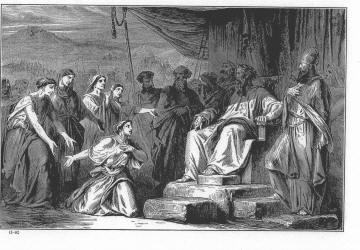
These five women feel the injustice of their father’s lack of legacy strongly, they want his name to continue into the future, and it matters to them that the physical legacy he left was to be diverted to people who were not his direct descendants, simply because of gender.  They band together and approach Moses with their case, and Moses is perplexed – what should he do in the face of this determined group of improbable heirs?  As we know, he approached God with his problem and is told that the daughters of Zelophehad speak well, they should indeed inherit their father’s estate, and his name should be allowed to be remembered. 

So they inherit, but soon, as we learn in Deuteronomy and later in the book of Joshua, limits are afterwards put upon the inheritance of daughters, the old need for land to stay within the tribe takes precedence, and the case law established by these five brave women is constrained, though not repealed.

          Inheritance is a strange phenomenon. I think of Abraham, the Ur-ancestor, who tells God that there is no point making a covenant with him because he is childless and his estate will all go to a member of his household, Eliezer of Damascus.  This text made so much more sense to me once I too became a parent – somehow life focuses more when there is a child to pass on to.  And it doesn’t really matter in what area the transmission takes place – tradition, values, wealth, family stories, family name – simply knowing that someone will take it into the next generation makes a difference. 

Yet of course there are many ways of ensuring an inheritance besides that of having a child.  Alexander Pope spoke of his books embodying his legacy. Teachers know that the impact they make on students can reverberate into the next generations, and the Talmud tells us that when a student recalls a teaching in the name of their teacher, it is as if that teacher’s lips move in the grave.  (BT Yevamot 97a)

Anyone who makes a relationship of trust with another knows that the legacy of that relationship will continue until the end of the life of the partner – and maybe even for longer.  What we do, and how we behave with other people, has a lifetime far longer than we expect or think about, the impact of our actions resonates for far longer than we can imagine.

          Inheritance is a strange phenomenon.  It is one of the defining things to give meaning to our lives and at the same time can rupture our connection with the future and the past if not properly organised.  It is something we would do well to consider deeply, to make serious plans about, and to consider the impact and the consequences of what it is we bequeath to the world as a result of our life.

          We are used to the idea of making wills – documents which record what we want to happen to our possessions after our death.  Many of us have made a will and have found that contrary to superstition the making of a will has not somehow brought about our untimely demise. 

But there is more to think about than who gets the jewellery and who gets the house and car. Inheritance is far bigger than possessions – it is, as the daughters of Zelophehad so rightly recognised, what we bequeath about with how we lived our lives and how what we learned or made sense of is transported into the world where we no longer will be. 

There is in Judaism the tradition of making a regular and updated ethical will. The idea is simple yet so important – besides worrying about who gets what of our material possessions, we spend the time thinking about what values we want to transmit, what lessons we have learned that we want our chosen beneficiaries to understand, what was really of importance in our life that we want not to be lost along with the trivia.  It is a valuable exercise, to create an ethical will, in which we put down in black and white what really has mattered to us, be it simple good behaviour or the imperative to tzedakah; be it the need for the discipline of a prayer life, or the permission to doubt God as much as one likes, as long as you still engage in the doubt. 

There is a powerful tradition of writing the personal ethical will as part of the preparation for the High Holy Days – in other words to begin to do so at this time of year, as we take stock of our lived life and try to make judgements about it, and create a framework for the future in order to live a life more in harmony with what is important to us. 

It gives us the space to think about ourselves. Not simply as amassers of material goods, nor as people who just get on with life without much thought for any deeper purpose than to live well enough and be successful and good enough – but as human beings who consider that our lives must have meaning and that that meaning is something to be nourished and cherished and transmitted into the future. 

I heartily recommend that you consider what it is you want your legacy to be. I recommend that you not only make a will, but that you tell your children what that will contains, so that you minimise the broyges after your departure from the scene. 

I also recommend that you consider what you want your spiritual legacy to be – not something unattainable or perfect and not something that you yourself don’t actually manage to do – but that you distil your values, your belief system, your sense of who you are and why you exist, and write on a plain sheet of A4 some of the truths you have learned which have sustained you on your journey through life, and which you would like to project through your nearest and dearest into the future.

What will your legacy be?

Will it be one of infighting for your possessions, of indifference to your existence on this world?

 Of minor irritations or major frustrations? 

Will your legacy be framed in such a way that people will recognise your contribution to the world, or will it simply be a dividing up of the goods?

I have always been so impressed with Zelophehad and with his daughters.  What he owned is irrelevant to me, that his name continued is one of indifference, but the fact that he and his wife bred 5 such superb daughters, who had confidence and tact, who held together to fight for what they felt to be right – that is a legacy to be proud of, an inheritance for which he – and his wife – deserve to be remembered.


Balak of Moab who did not know what he did not know

Israel faces a crisis – and yet does not seem to know it. Balak, King of Moab, is alarmed at the prospect of Israel crossing his land, has seen what they have done to others as they have journeyed towards his land. The Canaanites were entirely destroyed at Hormah (Num 21:3),  then it was the turn of Sichon the King of the Amorites (21;25-26)  who would not let them pass through his land and was defeated and destroyed, and finally Og the King of Bashan (21:35) who also went out to battle against them was utterly ruined. So Balak chose to get some supernatural help, and approached Balaam, a well known prophet the power of whose blessings and curses were legendary.

The sidra focuses entirely on the negotiations between Balaam and Balak, and the consequences of this discussion. What is happening in the Israelite camp is irrelevant – bible is telling us what is happening “offstage” so to speak, a side story that is however hugely important to the Jewish people even today.

Famously, to begin prayer, we take from this sidra the final words of Balaam, which he speaks almost without conscious intent. Balaam is hired to curse the people of Israel, though he knows that he cannot do this, for God has made clear that the Israelites are special and that the normal rules of blessing and cursing them will not apply. At the end of a long process of attempted curses in order to satisfy the wishes of his paymaster Balak, Balaam blurts out the phrase “Mah tovu ohalecha Ya’akov, Mishkenotecha Yisrael” – “how good are your tents Jacob, your dwelling places Israel” and this statement is taken by us as a blessing, and used as the phrase with which we begin our services – a tradition that was already established by the time the 9th century Babylonian Rav Amram compiled his first siddur and instructed us “”When entering a synagogue say: ‘Mah tovu ohalecha. . . V’ani, b’rov chas’d’cha; I, through your abundant love, enter your house; I bow down reverently at Your holy temple.”

Our liturgy begins deliberately by turning the curse of an enemy into a blessing for us to express our delight in entering a synagogue, confident that God will accept our prayer. The Talmud understands the tents and dwelling places as being the synagogues and houses of study of the Jewish people (Sanhedrin 105b). The Midrash on the other hand, quoted by Rashi (ad loc) (also Baba Batra 60a), sees the phrase as a paean of praise to modesty and privacy: “When Balaam saw that the tents of the Israelites were set up so that the entrance of one did not face the entrance of another, he praised them with the “Ma Tovu”.

Both traditions are teaching that it is the thoughtful behaviour of the Jews, either their respect for each other’s private space and personal modesty, or else the connection to God through prayer and study, that brings about the change in Balaam’s words, transforming attempted curse to fluent blessing. And that may indeed be a good lesson to draw from the story, but I think it is important to see respect for the other not as an end in itself, but as an important way of being.

To take this further: In this sidra the Israelites had no idea that Balak was so nervous of them. They were not intending to destroy Moab (Deut 2:8-9) who were distant relatives, being descended from Lot the nephew of Abraham. So while Balak was terrified of this horde of people who seemed to be destroying the peoples in their path – and was presumably ignorant of the requests for safe passage that were sent by the Israelites but that were not accepted and instead met with hostility and warriors – the people themselves knew nothing of their effect on the other peoples of the land. They see themselves only as innocents, wishing to travel through, to take nothing but what they would genuinely trade or buy from the inhabitants.

So the ignorance of Balak is matched – even dwarfed – by the ignorance of the Israelites, both of the effect they were having on others, and the reputation they were creating for themselves. Their ignorance extended to the machinations of the Moabite King and the professional prophet he hired, and also to the work that God put in to protect the Israelite people travelling through the desert. In the words of Donald Rumsfeld, they did not know what they did not know.

While Rumsfeld, then US defence secretary, was (unfairly) awarded the Plain English Campaign’s trophy for most obfuscating remark in December 2003 for the words: “Reports that say that something hasn’t happened are always interesting to me, because as we know, there are known knowns; there are things we know we know. We also know there are known unknowns; that is to say we know there are some things we do not know. But there are also unknown unknowns – the ones we don’t know we don’t know”. (Rumsfeld on February 12, 2002 at a press briefing at the White House on WMD)  The story of Balak is illuminated for me by his words. The Israelites knew the things they knew – though they did not always respond in the way that that knowledge would lead one to expect. They knew that God was looking out for them and providing for them, but they still rebelled; They also knew some things that they did not know – how to get into the land, when that would be, if they would succeed.  But they simply didn’t know how they were being perceived by the peoples whose land they needed to cross to get to Israel, they didn’t know how their reputation grew to be so fearsome that Balak was desperate for extra help, and they didn’t know that God was quietly active in the background in order to protect them.

What God is doing in this narrative remains, to the Israelites, an “unknown unknown”. Rabbi John Rayner would say that God does not intervene in the world, but that God is active in the world –meaning that God’s will is manifested in the actions of people: the choices by Balak and Balaam in this text, as well as the behaviour of the Israelites, being prime examples. Our daily actions, how we conduct ourselves and how that leads other people perceive us matters; indeed it is the one thing that can transform our world, that is able to transform curses to blessings. We cannot know the totality of the effects our choices have, but I would like to think that modern Jews and Israelites are more aware and perceptive than their ancient forbears about the effects on, and the analyses of, the peoples and lands around them of their actions. It cannot be enough to care for the wellbeing only of other Jews. It cannot be enough to spend our time in study and prayer. Such caring, such study must lead to good and ethical action, to being part of the action of God in the world.

The choices we make in our behaviour matters. How other people see us, even if we are currently unaware of them, or do not notice them, or find ways to sideline them – matters. If we see something as self defence but others see it as aggression – it matters. Even if their construction of events is something we would not recognise, their understanding must be understood and taken seriously and addressed. The bible is clear that God does not intervene in history – the story of the talking donkey shows how the bible views such intervention – but it is equally clear that the choices people make, whether they fully understand the situation or are in apparent ignorance of it, have real effects in the world. It is up to us, as it was to Balaam, to make the choices God would wish us to make, or we may find that the situation is taken out of our hands and we will lose the chance to make good choices and bring the will of God into our world. How then will curses be turned into blessings?

previously published on lbc.ac.uk