Sidra Vayigash:the reassurance of God’s presence in dark times

And Israel took his journey with all that he had, and came to Beersheba, and offered sacrifices to the God of his father Isaac. And God spoke to Israel in the visions of the night, and said: ‘Jacob, Jacob.’ And he said: ‘Here am I.’ And God said: ‘I am God, the God of your father; fear not to go down into Egypt; for I will there make of you a great nation. I will go down with you into Egypt; and I will also surely bring you up again; and Joseph shall put his hand upon your eyes.’ And Jacob rose up from Beersheba; and the sons of Israel carried Jacob their father, and their little ones, and their wives, in the wagons which Pharaoh had sent to carry him. And they took their cattle, and their goods, which they had got in the land of Canaan, and came into Egypt, Jacob, and all his seed with him; his sons, and his sons’ sons with him, his daughters, and his sons’ daughters, and all his seed brought he with him into EgyptGen 46:1-6

Jacob has a number of meetings with God during the night – the first was the dream on the road out to Haran when he was running away from Esau, and a ladder appeared to him that joined heavens to earth, and God delivered a reassuring message to him. The second the dream at the ford of Yabok, when he was returning home to Canaan, wealthy and secure but also anxious about the reception he would get from Esau.  And now here, at Beersheba, God appears in order it seems to reassure him that he will return from Egypt and will become a great nation. It reads to us a little strangely – for we know that Jacob will die in Egypt, and that as a nation they will only leave in over 400 years’ time, having survived a long period of slavery, yet one might read into it that the time in Egypt will be a short respite during the famine. Why? Does God think that Jacob will not cope with the reality of what his descendants will face? Is this vision one that emanates from Jacob’s need for support rather than being a real meeting with God? Is God responding more to the Jacob God first met, the frightened young man who yet was confident enough to tell God that only if God fulfilled the promises made in the dream would he finally believe, rather than to the older man whose world is shaped by the loss of his older son by his beloved wife Rachel; who has been frozen in grief since that time.

Or is the story added into the narrative later as a story to support the enslaved Israelites and ameliorate their suffering?

We have no answers, just as we have no answer for the interchangeable use of the two names Jacob and Israel, so powerful yet so cryptic in this passage. Yet as with all the encounters Jacob has with God during night time journeys, the vision is one we are able to hold on to today – providing reassurance in times of uncertainty, reminding us that we are one link in a chain that goes back into history and will go forward into a future we cannot know.

We are most definitely the children of Jacob rather than those of Abraham or Isaac. Abraham had a stern and all-encompassing faith which seemingly left no room for doubt or anxiety, Isaac lived in the shadow of that faith and his own encounters with God are clearly shaped by it. But Jacob was his own self, a mixture of self-assurance and anxiety, wanting to believe but not being too sure about it, prepared to do a deal with God when it seemed an expedient action.  It is given to few people to believe with certainty, and to fewer still to come to belief through their own experiences, rather than to have it bred into them. Doubt is a colourful strand in the Jewish character, it threads through our narratives and our prayer. Indeed we pray in an aspirational way – hoping to be able to believe rather than asserting that we hold such a conviction.  Whether God ever speaks to Jacob in the night or whether Jacob creates the experience for himself becomes an irrelevant question – what is important is that Jacob is able and willing to create such an encounter (or to believe it when it comes). It is all that is asked of us too – to be able and willing and open to the presence of God when times are at their darkest.

Toledot: lessons on the control of resources and why we should resist the power

 046-welfare-state

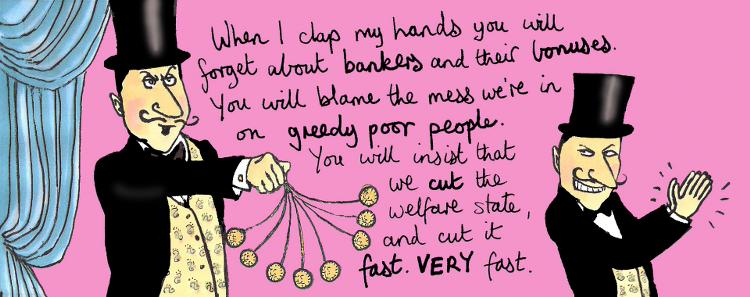
Within the powerful narrative of sibling rivalry and family betrayal of parashat Toledot there runs another, equally powerful and important theme – the control of resources of food and water and how the manipulation of this control distorts everything around it.

Two stories of deception and duplicity frame this sidra, both pivot on the manipulation of food and drink. In Genesis 25:27-34 we have the story of Esau coming in hungry from his venison hunting, and selling his birthright blessing to Jacob for the red lentil stew that Jacob has cooked and whose savoury smell tempted Esau whose appetite was so sharp he felt he would die if he did not eat it. In Genesis 27 we have the story of the blind and ailing Isaac asking Esau to go and hunt him a last meal of venison, after which he would give him the blessing of the firstborn before he died. The same motifs and words come up again and again: blessing; death; venison; In one story food is withheld until the blessing sworn over, in the other the blessing is withheld until the food is eaten. The stories play with each, resonate and mirror each other, but each of them uses food and the control of resource to put one party at a disadvantage to the other.

In the middle of these two stories of blessing and feasting, of manipulation and betrayal comes quite a different narrative. In Chapter 26 we have a story that begins with famine, specifically a new famine that is not the one faced by Abraham and Sarah, and Isaac and Rebecca go to the Philistine Abimelech king of Gerar to find food. God tells Isaac not to leave for Egypt as his parents had done in the previous famine, but to stay on the land and the blessing first given to Abraham would be his. Isaac stays in Gerar, but in a parallel to the story of his parents he tells everyone that Rebecca is his sister rather than his wife, as he clearly fears for his life should the truth be known. Abimelech notices the relationship between Isaac and Rebecca and chastises Isaac – someone could easily have taken Rebecca for a wife and the community would have been punished, and Abimelech places his protection on the couple. The result was that Isaac sowed the land and immediately reaped “me’ah she’arim” a hundredfold return on his work, and God blessed him and all his work. He became richer and richer, with huge flocks and herds, a great household, and this drew the envy of the surrounding Philistines.

I must confess that I find this extraordinary – why should he reap so much for his work? Surely enough would have been enough, and it would surely have been inevitable that such astonishing wealth would attract the unwelcome interest of those who had less than he, but let us pass on for now…

There follows a rather sad narrative of Isaac and the herdsmen of Gerar fighting for the wells that had belonged to Abraham and should therefore now belong to his son. Bible rather laconically tells us that “All the wells which his father’s servants had dug in the days of Abraham his father, the Philistines had stopped them, and filled them with earth”. It is not clear if this was an earlier event to prevent others taking the water after Abraham had left, or if this was a reprisal motivated by jealousy of Isaac’s wealth, or even if this was an attempt to erase any historical roots that Isaac would have had to the area. The wells don’t seem to have been taken over, strange in a world where water is so precious, but filled in – at least until re-dug by Isaac’s men when the fight over the water between the herdsmen became serious. Finally Isaac moved far enough away – first to Rehovot (meaning wide or spacious) and then to Beersheba (meaning 7 wells) – and an uneasy truce prevailed, cemented by Abimelech making a treaty with him having seen that God was with him – a curious treaty hedged with diplomatic ambiguity, asking that Isaac not hurt the people of Gerar, “as we have not touched you and as we have done you nothing but good, and have sent you away in peace…..” (v29)

In this curious narrative, resonant of the earlier stories of Abraham and Sarah, showing Isaac as both a hungry frightened migrant and as a wealthy possessor of animals and land, and finally as a synthesis of these – wealthy but insecure on the land and moved on further and further into the desert, we have the crux of the story. Control of necessary resources is everything. It doesn’t matter how much you possess if you don’t possess the basics of food, water and space to live on. You can be manipulated and dealt out of your rights by the person or group who has control over these, and who can take everything else of value from you. For all that Isaac reaped a hundredfold from his first planting, his wealth meant nothing as long as he was not secure for his immediate needs. Ultimately we are all in thrall to our basic needs. Bible already recognises what Abraham Maslow later put into his theory of the hierarchy of needs – that to live our lives fully we must first meet certain criteria: his first two sets are “Biological and Physiological needs – air, food, drink, shelter, warmth, sex, sleep.” And when these are met, then “Safety needs – protection from elements, security, order, law, stability, freedom from fear.” Only then are we in a place where we can grow well.

Why does bible frame the narrative of the Philistine King Abimelech and Isaac between the two stories of family manipulation and betrayal which both use food and immediate desire/need to control events?

One can only guess at the mind of the editor of the text. But in my mind I see that controlling others through controlling the access to resources they need is a human behaviour done to both those we are in close relationship with and those with whom we do not have such relationship. It is an atavistic strategy hard-wired into us, presumably for survival, but it is not a laudable strategy, and it seems to me that the structure of the biblical narrative is trying to remind us of this. The alienation of Jacob and Esau is painfully intensified through this behaviour. The pain between Isaac and Rebecca, and each of the participants in the deceptions reverberates through the text, as does the frustration and impotence of Isaac trying to claim his father’s wells and being chased off his land with violent encounters. There is nothing good to come out of this story except by negative example. We who control resources may wish to use them to control the behaviour of others, but we should think hard and long about giving in to this strategy. For history teaches that empires come and empires go, that there is a turning and a spinning of the world, and that what is in our grasp now may not be in our grasp in the future. How would we want those who control the resources to behave to us? As the famous first century rabbi Hillel framed the golden rule ‘That which is hateful to you do not do to your neighbour. This is the whole of the Torah, The rest is commentary. Go forth and study.’ (BT. Shabbat 31a)

alice2

both cartoons by the wonderful Jacky Fleming

Vayechi: Chesed ve’Emet, Acknowledging truth allows us to offer our compassion fully.

וַיִּקְרְב֣וּ יְמֵי־יִשְׂרָאֵל֘ לָמוּת֒ וַיִּקְרָ֣א ׀ לִבְנ֣וֹ לְיוֹסֵ֗ף וַיֹּ֤אמֶר לוֹ֙ אִם־נָ֨א מָצָ֤אתִי חֵן֙ בְּעֵינֶ֔יךָ שִׂים־נָ֥א יָֽדְךָ֖ תַּ֣חַת יְרֵכִ֑י וְעָשִׂ֤יתָ עִמָּדִי֙ חֶ֣סֶד וֶֽאֱמֶ֔ת אַל־נָ֥א תִקְבְּרֵ֖נִי בְּמִצְרָֽיִם:

And the days of Israel came close to death and he called to his son, to Joseph, and he said to him “If pray I found favour in your eyes, pray put your hand under my thigh, and treat with me with Chesed and Emet; do not, I pray, bury me in Egypt” (Exodus 47:29)

Chesed and Emet – two of the thirteen middot, the attributes of God explained by God to Moses, after the incident of the Golden calf, and which continue to be used liturgically in the same way that Moses used them then– to ask for divine mercy when there is no legal basis or reason for it.

Essentially, used as the centre of the selichot prayers of the Days of Awe, these words, taken from Exodus 34 (vv6-7) remind God of our individual and group relationship with the divine, and that sometimes it is only the mercy of God that allows that relationship to continue. They set the scene for teshuvah, for repentance or rather for a return to God after we have strayed.

Of the thirteen middot derived from this text, all but one refer to mercy, kindness, favour or forgiveness –the second of our pair here in Vayechi, when Joseph asks Jacob, Ve’asiti imadi Chesed ve’Emet.

The word Emet means truth or faithfulness. Its presence in the request is a problem for classical commentators on this text, and is beautifully glossed by Rashi who quotes the midrash (Gen. Rabbah 96:5) which uses the context of the proper burial of the dead by understanding Jacob to be saying to his son “The chesed/loving-kindness that is done for the dead is here a true loving-kindness, entirely altruistic, since one cannot expect payment or reward of any kind from the dead for caring for them”. And from this reading grows the mitzvah of Chesed SHEL Emet – truthful kindness or perfect kindness, the entirely altruistic mitzvah of helping those who are powerless and completely vulnerable and who will never be able to recompense or return the favour – the unburied dead.

It is a beautiful platform on which to stand this most selfless and necessary of activities, yet I find myself not entirely satisfied either with the midrashic gloss of Rashi or with the usual interpretation that “chesed ve’emet” in this context is simply an idiomatic phrasing of doing a favour or a good deed. It seems to me that the two words mean very different things, and placing them together (as happens fairly often in the bible) creates a new thing, a tension between loving kindness and truth/faithfulness with which we must engage.

As well as being in the verses which give us the attributes of God, the combination of words comes to describe God and God’s work, for example in psalms such as

“All the ways of God are Chesed and Emet to those who keep his covenant and his testimony” (25:10)  כָּל־אָרְח֣וֹת יְ֭הֹוָה חֶ֣סֶד וֶאֱמֶ֑ת לְנֹצְרֵ֥י בְ֝רִית֗וֹ וְעֵדֹתָֽיו:

Or “Righteousness and truth are the foundation of Your throne, Chesed and Emet go out from before You”        (89:15)    צֶ֣דֶק וּ֭מִשְׁפָּט מְכ֣וֹן כִּסְאֶ֑ךָ חֶ֥סֶד וֶ֝אֱמֶ֗ת יְֽקַדְּמ֥וּ פָנֶֽיךָ

Chesed and Emet come together in God, and are a fundamental part of the Covenant relationship we have with God – this is clear from the texts. So it is a very easy stretch when reading those same texts to understand that we expect Chesed/loving-kindness from God EVEN THOUGH the truth of our being is not always deserving – hence the use of the middot in the selichot prayers of pardon throughout the Days of Awe.

But the real lesson in the deathbed conversation between Jacob and Joseph is not that we expect unconditional love and forgiveness from God, but rather that we have to mediate the one with the other for ourselves, that however we might perceive the truth of our relationship with someone else, when the chips are down, then Chesed also has to be in the equation. Indeed sometimes compassion has to override the truth of someone’s behaviour.

What Jacob is asking of Joseph is not couched in the patriarchal power language – “you are my son and must follow my wishes”. It is phrased very much as a favour – “if I have found favour in your sight….” But then he adds to the request: “deal with me with both Emet and Chesed”.

It may be that Jacob know that he cannot order this son of his who has become so powerful in Egypt, and who may have his own political reasons to decide on the funeral planning for his father. It may be that Jacob knows that he may not even be successful when he appeals to Joseph’s magnanimity with his request formed in such conciliatory words as the formulaic “if I have found favour in your sight”.  He does this but then he goes on to nuance his words with the appeal to both Chesed and Emet. It seems to me that Jacob is asking of his son something quite new in human interaction at this point – he is acknowledging that the Emet, the truth of their relationship is that has been strained for many years, that he has not parented Joseph well, that he has little claim on his son for his request, and yet he is asking for the compassion of Chesed. He is saying to his son –“ I know who I am to you, and you know that I know this, but my request is so important to me that I am asking you to see past this truth we both acknowledge and help me.”

The honesty with which Jacob is speaking here to his son is the Emet he is asking for from his son. He does not want their story to be airbrushed or hidden from their interaction, but to be part of the decision making process that Joseph will go through. He does not want the failures in their relationship to be buried and treated as if they never existed. With the words “ve’emet” he is telling his son that the unfinished business of their relationship was real, that the pain felt by Joseph was real too, and he is asking Joseph to honour his wishes despite this pain, through the power of his compassion for his father. Essentially with the combination of Chesed ve Emet Jacob asks of his son not only great compassion, but great compassion in the light of the knowledge of the painful truth.

The lesson is well taught. Joseph honour his father’s wishes and the sibling rivalry ends here with the death of Jacob. The pain is recorded, and it does not go away or be hidden from view but neither does it sprawl out into the next generation. Once faced with integrity and acknowledged by the person who is perceived to have caused the pain, it can be overcome and compassion allowed to take its place. Psalm 89 tells us that the world is built with Chesed (v3) – it is the tool of creation, a new possibility.

כִּֽי־אָמַ֗רְתִּי ע֭וֹלָם חֶ֣סֶד יִבָּנֶ֑ה

And Jacob is asking for this too – once the truth is acknowledged a new possibility emerges and compassion has its place. The importance of the mitzvah of Chesed shel Emet, of the altruistic treatment of the dead who cannot repay us for what we do for them is great. But the importance of treating others with Chesed ve’emet is equally great, for only then do we truly let go of what is holding us back from our potential and our future.

Vayishlach: a kiss or a bite, it is all in the reading of it

וַיָּ֨רָץ עֵשָׂ֤ו לִקְרָאתוֹ֙ וַֽיְחַבְּקֵ֔הוּ וַיִּפֹּ֥ל עַל־צַוָּארָ֖ו [צַוָּארָ֖יו] וַיִּשָּׁקֵ֑הוּ וַיִּבְכּֽוּ:

“And Esau ran to meet him and he embraced him and he fell upon his neck and he kissed him and they wept.”

Francesco_Hayez_061  jacob and esau

In the Torah scroll, the word “vayisha’kei’hu” – “And he kissed him” has a scribal marking – six dots carefully placed over it, drawing our attention and demanding we question the text. But what is the question being asked? Is it that there is an extra word that should not be there? Is the word to be read differently – not “Vayisha’kei’hu    וישקיהו     and he kissed him” ,but “Vayisha’kei’hu    וישכיהו   and he bit him”.   Same sound, but one root letter difference changes everything – from the kiss of reconciliation after years of estrangement, to the betrayal of vulnerability and friendship instead. The midrash plays on this to say that Esau had attempted to bite Jacob’s neck but at the last minute it was turned hard as marble and so his evil intention to destroy his brother was foiled.

Jacob and Esau had struggled even before they were born, causing their mother Rebecca enough pain that she went to enquire of God about what was happening within her body. Each of them was favoured by a different parent, each of them had their own distinct personality: Esau a hunter and a man of the field, Jacob a man who liked to stay at home. If we look at the biblical texts about Esau without the lenses of rabbinic tradition and storytelling, we see a simple uncomplicated man who follows his powerful appetites, his huge physicality determining his behaviour. We see a man who loves his father and is admired by him. We see a man who stays local to his parents, marrying two Canaanite women, and who, when he realises that his parents are not happy with him marrying out of the family, marries the daughter of his uncle Ishmael, mistakenly believing that this is a choice which will please them.

After his brother Jacob had run away from his furious anger having cheated him of their blind father’s covenant blessing, Esau stays near home, becomes wealthy, and settles with his large and prosperous household in Seir. When their father eventually dies Jacob has also come closer to home, having left Shechem and entered Canaan, finally coming home to Hebron. The two brothers buried their father together, the text telling us “and they buried him, Esau and Jacob his sons” (Gen 35:29). It seems as if the reconciliation is complete.

And then we are told (Genesis 36:6)    וַיִּקַּ֣ח עֵשָׂ֡ו אֶת־נָ֠שָׁ֠יו וְאֶת־בָּנָ֣יו וְאֶת־בְּנֹתָיו֘ וְאֶת־כָּל־נַפְשׁ֣וֹת בֵּיתוֹ֒ וְאֶת־מִקְנֵ֣הוּ וְאֶת־כָּל־בְּהֶמְתּ֗וֹ וְאֵת֙ כָּל־קִנְיָנ֔וֹ אֲשֶׁ֥ר רָכַ֖שׁ בְּאֶ֣רֶץ כְּנָ֑עַן וַיֵּ֣לֶךְ אֶל־אֶ֔רֶץ מִפְּנֵ֖י יַֽעֲקֹ֥ב אָחִֽיו

And Esau took his wives and his sons and his daughters, and all the souls of his household, and all his flocks and his beasts and all he had acquired, which he had gathered in the land of Canaan, and he went to a land because of/ away from Jacob his brother. The bible goes on to tell us that the two brothers had too many animals between them to be sustained on the land together, and so Esau went to Mt Seir, the same is Edom. Rather as Abraham and Lot had separated earlier, in order to keep the tensions of their flocks and shepherds down, so here the twin sons of Isaac separate, and the one who leaves walks out of history. But it reads differently than the story between Abraham and his nephew – there is no recorded tension, no struggles between the shepherds, just the realisation that they each need to find their own space for their burgeoning families.

So why is Esau turned into Edom, into the paradigm for the enemy of the Jewish people when he seems to have overcome his ravening appetites, made something of his life, and made his peace with his twin brother sufficient for the two to mourn their father together? Why the need to draw attention to the kiss of reconciliation and by implication to suggest that not everything was as it seemed?

In rabbinic tradition Esau becomes the code name for the oppressor – Rome.

Rabbi Akiva (c50-135) first glosses the ambiguous statement of the blind Isaac at the time of the blessing of the firstborn son (when he says “The voice is the voice of Jacob but the hands are the hands of Esau”) as being a description of the anguished voice of the Jews/Jacob crying out against oppression perpetrated against them by Rome/ the hands of Esau. And in the middle of the second century Rabbi Shimon bar Yochai famously commented that “it is a Halachah/well established tradition that Esau hates Jacob” (Sifre Numbers 69).

It was a fairly clumsy cipher but it did the trick of being able to discuss their oppression and ways to counter it without the oppressors being too easily aware – at least for a time. By the time of Akiva’s student Shimon bar Yochai the Roman oppression was all consuming and he had to go into hiding to survive. No wonder then his belief that the implacable hatred of Rome for the Jews was somehow primal, a Halachah from Sinai, unquestionable and for ever.

But time moves on and we move with it. The power of Rome has long gone and what stays with us is the Biblical text and our obligation to encounter it and understand it in our generation. And in the biblical text Esau is not the figure of evil and hatred that he becomes in later tradition – indeed he is portrayed as running towards his brother to embrace him, they weep together (although this may be relief in the case of Jacob), Esau refuses the gifts Jacob offers to him in tribute. Essentially one might say that Esau has got over his anger. His personality of appetites and passions is sated with his own achievements, wealth and family. For him the fight over the birthright blessing is old news, finished business, dead and gone. The issue now is pragmatic- how do the two wealthy brothers with their large households and flocks and herds live on the land and support their needs? By separating of course, but coming together for the family rite of burial of their father. Esau walks out of history of his own volition, content with what he has.

So isn’t it time to stop the belief that there is a visceral and unquestionable hatred of us by the powers that line up to destroy us, and recognise that for sure there is anti-Semitism in the world, but that is not pre-ordained nor something we are powerless to engage with or combat. It is not primal truth that Esau hates Jacob; that Jacob has to duck and dive to survive. This is a model that has outlived its usefulness, a story that hampers us from proceeding with our lives. We will almost certainly encounter anti-Semitism, just as many of us will encounter other prejudices – against our gender or height or skin colour or sexuality. But this must be faced firmly and responsibly, engaged with, shown for what it is, protested against and other behaviour demanded. If Esau really kissed Jacob on his vulnerable smooth neck, (the part of him so unlike Esau Jacob had queried whether his father would know him by it) and if they had then parted on relatively reasonable terms and been able to come together to bury their father, then maybe we too can create a living peace, one that does not have to be passionate or entangled together, but respectful and honourable. And then maybe we can take those scribal marks off the scroll, and believe that reconciliation really is possible.

image of reconciliation of Jacob and Esau by  Francesco Hayez

Vayetzei: We become who we can imagine and dream we can become.

There is so much deceit in this week’s Torah reading. Deceit and dreaming. Jacob is on the run from his brother Esau, having deceived their father into giving him the blessing meant for Esau, the blessing of the firstborn. He falls in love with Rachel, the younger daughter of his uncle Laban, only to be deceived on the wedding night and given Leah her elder sister instead. In order to achieve the wages owed to him he strikes a deal with Laban which means he can selectively breed a huge flock of animals, something Laban was clearly not expecting. While Laban is away, Jacob sneaks away with Rachel and Leah and his household including a large flock of animals. Rachel steals the household gods and hides them, something she keeps from everyone. When Laban pursues them she lies about having them – a lie that will lead to her own death.  Deception follows dishonesty, it is a sorry read for those who would like to find bible reading an uplifting experience.

And yet – at the same time as all the double dealing and the cheating, something else seems to be happening. Alongside the scheming is a growing sense of God, a sense of awe; an understanding that the individual is neither alone in the world nor irrelevant to it.

The understanding begins as Jacob sleeps, when he senses the presence of God in a lonely isolated place on the road, and perceives that that presence is caring and watchful.  It grows as he learns to love selflessly – Jacob works for fourteen years in order to pay Laban so as to marry the woman he loves. Once his beloved younger wife has a son, Jacob realises it is time for him to go home, he himself is in danger of absorbing too many of the dubious values of his father in law Laban and somewhere deep inside himself he knows that needs to protect this beloved son from doing so also. It turns out that the rather unreliable and devious Jacob we met at the beginning of the sidra is in fact capable of deep love and loyalty; he is rooted in the landscape of his family, his untrustworthy personality and selfish behaviour are not the full measure of the man.

What are the mechanisms that bring about this deeper understanding? They seem to be a combination of dreams and imaginings. Whatever happens on that lonely night by the roadside on the way to Haran, Jacob begins to transform his world. As he sleeps he dreams of angels mounting a ladder to heaven and other angels descending a ladder to the earth. He hears God speak to him, renewing the covenant made between God and Abraham and God and Isaac. He believes the covenant is now also with him. And then he awakes. Torah never clarifies if this is truly a religious encounter or a product of the imagination of Jacob, something of his own that yet provides him with a new understanding and insight. Whatever it is, Jacob begins to understand that God can be present in his life.

Rashi suggests that when Jacob says “The Eternal is present in this place and I, I did not know it”, he means “had I known, I would not have slept in such a holy place. And yet, had he not slept there he would never have known it to be a holy place. So paradoxically, in order to understand the sacredness of the place, Jacob had to trust his own inner self, his own imagination, his own ability to create and transform the world. And this is what brought about a change in him, allowed him to become a better self.

As Jacob dreams, as he imagines possibilities, he begins to form them and make them real. He wakes knowing with certainty now that he is the true inheritor of the blessing, the one with whom the covenant is made. From that moment on he seems to be a different person – one with a purpose beyond his own gratification and enjoyment. While dreaming or imagining the encounter with God, he effectively created the outcome of such an encounter, he became the next possessor of the covenant.  The power of our dreams or imagination should never be dismissed. We become who we can imagine and dream we can become.

Parashat Terumah: In the making of Sacred Space, we create Sacred community

When Jacob left his home and journeyed to Haran he spent the night on the road. There he had a dream of a ladder between heaven and earth, and of God standing above him. When he woke, he said to himself:  Ma Norah HaMakom ha’zeh. Eyn zeh ki im beit Elohim, v’zeh sha’ar hashamayim.   ‘How full of awe is this place! this is none other than the house of God, and this is the gate of heaven.’ Gen 28:17

Sacred space is something that we all resonate with. And in parashat Terumah we have the beginnings of the first deliberately created sacred space.

When Jacob recognised the awesomeness of the place where he had so blithely slept, he simply set up a pillar and offered a sacrifice of oil to the God he had just encountered. He moved on to Haran the next day, keeping with him the memory and the promise God had given him. He had no need to do more than mark the space for future use, but we need more – either because we have never had an encounter with the divine, or because we know that memory fades and we need a more concrete reminder of what God can be for us – we need to inhabit sacred space.

In parashat Terumah God tells Moses to build a sacred space – a mikdash, a place that is in some way kadosh – separate, distinct and special, that embodies an idea and directs us towards it.

From earliest times the commentators have pointed out that what the mikdash does NOT do is to embody God, or in any way be a place where God actually lives. The phrase that God uses “Assu li mikdash v’shachanti BETOCHAM” – let them make for me a mikdash, a sacred and separate space, and I will dwell AMONG THEM is key.Image

The mikdash is the first building to be created for the awareness of God, it will be in the midst of the camp and will be a portable building that moves with the community, but it will be in the making of it – assu – that God dwells among us. Moses is told where and how to build the mikdash.  There are chapters and chapters of detail as to how to build it, with what materials, what colours shapes and sizes, how much everything weighs and costs, where it is to be placed. But all of that is secondary – God’s presence isn’t in the building, but in the people working to create it. The presence of God is something that occurs only when people are actually doing something to bring it about.


The synagogue I grew up in, the Bradford Synagogue was the third Reform synagogue in this country and is the second oldest building (Manchester having lost its original synagogue in Park Place). The quotation at the top of the extraordinarily decorated exterior comes from a young Jacob who had just encountered God in a very ordinary place, “Ma Norah HaMakom hazeh. Eyn zeh ki im beit Elohim, v’zeh sha’ar hashamayim.   ‘How full of awe is this place! this is none other than the house of God, and this is the gate of heaven” was one that seemed to fit the grandeur of the Moorish Architecture of this beautiful building which was built in 1880 as the Bradford Synagogue for British and Foreign Jews. It was and is an amazing building, with vaulted ceilings and a free standing domed ark with grille-work to the front standing within a huge niche which is painted a midnight blue, and golden stars shine behind it, so that as a child it was easy to imagine being in a different and exotic world. Added to that the rich scarlet of the bimah coverings and the Persian carpets covering the raised area by the ark meant that truly it was (and is) a place filled with awe.. It was an awesome place and a place where heaven and earth met because of the community which met within it, which educated its children and celebrated the festivals and fasts of Jewish time. It was a community always small enough for every single person to matter, for everyone to have to be involved if it would survive.Image

That Synagogue is proof that it isn’t really the building that creates a sense of God, however gorgeous and ornate it might be – it is the people who come to work within it, the ordinary people who in daily life might work in retail or wholesale, be dentists or doctors, teachers or journalists.  Each of them, with willing heart, brought what they had to create a community. The whole key is in that verb – assu. We have to be doing, to making, to be forming and creating the whole time, not resting on our laurels in beautiful places, not turning places into museums of sacred space. Jacob had the right idea when having acknowledged the power of the encounter with the words “Ma Norah HaMakom hazeh. Eyn zeh ki im beit Elohim, v’zeh sha’ar hashamayim.   ‘How full of awe is this place! this is none other than the house of God, and this is the gate of heaven.‘ –  he then he marked the place and moved on.

Sacred space is only sacred if we keep adding to its kedushah by being ourselves people who are kedoshim – people who follow the sacred principles and try to be more like God in our behaviour.


Vayishlach: Politics before People always leads to disaster

This sidra is choc a bloc with story after story waiting to be told, and one of the most painful is that of the rape of Jacob’s daughter Dina, and the retaliation taken on the rapist, Shechem, and his whole city. 

Horrific as the story is presented to us, and with so much detail, there is a great deal that is omitted. We hear nothing of the feelings of Dina herself, see nothing through her eyes, and also there is nothing told of the horror or pain of her father whose only daughter has been abducted and raped.  The only feelings reported are those of Shechem who falls in love with the girl he has violated, and possibly the outraged feeling of her furious brothers.

Shechem and his father came to discuss marriage between the rapist and the victim, proposing in effect an alliance between the tribe of Israel and the tribe of Shechem. Strangely, Jacob is not involved in the discussion; instead it is his sons who respond to the request, and they make only one demand – that if Shechem is to marry their sister, then the men of Shechem must undergo circumcision, as Dina could not marry an uncircumcised male because this would be a disgrace to THEM! Rashi tells us that wherever this verb (Chet, Reish Peh) is used, it is an insult. So the men are negotiating the fate of Dinah only in relation to the honour or dishonour they feel, and with no concern whatsoever for the woman at the centre of the negotiation. 

One could argue that this ritual of circumcision actually converted the men of Shechem, bringing them into the covenant between Israel and God – they would undergo milah – and so they would become, as the Shechemites clearly believed, one people. While the word ‘brit’ is conspicuous by its absence, the mass circumcision was clearly supposed to align the two peoples in more ways than the physical. And becoming part of the people of Israel in those days did not seem to entail much more than the ritual of milah.

 The enabling of the prince of Shechem in order to marry the daughter of the House of Jacob was clearly supposed to create an alliance of equals from which it is not hard to understand that the two peoples would integrate fully. So the Shechemites agreed to the condition that every male be circumcised, and three days later, when they were all still in great pain from the procedure, Shimon and Levi, two of Jacob’s sons, entered the city, killed all of its male inhabitants, and took the women and children as captives.

Jacob’s response when he found out about this is only about the practical impact it will have  – he and his household are in danger from the other tribes around in the land. Surely they will gather together to destroy him and all his people. He is troubled, but not (as we are) by the morality of what has happened. He didn’t seem to be concerned about the personal damage done to his only daughter or about what would happen to her in the future, and now he is only worried about the immediate consequences of the actions of his sons. Increasingly we see that the focus of this story is jarringly political at the expense of anything remotely personal.

The Torah in this narrative is hugely disturbing.

Where is the voice of the victims? First Dina and then the people of Shechem are silenced as the political agenda is pursued.

Where is the voice of morality? Can the response of the sons of Jacob really be seen as justification when they ask “should one deal with our sister as with a harlot?” And why is Jacob himself silent when they plan to attack a people who have made themselves vulnerable in a belief that they are trustworthy?

Where is the voice of the God of all peoples who allows the act of circumcision to become the vehicle for murder?

The meta-Torah is perfectly clear from this narrative: When we think about politics and about political gain at the expense of thinking about real living breathing people then we make the wrong decisions, we allow violence to become justifiable, we think that retribution is acceptable. When we forget the reality of others, their needs and their lives, we narrow our focus deplorably, we think only of our own situation and not that of others.

The voice of Dina calls to us from this piece. I am sure I can hear her calling out “First I was treated without respect by Shechem and then without respect by my brothers, and finally  I was silenced by the choices of the Torah narrative. And this happened because you were focussing on your own enhancement, your own security, and your own needs.”

The voices of the men of Shechem call out to us too. “We did what you said we needed to do to make a peaceful alliance through marriage, and our action was callously used against us, our lives taken from us, our women and children taken captive, our wealth appropriated”.

 What can we learn from this sorry tale spun around Dina, daughter of Leah and Jacob?  It is this. If we put politics before people, the outcome will always be violence and pain, and the gain will be as nothing compared the anger we store up against us.

In the light of the Begin-Prawer bill currently before the Knesset, it is time for us to remember the story of Dina and to remember that nothing has changed in humanity since this story was first told. Putting politics before people will result in hostility and anger, violence and pain.

Please see http://rhr.org.il/eng/2013/05/position-paper-the-time-has-come-to-truly-and-fairly-resolve-the-negev-bedouins-rights/  for more information on this.

Image

Vayeitzei – Filled with Awe we encounter God

bradford synagogue doorwaybradfordshul outside

ark 2

bradford shul
Jacob awoke from his sleep and said “Surely God is in this place and I, I did not know”. And he was overawed and said “how full of awe is this place. This is none other than the house of God, and this is the gate of heaven”
The phrase “ma nora ha’makom ha’zeh, ein zeh ki im beit Elohim” (How full of awe is this place, this is none other than the house of God”) is part of the stonework on the exterior of the synagogue I grew up in, and as one walked in and looked up, that is the sentiment one felt – even though it is situated in what is now inner city Bradford, on a less than salubrious road.
The religious message I received as a child was bound up in this synagogue, in the community of people and in the building they worshipped in. It was a two-fold message-
Firstly that we can encounter God wherever we are, for God is always ‘in this place’ as are we, and often we do not notice how close God can be to us.
And Secondly that awe is a necessary instinct, God is, and we must respect that reality. We have to live with not being able to control God or demand from God or expect to understand God.

When we pray, what are we really doing?
Abraham Joshua Heschel (1907-1972) was a scholar, theologian and social activist. He wrote “the predicament of prayer is twofold: not only do we not know how to pray, we do not know what to pray for. We have lost the ability to be shocked.” Heschel also suggested that we have overemphasized intellectual ideas when we think about religion, and that we also overemphasise religious belief; For Heschel religion is more like a way of being in the world, a way of facing life and dealing with it.
In Judaism, believing is not the most important thing for a religious Jew, but Awe, or the ability to be shocked is the fundamental requirement. The bible talks of the religious person as one who is yirat Adonai, or yirat shamayim – in awe of God or in awe of heaven. Without a sense of awe, without the ability to be shocked or moved by what we see around us, we can never really move on to encounter God, or develop a sense of faith.
I have lost count of the number of times that I have been told that someone doesn’t really believe in God, the number of apologies that somehow come my way. I never quite know as a rabbi how to help people to believe in God if that is what they think they want, but what I am sure of is that the beginning of such a journey is Awe.
When Jacob first encounters God he notices how the place is filled with Awe, and he had not understood it. It takes time, and possibly even a certain vulnerability for us to open ourselves to noticing God.
Many of our services begin with the phrase “v’ani tefilati lecha Adonai eit ratzon” usually translated as “and as for me, let my prayer come before you God at a favourable time”, but it is more complex than that, meaning something more like and I am my prayer to you God at a favourable time”. We are in fact our own prayers – if only we would let ourselves be so. Rabbi Lionel Blue once wrote “Meeting God can be simple, but nothing can happen if we do not will it. If we seek God then God can be found. God will allow us to find God if we seek with all our will”

Parashat Vayechi

On Friday evenings it is traditional to bless our children before making Kiddush. We place our hands on the head of each child, and for boys we say, “May God make you like Ephraim and Manasseh.” For girls we say “May God make you like Sarah, Rebecca, Rachel and Leah.” And for all the children we add the Priestly Blessing, asking for God’s protection, blessing, and grace.

The biblical source for blessing sons at Kiddush comes from today’s parashah. A short time before Jacob dies, he meets Joseph’s children, his grandsons, and in an emotional scene, he says (Genesis 48:20): “By you shall Israel invoke blessings, saying: ‘God make you like Ephraim and Manasseh…'” And so the Jewish people have been using that invocation to bless their children for centuries.

But the content of the blessing to Ephraim and Manasseh actually comes before Jacob speaks to them and the blessing seems to be given to their father initially – in verses 15 and 16, the Torah records: “And he [Jacob] blessed Joseph, saying, ‘The God in Whose ways my fathers Abraham and Isaac walked, the God Who has been my shepherd from my birth to this day – The Angel who has redeemed me from all harm – Bless the lads. In them may my name be recalled, and the names of my fathers Abraham and Isaac, and may they be teeming multitudes upon the earth.'”

If this is a blessing for Ephraim and Manasseh, why does the text say, “And he blessed Joseph“?

The medieval commentator Nachmanides provides one answer: “. . .Jacob really wanted to bless his beloved Joseph;  and out of his love for Joseph, Jacob blessed his sons”.  And the 17th c scholar and kabbalist Rabbi Isaiah Horowitz comments: “[Jacob blessed Joseph] in order to show that there is no greater blessing for a father than the wish that his children should take after him and become good people”.

Whatever the reason, Joseph, Ephraim and Manasseh were all blessed by Jacob.

The language that he uses in his interaction with the Egyptian influenced Joseph and his completely Egyptian sons is interesting. From his perspective at the end of life, Jacob understands that God has been his Shepherd from his birth and throughout his life, watching over him during his difficult physical and emotional journeys. And so he wishes for Ephraim and Manasseh that same sense of protection and security. Nachmanides  suggests that the word for shepherd, “ro’eh“, may be related to the word “ray’ah“, friend and that in referring to God as “ro’eh,” Jacob is also wishing the blessings of  friendship on Ephraim and Manasseh.

The image of the Angel, who “has redeemed me from all harm” is traditionally understood literally – Jacob certainly has encountered redeeming angels in his lifetime (on the ladder at Beit El when he left home precipitously, and at the Ford of Jabok the night before meeting Esau when he returned home after 20 years), but ultimately an angel is a messenger of God, and as Rashi understands it, it was God whowas with Jacob in his times of trouble. And this, then, is the particular blessing for Ephraim and Manasseh: that God should be with them, protecting them, encouraging them and supporting them in their times of trouble.

The third portrayal: “The God in Whose ways my father Abraham and Isaac walked” is seen as more than just descriptive to 13th Century scholar David Kimchi (Radak).  To him “Walking with God” means serving God in heart and deed, and Radak believes that the root of this service is in the heart. Jacob is thus understood to be praying that Ephraim and Manasseh walk in God’s ways, in their thoughts, intentions, sincerity and day-to-day deeds. What God wants from them should never be far from their minds.

And finally, Jacob prays (Genesis 48:16): “In them may my name be recalled, and the names of my fathers, Abraham and Isaac, and may they be teeming multitudes upon the earth.”Nachmanidestells us that this means that for Ephraim and Manasseh “their descendants and their names should exist forever, and the name of Abraham, Isaac and Jacob should forever be upon them.”

All these traditional understandings give us a rich insight into what was in the mind of Jacob, – he was blessing both the oldest son of his beloved wife Rachel and also the descendants of that son with the friendship and nurturing of God, with the protection and encouragement of God, and with the ability to serve God with complete sincerity, and these are things we want for all our children.

But what is so special about Ephraim and Manasseh that we pray to make our children like them? The Torah itself gives us shockingly little information about these two brothers, the sons of Jacob’s favourite son, Joseph, and Joseph’s Egyptian wife, Asenat. We know that they lived their entire lives in Egypt, that Manasseh is the older of the two (although some scholars suggest they might have been twins), that they were born before the famine came to Egypt, and that Genesis and Chronicles disagree a bit about whether one of Manasseh’s descendants was his son or grandson. Otherwise, all we have are conjectures based on this one scene at their grandfather’s deathbed.

What was Jacob thinking? What was he doing in adopting Joseph’s two sons as his own and effectively transgressing the generational boundary? And why, after adopting them in verse 5, does he suddenly notice them in verse 8 and ask, “Who are these?”

Jacob is altering the system of inheritance in so many ways in this action – he in effect disinherits Joseph in favour of the two grandchildren, who each become a sort of half-tribe. And then he crosses over his arms while blessing the boys, symbolizing the reversal of the usual pattern of bestowing the greater blessing on the older son. Joseph – the older brother of Rachel’s two boys – protests, but Jacob—a younger brother himself, is happy to subvert the position of the older brother.  He’ll bless in his own way, giving priority to the younger son as he himself took priority from his older brother. The scene is reminiscent of his own parental blessing, when his blind father also asked

 who it was who was to be blessed, but here everything is explicit and open. It seems that this blessing is less about God acting as supporter, nurturer and protector, and more about the people doing the blessing and those accepting the blessing.

So why Ephraim and Manasseh? Perhaps because they were the first children who had to maintain their identity in a foreign land. Or perhaps because they were the first brothers in the Bible to get along peaceably … Now that siblings have learned to get along, the story of the Jewish people can move to the next stage.

In our time, Rabbi Harold Kushner sees a blessing that is surely relevant for ourselves and our children today: When we say to our children that we would like them to be like Ephraim and Manasseh, two Egyptian born and raised young men, who are yet able to be part of the family of Israel, we are maybe asking for them to maintain their Jewish identities while living fully within our non-Jewish society. May they be like Ephraim and Manasseh, living complex lives with integrity, being fully themselves.

Kushner also sees a blessing in the boys’ relationship with each other. He suggests they become a source of blessing “because they were the first brothers in the Bible to have a good relationship, after the conflicts that marred the lives of Cain and Abel, Isaac and Ishmael, Jacob and Esau, and Joseph and his brothers.” So it’s possible the blessing of Ephraim and Manasseh is one of peace and acceptance. When Jacob crosses his hand to bestow the greater blessing on the younger boy, neither boy complains (although their father does). They accept the blessing they are given, and given the lack of a story of brotherly strife, we assume it did not harm their relationship.

Whatever is behind the blessing of Ephraim and Manasseh, the blessing that we are to repeat to our own sons each week – whether it is an incantation designed to protect our children by calling on God to care for them, or an aspiration that they will grow to live their lives in harmonious relationships, or that they will understand their complex identities in a diverse world, or a formula to remind them of their place in the chain of tradition that connects them to both ancestors and descendants – this is a complex and beautiful ritual.

The blessing to Joseph and his sons is wonderful, and a stark contrast to the blessings Jacob will bestow on his own sons shortly before his death. He must have looked into the future of his grandchildren and seen for them a world where they would carry the message and the memory of the patriarchal promise, the covenant with God. While we may wonder what exactly Jacob understood and hoped for his grandchildren, we should take the opportunity to think too about what we pray for today when we bless our own children. What do we want for our children and what do we want for the children of our community and our society?  

While we live, we can invoke and provide a blessing for the next generations. How we choose to do it is up to us.



The naming of Jacob and a midrash on Israel – Parashat Vayishlach

Twice in this sidra we are told about the name given to Jacob. The first time happens at the Ford of Yabok after he has wrestled all night before meeting his brother Esau again. At his demand as the dawn rises he requests a blessing and his name Jacob is changed to Israel, (Vayomer: lo Ya’akov yei’ameir od shimcha, ki im Yisrael, ki sarita im Elohim v’im anashim v’tuchal Your name shall be called no more Jacob, but Israel; for you have striven with God and with people, and have prevailed.’  (Genesis 32:28-29)

The second time is a few chapters later, when having met Esau he has reached Beit El, the place we are told was the scene of his original meeting with God when, having fled his family after cheating Esau of the birthright blessing he dreamed of a ladder from heaven to earth and made his deal with God should he come back safely to his own land. This time we are clear about who is doing the naming, but with less clarity about what the new name is supposed to mean:  “Vayomer Elohim lo, shimcha Ya’akov. Lo yikarei  shimcha od Ya’akov ki im Yisrael yihyeh sh’mecha, Vayikra et sh’mo Yisrael” And God appeared to Jacob again, when he came from Padan Aram, and blessed him. And God said to him, “Your name is Jacob, your name shall not be called any more Jacob, but Israel shall be your name. And God called his name Israel”

So the first time we have a reason for the name given to Jacob – albeit one that is a bit of a stretch for our imaginations – by a shadowy figure who may or may not really be there; And a few chapters later we have certainty that his name is given to him by God but no reason given for the name.

The names Jacob and Israel have been the focus of much discussion and debate over the generations – after all we call ourselves B’nei Ya’akov – the children not of Abraham or Isaac, but of Jacob; our pleople and land are named Israel and any other name would seem unthinkable.  We descend in a very intimate way from this naming; we take the identities as our own, we describe ourselves as a people who struggle with God and who survive.

Much of the debate centres around the interchangeability or not of the two names and what they indicate in each context. Everywhere else in bible when your name is changed it is changed forever and there is no going back to the old one. Your name signifies a central essence, it is you and you are it, be it description, aspiration or significant memory, names in bible describe what that person most essentially and existentially is. Yet here we have a patriarch whose name is changed by God in dramatic circumstances with the words “your name shall no longer be Jacob”, who continues to be called by his original name as well as the new name throughout the text until his death.

Let us look a little closer at the names. Ya’akov/Jacob means to be curved, like a heel (and the pun works in English as well as in Hebrew).  In truth, Jacob is a bit of a heel, someone perfectly able to treat his twin brother without real respect, pulling him back in order to gain advantage. Israel means – well what does it mean? Bible tells us it means one who has struggled with God, though etymologically it would make more sense to be from Yashar El – the one whom God straightens out.

Bible though has a different interest to that of etymologists and does not need to follow the rules of grammar in the way that we might expect it to. It wants to tell us something important. Jacob has struggled with God and with Humankind and has “tuchal” – variously understood as “prevailed”, “been able, continued. So the name is given – Yod, S/hin, Reish, Alef, Lamed.

Taking this word apart, in the full knowledge that Jacob has not only wrestled with God (Elohim) but also with Humankind (Anashim) we can see that the word begins with the word for human being – Ish, and ends with the name for God – El. And what is left in the middle is the letter Reish. The name can be understood as signifying something of the relationship between God and Humanity; the letter Reish is the bridge between the two, the place of the wrestling and struggling which is the pathway to God.

What is this connecting letter, the Reish? Well it comes almost at the end of the Hebrew alphabet, but its meaning is primarily to do with beginning – it is connected to the word Rosh meaning ‘head’ or Rishon -‘beginning’.  The word ‘Reish’ is also part of the very first word of Torah, Bereishit, famously translated as ‘in the beginning’ but actually part of a very ambiguous phrase – it could mean “with Reishit God created….”  or even “for the sake of Reishit God created” and the rabbinic traditional exegetical process then develops to understand “Reishit” as meaning “Wisdom”. And what is true Wisdom? Surely it is Torah. So Jacob becoming Israel could be seen as the realigning (from the curvature of the heel to the straightening of yashar) of the relationship between God and humanity through Reish, through new beginnings or through Torah.

Two events happen in between the two texts about the renaming of Jacob.

One is the meeting and reconciliation with his brother Esau, after which Jacob continues his journey to Canaan and Esau back to his own land.

The second event is the story of Dinah and the Prince of Shechem, where Jacob is passive and his sons unleash horrible violence upon the Shechemites when they are recovering from their circumcisions in order to be able to marry into the family of Jacob. Jacob is passive but he does speak and act at the end – He accuses Shimon and Levi of putting himself and his family into danger by their actions and he follows God’s imperative to go to Beit El and to fulfil his vow made there when he had woken from his dream of the ladder. Jacob takes all the idolatrous artefacts from his household and buries them in Shechem, and then he brings his newly cleansed household to Beit El ready to start his new life in the Land.  It is at this point that God names him once more.

In each of these stories there is one common thread – at first Jacob is passive and then reactive to the immediate circumstance, then he eventually  does act to try to do the right thing, and then he moves on.

The letter Reish is written as a curve, rather like a person with head bent over. It is often mistaken for the letter Dalet which is all sharp angles and straight lines. It has been noted that the Reish symbolises the one who searches out a number of directions, bending and swaying around, while the Dalet looks neither right nor left but moves onwards to its destination. If the Reish in Israel is the bridge between humanity and God, the process that takes the one to the other, then it makes a lot of sense that this letter is chosen, the one that bends and sways, the one that symbolises new beginnings and uncertainties, fresh starts and reservations. For that is what we always do, we feel our way through life uncertainly, responding as best we can with what we know, making mistakes. We make mistakes but then we make another new beginning. We use our heads and increase our wisdom as we experience our lives, and we hope that this life journey will eventually bring us closer to God.

Jacob becomes Israel but stays Jacob till his death. He does not prevail, instead he increases in his ability to live life even while making mistakes.  Scripture is right to see both his reality (Jacob) and his aspiration (Israel) alongside each other, for sometimes one is expressed and sometimes the other. We don’t find holiness in one moment or with one action – holiness is the sum of all our actions and the way we learn from them and change because of them.  Jews are certainly Israel in that we struggle with God and with people as did Jacob. But I would take issue with the understanding of “tuchal” as meaning we prevail in the struggle. Rather I would rather see that verb in its more primary meaning of being able. We struggle to bridge many gaps in life, we struggle to build a bridge between the heavens and the earth, between aspiration and reality, between people who find each other difficult – and the naming of Jacob reminds us that each failure, as well as each success, can bring us closer to forming that bridge, and making it secure.