Vayeshev: the different personalities of Jacob’s sons bring balance to our tradition

The Book of Genesis tells the stories of a succession of families, but the thread of sibling rivalry goes through them all – from Cain and Abel the sons of Adam and Eve, through to Joseph and his older brothers. And it has to be said that the rivalry between Joseph and his siblings overshadows all the other sibling squabbles in the intensity and passion with which it is played out – the near murder and the series of betrayals. From this sidra until we end the book of Genesis, everything, – including the going down to Egypt by Jacob and his family which will lead into slavery and ultimately the redemption by God – emerges directly from this sibling struggle.

On the one side of the conflict we have Joseph, oldest son of his mother Rachel, beloved and spoiled son of his father, the dreamer of dreams. On the other side we have ten of his eleven brothers, including Judah, the oldest son of his mother Leah, the son who loves his father much more than he himself is loved.   The struggle between Joseph and Judah is not only a personal one, it is ideological, and that ideology is played out in our history.

The language of Joseph’s dreams implies that he will travel far from his family’s home into the wide world outside it and live his life amongst other peoples. Joseph dreams universal dreams, and though only 17 years old he senses that his star is rising, he is destined to make his mark on history, and he is keen to go further into the world, to rise above the parochial concerns of his immediate family.

In contrast to the outward looking Joseph, Judah represents the brother who never even dreams of leaving home, nor of wandering very far from his father’s sight. Tradition tells us that he was a studious man, a conserver of traditions, a man who cared deeply for his family and his inheritance, and was not at all interested in any interchange with the world outside – indeed he actively chose to repulse any attempts to ally his family with other groupings.

So which of these streams, the inward Judah or the outward Joseph, represents authentic Judaism?

The truth is that both are, and that both are needed to form the balance that makes Judaism the firmly grounded yet dynamic and responsive religion that it is. Our calendar contains festivals that are particularistic and festivals that are universalistic, our prayer books contain prayers that are particularistic and prayers that are universalistic. Judaism even recognises the possibility of two messiahs – one from the line of Joseph and one from the line of Judah (the House of David) because it understands and acknowledges both aspects of existence – the need to remain rooted in traditions and texts as well as the burning need to reach outwards and upwards – towards other societies and peoples, towards the stars.

Both aspects of Judaism are authentic and both are needed. Our texts and our historical narrative tell us that again and again. The problem we face is that in our day the polarisation between the two is again very strong: part of the Jewish world is increasingly internal, drawing stronger and stronger boundaries against modernity, and part of the Jewish world is choosing to be porous and open to the point of apparent assimilation. We need each other and we need the different ways to be Jewish, and as Jacob and Judah eventually do – but not yet in this sidra – we need to honour each other’s difference and recognise that we are and always will be family.

Vayishlach: a kiss or a bite, it is all in the reading of it

וַיָּ֨רָץ עֵשָׂ֤ו לִקְרָאתוֹ֙ וַֽיְחַבְּקֵ֔הוּ וַיִּפֹּ֥ל עַל־צַוָּארָ֖ו [צַוָּארָ֖יו] וַיִּשָּׁקֵ֑הוּ וַיִּבְכּֽוּ:

“And Esau ran to meet him and he embraced him and he fell upon his neck and he kissed him and they wept.”

Francesco_Hayez_061  jacob and esau

In the Torah scroll, the word “vayisha’kei’hu” – “And he kissed him” has a scribal marking – six dots carefully placed over it, drawing our attention and demanding we question the text. But what is the question being asked? Is it that there is an extra word that should not be there? Is the word to be read differently – not “Vayisha’kei’hu    וישקיהו     and he kissed him” ,but “Vayisha’kei’hu    וישכיהו   and he bit him”.   Same sound, but one root letter difference changes everything – from the kiss of reconciliation after years of estrangement, to the betrayal of vulnerability and friendship instead. The midrash plays on this to say that Esau had attempted to bite Jacob’s neck but at the last minute it was turned hard as marble and so his evil intention to destroy his brother was foiled.

Jacob and Esau had struggled even before they were born, causing their mother Rebecca enough pain that she went to enquire of God about what was happening within her body. Each of them was favoured by a different parent, each of them had their own distinct personality: Esau a hunter and a man of the field, Jacob a man who liked to stay at home. If we look at the biblical texts about Esau without the lenses of rabbinic tradition and storytelling, we see a simple uncomplicated man who follows his powerful appetites, his huge physicality determining his behaviour. We see a man who loves his father and is admired by him. We see a man who stays local to his parents, marrying two Canaanite women, and who, when he realises that his parents are not happy with him marrying out of the family, marries the daughter of his uncle Ishmael, mistakenly believing that this is a choice which will please them.

After his brother Jacob had run away from his furious anger having cheated him of their blind father’s covenant blessing, Esau stays near home, becomes wealthy, and settles with his large and prosperous household in Seir. When their father eventually dies Jacob has also come closer to home, having left Shechem and entered Canaan, finally coming home to Hebron. The two brothers buried their father together, the text telling us “and they buried him, Esau and Jacob his sons” (Gen 35:29). It seems as if the reconciliation is complete.

And then we are told (Genesis 36:6)    וַיִּקַּ֣ח עֵשָׂ֡ו אֶת־נָ֠שָׁ֠יו וְאֶת־בָּנָ֣יו וְאֶת־בְּנֹתָיו֘ וְאֶת־כָּל־נַפְשׁ֣וֹת בֵּיתוֹ֒ וְאֶת־מִקְנֵ֣הוּ וְאֶת־כָּל־בְּהֶמְתּ֗וֹ וְאֵת֙ כָּל־קִנְיָנ֔וֹ אֲשֶׁ֥ר רָכַ֖שׁ בְּאֶ֣רֶץ כְּנָ֑עַן וַיֵּ֣לֶךְ אֶל־אֶ֔רֶץ מִפְּנֵ֖י יַֽעֲקֹ֥ב אָחִֽיו

And Esau took his wives and his sons and his daughters, and all the souls of his household, and all his flocks and his beasts and all he had acquired, which he had gathered in the land of Canaan, and he went to a land because of/ away from Jacob his brother. The bible goes on to tell us that the two brothers had too many animals between them to be sustained on the land together, and so Esau went to Mt Seir, the same is Edom. Rather as Abraham and Lot had separated earlier, in order to keep the tensions of their flocks and shepherds down, so here the twin sons of Isaac separate, and the one who leaves walks out of history. But it reads differently than the story between Abraham and his nephew – there is no recorded tension, no struggles between the shepherds, just the realisation that they each need to find their own space for their burgeoning families.

So why is Esau turned into Edom, into the paradigm for the enemy of the Jewish people when he seems to have overcome his ravening appetites, made something of his life, and made his peace with his twin brother sufficient for the two to mourn their father together? Why the need to draw attention to the kiss of reconciliation and by implication to suggest that not everything was as it seemed?

In rabbinic tradition Esau becomes the code name for the oppressor – Rome.

Rabbi Akiva (c50-135) first glosses the ambiguous statement of the blind Isaac at the time of the blessing of the firstborn son (when he says “The voice is the voice of Jacob but the hands are the hands of Esau”) as being a description of the anguished voice of the Jews/Jacob crying out against oppression perpetrated against them by Rome/ the hands of Esau. And in the middle of the second century Rabbi Shimon bar Yochai famously commented that “it is a Halachah/well established tradition that Esau hates Jacob” (Sifre Numbers 69).

It was a fairly clumsy cipher but it did the trick of being able to discuss their oppression and ways to counter it without the oppressors being too easily aware – at least for a time. By the time of Akiva’s student Shimon bar Yochai the Roman oppression was all consuming and he had to go into hiding to survive. No wonder then his belief that the implacable hatred of Rome for the Jews was somehow primal, a Halachah from Sinai, unquestionable and for ever.

But time moves on and we move with it. The power of Rome has long gone and what stays with us is the Biblical text and our obligation to encounter it and understand it in our generation. And in the biblical text Esau is not the figure of evil and hatred that he becomes in later tradition – indeed he is portrayed as running towards his brother to embrace him, they weep together (although this may be relief in the case of Jacob), Esau refuses the gifts Jacob offers to him in tribute. Essentially one might say that Esau has got over his anger. His personality of appetites and passions is sated with his own achievements, wealth and family. For him the fight over the birthright blessing is old news, finished business, dead and gone. The issue now is pragmatic- how do the two wealthy brothers with their large households and flocks and herds live on the land and support their needs? By separating of course, but coming together for the family rite of burial of their father. Esau walks out of history of his own volition, content with what he has.

So isn’t it time to stop the belief that there is a visceral and unquestionable hatred of us by the powers that line up to destroy us, and recognise that for sure there is anti-Semitism in the world, but that is not pre-ordained nor something we are powerless to engage with or combat. It is not primal truth that Esau hates Jacob; that Jacob has to duck and dive to survive. This is a model that has outlived its usefulness, a story that hampers us from proceeding with our lives. We will almost certainly encounter anti-Semitism, just as many of us will encounter other prejudices – against our gender or height or skin colour or sexuality. But this must be faced firmly and responsibly, engaged with, shown for what it is, protested against and other behaviour demanded. If Esau really kissed Jacob on his vulnerable smooth neck, (the part of him so unlike Esau Jacob had queried whether his father would know him by it) and if they had then parted on relatively reasonable terms and been able to come together to bury their father, then maybe we too can create a living peace, one that does not have to be passionate or entangled together, but respectful and honourable. And then maybe we can take those scribal marks off the scroll, and believe that reconciliation really is possible.

image of reconciliation of Jacob and Esau by  Francesco Hayez

Vayetzei: We become who we can imagine and dream we can become.

There is so much deceit in this week’s Torah reading. Deceit and dreaming. Jacob is on the run from his brother Esau, having deceived their father into giving him the blessing meant for Esau, the blessing of the firstborn. He falls in love with Rachel, the younger daughter of his uncle Laban, only to be deceived on the wedding night and given Leah her elder sister instead. In order to achieve the wages owed to him he strikes a deal with Laban which means he can selectively breed a huge flock of animals, something Laban was clearly not expecting. While Laban is away, Jacob sneaks away with Rachel and Leah and his household including a large flock of animals. Rachel steals the household gods and hides them, something she keeps from everyone. When Laban pursues them she lies about having them – a lie that will lead to her own death.  Deception follows dishonesty, it is a sorry read for those who would like to find bible reading an uplifting experience.

And yet – at the same time as all the double dealing and the cheating, something else seems to be happening. Alongside the scheming is a growing sense of God, a sense of awe; an understanding that the individual is neither alone in the world nor irrelevant to it.

The understanding begins as Jacob sleeps, when he senses the presence of God in a lonely isolated place on the road, and perceives that that presence is caring and watchful.  It grows as he learns to love selflessly – Jacob works for fourteen years in order to pay Laban so as to marry the woman he loves. Once his beloved younger wife has a son, Jacob realises it is time for him to go home, he himself is in danger of absorbing too many of the dubious values of his father in law Laban and somewhere deep inside himself he knows that needs to protect this beloved son from doing so also. It turns out that the rather unreliable and devious Jacob we met at the beginning of the sidra is in fact capable of deep love and loyalty; he is rooted in the landscape of his family, his untrustworthy personality and selfish behaviour are not the full measure of the man.

What are the mechanisms that bring about this deeper understanding? They seem to be a combination of dreams and imaginings. Whatever happens on that lonely night by the roadside on the way to Haran, Jacob begins to transform his world. As he sleeps he dreams of angels mounting a ladder to heaven and other angels descending a ladder to the earth. He hears God speak to him, renewing the covenant made between God and Abraham and God and Isaac. He believes the covenant is now also with him. And then he awakes. Torah never clarifies if this is truly a religious encounter or a product of the imagination of Jacob, something of his own that yet provides him with a new understanding and insight. Whatever it is, Jacob begins to understand that God can be present in his life.

Rashi suggests that when Jacob says “The Eternal is present in this place and I, I did not know it”, he means “had I known, I would not have slept in such a holy place. And yet, had he not slept there he would never have known it to be a holy place. So paradoxically, in order to understand the sacredness of the place, Jacob had to trust his own inner self, his own imagination, his own ability to create and transform the world. And this is what brought about a change in him, allowed him to become a better self.

As Jacob dreams, as he imagines possibilities, he begins to form them and make them real. He wakes knowing with certainty now that he is the true inheritor of the blessing, the one with whom the covenant is made. From that moment on he seems to be a different person – one with a purpose beyond his own gratification and enjoyment. While dreaming or imagining the encounter with God, he effectively created the outcome of such an encounter, he became the next possessor of the covenant.  The power of our dreams or imagination should never be dismissed. We become who we can imagine and dream we can become.

Toledot: transitions and generations, the choices we make give birth to the next stage

 וַיִּתְרֹֽצֲצ֤וּ הַבָּנִים֙ בְּקִרְבָּ֔הּ וַתֹּ֣אמֶר אִם־כֵּ֔ן לָ֥מָּה זֶּ֖ה אָנֹ֑כִי וַתֵּ֖לֶךְ לִדְר֥שׁ אֶת־יְהוָֹֽה: כג וַיֹּ֨אמֶר יְהֹוָ֜ה לָ֗הּ שְׁנֵ֤י גֹייִם֙ [גוֹיִם֙] בְּבִטְנֵ֔ךְ וּשְׁנֵ֣י לְאֻמִּ֔ים מִמֵּעַ֖יִךְ יִפָּרֵ֑דוּ וּלְאֹם֙ מִלְאֹ֣ם יֶֽאֱמָ֔ץ וְרַ֖ב יַֽעֲבֹ֥ד צָעִֽיר:

Parashat Toldedot begins with the conception of the twins Esau and Jacob, and their struggle which begins even before their birth as וַיִּתְרֹצְצוּ הַבָּנִים “vayit’rotz’tzu ha’bonim” – usually translated as “the boys wrestled within her” but which equally could be translated as “squeezed themselves together within her”. It ends with the separation of the adult twins as Jacob flees from the righteous anger of his betrayed brother, and Esau marries women from outside of the family group in a doomed attempt to please his parents and provide the next generations.

Toledot usually translates as ‘generations’ and is the word we use for the history of Jewish peoplehood, the generations that follow one after the other.

The word itself comes from the root to give birth, yet we first find it early on in the book of Genesis when God is creating the world: –  אֵלֶּה תוֹלְדוֹת הַשָּׁמַיִם וְהָאָרֶץ, בְּהִבָּרְאָם:  בְּיוֹם, עֲשׂוֹת יְהוָה אֱלֹהִים–אֶרֶץ וְשָׁמָיִם.:

These are the generations of the heavens and the earth when they were created, in the day that the Eternal God made earth and heavens. (Gen 2:4).

So this is not simply a word to describe the generations of a family or a people – it is the word that describes transitions from one to the next, from one person to another, one event to both a subsequent one and a consequential one.

This word appears ten times in the Book of Genesis and each time it is used as marking an outcome, a development, a next stage. So the world is created with Toledot: The generations (Toledot) of Adam, Noah, the three sons of Noah, Abraham, Ishmael and Isaac, Esau and finally of Jacob are all noted in this text. And each generation brings its own perspective and activities, while connected to the generations before. We are given both a break point and a continuation of our history every time the word appears.

Jewish history is that of Toledot – of generations of peoplehood (including in bible the generations of those who are our family, but with whom the bonds have loosened as the ‘covenant generations’ take our focus).

It is also the history of the many times we have a break point alongside a strand of continuation, the choices every generation makes. The verbal root – to give birth – essentially reminds us that every choice we make gives birth to an outcome, to a reaction. Each action will create a reality that will change our world, for better or for worse.

This week we faced an event that feels like a real transition point. The terrible murders of four Israeli men at prayer and the Druze policeman trying to protect them, in place of prayer, the dwelling place of God. Like everyone else I am dizzy with the pain of those brutal and bloody murders of ordinary people in their morning minyan. I am angered at the responses both of the Western press which took a long time to report appropriately, and at the celebrations by some who declared the murderers to be martyrs. Angry and filled with pain it would be easy to escalate the rhetoric, to increase the hatred, to respond as Esau did when he threatened the life of Jacob here in Toledot. Easy, but wrong; terribly terribly wrong.

Parashat Toledot brings us two good lessons for this week. One is that the choices we make in the world give birth to other choices; That the violence suffered easily leads to threats of more violence. That the escalation of events as a tit-for-tat set of responses takes real courage to break into. That we need to take a breath before responding out of our distress and anger. And secondly, the parasha reminds us that our history is that of peoplehood, and that while we might focus on our own direct line of genealogy we are also connected to all peoples. Human beings who are created in the image of God are bonded and connected, squeezed together and struggling for our own space, but ultimately one humanity. Our stories and our lineages may diverge, but we must never lose sight of the rooted connections that exist between us, and make the choices which give birth to the next events, the transitional toledot, with that awareness in mind.

Chayei Sarah: Sarah Imeinu, a flawed and powerful matriarch

The death of Sarah so soon after the binding of Isaac by his father, is ascribed in the midrash as the result of the shock Sarah experienced when she became aware that Abraham had been prepared to sacrifice their son Isaac in order to demonstrate to God his total loyalty, and that God had been prepared to test Abraham with such an ordeal.

God had said to Abraham: take your son, your only one, whom you love…” but the truth is that Isaac was not Abraham’s only son, though he was Sarah’s, HER only one. Abraham still of course, had Ishmael.

sarah

Isaac was her miracle child, born to her after years of infertility had merged into menopause, prophesied to her by God, a boy whose name meant laughter, but whose life in the event seemed to have had very little joy in it.

Isaac was the boy who was born to fulfil the promise of huge numbers of descendants. In procuring a son, any son, for Abraham, Sarah had tried to make sure that promise was fulfilled, but in the process had given herself a life with very little laughter and a great deal of unhappiness. She had given her handmaid Hagar to Abraham, but the son born from that union had then had to leave the family as she understood that he presented a danger to Isaac and to his inheritance. Then too, the relationship between Abraham and Sarah was clearly not all it might have been.  We know that Abraham was not with Sarah when she died, and more than that, that they had separate households in separate cities. The Midrash also suggests that love had died between them before the Akedah, when it allows us read that famous command from God as “Take your son, the only one you love, take Isaac…”

Sarah lived for 127 years, and the content of her life was the launch pad for much of later Jewish history.  Her death gives us a stake in the future too, for the negotiations between Abraham and Ephron the Hittite to buy her gravesite provide us not only with an insight into such transactions, but give documentary credibility to the attachment of the Jewish people to the land.  Many is the scriptural literalist who points to this passage and declares – “see we bought this land all this time ago, it is ours.”

It seems to me horribly appropriate that it should have been for Sarah that the land was purchased and the transaction so scrupulously recorded, for it is Sarah who took matters into her own hands when she procured a son for her husband via her handmaid Hagar, and set up a chain of painful rejection and destruction that has never quite been dealt with by any of the protagonists or by their descendents.

It was Sarah who couldn’t wait; who caused the birth of Ishmael and who had him sent away to what she assumed would be his death. It was Sarah whose sad and ironic laughter prefigured the lack of any real laughter in Isaac’s life.

Sarah is a figure who comes from nowhere – her genealogy is not given (exceptional in the biblical context) except for the defensive statement by Abraham that she is his sister.  She is however included in the covenant promise  given to Abraham – it will be her child with him, not Hagar’s to whom the covenant will apply. She is beautiful enough to be wanted by Kings, yet her barrenness makes her beauty somehow irrelevant, and her beauty is seen by Abraham mainly as a threat to his own life should anyone more powerful than him desire her.

Her life is full of journeying, her relationships full of misplaced love, manipulation and pain.

Sarah’s death leaves unfinished and painful circumstances. There is a great hole in the life of her son, who does not meet her again after the terrifying experience with his father, and who later takes his own bride into his mother’s tent, (not his father’s), to be comforted for the loss of his mother. Her husband also mourns her, but having honourably buried her, swiftly remarries, fathering children who will be the ancestors of the surrounding tribes with which Israel will have to deal.  Intriguingly, Keturah, the second wife of Abraham, is equated in the Midrash with Hagar, the repudiated handmaid of Sarah, a way no doubt of dealing with the discomfort of the rabbis with the behaviour of Sarah and Abraham towards this innocent Egyptian maid, yet a resolution which essentially betrays Sarah.

Sarah’s death is too soon, despite her 127 years of full life. She bequeathed a series of family behaviours that took generations to deal with, if not to fully conclude.  Her son was left emotionally disabled by his upbringing, her grandchildren spent years unable to see past their own senses of injustice and betrayal.

Yet for all of this Sarah was a matriarch, she ordered and she sorted and she gave unquestioning loyalty to Abraham and to his perceived destiny.  She travelled with him, leaving her home and her background just as surely as Abraham had done.  She nourished and cared for him, she understood prophesy and indeed is seen as a prophet in her own right, her gifts in that field considered to be greater even than Abraham’s. She heard God’s voice and she spoke with God and she even had the confidence to laugh at God.

The rabbis say that Sarah’s death is announced in such a way (“The lives of Sarah were..and Sarah died”) to bring home the lesson that her life was fully lived and that that was the important thing about her – her death was inevitable but it was her life that counted.  As we remember the stories about her, the bold actions she took on behalf of those she loved, the meddling in history and the protecting of her own, we can begin to understand her and to some extent understand the choices she made. She was matriarch, wife, part of the chain of the covenant; she loved fiercely and maybe acted on that love unwisely. She was sometimes a problem for herself and for those around her, but her life remains a story worth telling from which we can learn. Sarah Imeinu, a brilliant and determined woman whose life was full and complex and left its mark on her descendants, and whose death has also impacted on our history up to the present time.

(image an embroidery of Sarah’s tent on Torah binder by Caroline Ingram)

Va’yera: the multiplicity of ways our world appears to us, the many lenses through which we choose to view it (or not)

So much happens in sidra Va’yera that it is almost impossible to focus in on it, yet could it be that this rich multiplicity of stories is designed to catch our attention by its very unusual amount of action? Right from the first sentence we are being shown more than one reality, and this is captured in the name of the sidra – Va’yera – meaning “and he appeared”.

The narrative begins with God deciding to appear to Abraham, but as soon as we are privy to that information the perspective changes, and through Abraham’s eyes we see three ordinary men travelling in the desert, and requiring hospitality.

Are they divine messengers? Angels? Ordinary people who somehow will carry out a special function?

And where are they? Standing right over him or at a distance which forces him to run over to them to offer this hospitality?

The confusion carries on right through the narratives here. One verse begins with the three speaking, the next has one (human) voice, the one after is clearly described as the speech of God. Sarah, on hearing the news, laughs inside, yet God hears her… Always a multiplicity of perspectives are woven into the story telling, a little like seeing an event through a variety of cameras, in real time and in flashback, from one angle and then another.

Why is the bible telling these stories in this way, sometimes slowing down the motion so we get almost every footstep of the journey to Mt Moriah and the verbatim conversation between father and son, sometimes speeding up so between Hagar leaving her son at a distance so she could weep, and the angel hearing the voice of the boy, there is barely a blink of the eye?

The Torah readings for Rosh Hashanah are both taken from this sidra – the first day’s text being the story of the abandonment of Hagar and Ishmael at the insistence of the frightened and jealous Sarah; while on the second day we read of Abraham taking of her own son Isaac up Mt Moriah in a terrifying ceremony apparently done at the insistence of God, after which we find that Isaac never speaks to either parent again. What messages are being conveyed in these choices of torah reading? Why are both taken from Vayera?

Could it be that we are being reminded of the many perspectives involved in understanding an event, that sometimes things are hidden and sometimes they are not; sometimes we understand and sometimes we simply don’t; sometimes people do things for the best intentions and get the worst outcome, and sometimes we do things not with good intentions but because we are afraid or territorial or jealous or determined to second guess God.

Could the rabbis who chose these two contiguous chapters have done so to remind us not only of the close relationship we have with Ishmael, but also of the fact that our perspective is not the only one that is important in the story of who inherits the Covenant God made with Abraham. Indeed that God promises Abraham that he should follow Sarah’s demand because “of the son of the bondwoman I will make a nation, because he is your seed.”(21:13)

The more that we read this sidra, the more the puzzlement grows. What is the sin of Sodom? Why does Lot behave as he does when the visitors come? What do Abraham and Sarah see and understand when the three strangers visit them? Why is God telling Abraham of his intentions with regard to Sodom and allowing Abraham to bargain him out of the plan – but only insofar as God allows. Why does God ‘test’ Abraham with the threatened sacrifice of his remaining son, and does Abraham pass the test or does he fail it?

There are so many perspectives given in this sidra, yet we still cannot encompass what is going on – only become aware of the multiplicity of viewpoints, and the complexity of relationships. Maybe that is the lesson in itself – as we form a view of our world and our role in it, we shouldn’t let ourselves look for simple answers, but always be aware of the many threads in the weave, each holding a truth of its own. And each action we take – be it the frankly terrifying decisions that Abraham makes for his sons, or the tragic actions of Lot’s daughters – each action has a consequence and leads to yet more complexity. On Rosh Hashanah it is important we come face to face with our own history and with the multiplicity of perspectives and lenses through which to view it. The rest of the year we shouldn’t lose the lesson – religion isn’t a matter of good versus bad, there isn’t a battle between the forces of light and those of dark, but in each of us there is a complex mixture of views and perspectives, and the choices that emerge from how we value those views will dictate whether our future will be one of resolution and peace or of continuing struggle. We tell ourselves a story about what is happening in the world or in our lives on a daily, even hourly basis. We should remember in our story telling that ours isn’t the only way to tell the story.

Blind-Men-and-The-Elephant

Lech Lecha: We Journey Towards our Selves

Abram’s journey, the expedition which is also the start of the journey of the Jewish people to the land of Canaan, begins with the words “ Lech Lecha” , a strangely poetic and formulaic compound meaning something like ‘go for yourself’ or ‘go into yourself’, or even the rather enigmatic ‘go towards yourself’. Without any introduction God tells Abram to leave his parental home behind, to take his entire family and go to a foreign land he does not, and cannot, know.   Doing this will incur God’s blessing for Abram and his descendants.

   לֵךְ לךָ

The bible tells us tantalisingly little about what is being left behind. There is a little written about Abram’s father Terach, but nothing about his wife, or about Sarah’s parents. But even so, the wrench through which they are torn from their past is almost palpable. We can imagine the feelings of the travellers who may never again see their home and their families, and we can imagine too the desolate feelings of those loved ones who are left behind.

The blessing/promise that God gave to Abram and Sarai comes in four parts: Firstly God promised to make them a great nation. Then there was the offer of divine blessing. This is followed by the promise to make their name great, and finally the exhortation ‘Be a blessing’.

This four fold pledge to Abram and Sarai has been interpreted again and again, and the many and various commentators have each offered vastly differing ideas about what it all means – the only consistent factor is that each commentator expounds within his own particular historical reality so that midrashic commentators who lived in days of peace and prosperity for the Jews as much as for their neighbours could really believe that a great nation would mean they would have many children, that God’s blessing could only mean material prosperity, and a great name imply straightforward fame.

A commentator in medieval Russia or Poland though would not see the text in the same way, “A great nation must mean greatness of quality, not quantity” laments one rabbi who sees the toll that centuries of pogroms have taken on the Jewish population. Another bemoans the fact that for Jews the blessing of wealth is a temporary phenomenon, lasting at the most a generation or two.

The truth is, as we know, that every generation makes its own journey, and every generation has to contend with the situation it finds itself in. In every generation we act out the leaving, we find ourselves at the beginning of something new again, we relive the pain of the parting, the fear of the unknown, the response to a call of blessing or else the need to leave behind something that is no longer a tenable way of life for us. We did it, our parents did it, our grand parents did it – and theirs. And our children too will at some point undertake the journey – the Lech Lecha that is in our essential being.

The creature of popular imagination – the wandering Jew – begins with Abraham, who describes himself as an IVRI – one who has crossed over. Haran, the place where Abram and Sarai lived at the time we met them (they had, after all, travelled with Terach already from Ur of the Chaldees) means ‘crossroads’ – they are par excellence the people who move from one area to another, across boundaries, through the margins. Although promised the land of Canaan they remain essentially rootless for most of the stories, and by the time of Sarah’s death we still don’t have a clear picture of whether they had pitched their tent together and settled down. Only by the time of Abraham’s burial at the cave of Machpelah alongside his wife, do we get a sense that they have finally stopped all their restless travelling.

This continual movement, the habitual crossing of limits and of confines, is probably our greatest – although certainly our most uncomfortable – blessing.   Because we never get too settled we are able to retain a particularity, the clarity of perspective of the outsider, we are able to retain a sense of the ‘otherness’ of the ‘other. We are able to bring many strands and streams of culture and philosophy into how we view the world, how we operate in it., and we move between different worlds with great ease. It seems that the word ‘cosmopolitan’ has become almost a code word for ‘Jew’ in some quarters.

But there is a price to be paid for our being Ivri’im, and it can be a high one. Measured out in suspicion and mistrust, in persecution and even murder, we have many times paid a terrible cost. We know this, but it has never stopped us following the imperatives God gave to Abram – “Lech Lecha” – “Go to and for yourself”; “Hayei Bracha” – Be a blessing.

There is pain in leaving and there is pain in being left behind – and the pain is all the greater when the travelling doesn’t come from active and willing choice, but from the forces around us. In the last few years there have been published a plethora of books of personal stories from the years of the holocaust, an outpouring of memories that have been held and contained quietly within so many people, suppressed while they lived their active lives, attaining qualifications, working hard, marrying and bringing up children. Now is the time to tell the real stories of those Lech Lecha’s, and emerging from these stories is an echo of the pain and confusion of leaving the parental home with its security and its warmth and love. I never fail to be moved to tears when I read of the separation for ever of children and their parents, of partners and friends. This is part of our historical reality, but it is hard to find any sense of God within it.

But there is another part to the Lech Lecha of setting out on the journey, and that is that while bonds are inevitably broken and families ruptured beyond repair, the journey itself brings new experiences, often a broadening of horizons, and most importantly it seems to me that we recreate family and community alongside those with whom we journey.

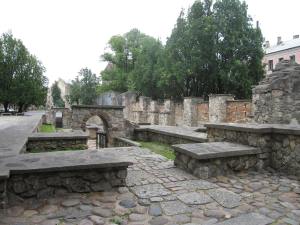
I am the daughter of a German Jew who came to England as a young teenager alone, leaving parents and extended family behind. I grew up in a synagogue community made up predominantly of survivors, and I remember not only the pain in their eyes, but also the dedicated devotion to create a vibrant and warm synagogue community. I remember the Jews who gave up their time to teach me and the other children of the community bible and siddur, albeit with strongly German accented Hebrew and English. I remember the Jews who gave up their evenings to plan for Jewish festivals to be both educational and fun, the Jews who gave free rein on the bimah to the young teenagers on the community because they knew that everyone should be able to take a service – you never knew when you might find yourself in a place where there was no one able to lead it for you. Few of them had roots more than a few years old in the community, yet they made roots for themselves and for their families. They settled in the main, though their children have generally moved on again to larger cities. But they did indeed make, if not a great nation, then a wonderful Jewish community and a link in the chain of tradition. They may not have noticeably received a divine blessing, but they did make for themselves a good name, and they lived out the imperative to be a blessing. When I look back at the journeys of the generations immediately before mine, the perilous journeys from what seemed to be simply called “Russia” at the beginning of the last century, or the terrified fleeing of Europe in the early middle part of it, and I see the fruits of those journeys, I see that we continually travel towards ourselves, as well as for ourselves. This strangely poetic formula is the only one to do justice to the journey.riga old synagogue memorial (Picture of Synagogue Ruins Memorial in Riga )

Parashat Noach: a sorry tale where God the Creator becomes God the Destroyer – never again

Ten generations after the creation of the world, it is so appallingly corrupt and violent that God can think of only one response – to wash it all away and begin again with the remnant of humanity that was the best of its generation. It is a terrible story to read – how, after such a short time, is the world so corrupt? How is God the Creator, able to become such a profligate Destroyer? What we have learned in the two weeks since we began to read the new cycle of Torah, is that human beings, created in the image of God, are able to both create and destroy, and also able to repent their behaviour.

world-destroyed-by-water

It is clear that the flood was not the answer God wanted or needed to the problem of world violence. Noah, who had not ever protested God’s edict, nor had warned his fellow people of the impending doom, is not exactly the most promising raw material. Added to his passivity in simply following God’s command to build the ark and stock it, once the flood had receded, Noah’s immediate response was to build an altar and sacrifice a number of the ritually pure rescued animals. God, on smelling the smoke finally seems to be defeated, saying “I will not again curse the ground any more for the sake of humankind; for the imagination of the human heart is evil from its youth; nor will I again destroy every living thing as I have done this time, but the regular seasons and rhythms will never cease.

The whole sorry tale was one that need never have happened. The earth is once again going to become corrupt and violent – albeit within cities such as Sodom and Gomorrah rather than everywhere and all at once – but it is a necessary story in the process of God learning about people and people learning about God. God has already learned about the exercising of free-will by the inhabitants of the Garden of Eden, and people have learned about the cost of freedom of choice. Adam and Eve have already shown the difficulties that marital relationships can encapsulate, and Cain and Abel have demonstrated not only the problems of sibling rivalry but also the problems of the lack of fairness in the world. The early stories of Genesis can be seen as ways to deal with the problems we all encounter – unrequited love as well as loving too much; the need for independence balanced with the need for relationship; the power of nature that we cannot ever control; the fragility of our existence in the world.

Bereishit: two questions to two generations – where are we now?

The Torah begins with two separate stories of creation. The first one is a very structured and ordered story, with each stage (or day) developing order out of the tohu vavohu, the chaos of the beginning. God creates by speaking words which then bring forth the thing – light and dark, and day and night. The heavens and the earth, each surrounded by their own watery boundaries. Sea and dry land.  Grass, herb yielding seed and fruit trees. Sun moon and stars. Water living creatures and those that fly in the air. Cattle and land walking creatures. Human beings. And Finally – Shabbat. God declares the goodness of each category in this physical world being created, and with the creation of humankind God sees that everything created is very good. And God blesses the Sabbath day.    The second story is a different narrative, and can be read as either complementary to the first adding details, or else as an entirely different tradition. In this story, human beings are created first rather than last, and man is created before woman, instead of them being created together. We are told the story of the Garden of Eden, with its trees of knowledge of good and evil, and of eternal life. The human beings eat from the first tree and are expelled from the garden lest they eat of the second. Their relationship is clearly not ideal, yet they produce children. Cain and Abel each offer a sacrifice to God, but while the sacrifice of Abel is accepted, the sacrifice of Cain is not. Cain, rejected by God, kills Abel his brother.                                                                                                                                The generations continue. Agriculture and technology become part of their worlds. But by the time of Noah ten generations after Adam, the world is a terrible place and God  has had enough of this creation. God is ready to destroy it…

Dvar Torah

Vayikra Adonai Elohim el ha’adam vayomer lo “ayekah?”  And the Eternal God called to the human beings (hiding in the garden) “where are you?” And the human said: ‘I heard Your voice in the garden, and I was afraid, because I was naked; and I hid myself.’ (3:9-10)

Vayomer Adonai el Kayin, Ei Hevel achicha? Vayomer ‘lo yadati. Hashomer achi Anochi?’ And God said to Cain, where is Abel your brother? And he said “I don’t know. Am I my brother’s keeper?” (4:9)

Two questions that God puts to two generations in the beginning narratives of Genesis.  In the first the people respond in fear, having understood just how vulnerable they are. In the second Cain tries to brazen out the fact he has murdered his brother, hoping somehow to get away with it. The first is a sin against God, the second a sin against another human being. We are learning in these stories the limits of behaviour. But we learn something else that is quite startling. What becomes clear in God’s response to Adam and Eve is that while they have disappointed God by taking the fruit of the tree of knowledge of good and evil, worse is that they do not take responsibility for their actions – the man blames the woman and the woman blames the serpent. They want, they desire, and they will lie in order to try to fulfil that craving. When they are sent from the garden the woman is told (3:16) that her desire will rule over her (yimshol). Humankind will always be trying to master their own selfishness and wants, it will be an ongoing struggle. But Cain, he seems to struggle rather more than his parents, he responds out of disappointment and rejection when God does not accept his offering, but does accept that of his brother Abel – God says to him ‘Why are you angry? and why is your countenance fallen? If you do well, shall it not be lifted up? and if you do not well, sin couches at the door; and to you is its desire, but you may rule over it.’ Ve’ata timshol bo (4:7). Cain is given the possibility of triumphing over his selfishness – albeit he only takes it up after the awful event, when he repents and says that his punishment is more than he can bear.

The rabbis notice the difference in the taking on of responsibility. According to the midrash (Genesis Rabbah 22:13) Cain later meets Adam who asks him about the punishment he received, and Cain tells him “I repented and am reconciled”. At that point Adam began to weep and to keen, saying “so great is the power of repentance, and I did not know”.

The power of God’s words to Cain is proved – while we will always struggle with behaving well, while the willingness to behave selfishly and thoughtlessly is always close by and ready to come to the fore, we can indeed take responsibility for our behaviour and choose NOT to behave in a damaging and egotistical way. We can think of others, we can choose to forgo what we want for the benefit of our community or wider society, we can decide not to take, not to hurt, not to ignore.

So soon after the yamim noraim the lesson is driven home in torah. Repentance is always the path back to God, who waits for us patiently, hoping to be found. And Torah reminds us of our human frailty – that we might rather lie than take responsibility for our actions, that we may prefer to brazen out what we know to be unacceptable behaviour, or deny our accountability or liability – human beings will always try to find a way to get what we want or what we think we deserve. But it is the taking of responsibility, the true acceptance of what we do and the genuine desire to become better people that will help us to win the struggle so that we too will be able to overrule our baser natures and become a little more like the divine.

Nitzavim Vayelech: Standing Up – for each other and for our common humanity.

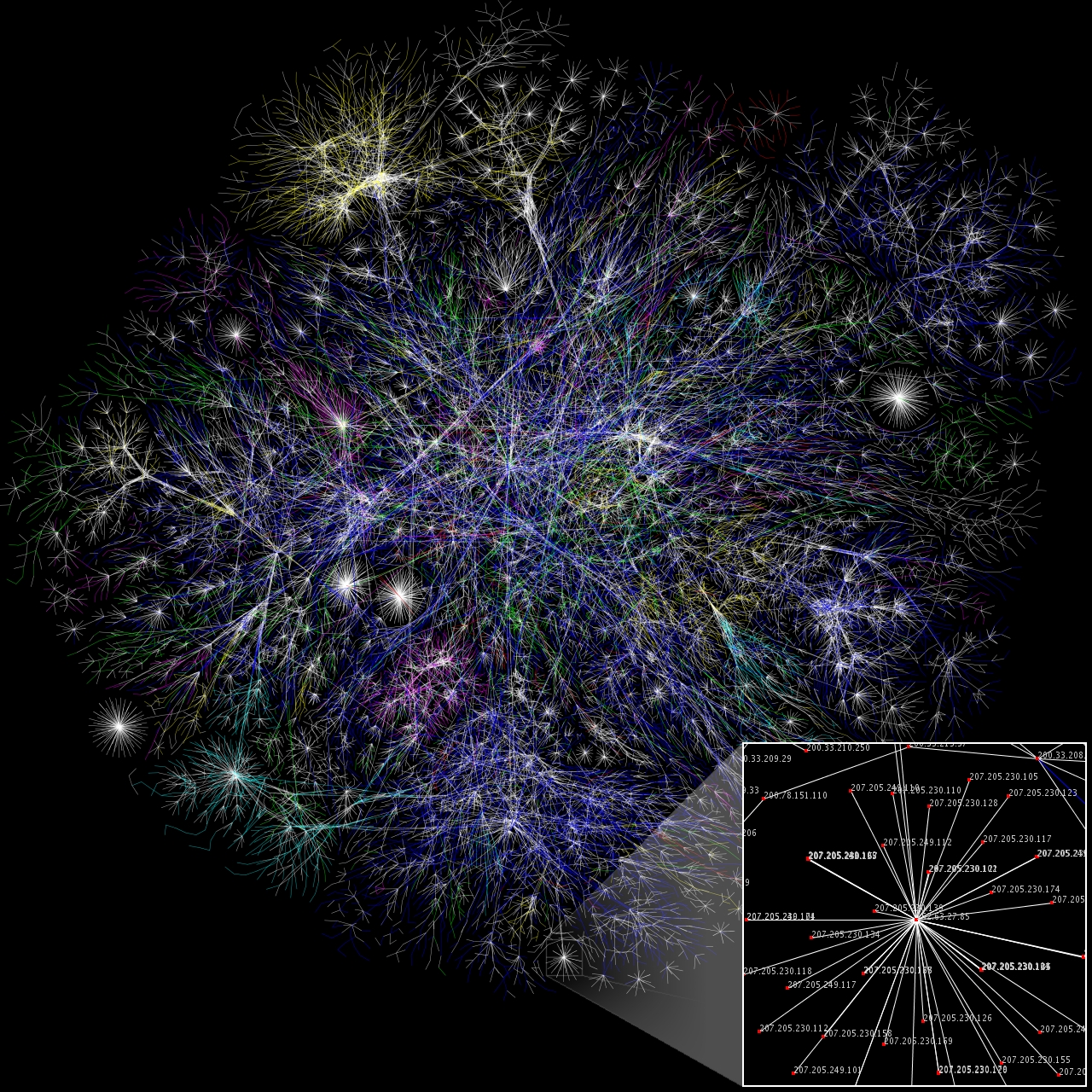
Internet_map_1024

In Nitzavim Moses warns that “The secret things belong to the Eternal our God; but those things which are revealed belong to us and to our children forever, that we may do all the words of this Torah.”  (Deuteronomy 29:28). It sounds perfectly reasonable as a sentence until one starts to look a little closer – what are the secret or hidden things being referred to here? What are the revealed? And why the need to state the distinction? It is an obscure verse and open to much conjecture.

Rashi understands this verse as one where Moses reassures the people who are standing and accepting the covenant for all time and all Jews – even those not yet born. They must be afraid that they will be held responsible for things about which they knew nothing, as part of some Jewish collective responsibility – indeed we are told in Talmud (Shevuot 39a) that” Kol Yisrael areivim zeh la zeh – all Israel are responsible, one for the other.” So in Rashi’s eyes Moses is explaining that any sins that were openly committed and that we might have been able to prevent or mitigate – these we remain responsible for. But actions done in secret, about which we can have no knowledge – these are left for God to deal with; and he goes on to explain that God will indeed punish sins that are not publicly known about, if they are not acknowledged or mitigated.

One of the great themes of the end of the book of Deuteronomy is ‘arvut’ – the mutual responsibility between Jews. As the leadership of Moses is coming to an end, he clearly foresees a splintering of the group, maybe the challenge of a number of different leadership candidates, and he does his best to prevent this by stressing the communal nature of our relationships with each other. So here we are reminded: we are part of a single people bound by a single covenant. We cannot afford to ignore what each other is doing, or to challenge what we see to be against the values of our tradition, or to excuse something as fringe or marginal or not impacting upon us.

There is a something else that adds to the oddity and opacity of this verse – in the scroll the words ‘for us and our children’ with dots over each letter. The reason for this scribal notification is not known, but it drags our attention to the verse asking for us to pay even more intense attention to it.

We read in the Talmud: Why are there dots over ‘for us and our children’ and the ayin of ‘ad’? To teach that they were not punished for the hidden things until the Jews had crossed the Jordan – the words of Rabbi Judah. Rabbi Nehemiah said to him: Is one ever punished for the hidden things? Doesn’t it say: to eternity? Rather, just as one is not punished for the hidden things, so they were not punished for the revealed things until the Jews had crossed the Jordan. (Sanhedrin 43b)

The Talmud seems to imply that the collective responsibility only comes into being once the Jews had arrived in the land, that the peoplehood only becomes absolute at the point they have a land. This idea has evolved as the Jewish people fulfilled the Abrahamic promise by being dispersed all over the world, and as the land became metaphor more than reality for so much of Jewish history to grow into a sense of collective arvut – of responsibility for more than our Jewish community but for the different communities of which we are part, and certainly our identities have become more complex and overlain with different relationships. We grow into our communities when we have shared purpose, shared values, shared space. But the dots over the phrase “for us and our children” direct us to look deeper and closer, and again Rashi comes to our aid. Rashi, (commenting on Psalm 87:6) suggests that “the hidden things are not sins, but people” – that while many Jews have left Judaism either through historical circumstance or through assimilation, and their children may never even know of their Jewish history and backgrounds, Rashi understands that their Jewish roots are never forgotten by God.

Now this may make some people uncomfortable. In Nitzavim we were entered into a covenant without either assent or consent – by our descending from Jewish parentage we are part of this covenant whether we like it or not. Jewishness is something that is given to us whether we wanted it or not. Similarly, the understanding of a verse around this covenant is that we can never escape it – even if we no longer are aware of being part of the Jewish people, by virtue of heritage all who descend from that time will find themselves brought back into it. One thing that it does do however is to bring into focus that we cannot really know anyone’s yichus, and that we should trust God’s judgement over our own. It also means that we cannot be narrow in our understanding of who is in our community, with whom we share responsibility – the obligation to care for others extends beyond the confines of family or known community, out to the whole human world – the arvut is rightly broadened out to include all the groups among whom we live.

This verse about the hidden and the revealed reminds us that we cannot know everything about the world. It reminds us that we have responsibility for what we do or should know about – and it also reminds us that one of the things we know is that we cannot know for sure where the boundaries of our community lie, only that they extend into the human race.

Danny Siegel wrote a wonderful poem which speaks to us in the same way, a poem I love to read and use to remind myself of the extensiveness of arvut:

“If you always assume/ that the person sitting next to you/ is the messiah/ just waiting for some simple human kindness/ You will soon come to weigh your words/ and watch your hands/ and attend to your responsibilities./ And/ if he so chooses/ not to reveal himself in your time/ It will not matter. (Danny Siegel, ‘A Rebbe’s Proverb (from the Yiddish)’)

Image taken from Wikipedia internet map http://upload.wikimedia.org/wikipedia/commons/d/d2/Internet_map_1024.jpg