The Ascent of Women, the Assent of all of us: or how we are all part of progress

When a woman vows a vow to God…being in her father’s house, in her youth, and her father hears her vow….and holds his peace, then all her vows shall stand…. But if her father disallows her in the day that he hears, none of her vows… shall stand; and God will forgive her, because her father disallowed her.

And if she be married to a husband, while her vows are upon her…  and her husband hear it, whatsoever day it be that he hears it, and hold his peace at her; then her vows shall stand.. . But if her husband disallow her in the day that he hears it, then he shall make void her vow which is upon her, and the clear utterance of her lips, wherewith she has bound her soul; and God will forgive her.

The vow of a widow, or of her that is divorced, even everything wherewith she has bound her soul, shall stand against her.

….These are the statutes, which God commanded Moses, between a man and his wife, between a father and his daughter, being in her youth, in her father’s house”

On first encounter this makes dispiriting reading for any feminist.  The patriarchy is being powerfully accentuated. A woman in relationship with a man – be it father or husband – may make vows just as men may do, but her ability to do so is constrained by the man in her life. He can annul them if he wishes to do so.

After reading only a few chapters earlier of the case of the daughters of Zelophehad who won the right for women to inherit property from their father (a right which will also be limited in this sidra) it is a splash of cold water to see how bible seems to accept the status of women as lesser than that of their men.

But a closer reading gives some cause for hope. Bible is a text that responds to its context, it brings the assumptions and the classifications of the ancient world but often with a twist that undermines the certainties of the world it springs from.

We are given three cases here of women’s vows.. the young daughter, the wife and the widowed/divorced woman.  Two of them are economically dependent on the man in whose house they live, one is in charge of her own economic fortune through the payment of her Ketubah. The vow, which may well have required future payment, could be problematic for the woman if there was no money to fulfil it. It seems that in these cases the husband would be able to annul it in order to protect the finances of the household that were his business to safeguard.  So while it is still frustrating to note that women who were in the roles of daughter or wife did not have a real say over the discretionary spend of the household, we can look at these cases again and see two encouraging signs. First, that the woman has the right to vow – this is not in dispute. A form of religious expression (however problematic) is open to her from youth onwards. And secondly we see an interesting development. The man has the right to annul her vow, but ONLY if he does so within the day of the vow being made. Otherwise he not only has to allow it, he has to support its execution. The language strengthens so it is not just to allow it to stand but he must establish it – heikim otam.

It doesn’t look like much, but this is indeed a revolution in the status of women. A man doesn’t control a woman’s vow in perpetuity – there is a very limited window where he can protest and annul, in order to defend the family finances. After that he must help her to fulfil her vow.

Talmud picks up this revolution and develops it. They take seriously the idea that the daughter at home is young (bin’urecha) and limit the time she is under her father’s power for this up till the age of puberty – around twelve years old. After that, she may vow her own vows.  A husband is not able to annul vows a woman made before her marriage and after the age of puberty, and indeed the Talmudic sages limit even the vows she makes after marriage to those which impinge on him or which afflict her.

There is a further principle that is introduced here that will become important in the later development of Halachah.   The phrase      וְשָׁמַ֤ע  וְהֶֽחֱרִ֣שׁ לָ֔הּ

And he heard [the vow] and he was silent /held his peace  is taken as the proof text that in cases like this  silence is assent.   One who could protest but does not do so is deemed to have assented.

Now sometimes this principle is taken out of context – for it is important that the person who is deemed to have assented through their silence both knew the implications of what was happening and also could properly protest.  The silence of people who are frightened or vulnerable or feel themselves to be powerless is NOT assent. Just because someone does not whistleblow in their employment or does not fight back when physically or sexually attacked, assent to what is happening cannot be inferred.

But it does mean that we, who maybe watch the news and see unfairness happen in the world, see refugees attacked or maligned, see pensioners robbed by the owners of their fund, see Governments create policy that will widen the gap between those who have and those who have not – we must not assent. We have to protest and continue to protest.

And there is no limited window for such protest – if we see injustice we have to stand up and say so, demand compensation and change.

Bible shows us that the way the world works isn’t for all time. It takes the status of women’s vows and it changes how they can happen from the usual customs. Talmud takes the journey further, promoting more fairness, more agency to the people who were once without agency.

It is up to us to take the next steps into more fairness, more justice. Our silence must never be construed as assent, and to make sure that it isn’t it is time for our voices to be heard.


Beha’alotecha: the silencing of Miriam and the Cushite woman

And Miriam and Aaron spoke against Moses because of the Cushite woman whom he had married; for he had married a Cushite woman.” (12:1)


She is the ultimate object, critical to the narrative but without voice or name. She exists only in passivity – the woman that Moses had taken.  Ha’Isha HaKushite, black and female, her presence in the text is enough to irritate Miriam and Aaron, but not enough to make any statement of her own.  Only her femaleness and her blackness are remarkable, and both are cause to keep her powerless. The unseen narrator sets her up against Miriam, the powerful sister of the man to whom she is married, a woman earlier described as a prophetess – yet Miriam too is demeaned and diminished in this interaction.


Framed between the story of the false prophesying of Eldad and Medad, and the divine statement that only Moses’ prophecy is entirely trusted, this is a story about real and illusory power and the two women are ciphers, literally seen in black and white, silenced .


Miriam is described as challenging Moses “on account of the Cushite woman he has taken as wife”, even while the speech reported to us is about the equal prophetic status of the triumvirate of siblings: “Has the Eternal indeed spoken only with Moses?  Has God not spoken also with us?’    And it is noticeable that Miriam alone is punished, even though Aaron had joined her in asserting their status in relation to Moses. Why does the narrator divert our attention towards race and gender when the issue is about the leadership of Moses and the relative status of his sibling co-leaders?


We never learn more about the Cushite woman, about when Moses married her, about her story and how she came to be with the Israelites and the mixed multitude leaving Egypt. We know that ancient civilisations were racially diverse and there is a buried history of black Egyptians which only now is being recognised by scholars, but our modern categories of race are not those of the ancient world. Her description as Cushite signifies only that this is not Zipporah, Moses’ Midianite wife.


It is sometimes said that the story of Miriam and the Cushite woman proves that God has a sense of humour, that Miriam who complained about this black interloper is given her comeuppance by God when her skin is turned white as snow with the impurity of tzara’at. And her anger at her relative loss of leadership status leads to her exclusion from the community, put outside of the camp until her skin heals once more. Comical reversals of fortune.


But there is a murkier thread to this tale. For now both women are silenced, both passive recipients of the narrators attention.  Aaron, who confesses their joint sin, is not only unpunished for his part in challenging Moses’ authority but joins together with him in prayer for her healing, leading the people who are anxiously awaiting her return to camp. Both women are now out of action, their skin colour and their gender apparently rendering them unsuitable for a role in the public space. The power of the men is enhanced.


A Jewish friend of mine, married to a black woman, once told me that their fights usually ended up with her telling him he could always take off his kippah and ‘pass’ in society, but she could never take off her skin, echoing Jeremiah who asks “Can an Ethiopian/Cushite person change their skin, or a leopard their spots?” (Jer13:23) Some things about us are the first thing that people see, and sometimes those people never get past that attribute. Never notice the person inhabiting that skin.  Sometimes they dismiss the person because of the characteristic, ignoring them or silencing them, putting them ‘outside the camp’, not hearing their voice or recognising their cause.

Whatever we might wish, society is neither colour nor gender blind. But noticing characteristics should not lead to disadvantaging their bearers.


The prophet Amos had God ask “Are you not like the Children of the Ethiopians to me, O Children of Israel?”  Bible reminds us that our common humanity is recognised by God who sees beyond the outer aspects. But it also reminds us that we often fail to see that shared humanity for ourselves, that we categorise and judge by gender and by race, and those who are so judged can find themselves trapped without voice or power to change the perception.


We never find out the fate of the unnamed woman from Ethiopia, but we do have one shaft of light at the end of this story. The people wait for Miriam to be healed and brought back to the camp before they move on. She may be chastened, but Miriam is back in the public space, and one day she may yet sing with her unnamed black sister, their voices raised up – and heard and responded to by all.


First published in Jerusalem Report The People and the Book 2015

image “Miriam The Leper” by Rose Rosenthal http://imajewnation.org/the-museum/past-events/freedom-imagined-freedom-lived/part-3/


Shavuot: the voice of God is heard in the voices of ALL the people. (Or women were at Sinai too, and at the kotel)

In a very few days we will be celebrating Shavuot, a festival of biblical origin which can lay claim to being  one of the most mysterious of our holy days. To begin with, it has no fixed date but instead we have to count towards it from the first day of the Omer, the bringing of a sheaf of the new barley harvest which must be offered in thanksgiving before the harvest can be used. In Leviticus 23 we read “And the Eternal said to Moses, Speak to the Children of Israel and tell them, ‘When you are come into the land which I am giving you, and you reap its harvest, then you will bring the first omer of your harvest to the priest, and he will wave the omer before the Eternal for you to be accepted, on the morrow after the Sabbath, the priest will wave it…and you will not eat bread nor parched corn nor fresh corn until this day, until you have brought the offering of God, it is a statute forever…and you will count from the morrow after the Sabbath from the day that you brought the omer of waving, seven weeks shall be complete, until the morning after the seventh week you shall count fifty days, and you shall present a new meal offering to the Eternal” (9-16)

In this opaque text a few things stand out: That we must bring from the new harvest in thanksgiving to the Creator of all before we can eat from it. That we must count a period of fifty days from the bringing of one harvest (barley) till the next harvest (wheat), and that the fiftieth day is also to be a festival with full ritual panoply.

It is a feast of harvest, a festival of first fruits – but so are other festivals. It feels like there is something missing in the text, some other layer that was either so well known as to be pointless to explain, or something so deeply mysterious as to be impossible to explain.  Its name is also problematic – in the same chapter we are told of the festival of matza called Pesach and of the festival of booths called Succot but Shavuot – it just means weeks.

The lacunae were noticed very early on and if nature abhors a vacuum, rabbinic tradition refuses to allow one too, rushing to fill any apparent jump or void in text with explanation and midrash. So to begin – what is the date of Shavuot? Should it always be a Sunday, as it would be if we really counted seven weeks from the ‘morrow after the shabbat’    הַשַּׁבָּת  מִמָּחֳרַת

The Second Temple period was one of great disruption and great creativity. Two powerful groups – the Pharisees (forerunners of the Rabbinic tradition) and the Sadducees (political and priestly elite) differed as to the date of Shavuot. The Sadducees read the text literally – the counting began the day after the Shabbat, while the Pharisees interpreted it, specifically that the word “Sabbath” was a word meaning not just the seventh day, but also “festival”, specifically in is case the festival just described before the text quoted, and therefore the omer counting would begin the day after the first day of Pesach.  At a stroke Shavuot was linked to Pesach and with a little creative accounting with the days of the journey towards Mt Sinai the Rabbis could attach the events at Sinai, the giving of the Ten Commandments and the creation of peoplehood with Torah as its powerful identifier to this date. So Exodus linked to Revelation, Freedom to Responsibility, and Shavuot stopped being simply an agricultural festival on a date that could vary and became a fixed point – a high point – in our journey to Judaism.  Shavuot became zeman matan torahteinu – the time of the giving of our Torah – the oral as well as the written – and more than that became the date of the unbreakable covenant made between God and the Jewish people.

So by extension, Shavuot became understood to be the date that we became not just a people, but God’s people. God descended far enough from the heavens to build a different kind of relationship with us, offered us a gift in order to delineate that relationship. And the language of marriage came into play – God wooed us in the desert and brought us to Sinai where the ‘wedding’ took place. God plays the part of the groom, Israel of the bride, and the words of Hosea are used “I will betroth you to me for ever, I will betroth you in righteousness and justice, In love and compassion, I will betroth you in faithfulness and you will know the Eternal (Hosea 2:2.1-2.). The mystical tradition went so far as to create a wedding liturgy within the Shavuot service, and famously Israel Najara, the poet and mystic of Sfat, created a ketubah to be read before the Torah reading in which God as bridegroom and Israel as bride are symbolically betrothed.

Some texts see the marriage as between God (groom) and Israel (bride) with the Torah as the binding contract; others see it as between Israel as groom and Torah as bride, with God as witness and the Oral Torah with Shabbat as dowry. Whichever role the participants took, the imagery of the marriage relationship is one of the most potent of the festival, and it points to the power that the rabbinic tradition saw in the marriage relationship.

The people of Israel as the bride of God, the covenant of marriage being marked with Torah, with Shabbat, with gifts that bring us closer to God – it is extraordinary in so many ways.  The position of the woman in this image – that she is Israel, that Israel is fundamentally feminine, and that the relationship is one of real love and partnership between both parties to the agreement -this is the ideal of marriage. Right from the creation stories in Genesis, where God created men and women at the same time, or where God created woman to be ezer k’negdo, a partner and help who was equal and in dynamic tension to the man, the relationship of marriage between two companions in bible and in the early rabbinic world was real partnership and both parties had their own agency and autonomy which contributed to a strong and confident enterprise.

Quite how we got to the position today from this ideal and idealised partnership to women being marginalised and disempowered in many areas of ‘traditional’ Judaism is a long and painful journey.  How has Israel, the bride of God, relegated its own women to behind a mechitza, distanced us from prayer and from learning, spun stories of idealisation that turn the Shavuot ideas on their head, (for example those about the special spirituality of women which means they don’t need to perform mitzvot). Over time there has been a persistent and incremental and continuing removal of women from the discourse of partnership, from the public space and from the partnership which is developed and rooted in the Shavuot mythology of the marriage between God and Israel.  At Sinai the mountain trembled and the people trembled and all the people stood together at the foot of the mountain and all the people answered together saying “everything that God has spoken we will do” as the voice of the shofar was heard and God answered Moses with a voice.  Voices mingling and speaking and answering – God’s voice, Moses’ voice, the voice of all the people, the voice of the shofar. But now it seems that some voices have precedence and other voices must be stilled. After generations of lying fallow and unused in Talmud the dictum of kol isha has surfaced in rabbinic thinking as a prop to their wish to remove women’s voices from their hearing.

Yesterday on Rosh Chodesh Sivan, the women of the wall (WOW)  in Jerusalem held their service for the new month early in the morning. 80 women and more prayed together from their hearts, welcoming the new month and the upcoming festival where Torah was given to ALL the people at Sinai. The prayer was respectful and peaceful and yet – Lesley Sachs, the Director of WOW was detained with the Torah scroll immediately following RH Sivan prayers. Despite a quiet prayer, Sachs was held by police for “disturbing the public order”.  The man who oversees the administration of the wall Rabbi Rabinowitz told journalists that she had smuggled the Torah scroll in under her skirt. An extraordinarily offensive accusation that was provably untrue – she was wearing trousers. But this insight into the mind of the ‘traditional’ rabbi tells us a lot as to why women’s voices are being silenced – what exists under a woman’s skirt is somehow terrifying, our sexuality must be controlled and restrained, a woman’s voice is her nakedness/lewdness in the minds of those who distort the biblical quotation (from a woman’s voice is her sweetness)

We are approaching the anniversary of what happened at Sinai when ALL the people witnessed the divine theophany and ALL the people accepted Torah.  This Shavuot it is even more important that we make sure that ALL the voices can be heard in our public spaces and places, in teaching and learning, in work and in play.  For if God chose to do to Israel what some in Israel choose to do to women, then the marriage must surely be voided on grounds of complete deviation from the agreement.  The countdown is nearly over, the last days of the omer are here. It has been a period of reflection and quietness, readying ourselves for the revelation. Let’s hope the revelation takes us back to our roots, and that the voice of women in prayer and learning will once again be heard with the voice of men doing the same.

This slideshow requires JavaScript.

Beshallach/ Shabbat Shira: the Song of Miriam

“And Miriam the prophetess, the sister of Aaron, took a timbrel in her hand; and all the women went out after her with timbrels and with dances. And Miriam sang to them: Sing ye to the Eternal for God is highly exalted: the horse and its rider God has thrown into the sea.”

Shabbat Shira, the Sabbath of Song, is named for the Song at/of the Sea (Shirat haYam) and this name takes precedence over the usual format of the first important word giving the title to the week. Shirat haYam was the song of victory sung by the Israelite slaves after they had successfully crossed the Reed Sea, and the pursuing Egyptians had drowned there following the miraculous opening and then closing of the waves to allow the Israelites safe passage but not the heavily armed Egyptians.

Along with the poem in Deuteronomy (Ha’azinu) it bookends the story of Moses and the people of Israel as they leave Egyptian slavery and journey through the wilderness to arrive at the edge of the promised land, and tradition ascribes its authorship to Moses.

But tucked into the text a little way down we are introduced for the first time by name to Miriam, described as “Miriam the prophetess, the sister of Aaron” and she takes a drum in her hand and leads the women in singing and dancing and drumming to celebrate the victory. And while apparently singing the same first line, Moses and the children of Israel sing “I will sing to the Eternal, for God is highly exalted” while Miriam sings “Sing to the Eternal, for God is highly exalted”. She uses the imperative version, whereas Moses and the Israelites use the personal pronoun.

The order of the text makes us read this as the song of Moses, but is there a clue in the wording of the text to tell us that this is the song of Miriam?

In the fragments of text found in Qumran (known as the Dead Sea Scrolls) we find a tantalising addition. Just as in the biblical text we find that “Miriam the prophetess, the sister of Aaron took a timbrel in her hand and led the women out with her with timbrels and dancing”, but then there is a break, and then the fragments of seven lines NOT found in the biblical text, followed by the narrative being picked up as the biblical verse 15:22 where Moses leads the Israelites away from the Reed Sea into the desert, and the people find no water until arriving at Marah they find undrinkably bitter (Marah) water.

Is the Qumran text a gloss on the biblical poem of Moses, answering the question of what Miriam might have sung and paralleling other songs of victory or was it the original text which took away words from Miriam and the women in order to give them to Moses and the Israelites? We know that women sang songs of victory after battles – Deborah is a prime example whose song is recorded (Judges 5), and Jephthah’s daughter (Judges 11:34) comes out with timbrel and dancing on his return home. Unnamed women come out dancing and singing with their timbrels when David returns having defeated the Philistines (1Sam 18:6-7) celebrating his success and humiliating King Saul’s record. Hannah (1Sam:2) sings when she achieves her goal of a child, and the late book Judith has her sing in the final chapter, having beheaded Holofernes…

So why not Miriam and the women singing their song? Miriam the prophetess was also Miriam the musician and song leader. Her voice and her words deserve to be heard and to be recognised.

miriams timbrel

Whatever the reason for the biblical canon to contain just the remnant of her singing with the women, apparently echoing the words of Moses and the men, so that tradition could claim her as the song leader for the women only, I think there are enough clues left for us to give her the power and place she deserves.

The first place that Moses leads the Israelites to is called by the narrator “Marah” , after the bitter and undrinkable water found there and there is much murmuring against Moses until on God’s instructions he finds a tree whose wood will sweeten the water. Moses uses this as a teaching aid to remind the people that God is their healer, and then they move on to Elim where there are twelve good water sources and seventy palm trees. Is this a veiled reference to Miriam, whose name is impossible to translate with certainty but which is often understood as coming from “Mar – yam – bitter – water/sea”? Are the people murmuring because of Miriam and her treatment by Moses that he appropriated her rightful role? And are they pacified by the oasis of plenty represented by 12 springs and seventy palm trees and so forget their indignation?

But more intriguing I think is the possibility that Miriam’s name is not derived from bitterness MRH) but comes from a rarely used root MRR to mean a flow of water, drops of water or a watercourse. In which case her name would mean the flowing of water or the directing of water – something that would come to fruition not only in the midrashic idea that wherever Miriam was there was water for the Israelites in the desert (which comes from the drought that is the first reported event after her death), but from this text about the Reed Sea, which changed direction, flowed differently and intentionally while the Israelites crossed it. The name Miriam, introduced exactly here, is I think a clue to her purpose –  we are already explicitly told that she is a prophetess, she has real and intentional meaning and understanding – it is Miriam who causes the sea to part and the miraculous redemption of the fugitive people. Her name, hiding in full view, tells us exactly that.

So the Song here attributed to Moses yet called slightly confusingly Shirat HaYam , the Song of (or at) the Sea (a name first recorded in the 2nd Century in Talmud Yerushalmi), might actually have been Shirat MirYam, the song of Miriam. And how powerfully that simple change could have affected our understanding of our foundational texts and shaped the hearing of the voices of women in our tradition.

Drop by drop as we look again at the texts, we who see Miriam as a role model, who see ourselves reflected in her life as prophetess, sister, organiser, carer for children, provider of life giving water/nourishment, song leader, drummer and dancer , as well as a hard worker behind the scenes who protested injustice done to others and the arrogating of power to the male leadership – we need to take notice of the effect that the flow of water can have – it can wear away the hardest rock. Drop by determined drop we take up her mantle and raise our voices in song and in challenge and in prophecy, and hope that this time the words will not disappear from the canon.

(Photo of Miriam’s timbrel and the reeds in Egypt/water of the Reed Sea from an embroidered Torah Wimple made by Caroline and Naomi Ingram for the author)

Shabbat Bereishit: the yahrzeit of Rabbiner Regina Jonas

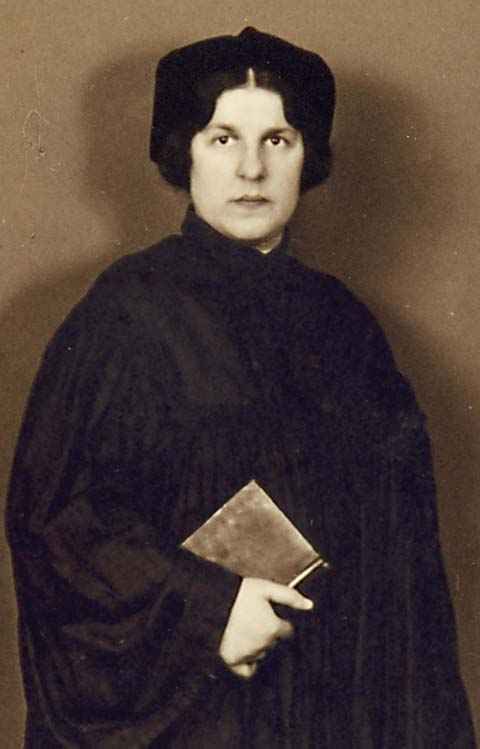
Fraulein Rabbinerin Regina Jonas, the first woman to be ordained Rabbi in modern times, was murdered in Auschwitz in 1944 and her name and story submerged until the fall of the Berlin Wall meant that some of her papers were retrieved and studied.

Jonas-Regina

Her story is a complex one. We know tantalisingly little about her; there are some basic facts about her birth and parentage. She grew up in a poor part of Berlin, and after the early death of her father when she was only eleven years old, she, her older brother and her mother became ever poorer. She lived amongst Jews from Eastern Europe, whose religious practise was orthodox (as was hers). In her teens she found the comfort of the synagogue, and never really left. The rabbi helped her to take her Jewish studies to a level where she could make a living teaching, and so she supported her widowed mother and herself as best she could, and she continued to study, and she dreamed of rabbinic ordination, writing her thesis on the subject “Can Women Serve as Rabbis?” and proving to her own satisfaction that according to Halachah the answer was ‘yes’

While her thesis was sound, academic scholarship was no match for centuries of misogyny and custom. Her teachers would not ordain her as a Rabbi. She was the victim of a collision of circumstances- her teachers did not want to cause a problem in the wider Jewish community by going outside of orthodox tradition and ordaining a woman. The conditions in Germany in 1933 were preoccupying the German Jewish world as they cast about looking for a rational response to an insane situation. More than that, she was an orthodox woman studying at a Liberal institution. She was widely perceived as being ‘strange’, a woman who did not care about her looks, an academic whose mind did not deal with frivolity, a radical and transgressive figure who yet wore the clothes of convention and tradition. She challenged many social and religious norms, demanding her right and coping with what was clearly some hostility towards her. She was said to be a good teacher, a good pastoral worker, yet even with the dwindling number of rabbis in Germany she could not find a community willing to take her. Her work took place in the old age homes and the hospitals – the traditionally gendered “caring” roles.

Regina Jonas comes across as an isolated and lonely figure, a trailblazer and pioneer who did not however achieve a following in her lifetime. Yet she did not give up. She worked wherever she could, and before deportation to Theresienstadt she ensured that her papers would be lodged in the archive from where some fifty years later they would emerge. She deposited photos of her in her rabbinical gown, her ordination certificate and some press cuttings. She held on to a hope that she would be remembered, not go nameless and forgotten into the future.

She worked in Theresienstadt for two years, teaching, giving a series of lectures, acting pastorally and rabbinically and working in the team of the famous psychoanalyst Viktor Frankel – her job was to meet the trainloads of shocked and frightened Jews transported to the ghetto and to try to comfort them. She worked hard and with great dedication for two years until she too was sent to Auschwitz where she was later murdered.

Her date of deportation was 12th October 1944. It was Shabbat Bereishit, the first Sabbath after Simchat Torah, when we finish the book of Deuteronomy with the death of Moses and the transition in leadership to Joshua and we immediately begin to read the book of Genesis with its universal story of the creation of the world.

On Shabbat Bereishit we learn that leaders die but leadership goes on. That ideas are stronger than individuals. That out of endings come new beginnings.

We don’t really know very much about Regina Jonas except what we can try to piece together from scant evidence and tiny remnants of memory. Having been officially forgotten from 1942 until the early 90’s she has re-emerged, as ambiguous and as perplexing as she seems to have been in life.

We progressive women rabbis have taken her for a standard. She has become “the first woman rabbi”. Her story reads as a cautionary tale for the rest of us – will we too disappear after working so hard to achieve, after caring so much, after labouring at the coal face of the community rabbinate?

Anger has been expressed at her ‘disappearance’ from the narrative when so many who knew her or knew of her never bothered to pass the information on to the next generation of women studying rabbinics who felt so lonely, so trailblazing, so exposed. There is the sense that if only we had known about her when studying ourselves, we would have been able to speak of her and so be comforted by her earlier initiatives. She would have stood between us and the void of women rabbis in history.

We have taken her for a standard, and now we have adopted Shabbat Bereishit for her yahrzeit, the probable date of her death. In Bereishit we read the two stories of creation – the first where women are created equal to men and at the same time as them; the second where woman is created from the side of the first man to become ezer k’negdo, a help and an opposition to him.   Regina Jonas’ life expresses so many ideas in this Torah reading, read both on Simchat Torah and the following Shabbat – it is almost as if it were bashert. The way she lived her life demands of us that we take seriously the questions she posed to the conventions and community of her time as we look at how those questions are asked and answered in our time and communities.    But maybe we should also be more honest and say that Regina Jonas is not the forerunner of women in the non-orthodox rabbinate – she is really the forerunner of women in the orthodox rabbinate. That now there are women with orthodox semicha is exciting, though there is still a long way to go for them to be much more accepted than Regina Jonas was when she finally received her semicha eighty years ago.

Eighty years – twice times 40, the signifier of “a long time”. Eighty years, the biblical length of a long life. And so much has happened since her ordination. The number 80 is signified by the letter Peh. It is an explosive sound. It means an opening or a mouth. The Torah is both written text (bich’tav) and oral (she’b’al peh). It give me some satisfaction that at 80 years since ordination there are women rabbis in every stream of Judaism. Regina Jonas’ mouth continues to open and to teach, and each of us embroiders what we hear.

Forty Years of Women Rabbis in Britain: From Regina Jonas to Jackie Tabick

In bible, the number ‘forty’ is code for ‘a very long time’. The years marked in tranches of ‘forty’ are also usually times of trial or probation. Forty years ago Jackie Tabick was ordained by the Leo Baeck College as the first woman Rabbi in the UK. Forty years before that, in 1935, Regina Jonas was ordained privately in Germany. Before Jonas there had been other women who had achieved the scholarship required to function as a rabbi, and there were a number who had sought to be ordained as rabbis and failed. The question about women’s ordination was asked yet somehow never answered, responded to instead with ridicule or outrage or dissembling. Even where there appeared to be a rabbinic will to ensure religious equality, somehow this never got past the ideological stage. The father of German Reform Judaism Abraham Geiger called for equality for women as long as it did not transgress “the natural laws governing the sexes”, while those who left Germany to develop Reform Judaism in the USA also called for full religious emancipation for women but failed to either discuss the measures needed, or vote upon the call at the 1846 Breslau Conference due, they said, “to lack of time”, and had anyway moderated their call for women’s religious equality “so far as it is possible”.

Until Regina Jonas, many women studied but none took away more than a certificate that qualified them to teach Judaic studies. Jonas was different. Clearly formidably determined, with no status to lose either within the Jewish world or the rapidly disintegrating secular environment, she pushed and pushed, writing her thesis on the question “May a woman hold rabbinic office?” and having examined the rabbinic literature concluding “Almost nothing halachically but prejudice and lack of familiarity stand against women holding rabbinic office” .

Jonas studied at the Berlin Hochshule, where a number of teachers at both Leo Baeck College in London and Hebrew Union College in the USA had trained. They must have been aware of her and her struggle to overcome the prevailing culture that mitigated against the early ideology of Reform Judaism, and yet they never spoke of her. They didn’t tell us of her semicha, or her work as rabbi and teacher in Berlin albeit not in the synagogue setting. After her death in Theresienstadt she vanished into history until the fall of the Berlin Wall and the opening of archives, ironically to be rescued by Dr Katerina von Kellenbach, a Christian researcher who had written on anti-Jewish themes in feminist theology.

In the daughter seminaries of the Hochshule women came to study, but fell by the wayside before reaching ordination. It is noticeable that Sally Priesand and Jackie Tabick, the two women first ordained in the States and in the UK, were women who entered their respective seminaries unsure that they would be seeking semicha, women who were by nature private and introspective people, who chose ordination after beginning their studies. Somehow it seemed they flew under the radar, not challenging the rabbinic faculty, not interested in what Priesand called “the unbelievable and almost unbearable pressures of being the first woman rabbi”, and possibly because of their unconfrontational natures they found themselves at the end of their studies with the majority of their teachers willing to give them ordination – though this was not unanimous.

Both became associate rabbis in large synagogues and both left after serving well and faithfully when it became clear that they would not become the Senior Rabbi. As Sally Priesand said she believed that “ability, sincerity, and dedication would outweigh gender” but she learned that “competence and commitment are enough for a man, but not for a woman.” There was certainly a view among the pioneering women rabbis in this country that we had to work extra hard and extra well to justify our desire to enter the rabbinate, though this fear has weakened over time.

Biblically forty years describes a long time characterised by trial and probation. In the forty plus years women have been ordained by seminaries, have we passed the test? And has the Jewish world come to terms with women rabbis? In the non-Orthodox world women rabbis are a fact of life. Leo Baeck College has ordained 52 women for progressive movements around the world, HUC many more. In the UK women are the Senior Rabbis of both the flagship mother synagogues for Reform and Liberal Judaism, both Rabbinic bodies are chaired by women Rabbis, the Leo Baeck College Principal is a woman as is the Senior Rabbi to the Movement for Reform Judaism. And Rabbi Jackie Tabick is the Convenor of the Reform Beit Din. So it looks good for women – but….

Comments are still made about the bodies of women on the bimah, as are derogatory remarks about the feminisation of the Rabbinate, about women not having the authority or gravitas of men. More worryingly there is still a view that there can be ‘too many women’, and here the fact that women have risen to prominent roles is seen as a negative rather than a positive phenomenon. More than one person suggested to me that celebrating the 40th anniversary of the ordination of the first woman rabbi in the UK might not be a good idea as it would ‘draw attention to the number of women in senior roles”.

Colleagues tell anecdotes showing that for those who are familiar with women rabbis, the phenomenon is unremarkable, but for those who have not been so exposed it remains alien and ‘not quite right’. People still ask if for a male rabbi for their life cycle events, or comment if there is more than one woman rabbi at a service, or tell male rabbis that they are pleased to have a ‘real’ rabbi. The voices, bodies and family choices of women rabbis are still seen as fair game for comment, whereas for male rabbis appearance is unremarked, and children seen as a positive asset. Some women rabbis speak their gratitude for the generation that came before them having opened the doors, and others speak irritation in encountering patronising comments about gender and people who cheerfully transgress personal boundaries. Often difficulties are coded, people will say they want a ‘more traditional’ rabbi when they mean male, and certainly there is a pay differential that is closely tied to the gender of the rabbi.

Forty years is just over one generation. It has certainly been a testing time for the women blazing this trail. Clearly women have brought new energy and perspectives to the rabbinate, have shaped it and helped it understand and reflect women’s experience. Now many more life cycle events have rituals and liturgies to help us navigate them. Now more women take a full part in the religious life of the community they pray in, are engaging with texts and bringing their views to enrich our understanding. The orthodox world has taken note and is now creating women rabbis in all but title, recognising the value of women to this role.

It took forty years in the wilderness for the Jewish people to transition from Egypt to Israel. After twice forty years it’s time to step into the new world and see role of rabbi as fit for both women and men of ability, sincerity, and dedication.

(this is a longer version of an article written for Jewish Chronicle. Photo of Regina Jonas found in the archive in East Germany)

Women’s Voices and the Public Space:Tradition and Texts that must not disappear

I am increasingly convinced that unless women know the texts of our own tradition, we will be at the mercy of the interpretations of those who wish to keep women’s voices from the public sphere. The tension that exists between those who wish to shut women up and the rights and desires of women to speak and be heard has been around for hundreds, even thousands of years. And yet the texts upon which our tradition actually stands are unaware of such tension. It is clear that women and men both had a voice that must be heard, there is no cognizance or pattern in bible of women being silenced. Indeed the voices of the matriarchs are powerful drivers of the narrative, their needs are documented, their feelings acknowledged. Indeed one of my favourite overlooked verses in bible is when Abraham is told to listen to the voice of Sarah: “And God said to Abraham: ‘Let it not be grievous in your sight because of the lad, and because of your bondwoman; in all that Sarah says to you, hearken to her voice; for in Isaac shall seed be called to you.” (Genesis 21:12)

I am well aware that in Genesis 3: 17 God punishes Adam, apparently because he listened to his wife’s voice: “And to Adam God said: ‘Because you have hearkened to the voice of your wife, and have eaten of the tree, of which I commanded you, saying: You shall not eat of it; cursed is the ground for you sake; in toil shall you eat of it all the days of your life.” But these two verses do not need to be in opposition. In the story of the eating of the fruit of the tree, the words “because you have listened to the voice of your wife” are apparently superfluous in that Adam also ate of the fruit of the tree. So what is the problem here? Chaim ibn Attar (known as the Or ha-Ḥayyim) a prominent 18th century Moroccan Rabbi suggests that the problem is that Adam listened to his wife but did not engage her in conversation and so did not understand the provenance of the fruit that she was giving him. If we extend this argument to the verse where Abraham is told to listen to Sarah, his listening (presumably a more dynamic and thoughtful listening than that of Adam) leads him to do what God wants. The point is that both voices in active conversation, with active listening to the other, are required, and not the one way control where women are instructed by the voice of men to keep their voices silent. That way lies the fate of Adam, cast out of the garden because he did not actively converse with his wife.

The classical world did not appreciate the voice of women in public space, and it seems to me that Judaism (along with other traditions and cultures) have whole heartedly adopted the mores of the Greek and Roman worlds where it comes to the voices of women. Mary Beard wrote a wonderful treatment of women’s voices in this classical world which you can access here http://www.lrb.co.uk/v36/n06/mary-beard/the-public-voice-of-women and I recommend that you do so in order to see just how much syncretism has gone on in order to suppress the sound of women’s voices. She speaks not only of the systematised disempowerment of women in the classical world but also of the thinking behind it, writing that “to become a man – and we’re talking elite man – was to claim the right to speak. Public speech was a – if not the – defining attribute of maleness. A woman speaking in public was, in most circumstances, by definition not a woman.”

But in the world of bible the genders were not so defined, though certainly the rabbinic literature is influenced by the view of women as being of lower status that threads through the law and customs from the Roman world. The rabbis might have absorbed this view, but it comes to them from a world view outside the ur-texts of our tradition.

So here is a list, not exhaustive and not definitive, of the voices of women singing and dancing and loudly celebrating in the presence of – indeed alongside – the men.

The songs (and dances) of Women

  1. Miriam dances and sings with timbrels in a victory song Exodus 15: 1-3, 20 – 23

א אָ֣ז יָֽשִׁיר־מֹשֶׁה֩ וּבְנֵ֨י יִשְׂרָאֵ֜ל אֶת־הַשִּׁירָ֤ה הַזֹּאת֙ לַֽיהֹוָ֔ה וַיֹּֽאמְר֖וּ לֵאמֹ֑ר אָשִׁ֤ירָה לַּֽיהוָֹה֙ כִּֽי־גָאֹ֣ה גָּאָ֔ה ס֥וּס וְרֹֽכְב֖וֹ רָמָ֥ה בַיָּֽם: ב עָזִּ֤י וְזִמְרָת֙ יָ֔הּ וַֽיְהִי־לִ֖י לִֽישׁוּעָ֑ה זֶ֤ה אֵלִי֙ וְאַנְוֵ֔הוּ אֱלֹהֵ֥י אָבִ֖י וַֽאֲרֹֽמְמֶֽנְהוּ: ג יְהוָֹ֖ה אִ֣ישׁ מִלְחָמָ֑ה יְהוָֹ֖ה שְׁמֽוֹ:

“Then sang Moses and the children of Israel this song unto the Eternal, and spoke, saying: I will sing unto the Eternal, for God is highly exalted; the horse and his rider God has thrown into the sea. The Eternal is my strength and song, and God is become my salvation; this is my God, and I will glorify Him; my father’s God, and I will exalt Him. The Eternal is a man of war, The Eternal is God’s name.”

כ וַתִּקַּח֩ מִרְיָ֨ם הַנְּבִיאָ֜ה אֲח֧וֹת אַֽהֲרֹ֛ן אֶת־הַתֹּ֖ף בְּיָדָ֑הּ וַתֵּצֶ֤אן ָ כָל־הַנָּשִׁים֙ אַֽחֲרֶ֔יהָ בְּתֻפִּ֖ים וּבִמְחֹלֹֽת: כא וַתַּ֥עַן לָהֶ֖ם מִרְיָ֑ם שִׁ֤ירוּ לַֽיהוָֹה֙ כִּֽי־גָאֹ֣ה גָּאָ֔ה ס֥וּס וְרֹֽכְב֖וֹ רָמָ֥ה בַיָּֽם:   ס   כב וַיַּסַּ֨ע מֹשֶׁ֤ה אֶת־יִשְׂרָאֵל֙ מִיַּם־ס֔וּף וַיֵּֽצְא֖וּ אֶל־מִדְבַּר־שׁ֑וּר וַיֵּֽלְכ֧וּ שְׁלֹֽשֶׁת־יָמִ֛ים בַּמִּדְבָּ֖ר וְלֹא־מָ֥צְאוּ מָֽיִם: כג וַיָּבֹ֣אוּ מָרָ֔תָה וְלֹ֣א יָֽכְל֗וּ לִשְׁתֹּ֥ת מַ֨יִם֙ מִמָּרָ֔ה כִּ֥י מָרִ֖ים הֵ֑ם עַל־כֵּ֥ן קָֽרָא־שְׁמָ֖הּ מָרָֽה:

“And Miriam the prophetess, the sister of Aaron, took a timbrel in her hand; and all the women went out after her with timbrels and with dances. And Miriam sang to them: Sing ye to the Eternal, for God is highly exalted: the horse and his rider God has thrown into the sea. And Moses led Israel onward from the Red Sea, and they went out into the wilderness of Shur; and they went three days in the wilderness, and found no water. And when they came to Marah, they could not drink of the waters of Marah, for they were bitter. Therefore the name of it was called Marah.”

Many scholars are of the opinion that the whole hymn in Exodus was originally led by Miriam, not just the verse above (v21) that mirrors Moses in verse 1. It was known that women would lead victory songs and dancing (see 1 Samuel 18:6-7 below)

A separate song of Miriam has survived in part in a Qumran text (4Q365 fragment 6a and 6c). The seven lines which expand the song and are preserved here indicate that Miriam was considered in the ancient Jewish text as an appropriate singer of songs, an autonomous figure with her own song of triumph which, while it repeats some of the features of the Mosaic song recorded in Exodus has other material not so recorded.

Certainly Jewish tradition contains a number of statements that refer to the song of Miriam and to the way her voice was heard at the Reed Sea. Philo of Alexandria (also known as Philo Judaeus) (20 BCE- 50 CE) suggests that the men and women sang together. Rashi, citing the Mechilta (ad loc), comments that “Moses sang the song to the men; he sang the song and they responded after him, and Miriam sang the song to the women (and they responded after her, as it is written ‘Sing’ [Shiru]).”

Malbim (Rabbi Meir Leibush Weiser, 1809-1879) also assumes that the women sang, because they could claim that the redemption from Egypt only took place because of their merit as women had saved Moses as a baby and the midwives Shipra and Puah had defied the Pharoah in order to deliver baby Jewish boys. Indeed he says that they sang separately from the men so that their voices would be heard clearly, as they had had such a share in the miracles. And other commentators suggest that the men and women sang polyphonically, with the men initiating song and the women responding by repeating it, both parts equally important.

The song of Miriam as a response to military victory with dancing and the beating of drums, is part of a strand of women’s singing that can be found as a victorious celebration by women throughout bible (see also Judges 11:4; Jer.31:3; Psalm 68:26; Judith 15:12-13)

  1. Deborah the prophetess sings her song of victory

א וַתָּ֣שַׁר דְּבוֹרָ֔ה וּבָרָ֖ק בֶּן־אֲבִינֹ֑עַם בַּיּ֥וֹם הַה֖וּא לֵאמֹֽר: ב בִּפְרֹ֤עַ פְּרָעוֹת֙ בְּיִשְׂרָאֵ֔ל בְּהִתְנַדֵּ֖ב עָ֑ם בָּרְכ֖וּ יְהֹוָֽה: ג שִׁמְע֣וּ מְלָכִ֔ים הַֽאֲזִ֖ינוּ רֹֽזְנִ֑ים אָֽנֹכִ֗י לַֽיהֹוָה֙ אָֽנֹכִ֣י אָשִׁ֔ירָה אֲזַמֵּ֕ר לַֽיהֹוָ֖ה אֱלֹהֵ֥י יִשְׂרָאֵֽל: ד יְהֹוָ֗ה בְּצֵֽאתְךָ֤ מִשֵּׂעִיר֙ בְּצַעְדְּךָ֙ מִשְּׂדֵ֣ה אֱד֔וֹם אֶ֣רֶץ רָעָ֔שָׁה גַּם־שָׁמַ֖יִם נָטָ֑פוּ גַּם־עָבִ֖ים נָ֥טְפוּ מָֽיִם: ה הָרִ֥ים נָֽזְל֖וּ מִפְּנֵ֣י יְהֹוָ֑ה זֶ֣ה סִינַ֔י מִפְּנֵ֕י יְהֹוָ֖ה אֱלֹהֵ֥י יִשְׂרָאֵֽל: ו בִּימֵ֞י שַׁמְגַּ֤ר בֶּן־עֲנָת֙ בִּימֵ֣י יָעֵ֔ל חָֽדְל֖וּ אֳרָח֑וֹת וְהֹלְכֵ֣י נְתִיב֔וֹת יֵלְכ֕וּ אֳרָח֖וֹת עֲקַלְקַלּֽוֹת: ז חָדְל֧וּ פְרָז֛וֹן בְּיִשְׂרָאֵ֖ל חָדֵ֑לּוּ עַ֤ד שַׁקַּ֨מְתִּי֙ דְּבוֹרָ֔ה שַׁקַּ֥מְתִּי אֵ֖ם בְּיִשְׂרָאֵֽל: ח יִבְחַר֙ אֱלֹהִ֣ים חֲדָשִׁ֔ים אָ֖ז לָחֶ֣ם שְׁעָרִ֑ים מָגֵ֤ן אִם־יֵֽרָאֶה֙ וָרֹ֔מַח בְּאַרְבָּעִ֥ים אֶ֖לֶף בְּיִשְׂרָאֵֽל: ט לִבִּי֙ לְחֽוֹקְקֵ֣י יִשְׂרָאֵ֔ל הַמִּֽתְנַדְּבִ֖ים בָּעָ֑ם בָּרְכ֖וּ יְהֹוָֽה: י רֹֽכְבֵי֩ אֲתֹנ֨וֹת צְחֹר֜וֹת יֹֽשְׁבֵ֧י עַל־מִדִּ֛ין וְהֹֽלְכֵ֥י עַל־דֶּ֖רֶךְ שִֽׂיחוּ: יא מִקּ֣וֹל מְחַֽצְצִ֗ים בֵּ֚ין מַשְׁאַבִּ֔ים שָׁ֤ם יְתַנּוּ֙ צִדְק֣וֹת יְהֹוָ֔ה צִדְקֹ֥ת פִּרְזֹנ֖וֹ בְּיִשְׂרָאֵ֑ל אָ֛ז יָֽרְד֥וּ לַשְּׁעָרִ֖ים עַם־יְהֹוָֽה: יב עוּרִ֤י עוּרִי֙ דְּבוֹרָ֔ה ע֥וּרִי ע֖וּרִי דַּבְּרִי־שִׁ֑יר ק֥וּם בָּרָ֛ק וּֽשֲׁבֵ֥ה שֶׁבְיְךָ֖ בֶּן־אֲבִינֹֽעַם:Judges 5

Then sang Deborah and Barak the son of Abinoam on that day, saying: When men let grow their hair in Israel, when the people offer themselves willingly, bless the Eternal. Hear, O ye kings; give ear, O ye princes; I, to the Eternal will I sing; I will sing praise to the Eternal, the God of Israel. Eternal, when You went forth out of Seir, when You did march out of the field of Edom, the earth trembled, the heavens also dropped, yea, the clouds dropped water. The mountains quaked at the presence of the Eternal, even Sinai at the presence of the Eternal, the God of Israel. In the days of Shamgar the son of Anat, in the days of Jael, the highways ceased, and the travellers walked through byways. The rulers ceased in Israel, they ceased, until you did arise, Deborah, that you did arise a mother in Israel. They chose new gods; then was war in the gates; was a shield or spear seen among forty thousand in Israel? My heart is toward the governors of Israel, that offered themselves willingly among the people. Bless ye the Eternal. Ye that ride on white asses, ye that sit on rich cloths, and ye that walk by the way, tell of it; Louder than the voice of archers, by the watering-troughs! there shall they rehearse the righteous acts of the Eternal, even the righteous acts of God’s rulers in Israel. Then the people of the Eternal went down to the gates. Awake, awake, Deborah; awake, awake, utter a song; arise, Barak, and lead your captivity captive, you son of Abinoam”.

3.Jeptha’s Daughter Judges 11:34ff meets her victorious father with timbrels and dancing

לד וַיָּבֹ֨א יִפְתָּ֣ח הַמִּצְפָּה֘ אֶל־בֵּיתוֹ֒ וְהִנֵּ֤ה בִתּוֹ֙ יֹצֵ֣את לִקְרָאת֔וֹ בְתֻפִּ֖ים וּבִמְחֹל֑וֹת וְרַק֙ הִ֣יא יְחִידָ֔ה אֵֽין־ל֥וֹ מִמֶּ֛נּוּ בֵּ֖ן אוֹ־בַֽת: לה וַיְהִי֩ כִרְאוֹת֨וֹ אוֹתָ֜הּ וַיִקְרַ֣ע אֶת־בְּגָדָ֗יו וַיֹּ֨אמֶר֙ אֲהָ֤הּ בִּתִּי֙ הַכְרֵ֣עַ הִכְרַעְתִּ֔נִי וְאַ֖תְּ הָיִ֣יתְ בְּעֹֽכְרָ֑י וְאָנֹכִ֗י פָּצִ֤יתִי־פִי֙ אֶל־יְהֹוָ֔ה וְלֹ֥א אוּכַ֖ל לָשֽׁוּב: לו וַתֹּ֣אמֶר אֵלָ֗יו אָבִי֙ פָּצִ֤יתָה אֶת־פִּ֨יךָ֙ אֶל־יְהֹוָ֔ה עֲשֵׂ֣ה לִ֔י כַּאֲשֶׁ֖ר יָצָ֣א מִפִּ֑יךָ אַחֲרֵ֡י אֲשֶׁ֣ר עָשָׂה֩ לְךָ֙ יְהֹוָ֧ה נְקָמ֛וֹת מֵאֹיְבֶ֖יךָ מִבְּנֵ֥י עַמּֽוֹן: לז וַתֹּ֨אמֶר֙ אֶל־אָבִ֔יהָ יֵעָ֥שֶׂה לִּ֖י הַדָּבָ֣ר הַזֶּ֑ה הַרְפֵּ֨ה מִמֶּ֜נִּי שְׁנַ֣יִם חֳדָשִׁ֗ים וְאֵֽלְכָה֙ וְיָרַדְתִּ֣י עַל־הֶֽהָרִ֔ים וְאֶבְכֶּה֙ עַל־בְּתוּלַ֔י אָנֹכִ֖י וְרֵעֹיתָֽי [וְרֵעוֹתָֽי]: לח וַיֹּ֣אמֶר לֵ֔כִי וַיִּשְׁלַ֥ח אוֹתָ֖הּ שְׁנֵ֣י חֳדָשִׁ֑ים וַתֵּ֤לֶךְ הִיא֙ וְרֵ֣עוֹתֶ֔יהָ וַתֵּ֥בְךְּ עַל־בְּתוּלֶ֖יהָ עַל־הֶהָרִֽים: לט וַיְהִ֞י מִקֵּ֣ץ ׀ שְׁנַ֣יִם חֳדָשִׁ֗ים וַתָּ֨שָׁב֙ אֶל־אָבִ֔יהָ וַיַּ֣עַשׂ לָ֔הּ אֶת־נִדְר֖וֹ אֲשֶׁ֣ר נָדָ֑ר וְהִיא֙ לֹא־יָדְעָ֣ה אִ֔ישׁ וַתְּהִי־חֹ֖ק בְּיִשְׂרָאֵֽל: מ מִיָּמִ֣ים ׀ יָמִ֗ימָה תֵּלַ֨כְנָה֙ בְּנ֣וֹת יִשְׂרָאֵ֔ל לְתַנּ֕וֹת לְבַת־יִפְתָּ֖ח הַגִּלְעָדִ֑י אַרְבַּ֥עַת יָמִ֖ים בַּשָּׁנָֽה:

And Jephtha came to Mizpah to his house, and, behold, his daughter came out to meet him with timbrels and with dances; and she was his only child; beside her he had neither son nor daughter. And it came to pass, when he saw her that he rent his clothes, and said: ‘Alas, my daughter! You have brought me very low, and you are become my troubler; for I have opened my mouth to the Eternal, and I cannot go back.’ And she said to him: ‘My father, you have opened your mouth to the Eternal; do to me according to that which has proceeded out of your mouth; forasmuch as the Eternal has taken vengeance for you of your enemies, even of the children of Ammon.’ And she said to her father: ‘Let this thing be done for me: let me alone two months, that I may depart and go down upon the mountains, and bewail my virginity, I and my companions.’ And he said: ‘Go.’ And he sent her away for two months; and she departed, she and her companions, and bewailed her virginity upon the mountains. And it came to pass at the end of two months, that she returned to her father, who did with her according to his vow which he had vowed; and she had not known man. And it was a custom in Israel that the daughters of Israel went yearly to lament the daughter of Jephtha the Gileadite four days in a year”

4.The women of the Cities of Israel sing their song of victory with dancing and timbrels   1 Samuel 18:6-7

     ו וַיְהִ֣י בְּבוֹאָ֗ם בְּשׁ֤וּב דָּוִד֙ מֵֽהַכּ֣וֹת אֶת־הַפְּלִשְׁתִּ֔י וַתֵּצֶ֨אנָה הַנָּשִׁ֜ים מִכָּל־עָרֵ֤י יִשְׂרָאֵל֙ לָשִׁ֣ור [לָשִׁ֣יר] וְהַמְּחֹל֔וֹת לִקְרַ֖את שָׁא֣וּל הַמֶּ֑לֶךְ בְּתֻפִּ֥ים בְּשִׂמְחָ֖ה וּבְשָׁלִשִֽׁים: ז וַתַּֽעֲנֶ֛ינָה הַנָּשִׁ֥ים הַֽמְשַֽׂחֲק֖וֹת וַתֹּאמַ֑רְן ָ הִכָּ֤ה שָׁאוּל֙ בַּֽאֲלָפָ֔ו [בַּֽאֲלָפָ֔יו] וְדָוִ֖ד בְּרִֽבְבֹתָֽיו:

“And it came to pass as they came, when David returned from the slaughter of the Philistine, that the women came out of all the cities of Israel, singing and dancing, to meet King Saul, with timbrels, with joy, and with three-stringed instruments. And the women sang one to another in their play, and said: Saul has slain his thousands, and David his tens of thousands”

5.Psalm 68 vv26-27 the women sing and dance and play timbrels

 כו קִדְּמ֣וּ שָׁ֭רִים אַחַ֣ר נֹגְנִ֑ים בְּ֖ת֥וֹךְ עֲלָמ֣וֹת תּוֹפֵפֽוֹת: כז בְּֽ֭מַקְהֵלוֹת בָּרְכ֣וּ אֱלֹהִ֑ים יְ֝הֹוָ֗ה מִמְּק֥וֹר יִשְׂרָאֵֽל:

 “The singers go before, the minstrels follow after, in the midst of damsels playing upon timbrels. ‘Bless ye God in full assemblies, even the Eternal, ye that are from the fountain of Israel.’”

  1. Judith 15: 8-13

Then Joachim the high priest, and the ancients of the children of Israel who dwelled in Jerusalem, came to behold the good things that God had showed to Israel, and to see Judith, and to salute her. And when they came to her, they blessed her with one accord, and said to her, You are the exaltation of Jerusalem, you are the great glory of Israel, you are the great rejoicing of our nation:  You have done all these things by your hand: you have done much good to Israel, and God is pleased therewith: blessed be you of the Almighty God for evermore. And all the people said, ‘So be it’.  And the people spoiled the camp the space of thirty days: and they gave to Judith Holofernes, his tent, and all his plate and beds and vessels, and all his stuff: and she took it and laid it on her mule; and made ready her carts, and laid them thereon.  Then all the women of Israel ran together to see her, and blessed her, and made a dance among them for her: and she took branches in her hand, and gave also to the women that were with her.  And they put a garland of olive upon her and her maid that was with her, and she went before all the people in the dance, leading all the women: and all the men of Israel followed in their armour with garlands, and with songs in their mouths.

Chayei Sarah: Sarah Imeinu, a flawed and powerful matriarch

The death of Sarah so soon after the binding of Isaac by his father, is ascribed in the midrash as the result of the shock Sarah experienced when she became aware that Abraham had been prepared to sacrifice their son Isaac in order to demonstrate to God his total loyalty, and that God had been prepared to test Abraham with such an ordeal.

God had said to Abraham: take your son, your only one, whom you love…” but the truth is that Isaac was not Abraham’s only son, though he was Sarah’s, HER only one. Abraham still of course, had Ishmael.

sarah

Isaac was her miracle child, born to her after years of infertility had merged into menopause, prophesied to her by God, a boy whose name meant laughter, but whose life in the event seemed to have had very little joy in it.

Isaac was the boy who was born to fulfil the promise of huge numbers of descendants. In procuring a son, any son, for Abraham, Sarah had tried to make sure that promise was fulfilled, but in the process had given herself a life with very little laughter and a great deal of unhappiness. She had given her handmaid Hagar to Abraham, but the son born from that union had then had to leave the family as she understood that he presented a danger to Isaac and to his inheritance. Then too, the relationship between Abraham and Sarah was clearly not all it might have been.  We know that Abraham was not with Sarah when she died, and more than that, that they had separate households in separate cities. The Midrash also suggests that love had died between them before the Akedah, when it allows us read that famous command from God as “Take your son, the only one you love, take Isaac…”

Sarah lived for 127 years, and the content of her life was the launch pad for much of later Jewish history.  Her death gives us a stake in the future too, for the negotiations between Abraham and Ephron the Hittite to buy her gravesite provide us not only with an insight into such transactions, but give documentary credibility to the attachment of the Jewish people to the land.  Many is the scriptural literalist who points to this passage and declares – “see we bought this land all this time ago, it is ours.”

It seems to me horribly appropriate that it should have been for Sarah that the land was purchased and the transaction so scrupulously recorded, for it is Sarah who took matters into her own hands when she procured a son for her husband via her handmaid Hagar, and set up a chain of painful rejection and destruction that has never quite been dealt with by any of the protagonists or by their descendents.

It was Sarah who couldn’t wait; who caused the birth of Ishmael and who had him sent away to what she assumed would be his death. It was Sarah whose sad and ironic laughter prefigured the lack of any real laughter in Isaac’s life.

Sarah is a figure who comes from nowhere – her genealogy is not given (exceptional in the biblical context) except for the defensive statement by Abraham that she is his sister.  She is however included in the covenant promise  given to Abraham – it will be her child with him, not Hagar’s to whom the covenant will apply. She is beautiful enough to be wanted by Kings, yet her barrenness makes her beauty somehow irrelevant, and her beauty is seen by Abraham mainly as a threat to his own life should anyone more powerful than him desire her.

Her life is full of journeying, her relationships full of misplaced love, manipulation and pain.

Sarah’s death leaves unfinished and painful circumstances. There is a great hole in the life of her son, who does not meet her again after the terrifying experience with his father, and who later takes his own bride into his mother’s tent, (not his father’s), to be comforted for the loss of his mother. Her husband also mourns her, but having honourably buried her, swiftly remarries, fathering children who will be the ancestors of the surrounding tribes with which Israel will have to deal.  Intriguingly, Keturah, the second wife of Abraham, is equated in the Midrash with Hagar, the repudiated handmaid of Sarah, a way no doubt of dealing with the discomfort of the rabbis with the behaviour of Sarah and Abraham towards this innocent Egyptian maid, yet a resolution which essentially betrays Sarah.

Sarah’s death is too soon, despite her 127 years of full life. She bequeathed a series of family behaviours that took generations to deal with, if not to fully conclude.  Her son was left emotionally disabled by his upbringing, her grandchildren spent years unable to see past their own senses of injustice and betrayal.

Yet for all of this Sarah was a matriarch, she ordered and she sorted and she gave unquestioning loyalty to Abraham and to his perceived destiny.  She travelled with him, leaving her home and her background just as surely as Abraham had done.  She nourished and cared for him, she understood prophesy and indeed is seen as a prophet in her own right, her gifts in that field considered to be greater even than Abraham’s. She heard God’s voice and she spoke with God and she even had the confidence to laugh at God.

The rabbis say that Sarah’s death is announced in such a way (“The lives of Sarah were..and Sarah died”) to bring home the lesson that her life was fully lived and that that was the important thing about her – her death was inevitable but it was her life that counted.  As we remember the stories about her, the bold actions she took on behalf of those she loved, the meddling in history and the protecting of her own, we can begin to understand her and to some extent understand the choices she made. She was matriarch, wife, part of the chain of the covenant; she loved fiercely and maybe acted on that love unwisely. She was sometimes a problem for herself and for those around her, but her life remains a story worth telling from which we can learn. Sarah Imeinu, a brilliant and determined woman whose life was full and complex and left its mark on her descendants, and whose death has also impacted on our history up to the present time.

(image an embroidery of Sarah’s tent on Torah binder by Caroline Ingram)

Tazria – the woman’s seed and maternal responsibility when a son is born

In the first verse of the torah reading we have a strange word, one which is used to name the portion – the word ‘tazria’ means to seed, and so we have the statement that “A woman who seeds, and who gives birth to a male child, will be ritually unclean for seven days” Shortly afterwards we are told of a woman who gives birth to a female child, and will be ritually unclean for fourteen days – there is no extra clause here to do with seeding. It seems that torah has placed an extra phrase into the text of the birth of a male child – the phrase “Ki Tazria”, “who seeds” is not needed to give clarity to the meaning and is not repeated in the following, almost identical, paragraph.

 “A woman who seeds”. What can it mean? Bible is usually very masculine about zera – seed. It focuses on the role of men in conception and for purposes of descendants etc. And yet here we have this odd, causative form of the word deliberately attached to a woman who will give birth to a male child.   We are taken back to the only other time in bible that the text talks about the seed of woman- the third chapter of genesis which tells us that God tells the serpent: “And I will put enmity between you and the woman, and between your seed and her seed; they shall bruise your head, and you shall bruise their heel.’ (Genesis 3:15) It is almost as if the passage discussing the birth of a male child, and the ritual impurity it brings, is harking back to the moment when humanity took responsibility for itself, having disobeyed God’s commands within the Garden of Eden. Yet one cannot read a doctrine of original sin or of a congenitally impure soul in the text, for the phrase is not repeated at the birth of a female child, so what CAN we understand from this strange piece? 

 Possibly the use of this verb here to describe the maternal responsibility for conception is to remind us that the child is not solely the child of the father, but also of the mother – something that had to be emphasised given the gender of the child.  A female body giving birth to a male body could be seen to be somehow confusing of boundary, or of making the woman somehow also male – all of which in terms of the system of the ritual world would cause problems of clarity. 

 A child must be seen as the product of both parents and the responsibility of both.  The Talmud goes further, saying (tractate kiddushin 30b) “Our Rabbis taught: there are three partners in every person, the Holy One Blessed is God, the father and the mother. When a person honours their father and their mother, the Holy One Blessed is God says, “I view them as though I had dwelt among them and they had honoured Me.” And Rabbi Judah the Prince used to say- “It is well known to the One who spoke and the world came into existence (i.e. God) that a son honours his mother more than his father because she sways him with words” and because of this the fifth commandment places the father before the mother in order to balance the relationship!

 ImageWe don’t know why this extra phrase ‘ki tazria’ was put into the text for, though we can see that it is clearly important – and given the way the torah readings were divided, the phrase gave the name to the sidra.  We don’t know, but we can think about this powerful reminder that both mothers and fathers are progenitors of the children, and both are to take the responsibility of parenting properly, and the child must acknowledge the different people and families from which they descend. This weekend is ‘mother’s day’ – a day which may have evolved from the worship of divine mother figures in ancient Greece and Rome, a day which has been taken into the church calendar as mothering Sunday, and which has been taken into the secular calendar as an opportunity for selling yet more unwanted consumables to a population who feel slightly guilty about how well they have actually been honouring their mothers in the previous year. 

Whatever you choose to do this weekend, take a moment to think about the many influences – from both father and mother – on every child, and the lost opportunities to influence as well. And think too of the opportunities to honour God by honouring parents that we all pass by or gloss over. Whatever the bible intended us to understand about this strange text, we can certainly draw many powerful contemporary lessons for ourselves.

Women in Public Space – a proud Jewish tradition in danger of being forgotten

tznius1tznius2

Where has it come from, this strident male voice insisting that women are so dangerous that they must neither be seen nor heard? When did woman, created equally and simultaneously alongside man in the first creation story  (Genesis 1:27) lose that position in the eyes of some commentators so that they not only feel the need to hide women away from the public eye and mute our voices, but go on to claim that this is God’s will as indicated in bible? And then, for good measure, decree that women cannot study these texts for reasons of modesty?

The position of women in Judaism is under assault and despite what some may say, this is essentially a modern phenomenon. Biblical women are strong personalities, active players in the narrative. Sarah, like Abraham, “makes souls” (Genesis 12:5). God tells Abraham “in all that Sarah says to you, listen to her voice (obey her); for through Isaac shall your descendants be called. (gen 21:12) making Sarah as important a transmitter of covenant as Abraham. The other matriarchs are equally powerful players in the narrative, as are many other women in bible. The Talmud tells of the seven prophetesses in bible (BT Megillah 14a) including Deborah, the only person in the book of Judges to actually be seen making judgements for the Children of Israel  who came to her for rulings  (Judges 4:5). Women scholars can be found in our tradition down the years: Talmud records the comments if first century Ima Shalom,  In the 2nd Century Beruriah, daughter of Rabbi Hananiah ben Teradyon was such a scholar that Talmud tells us “she learned three hundred laws from three hundred teachers in one day” (BT. Pesachim 62b).  Rashi’s daughters learned Talmud.

We have archaeological evidence that there were women leaders in the ancient synagogues from the second century on, that they were active participants in ancient Jewish society long before the rabbinic period. Women have affected tradition through the generations, be it taking on mikveh for themselves or creating their own prayers and techines. Even the way we pray the amidah is based on Hannah’s prayer (BT Berachot 31). So why now as the rest of the world is waking to the benefits of women in public space of is one part of the Jewish world going in the other direction? And how can traditional Jews recite Eshet Chayil (Proverbs 31:10-31) which celebrates the  domestic and commercial skills of a good woman, and at the same time declare that the mere presence of a woman in the public sphere will cause licentious thoughts and so must be prevented at all costs?

The segregation of women in prayer and study is a case in point. Mechitza is sometimes cited today as the gold standard of orthodoxy – yet less than a generation ago many orthodox synagogues did not require such a barrier between the sexes. Its origin is neither biblical nor from Temple period – indeed it most likely entered Jewish practise in medieval times from the practises of the people among whom the Jewish people were living. According to Talmud there was only one day in the year when men and women were separated, on the exceedingly festive Simchat Beit Ha’Sho’eva.  (Sukkah 5:1) Fascinatingly, according to the Talmud, on this day in order to prevent too much rowdy behaviour, there was a rabbinic enactment (takkanah) to separate the men and women, and after some trial an error putting the men outside the courtyard and the women inside, then vice versa, the solution was hit upon – to build a gallery above the courtyard and to place the women safely above the fray. Fancy that- a rabbinic enactment changing the plans of the Temple! Imagine the daring to create an architectural reformation that goes against the original divine blueprint.

The Talmudic Rabbis are well aware of this huge dissonance and dislocation in the tradition in order to respond to the people and attempted to support it with a verse from Zechariah, and as all those who study or write response know, supporting verses from the prophetic books are not enough to create Halacha, and most certainly they are not of the category of biblical law. The sleight of hand would be amusingly audacious if it has not meant within the last generation or so that it has disappeared behind the “because I say so” school of responsa, and emerged as a biblical imperative that must not be questioned.

 The area of the Second Temple known as the Ezrat Nashim was not an area designated especially for women as is popularly imagined, but the first courtyard as one entered the Temple precinct and it is clear that both men and women mingled within it. There is no evidence – either textual or physical, that men and women were separated during public worship until the middle ages when we find the statement in the tenth century Tana D’vei Eliyahu that “a man should not stand among women and pray, because he is likely to be distracted by them” – a statement that seems to imply that men are indeed praying alongside women.  

So why in the last few years has one part of the orthodox world chose to focus on taking women out of public space? Why have the laws of tzniut (modesty) become not a spiritual aid, but a stick with which to beat girls and women, to force them to suppress much of their own selves as an act of piety. Posters abound in the frum world, such as the ones shown on this blog, warning women that if they do not wear suitably modest clothing the messiah will not come, they may cause ill health to others and even to themselves, the world is dependent on their covering up and ensuring that no one might notice them at all as women.  There are attempts to silence the voices of women in public, to prevent women singing even at secular events such as Israel Independence Day or Holocaust Memorial Day, although confusingly the responsa about what and where women may sing are so many and varied that what one rabbi may see as the worst possible time and place is noted by another as the only permissible way for women to sing….  And now women’s prayer minyanim are under attack, something that has happened throughout the ages in the Jewish world as attested by the many prayer books left behind, women praying together, studying and reading Torah together, are suddenly in the firing line for some rabbis determined to have a ruling calling them inauthentic, and outside the orthodox fold.

As a woman rabbi trained and working in a progressive stream of Judaism, this concerns me deeply. While I know enough to know how to challenge some of the so called traditions and see them in their context, and can read and critique the responsa which are steering this flight into a mind-set one cannot even really call medieval, I also know that there is a growing determination to control women as never before, and this worries me. Where is it coming from this strident male voice that is insisting that women are dangerous, that sexuality is impure, that authenticity can be found in a mind set so far from biblical and most rabbinic sources as to be from a different world. What is happening in some parts of the Jewish world that it is consuming not only the rights to self expression of women, but also the dynamism and scholarship and thoughtfulness of so many years in order to make a one size fits all costume to clothe and smooth away and hide from view the diversity, the openness and the audacity of our rabbinic ancestors.