Ki Tissa

“And it came to pass, when Moses came down from Mount Sinai with the two tables of the testimony in his hand, that Moses knew not that the skin of his face sent forth beams while God talked with him. And when Aaron and all the children of Israel saw Moses, behold, the skin of his face sent forth beams; and they were afraid to come near him. (Exodus 34:29-30)

When Moses was in the presence of God that time on the mountain, something happened to him that was, quite literally transformative. Beams of light radiated from the skin of his face as he descended the mountain. The word used for the beam of light – “karan”- is connected to a word we are more familiar with – “Keren”, meaning a horn. The Vulgate, the Latin translation of the bible followed Jerome, one of the Church Fathers, who had misunderstood the difference and so of course artists such as Michelangelo and Donatello who read the texts in Latin, depicted Moses as having horns. And this anti-Semitic stereotype of the devilish Jew has been with us ever since – I can remember one of my childhood rabbis being challenged at a school visit to take off his kippah and show the class the horns that were surely hiding beneath it.

The rays of light that the bible describes are presumably something that distinguished Moses as having had a particularly close encounter with the Divine – they are more often seen as halos or auras in religious paintings from other faith traditions. So it is particularly poignant that this physical sign of Moses’ experience of God became the source of historical racism and ignorance about Jews.

But there is another aspect to this tale that is not well understood and from which we can take a more positive lesson. Moses was entirely unaware that his skin was radiating light as he came down from the mountain. He had been in close communion with God, had been offered for only his descendants to survive, had argued with God, had become violently angry when confronted by the idolatry of the people, had gone once more to God and had spent a very long time creating the second set of the Ten Commandments. He had gone from ecstatic high to terrible low, from great joy to great fury and back; he had been transformed by the journey he had undergone – and he did not know it.

Moses was, we know, a man who felt he would not be a great leader when God approached him at the burning bush. We are explicitly told of him that he was modest. He clearly spent a lot of his time in self-doubt and uncertainty, and that humble self-image was fuelled by the rebellions and mutterings against him of the Israelites. He did not in any was ‘do’ self-aggrandisement. He simply didn’t notice that his skin was radiating great light. And that is the nub of the story – rather like the burning bush which would have taken time and observation in order to see was not being consumed, the truly transformative events are often not the ones we especially notice at the time. And the truly great person gets on quietly and efficiently with the business in hand, rather than brags or boasts or swaggers to make sure everyone else pays enough attention.Image

Parashat Tetzaveh. Shabbat Zachor

 “And it will be, when the Eternal your God has given you rest from all your enemies round about, in the land which the Eternal your God is giving you for an inheritance to possess it, that you shall blot out the remembrance of Amalek from under heaven, you shall not forget” (Deuteronomy 25:17)

            So we read on the Shabbat before Purim, the Shabbat when we remember the gratuitous hatred shown to the Children of Israel as they fled from Egypt, echoing the hatred shown by Haman, said to be descended from the Amalakites, and we remember too the gratuitous hatred shown to Jews ever since.

            It is a text which has come to be something of an emblem for Jews – the act of remembering, so sacred to our tradition, is to be used in this one case to blot out the individuals concerned, to erase their names from history.

            As Jews we fear only one thing – we fear disappearing entirely, so that no trace of us is found.  One thinks of Isaiah’s phrase, poignantly taken up by the holocaust remembrance centre in Israel – “I  will give in My house and within My walls a monument and a memorial (yad v’shem) better than sons and daughters; I will give them an everlasting memorial, that shall not be cut off.  (56:5).  Yad v’shem – a hand and a name. 

            Almost everything we do as Jews is in some way about remembering, and what we remember can be linked to two grand themes – Creation and Exodus/Redemption.  All our festivals, whether agricultural in their origins or not, are linked to Creation and to Redemption – think of Pesach, Redemption of our people and Creation of peoplehood.  Shavuot, building on Pesach, brings us the meaning of our Redemption – Torah.  Rosh Hashanah reminds us of the cycle of time, a new start which may yet lead us to Redemption, Yom Kippur helps us leave behind and create again.  Succot is of course Creation led, with the underlying theme that our Redemption can come only from God, Simchat Torah neatly begins with the almost – Redemption of the Jewish people and focuses us again into the Creation story.  Chanukah and Purim, the two post biblical festivals are both about Redemption too, with the possibilities of starting again afresh.

            In our rich and complex Jewish tradition, we constantly and ritually remember the two experiences which mould us – the Creation which we experience newly every day, and the Redemption to which we are committed to work.  We remember where we come from and where we are going to.  That is our most sacred behaviour.  And so it is particularly shocking to be told to remember so as to be sure to erase all memory.

Such an instruction is a creative betrayal of that which we hold most sacred.  Nothing could be more designedly dumbfounding, more completely against our instincts.  Our whole imperative is to remember so as not to lose completely.

            Yet the special reading on Shabbat Zachor, designed to emphasise the response to Purim which will shortly follow, tells us that not everything or everyone should be remembered, that there are certain events the enormity of which means that they must be buried away forever.  They are beyond our capacity to deal with, beyond our ability to create anew or to bring to Redemption.  Few and far between – one thinks inevitably of the go’el who would not marry Ruth for the sake of his descendents, and who is named only Poloni ben Poloni – Mr X – in the text – these events where enforced erasing of the memory of a human being serve to point up the importance of conserving the memory.  Shabbat Zachor says it all – Shabbat Remember! 

            Nowadays we have so much to remember – and extra days have been added to our calendar with Yom ha Shoah, and Yom ha Atzma’ut, the depths and heights of the last century.  We are programmed to remember, to allow history to live again in us.  We just have to ask ourselves what we should be remembering, and how. 

            The text we read as part of Shabbat Zachor begins “And it will be, when the Eternal your God has given you rest from all your enemies round about, in the land which the Eternal your God is giving you for an inheritance to possess it, that you shall blot out the remembrance of Amalek from under heaven, you shall not forget”, places the enforced forgetting and erasing in a context – it begins with a future time “It will be”.  This reminds us of one very important lesson – we don’t have to worry yet about what we might erase or forget, that will be for the unspecified future.  Right now our task is to remember and to document and to keep alive, it is not, absolutely not, to do anything else.


Parashat Terumah – creating our own sanctuary

 “Dabeir el bnei Yisrael vayik’hu li teruma. Me’eit kol ish asher yidvennu libo, tik’hu et terumati. …. va’asu li mikdash v’shachanti betocham .And God spoke to Moses, saying:  ‘Speak to the children of Israel, that they take for Me an offering; of everyone whose heart makes him willing you shall take My offering….And let them make Me a sanctuary, that I may dwell among them.”

With this sidra we embark upon no fewer than thirteen weeks’ worth of Torah portions detailing how the Mishkan, the tabernacle, was meant to be built. One might contrast this to the narrative about the creation of the world which takes two chapters to tell two stories, or the narrative about Sinai and the revelation of Torah which takes three chapters in total.   So why is Torah focussing so narrowly and for so long? The answer can I think be found in the key word – Terumah is usually translated as an offering that is lifted up, but it is made clear in this passage that this is an offering freely given by whoever is moved to give.

There is none of the hard sell we are used to in charitable appeals, none of the slightly guilt tinged writing of cheques or pledge cards.  This is an offering that is motivated only by the desire to give. The root of the word terumah is something that is uplifted, elevated to a higher status. What we see here is the moment when human beings choose to do something extraordinary of their own free will; and then they are uplifted in some profound way. This elevation happens not because they are giving, but rather they are giving because they are in some way transcending their base selves.

What is it that causes this shift in the soul, this opening out of the awareness of the person? The narrative comes immediately after the debacle of the golden calf, when again the people gave, but that time they gave their gold and jewels in order to make for themselves an idol to worship.

 it must surely be some deep recognition that however much we make for ourselves external props and supports in order to buttress our fragile existence, true strength comes from within us. God’s words in verse 8 “va’asu li mikdash v’shachanti betocham” is a clue – “let them make for me a sacred space and I will dwell within them”.

Once the people truly understand that the space they make within themselves by stopping all their frantic activity and verbal whirlwind and just letting themselves breathe and be – once they see that that this internal mindful space is effectively a mikdash, a sanctuary that is within themselves, then it quickly becomes apparent that the resources they need to support themselves are all there, all available and accessible. Call it God, call it by any other name, once we stop and let ourselves simply be, once we make the time and space to simply notice what our heart and mind truly wants, when we stop trying to fill the space around us and within us with busy-ness and activity then we ourselves are raised above the mundane. We become Terumah – uplifted; and we offer Terumah – the gift of who we are is a gift both to God and to ourselves.

Where does God dwell? This portion reminds us of the response of the Kotsker Rebbe Menachem Mendel. “God dwells wherever we let God in”.

As we begin the long and extraordinarily detailed description of the building of the sanctuary in the desert, we may reflect on why Torah spends so many weeks on the particular descriptions and the minutiae.   It takes a long time to create such a sacred space, yet consider the mikdash which we ourselves can create – without the gold or the silver, the purple or scarlet. The mikdash which we create within ourselves comes from our taking time out of our constant activity. And when we create that space within ourselves, we may find it filled with the Terumah – the willing heart, the presence of God, the strength and support that dwells within ourselves, if only we would reach for it.


Parashat Mishpatim. What is the purpose of mitzvot?

This sidra follows on from the dramatic events at Mount Sinai and the giving of the Aseret Hadibrot – the Ten Statements, and in effect it fills in the detail missing from those headline legal principles. Mishpatim means ‘laws’ or ‘rulings’ and they will govern the community who agree to accept them. And what a curious collection they are. Of the more than fifty mitzvot to be found in the sidra, we have some that deal with the treatment of slaves, with the crimes of murder and kidnap, with personal injury and with civil damages through neglect or theft. There are rules about witchcraft and idolatry, about oppression and unfair business practise, about applying legal codes in a prejudiced fashion and not giving false testimony; laws about not mistreating widows and orphans, and about care for animals.

The most frequent mitzvah in Torah, given at least 37 different times in the text, is repeated here too – “you shall not wrong a stranger or oppress them, for you were strangers in the land of Israel.”

 There are rules about the Sabbath, about the sabbatical year and about the three pilgrim festivals of Succot, Shavuot and Pesach.

It is a mishmash of a legal code but what comes through loud and clear to the reader is the importance to the Jewish people of mitzvot, commandments.

From Torah we see that for the ancient people there were particular reasons for observing the mitzvot – firstly and most importantly because God tells us to. Secondly there was in the ancient understanding an idea that people who obeyed them would be rewarded, and people who disobeyed risked punishment. Then there were two different types of reason given in Torah – that the mitzvot were intrinsically imbued with divine wisdom, and that they would lead us to achieving holiness.  

Interestingly while Judaism teaches that mitzvot are divinely ordained and therefore not to be questioned or even necessarily understood, it does at the same time try to explain them as a rational force, and many commentators suggest reasons for our doing them. We are told: – “The essential reason for the commandments is to make the human heart upright” ( ibn Ezra on Deut 5:18); or “Each commandment adds holiness to the people of Israel.” (Issi ben Akavia,  Mechilta on Ex 22:30); or even that “The purpose of the mitzvot is…to promote compassion, loving kindness and peace in the world” (Maimonides, yad, Shabbat)

So there is a tension in our tradition – do we do the commandments (mitzvot) simply because there is a Commander (metzaveh) who told us to do this and this should be enough, or do we search out a meaning behind each mitzvah? And if we do the latter, what happens if we cannot find a suitable reason and meaning? Do we abandon the mitzvah as unreasonable or pointless? Or do we continue to do it in the hope that meaning will emerge? After all, at Sinai the people famously answered “na’aseh ve’nishma, [first] we will do it and [subsequently] we will understand”.

The tension and balancing between holding a religious belief and a rationalist position was as great in the ancient world as it is today. Blind faith was never a prerequisite of a Jewish life and one could argue that the story of the Akedah (the story of the binding of Isaac) is as much polemic against such a narrow devotion as it is against child sacrifice. After all, Abraham never again talks to God, to his wife, nor to his son after his extreme ‘obedience’ to God’s will. Yet clear understanding of the meaning of what we do is not the great goal either – if we only behaved in a way we understood and could defend rationally we would find our lives impoverished and diminished beyond all imagination. Blaise Pascal had it right when he said “If we submit everything to reason our religion will be left with nothing mysterious or supernatural. If we offend the principles of reason our religion will be absurd and ridiculous . . . There are two equally dangerous extremes: to exclude reason, to admit nothing but reason.” (from Pensees)

Judaism tends to the position of na’aseh ve’nishma – doing in order to understand, blending faith and reason and giving neither the upper hand, but instead knowing that if we behave “as if” we believe, if we follow the way of mitzvot, then further understanding may come. Meanwhile we are impacting on ourselves and on our world in a positive way as we are directed to behaviour that may not be our first instinct – to support the poor and downtrodden, to value life, to respect the boundaries of others, to rein in our own power and desires so as not to trample over the lives of others. The list goes on.  

As tradition says again and again in different words, the same message:  “the commandments were given only to refine God’s creatures…”(Midrash Tanchuma). They change us, they cause us to think about what we are doing and not to act out of immediate self interest, they shape our behaviour and ultimately they may help us to bring holiness into our world. 


Yitro

The sidra that contains the Asseret HaDibrot, the Ten Commandments, is named for a non Jew, a pagan priest, a man who is grandfather to Moses’ sons and who teaches Moses about the importance of Justice not being delayed. He is also the man who recognises that the God of the Hebrews is the most powerful of all gods. And yet this man walks away just before the moment when the collective People of Israel is formed by the creation of its covenant with God. He, whose name means ‘abundance’ or ‘plenty’ seems to walk out of history and yet we remember him and all he did for Moses, we honour his name in the very sidra where God meets and forms the unbreakable covenant bond with the Jewish people.  Without Yitro, his care and protection, his teaching of religious rituals, Moses may never have come to understand what he saw at the burning bush, and Israel may never have understood what happened at Sinai, and yet Yitro himself did not seem to need this relationship – as a priest himself he clearly had his own connection with God.

When God does speak to Israel, we immediately face a curiosity in the text, for the word God begins with is strange – The introduction of God to the people is with the word:  “I am”  but using a rare four letter root “Anochi” instead of the more usual word “Ani”. The Talmud has a beautiful explanation for why God is using such a strange word to introduce God to the people:- Rabbi Yochanan explains that this word must be an acronym  for Ana Nafshi Ketovit Yehovit  – which means “I wrote My very soul and gave it to you” or “I am giving you My soul in writing” (Shabbat 105a).

The Ten Commandments are neither ten, nor are they commandments. They are, as the Hebrew nomenclature makes clear to us, statements. Some of them could be understood to be commandments, and indeed the famous biblical commentator Rashi sees them as the basic categories for the 613 commandments traditionally said to be in Torah, but to see them only as demands on us would be to miss out on the richness of the event.

Traditional commentators wrestle with the notion of commandments, and what it means for our ongoing understanding of God. Some say that the word “Anochi” might be said to be a commandment (Know that I am God), but equally others claim that it couldn’t yet be a commandment, as to be commanded one must first believe in (or at least acknowledge) a commander, and the speaking of the word Anochi therefore can only be the first moment of such understanding, and therefore the prerequisite to the mitzvot. Only if one believes in the existence of God can the further teachings of God have meaning.

So ‘Anochi’ is really a portal into relationship with God, it is the liminal moment when we understand that God exists. This cannot be commanded, it must be experienced in some way by the soul who chooses to do so. A colleague told me recently that during her rabbinic training she confided to one of her teachers that she was finding herself unexpectedly moved, gripped by she knew not what. The response “If you show an interest you will be taken seriously” was, she said, the most frightening thing she ever heard, and one that has stayed with her to this day. She had entered the portal of “Anochi”, had understood that when studying Torah she encounters God’s soul in writing.

There is so much more to mitzvot than “the ten commandments”, so much more to how we are in the world than “good behaviour” or kindness or charity to others. Once you search for “Anochi” seriously, you will be taken seriously and you will see the world through different lenses and over a different timeframe.  My guess is that Yitro had already done this in his own way, he did not need Sinai, he was already in his own particular relationship with God, his life was yeter, more than enough, filled with its own meaning and understanding.  But he opened the portal for us to find our way, our Jewish way.  For each of us must find God, and make our relationship with God, in our own way, and each must understand that “Anochi” has many ways of relationship just as there are many different peoples of the world.

Parashat Beshallach Shabbat Shira

This week we will be reading Parashat Beshallach, which is also known as Shabbat Shira, the Sabbath of song, because it contains within it the song sung by the grateful survivors of the escape from the Egyptians and the crossing of the Reed Sea.

Parashat Beshallach always coincides with the week we celebrate Tu B’Shvat, the new year for trees, a time when traditionally we understand that the trees are beginning to awake from the dormancy of winter and their sap begins to rise.  As we celebrate this minor festival which was originally a cut-off date for tax purposes, we become more aware of the nature that is around us and that we often forget to notice in the busyness of our lives. There are a number of customs that have grown up around this date. Planting trees, eating the fruits specific to the land of Israel, grapes, olives, dates, figs and pomegranates, and some say a carob or etrog too. There is a Kabbalistic custom to eat 15 different varieties of fruit on the fifteenth of Shevat – a sort of inflated “five a day”. There is also a Kabbalistic custom of having a Seder in which the fruits and trees of the Land of Israel were given symbolic meaning and ten different fruits and four cups of wine would be consumed in order to help complete the creation of the world. I have always liked the idea of eating and drinking being a good way to perfect our world !

But there is another custom that is very old and is connected with this weekend, specifically with Shabbat Shira, and that is to feed the birds.  This week we read of the despair that followed the elation after the people had crossed over the Reed Sea and the Egyptians were no longer pursuing them. They are hungry and thirsty. The water they find is bitter and unsuitable for drinking. There is little food for them to eat. They begin to moan and complain “The whole congregation of the children of Israel murmured against Moses and against Aaron in the wilderness, and they said to them : “If only we had died by God’s hand in the land of Egypt, when we sat by the fleshpots, when we ate our fill of bread. For you (Moses and Aaron) have brought us into this wilderness in order to starve the whole assembly to death” (Exodus 16:2-3). What followed of course is the appearance of Manna and of quail for them to eat: “God said to Moses, “I will rain down bread for you from the sky, and the people shall go out and gather each day that day’s portion — that I may test them, to see whether they will follow My instructions or not. But on the sixth day, when they prepare what they have brought in, it shall prove to be twice the amount they gather daily.” …and In the evening quail appeared and covered the camp; In the morning there was a fall of dew about the camp. When the fall of dew lifted, there, over the surface of the wilderness, lay a fine and flaky substance, as fine as frost on the ground. When the Israelites saw it, they said to one another, “What is it?” — for they did not know what it was. And Moses said to them, “That is the bread which God has given you to eat. This is what God has commanded: Gather as much of it as each of you requires to eat, an omer to a person for as many of you as there are; each of you shall fetch for those in his tent.” Exodus 16: selected from v4-v 16)

But we are told in the midrash that on the first Shabbat after the people had been collecting the manna, they went out on to try to collect some on that day too – even though they had been given twice the amount the previous day in order not to have go collect on Shabbat. And Rashi tells us that there were people who went even further in their wicked behaviour – these people not only went out to collect on Shabbat, but had previously scattered some of their extra manna around the camp in order for people to find it and to mistrust Moses and what he said God was saying. But, says the Midrash, birds came early in the morning and they ate up all the scattered manna in order to protect the reputations of both Moses and God, and no manna was found when the people came looking on Shabbat.  Because of this extraordinary kindness, our tradition is to feed the birds this Shabbat especially to thank them.

There is a second reason often cited for our custom of feeding the birds on this Shabbat particularly, and that is to do with the name of the sidra – Shira. God having rescued us from the pursuing Egyptians is praised in song, but singing is the special skill of birds so there is a mystical tradition that we must repay them for appropriating their particular worship style. Hence, we feed them.

Now I don’t really think that either of these stories have much grounding in reality, but I do notice that while Spring is marked with the onset of Tu B’Shvat, so often there is a turn for the worse in the weather, and that the birds, having survived many weeks of poor weather and poor hunting already, could do with a little help, and for that reason it seems to me to be a good thing to do – to spread a little birdseed or hang a few fat-balls and feel ourselves to be doing our bit for keeping the bird populations going.  The stories tell us that we are paying the birds back for their acts of kindness, but while that is an important lesson to learn, so is the lesson of caring for our world simply because it is our world, because we are co-creators with God in this world, because it is our responsibility to keep it going and to look after it. Our tradition also tells the story that when God created the first human beings, God led them around the Garden of Eden and said: “Look at my works! See how beautiful they are, how excellent! Take care not to spoil or destroy My world, for if you do, there will be no one to repair it after you.” (Midrash Rabbah, Commentary on Ecclesiastes 7:13)

International Holocaust Remembrance Day

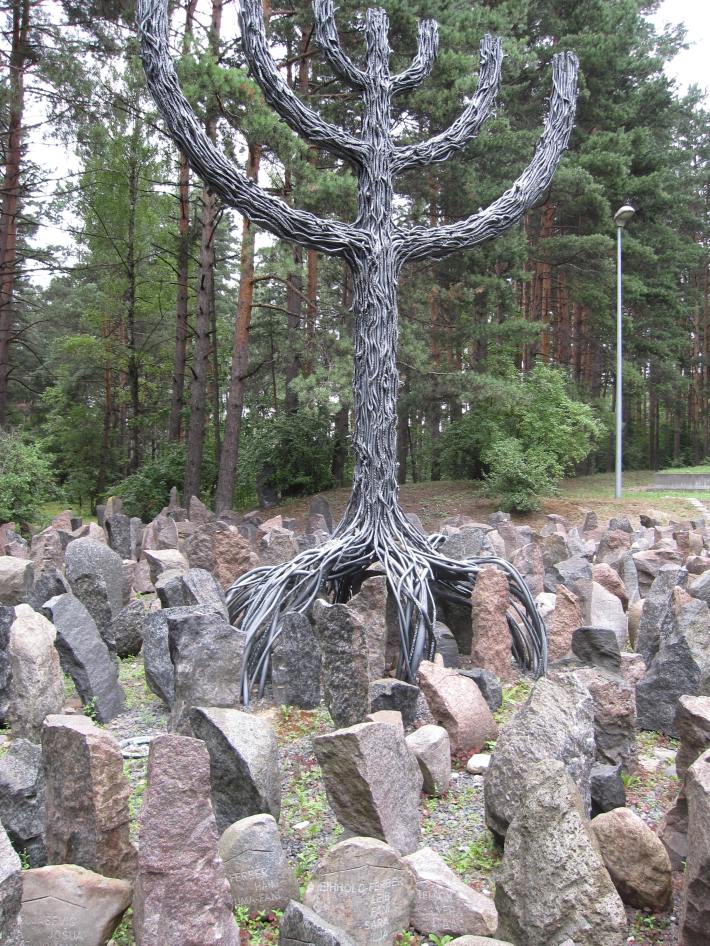
Two years ago I visited the Rumbula Forest, near Riga in Latvia, where nearly 28 thousand Jews were killed in just two days in November and December 1941, and where a heartbreaking memorial to them is hidden among the trees. Some of my own family, the brothers and sisters of my great-grandfather and their children are buried in the mass graves marked out on the forest floor. Only three people survived the murder that took place here.

The visit was poignant and it was also infuriating. One reason it had taken so long to build anything here as a memorial is that the inscription on the memorial had become an issue when some Riga officials wanted language that would have obscured Latvian complicity. Eventually an agreed inscription meant the memorial could go ahead

HERE, ON NOVEMBER 30 AND DECEMBER 8 OF 1941 THE NAZIS AND THEIR LATVIAN COLLABORATORS SHOT TO DEATH MORE THAN 25,000 JEWS WHO WERE PRISONERS OF THE RIGA GHETTO – CHILDREN, WOMEN, ELDERLY MEN, AND APPROXIMATELY 1000 JEWS WHO HAD BEEN DEPORTED FROM GERMANY. IN THE SUMMER OF 1944 HUNDREDS OF JEWISH MEN FROM THE “RIGA–KEISERWALD” CONCENTRATION CAMP WERE ALSO KILLED HERE.

And the memorial was finally dedicated on November 29, 2002, more than sixty years after the terrible events it bespoke.

Why so long after the event? Because it was supposed to be forgotten. There was no one who wanted to remember what had happened in Riga, and in many many other places just outside villages and towns in Latvia, Lithuania, and other countries. No one wanted to remember, no one wanted to think about it.

Our guide told us something else about why it took such a long time to build a memorial there – the story was not entirely forgotten, but the exact place in the forest had been lost. No one could admit to knowing where it might be. It took the efforts of an interested botanist, who found plants in a particular area of the forest that needed the kind of nutrition only a well blood-soaked soil could provide, to identify the place of the murder of so many innocent people. Once he had found it, the mass grave pits were identified.

Eyewitness accounts are horrific: On this particular day (30 November 1941), the air temperature in Riga was -7.5C at 7:00a.m. and 1.9 degree C at 9:00 RM. On the previous evening, 29 November 1941, there had been an average snowfall of seven centimetres. On 30 November between 7:00 A.M.  and 9:00 p.m. it did not snow.

“The Mass Shootings outside Riga, 30 November and December 1941.                               

The  actual site of execution lay about five miles outside  Riga in  the direction of Duenaburg [Daugavpils], between the highway and  the railroad, both of which connect Riga and Duenaburg. The railroad tracks and the road there run a near-parallel  course, with  the railroad tracks running to the north of the road.  The site lies in the vicinity of the railroad station at Rumbuli; its  terrain  is sandy and slightly hilly, sparsely wooded,  and forms part of the Rumbuli Forest.

In the centre of this site was a densely forested area; this was the location of the actual execution site, with prepared pits designed to accommodate about thirty thousand bodies.  The approaching  columns of Jews coming from Riga along the  highway between  Riga  and Duenaburg had to turn left from  the  highway onto  a dirt track which led up to the small patch of woods.  In the process they were funnelled into a narrow cordon, which  was formed by SS units, a contingent of the Special Task Unit  Riga, and Latvian units.

 The  columns of Jews advancing from Riga, comprising  about  one thousand  persons each, were herded into the cordon,  which  was formed  in  such a way that it narrowed greatly as it  continued into the woods, where the pits lay. The Jews first of all had to deposit their luggage before they entered the copse; permission to carry these articles had only been granted to give the Jews the impression that they were taking part in a resettlement.  As they  progressed, they had to deposit their valuables in  wooden boxes,  and, little by little, their clothing – first overcoats, then suits, dresses, and shoes, down to their under clothes, all placed in distinct piles according to the type of clothing.

 Stripped down to their underclothes, the Jews had to move forward along the narrow path in a steady flow toward the pits, which they entered by a ramp, in single file and in groups often.  Occasionally the flow would come to a standstill when someone tarried at one of the undressing points; or else, if the undressing went faster than expected, or if the columns advanced too quickly from the city, too many Jews would arrive at the pits at once.  In such cases, the supervisors stepped in to ensure a steady and moderate flow, since it was feared that the Jews would grow edgy if they had to linger in the immediate vicinity of the pits….

 In the pits the Jews had to lie flat, side by side, face down. They were killed with a single bullet in the neck, the marksmen standing at close range-at the smaller pits, on the perimeter; at the large pit, inside the pit itself-their semi-automatic pistols set for single fire. To make the best of available space, and particularly of the gaps between bodies, the victims next in line had to lie down on top of those who had been shot immediately before them. The handicapped, the aged, and the young were helped into the pits by the sturdier Jews, laid by them on top of the bodies, and then shot by marksmen who in the large pit actually stood on the dead. In this way the pits gradually filled.” (Gerald Fleming, pp78-79 in Hitler and the Final Solution, University of California Press 1984)

As I walked around the memorial, which includes stones on which are marked the streets from the ghetto that victims had come from, and stones with the names of some of the victims, I found the names of my grandfather’s cousins, and a stone inscribed with the name of the street in the ghetto which I had visited only an hour or so earlier and from which my great grandmother had emigrated in 1892 to escape a bad marriage and grinding poverty. I called over my sister and cousin and overcome with emotion we stood in silence thinking of those people, named and unnamed, who had died here so horribly, whose story had very nearly been hidden away so that their very existence would have been lost. And then we said the Kaddish prayer.

Looking at the stones inscribed with my maternal family name, it became clear that, while this had begun as a journey to find our roots and see for ourselves the “old country” our family had left, the experience in the forest was also a way of directly encountering what our own past would have been had my great grandmother taken a different route. Going to the forest to see for ourselves was initially part of the search for family, to honour those we had not known, to connect with a community which had once thrived and whose roots were entangled with ours. Yet it was also so much bigger an experience than connecting with a personal past.

We mourned for family we never knew who had died in that strange place in the forest, but this could not only be a personal ache as our visits to other family places had been – our grief and prayers encompassed everyone who had died in that place because of their Jewish heritage.  And even this was not enough to say – the place of the industrial scale process of murder with its belated yet extraordinary memorial prompted us to pray for all victims of genocide. In fact I think it was the story of the large quiet forest and the botanist who identified this site through the nutrient rich soil, and the so-careful wording of the plaque, as well as the long period of time between the event and its public recognition that so powerfully drove us to understand something more about the dirty secrets of genocide wherever it occurs. It is always a dirty secret hiding in full public view, an enormity sitting in plain sight and this is one reason it is perpetuated.

In our siddur is a prayer written for specifically for Yom HaShoah. It includes the lines “we mourn for all that died with them, their goodness and their wisdom which could have saved the world and healed so many wounds. We mourn for the genius and the wit that died, the learning and the laughter that were lost. The world has become a poorer place and our hearts become cold as we think of the splendour that might have been.” (Rabbi Lionel Blue in Forms of Prayer pub Movement for Reform Judaism p388)

This visit might have been a profoundly family moment, a coming face to face with branches of my family tree that had been torn from life and from the future, and it was indeed that, but it was also a profoundly human moment – everyone in such a situation deserves our thoughts, our prayers, our determination never to let anyone have to be in this situation ever, ever again and to do that we have to tell the stories, we have to remember.

While visiting the memorial in the place in the forest so nearly lost forever, I thought of the Chasidic story about remembering:

“When the great Rabbi Israel Baal Shem-Tov saw misfortune threatening the Jews it was his custom to go into a certain part of the forest to meditate. There he would light a fire, say a special prayer, and the miracle would be accomplished and the misfortune averted. Later, when his disciple, the celebrated Maggid of Mezeritch, had occasion, for the same reason, to intercede with heaven, he would go to the same place in the forest and say: “Master of the Universe, listen! I do not know how to light the fire, but I am still able to say the prayer.” And again the miracle would be accomplished. Still later, Rabbi Moshe-Leib of Sasov, in order to save his people once more, would go into the forest and say: “I do not know how to light the fire, I do not know the prayer, but I know the place and this must be sufficient.” It was sufficient and the miracle was accomplished.

Then it fell to Rabbi Israel of Rizhyn to overcome misfortune. Sitting in his armchair, his head in his hands, he spoke to God: “I am unable to light the fire and I do not know the prayer; I cannot even find the place in the forest. All I can do is to tell the story, and this must be sufficient.” And it was sufficient.”  Elie Wiesel, The Gates of the Forest, introduction.

And I thought too of Simon Dubnow, the great historian and scholar murdered in the Riga ghetto, who is said to have said “If you survive, never forget what is happening here, give evidence, write and rewrite, keep alive each word and each gesture, each cry and each tear.”

Today, International Holocaust Remembrance Day, we do that, and more, we remember all who have been persecuted for their religion, their politics, their sexuality, their ethnicity. We weep for them all. And more than that, we affirm our commitment to combating such persecutions, such demonising of the other, such monstering of other human beings that hides in plain sight in our own world, in our media and our social networks, in the communities where we live and in our wider human society.

From Wikipedia

International Holocaust Remembrance Day, 27 January, is an international memorial day for the victims of the Holocaust, the genocide that resulted in the annihilation of 6 million Jews, 2 million Gypsies (Roma and Sinti), 15,000 homosexual people and millions of others by the Nazi regime and its collaborators. It was designated by the United Nations General Assembly resolution 60/7 on 1 November 2005 during the 42nd plenary session. The resolution came after a special session was held earlier that year on 24 January 2005 during which the United Nations General Assembly marked the 60th anniversary of the liberation of the Nazi concentration camps and the end of the Holocaust. 27 January is the date, in 1945, when the largest Nazi death camp, Auschwitz-Birkenau, was liberated by Soviet troops.
Image

wonderful recipes from the wimshul cooks for tu bishvat

wimshulcooks's avatarWimshul Cooks

Here are a selection of mouth watering savoury and sweet recipes using the fruits and grains of the seven species, traditionally eaten on Tu B’Shevat, interspersed with photos of trees from the English landscape taken by Libby Hipkins. For other ideas, click here for a Biblical Hallah recipe using the seven species for Tu B’Shevat and for Claudia Roden’s Bazargan recipe which includes pomegranate molasses.

The seven species are: wheat and barley, pomegranate, fig, fruit of the vine, olive (oil) and (date) honey.

Barley Soup

Submitted by Claudia Camhi

Another of my mother-in-law’s recipe’s that works so well for a snowy Tu B’Shevat

  • 150 grams of pearl barley
  • 2 vegetable stock cubes
  • 50 grams of butter
  • 3 level tablespoons of plain flour
  • 350 ml of milk (semi or full fat)
  • Salt and pepper to taste
  • ½ a teaspoon of ground nutmeg
  • Juice of 1 lemon
  • 100 ml of single…

View original post 1,148 more words

Parashat Bo

The sidra opens with a challenge – the word we use to name this narrative – Bo. God is saying to Moses “Come to Pharaoh. I have made him and his advisors stubborn in order to demonstrate my miraculous signs among them. And so you may tell in the ears of your son, and of your son’s son, what I have wrought upon Egypt, and My signs which I have done among them; that you may know that I am the Eternal.’”

In Hebrew there are two different verbs – la’lechet which means ‘to go’ and which was the imperative used when God first met Abraham – Lech Lecha! And la’vo meaning ‘to come’ which is the verb used here to Moses. Come to Pharaoh!

But at the end of the sidra last week, Moses was outside the city – so from the usage of this verb we can only understand that while Moses was outside and away from Pharaoh, God was within, and close to Pharaoh.

The thirteenth century French commentator, Rabbi Hezekiah ben Manoach, noted this strange usage, and suggested that God was saying that when Moses went to Pharaoh, God would be there with him – in effect he would not be alone as he faced the increasingly paranoid and terrifying king.  This is a lovely reassurance to Moses, but it begs the question – why at this point does Moses need the reassurance? Is he in doubt that God can do what is promised? Does he fear that he will be led into a trap from which there is no escape?

Moses knows from later in the same verse, that God has hardened the heart of Pharaoh yet again. Maybe he was holding on to the hope that Pharaoh would finally yield to the wishes of his advisors, that he would understand that he was in a battle he could not win. But God has put paid to that hope – Pharaoh would, for certain, rebuff him. And this too would be part of God’s plan.

How difficult must it have been for Moses to go through with this. How much must he have wanted God to be actively present alongside him. And then the plagues themselves when they came were all of them about darkness, isolation and terror. As we feel today feel conflicted about God strengthening Pharaoh’s resolve to take the battle between them to the ultimate conclusion, how much more so must Moses have felt, a frightened human being shuttling between the two of them?

An ancient battle is being played out – between Good and Evil, between light and dark. What is different in this rendition of the mythology is that human beings are part of the thread of the narrative, that we must witness and understand what it is we see, we must go on to remember and to tell what we saw and understood.

Those first two verses set the scene ““Come to Pharaoh. I have made him and his advisors stubborn in order to demonstrate my miraculous signs among them. And so you may tell in the ears of your child, and of your children’s children, what I have done to Egypt, and My signs which I have done among them; that you may know that I am the Eternal.’”

The final element of the battle is to happen now. And all must know for all time from the process of this battle that God is the one and only and Eternal God.

The  parashah goes on to recount the events leading up to the final night, when the Israelites prepared for their departure from Egypt, and the instructions given to ensure that this core event in our history will be recorded forever in the collective memory of the Jewish people.

The events leading up to and surrounding the exodus from Egypt are embedded in our narrative in so many ways – Kiddush at Shabbat, the Amidah, the Seder, the Hallel. These are signs and signals for us to respond to, we  must consciously understand what we are doing, and tell and retell the narrative to ourselves and others in every generation. All of this so that we may never forget nor misunderstand that God is God.

There are two big themes in Judaism – there is the universalistic one of the Creation of the World and the Creator of all Things who is God of all people;  And there is the particularistic one of the Exodus from Egypt and the particular relationship we Jews have with God. All of our tradition and theology is balanced upon these two major events, the universal and the particular, the creation and the exodus, the whole and the part, the community and the individual.  We create actions and rituals, stories and prayers, all in order to remember that the Eternal is our God, and everything flows from that remembering. But in the smaller and particularistic scale our activity also reminds us that each of us has a consciousness and lives a life of moment and value, and we should not take any part of that for granted.  Each of us makes a contribution, each of us is a witness and our stories weave into the narrative to strengthen and form it.

If we choose not to be part of the story, then everything is weakened because of that choice. We are in it together, a people, a community, who share our narrative and understanding.  We may fear, we may doubt, we may have good reason for both the doubt and the fear. But like Moses, when we take our part in the narrative we should remember the choice of verb used by God – “come – be with Me, I will be with you, you are not alone in this however terrifying it looks”, rather than the verb used in the imperative to Abraham – Go for yourself. 

 In the two imperatives that God uses to force movement, we have moved from the individual to the communal journey. We are no longer alone. However difficult we might find God to be, we have each other and we have the reassurance of our history that however dark it seems to be, the dawn will come.
 

Parashat Va’era

There is so much packed into this sidra – where to begin? Is it with the conundrum of the name of God as presented here? The new and different kind of relationship that God has with Moses in comparison with the Patriarchs? The insight into Moses’ speech difficulties? The hardening of the resolve of Pharaoh by God – and for what purpose? The sudden placing of the genealogy interrupting the narrative flow? The terrible plagues inflicted on the Egyptians? The most amazing (to me, the mother of a primary school child) that the plague of lice could not be repeated by the powerful magicians who could copy other plagues?

One line spoke to me more this year than any other – Moses repeats the words of God who tells the people “I am YHVH and I will bring you out from under the burdens of the Egyptians and I will deliver you from being slaves to them, and I will redeem you with an outstretched arm and with great judgments, and I will take you to Me for  a people and I will be your God, and you will know that I am the Eternal your God who brought you out from under the burdens of the Egyptians and I will bring you in to the land concerning which I lifted up My hand to give it to Abraham, to Isaac and to Jacob, and I will give it to you for a heritage, I am YHVH” and the people “did not listen to Moses because of impatience of spirit and [their] difficult work” (6:6-9)

Literally the words “kotzer ruach” mean shortness of breath or limited spirit and could mean, as Rashi understands it, that they were physically finding breathing hard, presumably because of the severity of the work they had to do. But I find Rabbi Samson Raphael Hirsch’s translation as “impatience” more satisfactory. They did not listen to what Moses was saying because they were operating in a different emotional environment, they were focussed only on the here and now, they could not see beyond the next task to be achieved.  Short termism was all they could manage. The Jews were slaves – and had been for some generations – in a land named Mitzraim, “the doubly narrow place”. They had  become habituated to their surroundings and their lives, they had learned how to survive, and that skill was all about having narrow horizons themselves. They could not possibly imagine a future, let alone a future in a different world where they would be quite different themselves. The generation of the exodus were emotionally and intellectually locked down, they suffered failure of imagination as well as failure of faith, their one imperative was to keep their heads down and keep doing what they had always done. They would allow themselves no awareness outside this behaviour. They just wanted to survive but it seems they no longer knew why it was important to survive or what they were surviving in order to become.

This view of “kotzer ruach” of narrowness of spirit and failure to dream of a better future is one that comes into sharp focus for me as I watch the run up to the Israeli elections. The many shifting coalitions as people jockey for votes, the offerings of quick fixes rather than thoughtful change, the lack of focus on life -critical issues in favour of trivial ones, the refusal to engage with the peace process, the social pressures facing so many of the people, the financial pressures that can surely not be sustained, it is depressing to sit here watching a country I love suffering from kotzer ruach, taking short breaths that allow it to continue from moment to moment, but having lost direction, belief, imagination, purpose. In 1897 Theodor Herzl famously wrote “im tirtzu, ein zo agada; ve’im lo tirtzu, agada hi ve’agada tisha’er’,: ‘If you will it, it is no dream; and if you do not will it, a dream it is and a dream it will stay”. Because he and others thought and planned and imagined and dreamed, a Jewish State was born, but it requires the thinking and planning and imagination and dreaming of its current leadership for it to continue to be what it was set up to be: “THE STATE OF ISRAEL will be open for Jewish immigration and for the Ingathering of the Exiles; it will foster the development of the country for the benefit of all its inhabitants; it will be based on freedom, justice and peace as envisaged by the prophets of Israel; it will ensure complete equality of social and political rights to all its inhabitants irrespective of religion, race or sex; it will guarantee freedom of religion, conscience, language, education and culture; it will safeguard the Holy Places of all religions; and it will be faithful to the principles of the Charter of the United Nations.” (Declaration of Independence 1948) (1)

Moses offered hope and deep meaning to the Children of Israel, who could not listen to  him or understand what he was offering and so missed a vital opportunity to not only survive but to thrive as a people of God. I hope and pray that we will not suffer such a failure of imagination and will again, and that those who are able to vote in the coming election will make their voices heard for good, so that the promise “I will take you to Me for a people, and I will be to you a God, and you will know that I am the Eternal your God” with all that that extraordinary relationship of covenant and obligation can mean, will happen in our day.


(1)  taken from http://www.mfa.gov.il/MFA/Peace+Process/Guide+to+the+Peace+Process/Declaration+of+Establishment+of+State+of+Israel.htm