Sidra Vayigash:the reassurance of God’s presence in dark times

And Israel took his journey with all that he had, and came to Beersheba, and offered sacrifices to the God of his father Isaac. And God spoke to Israel in the visions of the night, and said: ‘Jacob, Jacob.’ And he said: ‘Here am I.’ And God said: ‘I am God, the God of your father; fear not to go down into Egypt; for I will there make of you a great nation. I will go down with you into Egypt; and I will also surely bring you up again; and Joseph shall put his hand upon your eyes.’ And Jacob rose up from Beersheba; and the sons of Israel carried Jacob their father, and their little ones, and their wives, in the wagons which Pharaoh had sent to carry him. And they took their cattle, and their goods, which they had got in the land of Canaan, and came into Egypt, Jacob, and all his seed with him; his sons, and his sons’ sons with him, his daughters, and his sons’ daughters, and all his seed brought he with him into EgyptGen 46:1-6

Jacob has a number of meetings with God during the night – the first was the dream on the road out to Haran when he was running away from Esau, and a ladder appeared to him that joined heavens to earth, and God delivered a reassuring message to him. The second the dream at the ford of Yabok, when he was returning home to Canaan, wealthy and secure but also anxious about the reception he would get from Esau.  And now here, at Beersheba, God appears in order it seems to reassure him that he will return from Egypt and will become a great nation. It reads to us a little strangely – for we know that Jacob will die in Egypt, and that as a nation they will only leave in over 400 years’ time, having survived a long period of slavery, yet one might read into it that the time in Egypt will be a short respite during the famine. Why? Does God think that Jacob will not cope with the reality of what his descendants will face? Is this vision one that emanates from Jacob’s need for support rather than being a real meeting with God? Is God responding more to the Jacob God first met, the frightened young man who yet was confident enough to tell God that only if God fulfilled the promises made in the dream would he finally believe, rather than to the older man whose world is shaped by the loss of his older son by his beloved wife Rachel; who has been frozen in grief since that time.

Or is the story added into the narrative later as a story to support the enslaved Israelites and ameliorate their suffering?

We have no answers, just as we have no answer for the interchangeable use of the two names Jacob and Israel, so powerful yet so cryptic in this passage. Yet as with all the encounters Jacob has with God during night time journeys, the vision is one we are able to hold on to today – providing reassurance in times of uncertainty, reminding us that we are one link in a chain that goes back into history and will go forward into a future we cannot know.

We are most definitely the children of Jacob rather than those of Abraham or Isaac. Abraham had a stern and all-encompassing faith which seemingly left no room for doubt or anxiety, Isaac lived in the shadow of that faith and his own encounters with God are clearly shaped by it. But Jacob was his own self, a mixture of self-assurance and anxiety, wanting to believe but not being too sure about it, prepared to do a deal with God when it seemed an expedient action.  It is given to few people to believe with certainty, and to fewer still to come to belief through their own experiences, rather than to have it bred into them. Doubt is a colourful strand in the Jewish character, it threads through our narratives and our prayer. Indeed we pray in an aspirational way – hoping to be able to believe rather than asserting that we hold such a conviction.  Whether God ever speaks to Jacob in the night or whether Jacob creates the experience for himself becomes an irrelevant question – what is important is that Jacob is able and willing to create such an encounter (or to believe it when it comes). It is all that is asked of us too – to be able and willing and open to the presence of God when times are at their darkest.

Miketz: the strange case of the disappearing women

Dr Ruchama Weiss points out that sidra Miketz is the first in Torah that is devoid of any stories of women : – she identifies it as the point at which bible begins to actively exclude women from the focus of the narrative. Over the fourteen years that the sidra spans in three and a half chapters of the book of Genesis, women are indeed conspicuous by their absence. The matriarchs have died, the only daughter of Jacob that we know of, the unfortunate Dina, has disappeared following her experiences with Shechem, no other daughters or indeed wives of the sons of Jacob are recorded here. They must have existed, but the biblical author does not see fit to document their presence.

There is in fact one woman who briefly makes an appearance – Asenath, the daughter of Potiphera a priest of On. Our introduction to her is laconic and almost imperceptible, she rates less than a third of the verse in which she appears, coming after the renaming of Joseph and before his status is recorded: “And Pharaoh called Joseph’s name Zaphenath-paneah; and he gave him to wife Asenath the daughter of Potiphera priest of On. And Joseph went out over the land of Egypt.—“(41:5). She reappears five verses later as mother to Joseph’s two sons: “ And to Joseph were born two sons before the year of famine came, whom Asenath the daughter of Potiphera priest of On bore unto him.” (41:50). She doesn’t get to name her sons, up till now the privilege of the mother, nor do we see her relationship with them – all we see is Joseph naming Manasseh and Ephraim in order to make statements about himself: “And Joseph called the name of the first-born Manasseh: ‘for God has made me forget all my toil, and all my father’s house. And the name of the second he called Ephraim: ‘for God has made me fruitful in the land of my affliction.’ (51,52)

Asenath

Her lonely presence in the sidra, useful only as a wife for Joseph and mother to his children, is picked up in the 6th century pseudepigraphical work “Joseph and Asenath” , though to be honest there too she is still the plaything and chattel of men. A pagan woman, she falls in love with Joseph and gives up her idolatry in a painful and protracted process in order to marry him and have his sons. Later the son of the Pharaoh tries to take her for himself but the plot is foiled, and Joseph takes the crown of Egypt. So there is not much more to her there either. She may be the daughter of a powerful priest of the Egyptian cult, the wife of the most powerful man in the country bar Pharaoh himself, the mother of the founders of the tribes of Ephraim and Menasse, but she is unknowable, mysterious and all but erased from history. Her fleeting presence in the sidra that is filled with the powerful men who control all the resources of the country only really serves to highlight the poignancy of her disappearance. And to complicate matters further, there are those who say that her presence in the sidra at all, inserted quite clumsily into the text as daughter, wife and mother, is only tolerated because she acts as a counterbalance to the physical beauty of Joseph which drives women into a sexual frenzy while he himself remains emotionally detached and essentially sexless. She is there as an answer to the questions about his sexuality, to put paid to any idea that he may not conform to the heteronormative ideal of the Hebrew bible.

This year – 2015 – is the eightieth anniversary of the private ordination of the first woman rabbi of modern times, Rabbiner Regina Jonas; and the fortieth anniversary of the ordination of the first woman to be given semicha by a European rabbinic institution (Leo Baeck College) Rabbi Dr Jackie Tabick.

One of the most shocking things about the life and times of Rabbiner Regina Jonas was how quickly she was forgotten after her death in Auschwitz in 1944. When I was studying at the Leo Baeck College in the 1980’s we knew only of rumours that there had been a woman who may or may not have been ordained Rabbi in Germany – even though some of the teachers and founders of the college had known her well. It was only with the fall of the Berlin Wall and the emergence of some of her papers and photographs from an archive that she once again became real. And now her life and name are being researched and reclaimed, yet there is so much that is lost beyond recall. She disappeared even while there were people alive to remember her. Her story is an object lesson, a cautionary tale, how quickly can the stories of people disappear if there is no interest, no will to record them and to keep them alive.

In the forty years that Rabbi Dr Jackie Tabick has been working as a rabbi the world has moved on. There is less anxiety (at least in the progressive Jewish world) about women working as rabbis, but still there are those individuals who ask for a male rabbi for a life cycle event, or synagogue search committees who worry what will happen to their community if a woman is appointed as rabbi, or as the senior rabbi.

So we should not be complacent and believe that the battle has been won. The erasing of the inconvenient from history goes on everywhere, and it is a truism history is written by the winners. If the narrator of the biblical text is not interested in the women then the stories of the women will not appear. If we don’t have a multiplicity of voices recording history as they see it, then we will have a thin and diminished version of history, seen through the narrowest of lenses. And this too has knock on effects. Because there are so few women fully described and fully voiced in our foundational texts, it is a short leap for some to believe that this must not be a function of the (lack of )interest of the narrator but a function of the divinely inspired status of women in society.

As the societal norms are impacting on Judaism, as the eightieth anniversary of the ordination of Regina Jonas and the fortieth of Jackie Tabick begin to filter into the consciousness of orthodox feminism, and as more Jewish women demand that their voice be heard, there is a corresponding kick back from some in the orthodox world. Only this week A senior haredi rabbi suggested at a conference for high school principals held in Bnei Brak that higher education for women constitutes a more severe blow to the haredi world than the Holocaust and a responsa was given to a man about letting his daughter go to university that “ to do so would be worse than stealing money since material goods may be recovered but the “spiritual damage” of permitting the young woman to achieve higher education could not be undone.”

The spiritual damage envisaged when a woman is allowed to study at a high level, to learn to think and question and understand the world around her is not to the woman herself – it is damage to the structure of a community which relies on unquestioning following of self-appointed sages. When people think for themselves, the artificial consensus breaks, and a real consensus, based on challenge and debate, logical argument and building of agreement is allowed to emerge. In sidra miketz the women are submerged in the narrative with just the flash of one woman’s presence that serves to point up all the absences. We should be warned, there is nothing new under the sun, and women are being ‘disappeared’ from public space in the Jewish world with increasing determination, just as they are in this sidra. In the book of Exodus the presence of women will reassert itself, but their silence as the book of Genesis begins to move towards its close is a telling one. And a nudge to us to take responsibility not to allow it to happen again.

Vayeshev: the crime of selling a person

“Behold, a caravan of Ishmaelites came from Gilead, with their camels bearing spicery and balm and ladanum, going to carry it down to Egypt. And Judah said to his brothers, “what profit is it if we slay our brother and conceal his blood? Come, and let us sell him to the Ishmaelites, and let not our hand be upon him; for he is our brother, our flesh.’ And his brothers listened to him.
And there passed by Midianites, merchantmen; and they drew and lifted up Joseph out of the pit, and sold Joseph to the Ishmaelites for twenty shekels of silver. And they brought Joseph into Egypt. And Reuben returned unto the pit; and, behold, Joseph was not in the pit; and he rent his clothes. And he returned unto his brethren, and said: ‘The child is not; and as for me, whither shall I go?’ (Gen 37:25-30)… And Joseph was brought down to Egypt; and Potiphar, an officer of Pharaoh’s, the captain of the guard, an Egyptian, bought him of the hand of the Ishmaelites, that had brought him down thither. (39:1)…[And Joseph said] For indeed I was stolen away out of the land of the Hebrews; and here also have I done nothing that they should put me into the dungeon.’ (40:15)

The first story of human trafficking is told here in sidra vayeshev, and sadly it is a story that resonates to this day in the lived experience of the six to eight hundred thousand people estimated to be trafficked across international boundaries each year, and the 20 – 30 million people who are currently estimated to be living in slavery.
Like many who are trafficked today, Joseph is young and vulnerable, he is (to be) sold off by family members, and while presumably sold for labour it is not impossible he could have been sold for sex (certainly Potiphar’s wife has expectations in this area). He finds himself at the mercy of a well organised people trafficking structure, sold through the agency of the Midianites to the Ishmaelites who go on to sell him in Egypt along with their other products. Today human trafficking is the third largest international crime industry (behind illegal drugs and arms trafficking). It reportedly generates a profit of over £21 billion every year of which £10 billion is made in industrialized countries. Human trafficking is big business. And it causes enormous suffering.
Bible begins by telling us that human beings are created in the image of the Divine, from which we understand the basic and absolute value of human beings. Just as God is indivisible and of infinite worth, so is humanity indivisible and of infinite worth. We might construct all kinds of models in our heads about class, ethnicity, gender, power, social status, geographical cultural and historical connections, but bible keeps reminding us of the one basic truth: human beings are one group, connected ultimately to the earth on which we live, connected deeply and irrevocably to each other.
The bible as a document is powerfully engaged with this idea, and with how it plays out in the power relationships that humans participate in, that shape our society. It knows how easy it is to abuse power, how simple to turn a blind eye to it happening in both the intimate details of our lives and in the macro environment in which we are live. It knows about the human tendency to construct realities that favour ourselves over others, to neglect or ignore what does not speak to our own self-interest or conform to our idea of reality. Bible provides the nudge, the spur to remind us that not only is there more to the world than our own experience, it repeatedly teaches us that there is an obligation on us to pay attention outside of our comfort zone, a requirement to see the world as God sees it – a fragile and beautiful place filled with fragile and beautiful creatures engaged in a process of improvement but simultaneously undermining and subverting that process out of ignorance or selfishness or thoughtlessness or greed.
We see ourselves in the texts; we recognise the themes and the motifs that play through the stories and we know that we are being prompted to respond.
So when we read the story of Joseph, defenceless in the pit after his brothers’ intervention, saved from being murdered but arguably paying the even greater price of being traded from group to group with no protection and no idea of what the end of his journey may be, powerless and frightened, a product not a person, about whom no one will care what happens – we have to pay attention and we have to respond. There are estimated to be between six and eight hundred thousand people having a similar experience ever year in our world. And we should care.
In the book of Exodus, in the legal code following the giving of the ten commandments and the covenant made between God and Israel, comes the instruction “And one who steals a person and sells them, or if a person be found in their possession (as merchandise), they shall surely be put to death. (Exodus 21:16). Deuteronomy repeats the command: “If a person be found stealing any of his brethren of the children of Israel, and he deal with him as a slave, and sell him; then that thief shall die; so shall you put away the evil from your midst.” (Deuteronomy 24:7). In the biblical world clearly people were bought and sold, seen as chattels to be profited from, and already the voice of the text is outlawing the behaviour. By the time of the Mishnah (2nd Century CE) (for e.g. Sanhedrin11:1) the death penalty for human trafficking is discussed and accepted – a mark of how seriously the crime is taken to be and this is continued in the Gemara (5th Century CE) (e.g. Sanhedrin 86a)
In the medieval period there are responsa again underlining the importance of challenging the prevalence of abducting and selling human beings – for example Maimonides (12th C) tells us that Torah views the kidnap of a person as the most serious form of theft that is strictly prohibited on pain of death under the Noachide code and in the eighth of the Ten Commandments, ( Laws of Theft 9:1-6) and also teaches that redeeming captives is more important than supporting the poor, because captives are in danger of their lives (Mishneh Torah, Hilchot Matanot Aniyyim 8:10). Rabbi Joseph Colon (1420-1480) warns that a person who has the ability to save a trafficked person yet delays doing so is “like one who sheds blood.”… the responsa can be found in every century, in every place, demonstrating that the crime of trafficking human beings can equally be found in every century and in every place – including, sadly, our own.
So what should we do? Firstly, we should not ignore the issue, not assume that it is not happening because we have not noticed it, nor that it “wouldn’t happen” in our bit of the world. Secondly we should educate ourselves on the signs, so that we are alert to the possibility of trafficking. These can be found here: http://www.stopthetraffik.org/uk/page/spot-the-signs
Community_Signs_2

And we can also think through the ways we live and the choices we make – are the clothes or food we want to buy surprisingly cheap indicating that the makers/pickers are on low wages? Is there an ethical policy in place in the financial transactions we make? Are we sufficiently educated about the real cost, the real chain by which products come to us, the reality faced by people who find themselves in economic bondage to others?
The tragedy of human trafficking is that it hides in plain sight. Bible knew that and tried to give us the tools to see. We are in need of such tools even today. Let the words of Joseph speak to us again “For indeed I was stolen away out of the land of the Hebrews; and here also have I done nothing that they should put me into the dungeon.’ And remind us that the lack of freedom for those who are trafficked is real, a dungeon from which they cannot escape and a place where no meaning can be gleaned.

Chanukah Readings: It is better to light a candle than to curse the darkness

Bible tells us that the first thing that God did having created the heavens and the earth was to utter the words “Let there be light”, and there was light. God saw the light was good, and God divided the light from the darkness, and so began the ordering of a world which would ultimately sustain and nourish humanity, and they in turn would work with God to continue the process of perfecting creation.

Chanukah, the Jewish festival of lights, comes to remind us of the need to continue that work, even though it might sometimes seem that the darkness is all enveloping, and the world has reverted to the state of primordial chaos filled with terrifying uncontrolled forces that is contained in the phrase “tohu va’vohu”

Just as light was the catalyst for the world to develop into a place where we could live and thrive, so too light is the response we must make when faced with a darkening world. Just as bible commands that a light was to be continually burning in the tent of meeting outside the veil of testimony, and the priesthood had to tend to it evening and morning in order to keep it in good order as an eternal statute for the generations, (Exodus 27:20 and Lev 24:2) so too we need our ner tamid, our continually tended and burning light, to remind us not only of God’s compassionate and watchful presence in the world, but also of our obligation to bring God’s presence further into the world. As the book of Proverbs tells us,” Ki ner mitzvah, v’torah or : the commandment is a lamp and torah is light” – to act as God wishes us to act brings light into our world. (6:23)

Chanukah, like all festivals of light, comes in the winter darkness to remind us that the glow of even a small candle can alleviate the deep darkness, and as the Talmud reminds us “the candle of one person can bring light to many people” (Shabbat 122a)

There are many small candles lit in the world, many people doing good work in creative and imaginative ways, tending to the ner tamid, keeping the light of hope alive. Our High Holy Day confession includes the phrase “Al cheit she’chatanu lefanecha b’tim’hon ley’vav – For the sin we have committed before you by giving in to despair” and I must confess that each time I read the news of what is happening in the world, the way so many people are terrorised and terrified, violently murdered or imprisoned or forced to live hand to mouth, treated without compassion or empathy, uprooted and fleeing for their lives or stuck in a societal stratum below any human dignity, I give in, for a while, to despair. And when I see how governments oppress and harass their own people whom they are supposed to protect and support, close their eyes to the pain of their public and to the social justice values of civil society I succumb to frustration and fury that “they” are misusing their power so freely, unchallenged and unrestrained. And I come close to despair.

But then I remember those many people and organisations, those many small candles lit and tended to, which challenge the dejection and despondency and allow me to hope, to connect, to believe that the prophetic values of the Hebrew bible are not only alive and well, but are fighting back hard to be heard and to be seen, to bring light back into the world

So here are eight organisations of civil society in Israel who bring me hope. Eight organisations in whose light we see God’s light, who speak out for justice because, like Rav Kook, they do not have the power to keep silent. One for each of the nights of Chanukah: as you light the small flame of each candle, remember the words of Isaiah “I will make darkness light before them, and crooked things straight. These things will I do for them, and not forsake them.” (42:16)


First Night of Chanukah:   Tag Meir – The Tag of Light

Founded in Jerusalem in 2011 in response to Tag Mechir (price tag), this is the largest grassroots organisation in Israel that works against hate crime and religious racism in Israel. Transcending religious divides, Tag Meir is an umbrella organisation for a coalition of groups who support and campaign for democratic and Jewish value of justice for all the people. It protests violence and responds to victims of violence. Tag Meir’s mission is to connect different groups in Israeli society in the battle to eradicate racism and violence, and to educate for tolerance and empathy, as well as creating public events to raise and amplify the voice of those committed to democratic values. They offer Israelis the chance to voice their opposition to violence, to publicise it to all who need to hear, from Government to the victims themselves. They hold demonstrations and vigils, they pay condolence calls to victims of terror, they repaint over racist graffiti, they offer material support to religious places defaced. They meet with politicians and decision makers to end incitement and inflammatory rhetoric. Their motto : Or Bimkom Terror – Light instead of terror.http://www.tagmeiren.media-sb.co.il/


tag meir

Second night of Chanukah :   The Sir Charles Clore Jewish-Arab Community Centre in Akko

The vision and life’s work of Mohammed Fahili, this is the only Jewish- Arab Community Centre in Israel. It began in 1985 as a simple after-school club run by volunteers and located in the communal bomb shelter of a poor neighbourhood, this was part of an effort by the local Jewish and Arab residents to improve their living environment.  In 1991 the Clore Israel Foundation funded the construction of a purpose-built community centre.

The Centre’s aim is to provide high-quality, low-cost activities for Akko’s residents regardless of ethnicity or ability to pay. It functions as an important part of the community, offering enrichment programmes from infants to pensioners, allowing the people of Akko to meet over shared interests and needs, informally connecting people and building strong relationships. Many of the children that they cater for are from large, poor families and are vulnerable to the dangers of street life.  They help combat school drop-out by offering extra-curricular activities and programmes, nurturing Akko’s children to help them achieve a future. They also offer vital programmes for women and a cultural club for pensioners from the Former Soviet Union.

The Centre is an independent, voluntarily funded, not-for-profit, non-political and unaffiliated organisation.  It is funded almost entirely by voluntary donations from people who believe in the importance of their work in creating a better future in the region.


Fahili himself is an inspiration a candle in a dark room. With courage, humility and perseverance he has created an oasis of hope, a meeting place, a model for how Israeli society can be. http://ajcenter.org.il/

fahili


Third night of Chanukah:  Hiddush For Religious Freedom and Equality

Founded in 2009, Hiddush works through advocacy and public education to strengthen Israel as a Jewish and democratic state. Taking as its platform the 1948 Declaration of Independence, which states “”The State of Israel … will ensure complete equality of social and political rights of all its inhabitants irrespective of religion … it will guarantee freedom of religion and conscience” Hiddush is a partnership between Israeli Jews and World Jewry to ensure that this guarantee remains at the centre of the Israeli Government’s policy.
www.hiddush.org


Fourth Night of Chanukah:  YTheater Project Jerusalem

Founded in September 2009 in Jerusalem, this is the Israeli-Palestinian Community Theatre for a Change. YTheater engages Israelis and Palestinians together in a creative process of empowerment and responsibility. Using activist community theatre methods, it builds relationships, nurtures civic virtues, and helps the participants to work together strategically. YTheater runs workshops for Jewish, Arab, and Anglo youth and young adults to empower leadership.


“We are Palestinians and Israelis. Our lives and world-views usually exclude one another. We agree about almost nothing.   We are positioned in opposition. Our souls are on the line. We burn with the passion of the Middle East. We grope for new pathways – to break through impasses, to un-lock the grid of violence, and to mend what is broken. Creating theatre is our shared language; the stage is our meeting point. We are Muslims, Jews, Christians and Druze who collaborate. We struggle, we do not whitewash. We face difference and difficulty with caring and respect. Awe for life feeds our commitment to persevere, to create, to pry open our own hearts and the hearts of our audiences and participants. YTheater Project Jerusalem explores, interprets and innovates. We delve deeply into our behaviour, traditions, and societies.  We critique, provoke, and even, humbly, propose.In a region raw with conflict and pain, we rehearse for better life together. We are contributing to the infrastructure for better Palestinian and Israeli civil society.  YTheater builds relationships that heighten confidence and active will toward peace.”       Website    http://ytheater.org


Fifth night of Chanukah:        The Hotline for Refugees and Migrants

The Hotline for Refugees and Migrants, founded in 1998, is Israel’s leading organization protecting the rights of refugees, migrant workers and victims of human trafficking. For over 15 years Hotline staff and volunteers have been visiting Israel’s immigration detention centres to monitor conditions, meet with detainees and provide paralegal intervention and legal representation. We represent some of the most vulnerable people in Israel and advocate for government policies consistent with a just, equal and democratic Israel.

By combining client advocacy with impact litigation, policy initiatives and public outreach, we aim to achieve broad-based, systematic improvements in policies and practices ensuring that the human rights of migrants in Israel are respected.

Their main activities are Crisis Intervention, Legal Action and Public Policy and Education.       Website http://hotline.org.il/en/about-us/

Sixth Night of Chanukah: The Negev Coexistence Forum for Civil Equality

In 1997, a group of concerned Arab and Jewish residents of the Negev (the southern desert region of Israel) established the Negev Coexistence Forum for Civil Equality to provide a framework for Jewish-Arab collaborative efforts in the struggle for civil equality and the advancement of mutual tolerance and coexistence. The Forum, also known as “Dukium” in Hebrew, is unique in being the only Arab-Jewish organization established in the Negev that remains focused solely on the specific problems confronting the Negev.

The Forum’s activities and projects are based on the principle of Arab-Jewish cooperation and among their members are leaders of the Negev Arab community and academics. As a joint Jewish-Arab group we maintain a balance and equal partnership in the bodies of the organization as well as in the decision-making processes.

NCF is engaged in a wide range of grassroots activities. They have worked with community leaders in “unrecognized” Bedouin villages to deliver vital basic services to their communities. In the spirit of coexistence, Bedouin residents and Jewish volunteers work together to provide clean water, nursery schools, access roads and rubbish removal systems to over a dozen villages.

In collaboration with other NGOs, the NCF has filed legal petitions against discriminatory practices affecting Bedouin communities in the Negev. For example, as a result of a joint petition submitted to the Israeli Supreme Court in 2005, the government agreed to properly dispose of sewage flowing through Um Batin. Other petitions have led to the establishment of health clinics in ten unrecognized villages and to the prohibition of toxic crop spraying.   Website www.Dukium.org

Seventh Night of Chanukah:    Breaking the Silence

“Breaking the Silence is an organization of veteran combatants who have served in the Israeli military since the start of the Second Intifada and have taken it upon themselves to expose the Israeli public to the reality of everyday life in the Occupied Territories. We endeavour to stimulate public debate about the price paid for a reality in which young soldiers face a civilian population on a daily basis, and are engaged in the control of that population’s everyday life.

We collect and publish testimonies from soldiers who, like us, have served in the West Bank, Gaza and East Jerusalem since September 2000, and hold lectures, house meetings, and other public events which bring to light the reality in the Territories through the voice of former combatants. We also conduct tours in Hebron and the South Hebron Hills region, with the aim of giving the Israeli public access to the reality which exists minutes from their own homes, yet is rarely portrayed in the media.

Founded in March 2004 by a group of soldiers who served in Hebron, Breaking the Silence has since acquired a special standing in the eyes of the Israeli public and in the media, as it is unique in giving voice to the experience of soldiers. To date, the organization has collected testimonies from over a 1,000 soldiers who represent all strata of Israeli society and cover nearly all units that operate in the Territories.”


Eighth Night of Chanukah:        Shomrei Mishpat: Rabbis for Human Rights

“Founded in 1988, Rabbis for Human Rights is the only rabbinic voice in Israel that is explicitly dedicated to human rights. Representing over 100 Israeli rabbis and rabbinical students from different streams of Judaism, we derive our authority from our Jewish tradition and the Universal Declaration of Human Rights. Our mission is to inform the Israeli public about human rights violations, and to pressure the State institutions to redress these injustices. In a time in which a nationalist and isolationist understanding of Jewish tradition is heard frequently and loudly, Rabbis for Human Rights give expression to the traditional Jewish responsibility for the safety and welfare of the stranger, the different and the weak, the convert, the widow and the orphan.

RHR works primarily in the following 4 fields:

Socioeconomic Justice Work in Israel:

Rights of the Poor: RHR focuses on raising awareness and lobbying the Knesset for better economic rights for impoverished Israelis at the national level. At the local level, our Rights Centre in Hadera helps hundreds of Jews and Arab citizens obtain socioeconomic rights that have been denied to them, and run empowerment and advocacy groups of local Arab and Jewish citizens  from the Hadera area who focus and advocate for policy changes of their choosing.

Rights to Public Housing: RHR provides legal representation for public housing tenants in Beit She’an, Beersheva, and Hadera whose housing does not meet their needs or who are facing eviction.


Human Rights Work in the Occupied Territories: For example the Olive Tree Campaign: RHR works year round with Palestinian farmers from several dozen villages in the Occupied Territories, to ensure that they can regularly access their agricultural lands, often denied to them because of their proximity to Israeli settlements.. During Tu B’shvat, we purchase and bring hundreds of Israeli and international volunteers together with Palestinians to plant some 2,500 olive trees in areas where settlers have cut, uprooted and/or burned trees in acts of vandalism and arson.

Challenging Land Confiscation in the Occupied Territories: RHR works to legally prevent or reverse the takeover of Palestinian lands in Area C, and ensure that Palestinian farmers can safely access those lands. We continually monitor the implementation of previous rulings on land access issues.

Promoting Human Rights Education in Israel: RHR works in 12 pre-military academies, exposing every year some 600 young Israelis to our human rights teachings based on our rabbinic interpretation of Israel’s Declaration of Independence. We believe that teaching human rights to young people who then continue onto their army service better equips them to deal humanely with the realities on the ground.


Human Rights Yeshivas: For more than a decade, RHR has been teaching about human rights and Judaism to Israeli university students. We currently run 2 human rights yeshivas, with a total of 40 participants. Students who participate in the program receive a stipend, and intern in a human rights or social change organization in order to understand more deeply the challenges facing Israeli society.”


RHR_logo_for-Site


LIGHTING THE CHANUKAH CANDLES: BLESSINGS

Candles are added to the Chanukiah from right to left but are lit from left to right.

(On the Shabbat of Chanukah, light the Chanukah lights first and only then the Shabbat candles)

Light the shamash first, then use it to kindle the rest of the Hanukkah lights. As you do, say or sing:

Baruch atah Adonai ,Eloheinu Melech ha’olam, asher kid’shanu b’mitzvotav, v’tsivanu l’hadlik ner shel Chanukah   Blessed are You Adonai our God, Sovereign of the universe, who makes us holy through doing the mitzvot, and commands us to light the lights of Chanukah.

Baruch atah Adonai Eloheinu Melech ha’olam, she-asah nissim la’avoteinu bayamim ha’hem Baz’man hazeh. Blessed are You Adonai our God, Sovereign of all, who performed wondrous deeds for our ancestors in days of old at this season.


And on the first night only, add the blessing:

Baruch atah Adonai, Eloheinu Melech ha’olam, she’hecheyanu v’kiy’manu v’higianu laz’man hazeh.

Blessed are You Adonai our God, Sovereign of all, for giving us life, for sustaining us, and for enabling us to reach this season.


As you light the other lights (or after you have finished lighting) recite the following:

Hanerot halalu anu madlikin / Al ha’te’shu’ot v’al ha-nissim v’al ha’nifla’ot, Sheh’aseeta la’avoteinu bayamim ha’hem biz’man hazeh/ Al y’dei kohaneh’cha ha’kedoshim; V’chol sh’monat Y’mei Chanukah Hanerot halalu kodesh hem, V’ein lanu reshut le’hishtameish ba’hen/ Ela lirotan bilvad, k’dei lehodot ul’haleil le’shimcha hagadol Al nisse’cha Ve’al niflotecha Ve’al yeshu’ote’cha.

We kindle these lights to commemorate the saving acts, miracles and wonders which You have performed for our ancestors, in those days at this time, through Your holy priests. Throughout the eight days of Chanukah, these lights are sacred, and we are not permitted to make use of them, but only to look at them, in order to offer thanks and praise to Your great Name for Your miracles, for Your wonders and for Your saving acts.


Eight Other Readings about Light and Mitzvot


“We live in a dark time. In a world ravaged by war, prejudice, disease, and now, an economic crisis that will put hundreds of thousands of people at risk of suffering. We need to bring more light. And to bring the light, we need to become the Maccabees- a people of faith who believed that liberty is worth fighting for, that human dignity is worth fighting for, and that justice is worth fighting for.” (Rabbi Sid Schwarz)


“If you offer your compassion to the hungry and you feed the famished creatures, then your light will shine in the darkness and your gloom will be like noonday” Isaiah 58:10


“When you think about someone or something that inspires you, the expression with the word נֵר would be Ner Le-Raglav- נֵר לְרַגְּלָיו. Literally, the expression means “a candle by his leg” but the contextual English translation for this expression would be “guideline” or “guiding principle.” I would add to this the meaning of “someone that you can follow”,  as it appears in Psalm 119:105 “Your word is a lamp to my feet, and a light to my path.” “נֵר-לְרַגְלִי דְבָרֶךָ; וְאוֹר לִנְתִיבָתִי.”


“According to the Created Worlds and Destroyed Worlds interpretation of the Bible, the passage in Genesis follows a major destruction of the world previous to our own. The light mentioned in Genesis 1:3 was a supernatural light that had the power to repair elements of the previously destroyed world. Day one of creation records the day when this supernatural light of repair was introduced into our current world. Day two records the start of the repair of the atmosphere and water. Day three describes the completion of the repair of the atmosphere and water and the repair of plant life. Day four describes the repair of the Earth’s relationship to the Sun, Moon, and stars. Day five describes the repair of marine life and winged creatures. Day six describes the repair of land animals and man.


“The people who walked in darkness have seen a great light; those who dwelt in a land of deep darkness, on them has light shined.” (Isaiah 9:2)


But the path of the righteous is as the light of dawn, that shines more and more unto the perfect day. (Proverbs 4.18)


“The Holy One said to Israel “My children, since My light is your light and your light is My light, let us, you and I go and give light to Zion. Arise, give light, for your light has come (Isaiah 60:1)” (Pesikta de Rav Kahana 21:1)
 

Parashat Vayishlach: a bite or a kiss? a messenger or an apology?

In parashat vayishlach we see the moment where Jacob the trickster, the one focussed only on himself and his own needs and aspirations, is able to change. He is on his journey home, a wealthy and powerful man. However he must first encounter his estranged brother Esau whom he had dispossessed from his birthright and from whose terrible pain and murderous anger he had fled all those years ago.

In preparation for the encounter he sent out messengers in order to both impress Esau with his power and wealth, and in order to try to find out what was likely to be ahead of him. The messengers’ report on their return distressed him – they had met Esau on his way to meet Jacob, accompanied by four hundred men. His response – to try to save what he could of his family and possessions by dividing them into two groups, and then he prayed for help, invoking the merit of his ancestors and the promises God had made to him regarding his descendants. Following this, he began selecting groups of animals that he could send ahead as gifts to Esau, in order to appease him before their meeting. Then he says a particularly curious sentence, given what is about to happen:

וְאַֽחֲרֵי־כֵן֙ אֶרְאֶ֣ה פָנָ֔יו אוּלַ֖י יִשָּׂ֥א פָנָֽי”

And after this, I will see his face, perhaps he will raise my face/accept me”

Having taken his family, divided into two camps, across the ford of Jabok and over the stream, Jacob was left alone, yet in the same sentence that tells us  וַיִּוָּתֵ֥ר יַֽעֲקֹ֖ב לְבַדּ֑וֹ that he had been left behind and was completely and utterly alone, we are also told

     וַיֵּֽאָבֵ֥ק אִישׁ֙ עִמּ֔וֹ עַ֖ד עֲל֥וֹת הַשָּֽׁחַר:

And a man wrestled with him until the morning dawned.

He was alone, but he was not alone. He was in the dark of the night. He was wrestling. His struggles through the dark night of his soul changes him forever. He is in liminal transitional time after which he will be transformed and given a new name – though not so transformed that he would lose his old name forever….

Who is Jacob wrestling? The narrator of the text tells us it is “ish- a man.”

The wrestler himself is more complex telling Jacob that he has struggled with God and with men and has prevailed:

כִּֽי־שָׂרִ֧יתָ עִם־אֱלֹהִ֛ים וְעִם־אֲנָשִׁ֖ים וַתּוּכָֽל:

Later in the text Jacob seems to believe the fight was with God, as he names the place Peniel, the face of God:

וַיִּקְרָ֧א יַֽעֲקֹ֛ב שֵׁ֥ם הַמָּק֖וֹם פְּנִיאֵ֑ל כִּֽי־רָאִ֤יתִי אֱלֹהִים֙ פָּנִ֣ים אֶל־פָּנִ֔ים וַתִּנָּצֵ֖ל נַפְשִֽׁי:

And he continues “for I have seen God face to face and my soul is preserved”

Traditional explanations are that Jacob is fighting an angel, in particular the guardian angel of Esau who is attempting to weaken Jacob before the meeting, or that ‘the’man’ was Jacob himself, struggling with himself and his own feelings and needs, with the two inclinations all humanity possess – the yetzer ha’ra and the yetzer ha’tov, the inclination to be motivated primarily for one’s own self-interest versus the inclination to be motivated for the good of the community and of others, battling it out for charge of his soul.

There is, I think, a clue to this critical and iconic night of struggle in another part of the sidra. When Jacob meets Esau we find that Esau was coming with a welcoming party not a gang of ‘heavies’, and we are told that far from there being a clash between the brothers there is instead from Esau’s side real emotion and warmth at their reconciliation. We are told that he ran to Jacob and embraced him and fell upon his neck and kissed him:

 וַיָּ֨רָץ עֵשָׂ֤ו לִקְרָאתוֹ֙ וַֽיְחַבְּקֵ֔הוּ וַיִּפֹּ֥ל עַל־צַוָּארָ֖ו [צַוָּארָ֖יו] וַיִּשָּׁקֵ֑הוּ וַיִּבְכּֽוּ:

But written in the Masoretic text over the words “and he kissed him” וַיִּשָּׁקֵ֑הוּ are dots, and these are understood in the midrash to be there to draw attention to the word and to add to its meaning. Rashi quotes midrash (Sifrei) and comments that the dots are there to show that the kiss, while it seemed whole hearted, was actually insincere. But the weight of rabbinic tradition goes even further. In Midrash Genesis Rabbah (78:9) we are told that R.Yannai plays on the word ‘vayeshakei’hu’ and by changing just one letter in the word while keeping the sound, one can translate it as Esau biting Jacob. From this midrash comes the stream of Rabbinic traducing of the biblical Esau, to develop him into an enemy of the Jewish people, eventually becoming Edom, the code for the Roman oppression.


I do not like this interpretation, being in fact a big fan of the biblical Esau who just couldn’t somehow get it right, but who clearly loved his parents and who wanted to be the son they wanted. However, I would suggest that what was good enough for R.Yannai is good enough for us – so let us look at another word that could be available to the midrashic technique of creating a homophone with a meaning that can alter our understanding of what is happening. ‘Vayishlach’, the name of the sidra, comes from the root שָׁלַח ‘to send’

One homophone, a letter different, is the root סָלַח ‘to pardon or to forgive’

When Jacob then is sending out messengers, maybe we could see that he is in the beginning of the process of searching out for forgiveness, something he clearly needs to do as he has achieved so much of the material possessions he has desired but has not yet matched this achievement with the facing of what he did that had brought him to Laban as a young and frightened boy, alone in the world after having betrayed his father and brother, effectively excluded from his father’s house and inheritance.

So what happens if we bring this word play back into the text? When Jacob wrestles with a man while all alone, while he recognises that the man is in some way both God and human, he is indeed wrestling with himself and his own inclinations. But what he is wrestling with is not so much his two natures but his desire for pardon and his desire not to have to ask for it, not to have to climb down from his arrogance and his power and admit his wrong doing. In Jungian terms, Jacob is fighting with his Shadow side, the darker side of his own self, the irrational and instinctive and unknown aspect of his personality where a perceived personal inferiority is recognised as a perceived moral deficiency in someone else.


We all know the phrase that ‘sorry seems to be the hardest word’. For some people it is so hard that they will do almost anything not to have to say it. They will pass on the blame to others, project their feelings so that they see the reconciler as the attacker, reconstruct their narratives of the past so that they will appear the blameless ones, or even the victims of others. They will blacken the name of someone else in preference to owning up to their own mistakes. They will put obstacles in the way of meeting and encountering the other, so as not to have to face up to the humanity and reality of the person whom they have wronged. They will see the ‘admission’ of an apology as something that makes them vulnerable, lose power, or lose their status and become in some way the loser. Saying sorry might mean taking some responsibility for a problem, diminish them in some way, give others the right to judge…


We see this everywhere, from individual human interactions to workplace politics to the way that nations in conflict will absolve themselves from the problem and blame it all on the other side. The midrash that claims that Esau bites Jacob rather than kisses him is a manifestation of it. So the idea that Jacob is wrestling in order to say ‘selicha: I am sorry, please forgive me’, is a nice counterpoint.


It takes him the whole night and he is physically damaged in the encounter, leaving it with a permanent limp to remind him of both the struggle and the outcome. He is also changed – he can become Israel, the one who struggles with God- while sometimes reverting to Jacob, the heel and the trickster. Saying sorry isn’t a one-time thing – we can find it hard to repeat the word, or to say it in the next situation we should be saying it having made another mistake.


And yet apologising when we are at fault is the beginning of redemption. It is about recognising the effect of our actions and taking responsibility for them in order to change our selves and out behaviours. It is at the root of the idea of teshuva, of return to God, of return to the right behaviour that we would want and expect from ourselves.

It is the moment we can turn from Jacob to Israel, the moment when we stop focussing on our pride in our possessions and begin focussing with empathy on others and their needs.


Saying sorry is the pivotal moment when we change, when we notice our negative impact and begin to heal it. It is a lifetime process, a skill we need to practise again and again, the moment when we stop being obsessed with our own power and status and rightness and look around us with empathy and compassion and try to care more about others than about ourselves.

When Jacob wrestles and the dawn breaks, he realises that his struggle has meant that his soul is preserved, the sun comes up, the dark night of the soul is over. How did he preserve his soul? He learned of the importance of recognising his own responsibility in what he had done, he said ‘selicha’ he made his peace with the part of him that didn’t want to admit to any flaw or vulnerability. He took his place in the world and limped out, damaged by the encounter but also blessed by it, into the future.

A beautiful Muslim Prayer for Peace

MinabLogoWeb

This prayer deserves to be read and shared as widely as possible. And with a few appropriate edits of the language, we may all add our voices in prayer

The Mosques and Imams National Advisory Board call on our members and their affiliates across the United Kingdom to adopt the “Prayer for the Nation” as part of their services and sermons, on Friday 20th November 2015.
One of the first and most fundamental ways Muslims show feelings of commonality and brotherhood is through prayer.

Imam Shahid Raza OBE, Chairman, Mosques and Imams National Advisory Board said:
“The prayer is thought to be an opportunity for British Muslims to express a national identity in their own way. The prayers ask God to keep Britain a harmonious nation that protects the marginalized, upholds strong moral values and to promote loyalty among our diverse communities.”
“My colleague and I have given our full support to establish the “Prayer for the Nation”, and through our network of 1500+ faith leaders across the UK, we will be launching the Prayer at our sermons on Friday 20th November, but not exclusively our attention will also be at those who may not regular visit the Mosque, we will share on our Facebook, Twitter and WhatsApp Accounts, we will get our young people to share on Instagram and SnapChat.”
“The prayer is not exclusive to faith leaders. We encourage it to be recited at our homes, madrassahs, community events, social gatherings and in our hearts and minds. We hope this will help nurture future generations of believers and contribute positively to the wider British society.”

Mustafa Field MBE, the Director of the Faiths Forum for London, said:
“The prayer could perhaps cultivate and give a voice to sentiments of amity and fraternity with British society at large.”
“The notion of citizenship revolve not only around moral values and legal obligations, but also around cultural narratives about identity and loyalty.”
“The concept of Britishness is fluid, but is based on our consensus around our shared values, and as a spiritual identity that favours cultural inclusiveness as an antidote to narrow nationalism.”
“The “Prayer for the Nation” is a contribution to the strengthening the sense of citizenship the holds our nation together.”


Prayer For The Nation

Oh Allah, our lord, unite our nation around the principles of justice, peace, love and faith.

Put peace and love in our hearts for the diversity that makes our country so beautiful

Oh Lord, most Strong, Give us the strength to protect and care for our neighbours.

Oh Lord, we pray for our nation, the United Kingdom. to remain loving, compassionate, remove prejudice from our hearts, and enable us to love our brothers and sisters of all faiths and none

Make our hearts and minds aware of our heritage, fulfilling duties and responsibilities as a citizen of our country!

Allah, Most Merciful, allow us to show kindness to those most vulnerable in society.

Protect us from evil, inspire and guide us in defending those open to abuse.

Lord, Most Generous allow us to give in charitable activity, and to help those most in need.

Lord give our Government vision and wisdom, as they take decisions affecting peace in our world.

Allah, our Sustainer, allow us to care for our environment and sustain this world for future generations.

Lord, Most merciful, Most Generous, please give us the patience to continue to learn from one another and work towards a more peaceful and kind world.

Make true in our nation the ideas of freedom and justice and brotherhood for all those who live for them.

Make our hearts generous so that we may treat others as we wish to be treated ourselves. Help us to share that which we have with others, for your sake. Strengthen us, love us and be kind to us all.

For media enquiries email mustafa@faithsforum4london.org or call 07946 515 987

Vayetzei: Jacob throws his hat into the ring and sets the scene for some mad hattery

Many years ago I heard that the mitzvah of Jewish men covering their heads came from this sidra Vayetzei. “But where in Vayetzei does the text speak of headcoverings?” I asked. The response was both humorous and instructive. I was told “It begins “Vayetzei Yaakov” “And Jacob went out”. And surely he would not go out without wearing a hat”

Now it might cause a groan, but it also shows up a few different ways of treating text in Jewish tradition. Firstly the need to find a biblical source to underpin a cherished practise – in this case head covering for which there is no such explicit source. Secondly the willingness to read back into the text in order to root an established view. Thirdly the willingness to use whatever it takes to make a point,

In bible, the only people mandated to wear a head covering were the priests when they were ministering in the Temple – the high priest wore a mitznefet, a kind of mitre, and the ordinary priests a migba’at, which is often translated as a turban. By Talmudic times it was clearly an option for men to cover their heads, though women were less free not to do so (“Men sometimes cover their heads and sometimes not; but women’s hair is always covered, and children are always bareheaded.” Nedarim 30b). Children were also not always bare headed – there is a story in Tractate Shabbat about R. Nachman b Isaac whose mother was told by astrologers, Your son will be a thief. [So] she did not let him [be] bareheaded, saying to him, ‘Cover your head so that the fear of heaven may be upon you, and pray [for mercy]’.

The story is about Israel not being governed by astrological forces; instead we make our own choices, and so R Nachman’s mother made him cover his head to remind him of the authority that is located in the heavens (ie wearing a kippah would remind him always of God and so he would not behave badly), but there is a twist in the tale. Because she had not made explicit the reason for his wearing kippah, it had no effect on his behaviour. “One day he was sitting and studying under a palm tree; temptation overcame him, he climbed up and bit off a cluster [of dates] with his teeth” (Shabbat 156b)

Head covering today has become de rigueur for religious Jews. While there is not only no biblical source, there is not even a consensus from the medieval commentators and codifiers as to when and where it is appropriate or necessary to wear kippah, and yet – Jacob went out, and he must have been wearing a hat.

The headcovering in modern times is a signal to others of Jewish status, and a badge that declares the political and denominational attachments of the wearer. The language of head coverings is almost as complex and nuanced as the old fashioned language of flowers. Do you wear a kippah nearer the front or nearer the back of the head? Is it suede or crocheted, satin or velvet or cotton? Is it large or small? Decorated or plain? Black or with colours? Do you use obvious hairpins or Velcro? Do you wear a hat over your kippah? A baseball cap? A streimel? People will know from these small differences if you are a Zionist, a yeshiva bochur, traditional religious, frum, progressive, chareidi….. They will be able to tell whether you are from old school traditions, or follow a more modern line. Your kippah will pigeon hole you in the Jewish world quicker than your accent will betray your class in the UK.

And then of course there is the modern phenomenon of people wearing their allegiances not so much in the coded way of material/size/colour/placement – we now have the rise of the kippah decorated in the colours of the football team of your choice, with their crest and logo, with the name of the team worked around the edge. This version of wearing the heart on the sleeve leads to some pretty robust conversations between young men as they scorn the team whose colours and brand is worn with pride by their friend.

The covering of the head, so unnecessary in biblical times except for the active priesthood, but taken up by some in Talmudic times as an act of piety and in order to remind the wearer of the presence of God, to inculcate a sense of ‘yirat shamayim/ awe of heaven’ has become not so much a prop for spiritual awareness as a prop to advertise to others something less than spiritual. Be it adherence to a particularly introverted and orthodox sect or to show a particularly secular passion for team sports, it now functions as a flag of identity.

There used to be an advert in the UK in the 1930’s which famously stated “if you want to get ahead, get a hat” It was written by Charles Sydney Catlin, who had apparently showed this statement mocked up as a poster in a job interview. He didn’t get the job, but somehow his slogan found its way into the world of headgear advertising, and he used the story as a reminder of the importance of safeguarding one’s work.

The story resonates with the story of headcoverings in Judaism. Just as the really important reason for wearing kippah is as a reminder to the self of context in the world, that there is a Divine presence who sees everything and notices everything – yet it has become a way of signalling one’s identity to others, and the awe of heaven is often far from the consciousness of the regular kippah wearer, so the cleverness of the slogan and its focus on appropriate head gear in order to ‘fit in’ has overlaid the history of the man whose work was taken from him without credit.

We see the surface, we forget the deeper meanings and truths that the surface is pointing to. We signal to others about our affiliations and forget to signal to ourselves the one important affiliation – to fulfil the covenantal relationship with the ever living God.

kippot serugot

Toledot: lessons on the control of resources and why we should resist the power

 046-welfare-state

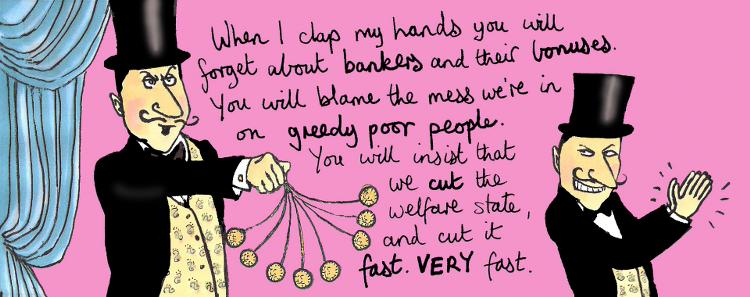
Within the powerful narrative of sibling rivalry and family betrayal of parashat Toledot there runs another, equally powerful and important theme – the control of resources of food and water and how the manipulation of this control distorts everything around it.

Two stories of deception and duplicity frame this sidra, both pivot on the manipulation of food and drink. In Genesis 25:27-34 we have the story of Esau coming in hungry from his venison hunting, and selling his birthright blessing to Jacob for the red lentil stew that Jacob has cooked and whose savoury smell tempted Esau whose appetite was so sharp he felt he would die if he did not eat it. In Genesis 27 we have the story of the blind and ailing Isaac asking Esau to go and hunt him a last meal of venison, after which he would give him the blessing of the firstborn before he died. The same motifs and words come up again and again: blessing; death; venison; In one story food is withheld until the blessing sworn over, in the other the blessing is withheld until the food is eaten. The stories play with each, resonate and mirror each other, but each of them uses food and the control of resource to put one party at a disadvantage to the other.

In the middle of these two stories of blessing and feasting, of manipulation and betrayal comes quite a different narrative. In Chapter 26 we have a story that begins with famine, specifically a new famine that is not the one faced by Abraham and Sarah, and Isaac and Rebecca go to the Philistine Abimelech king of Gerar to find food. God tells Isaac not to leave for Egypt as his parents had done in the previous famine, but to stay on the land and the blessing first given to Abraham would be his. Isaac stays in Gerar, but in a parallel to the story of his parents he tells everyone that Rebecca is his sister rather than his wife, as he clearly fears for his life should the truth be known. Abimelech notices the relationship between Isaac and Rebecca and chastises Isaac – someone could easily have taken Rebecca for a wife and the community would have been punished, and Abimelech places his protection on the couple. The result was that Isaac sowed the land and immediately reaped “me’ah she’arim” a hundredfold return on his work, and God blessed him and all his work. He became richer and richer, with huge flocks and herds, a great household, and this drew the envy of the surrounding Philistines.

I must confess that I find this extraordinary – why should he reap so much for his work? Surely enough would have been enough, and it would surely have been inevitable that such astonishing wealth would attract the unwelcome interest of those who had less than he, but let us pass on for now…

There follows a rather sad narrative of Isaac and the herdsmen of Gerar fighting for the wells that had belonged to Abraham and should therefore now belong to his son. Bible rather laconically tells us that “All the wells which his father’s servants had dug in the days of Abraham his father, the Philistines had stopped them, and filled them with earth”. It is not clear if this was an earlier event to prevent others taking the water after Abraham had left, or if this was a reprisal motivated by jealousy of Isaac’s wealth, or even if this was an attempt to erase any historical roots that Isaac would have had to the area. The wells don’t seem to have been taken over, strange in a world where water is so precious, but filled in – at least until re-dug by Isaac’s men when the fight over the water between the herdsmen became serious. Finally Isaac moved far enough away – first to Rehovot (meaning wide or spacious) and then to Beersheba (meaning 7 wells) – and an uneasy truce prevailed, cemented by Abimelech making a treaty with him having seen that God was with him – a curious treaty hedged with diplomatic ambiguity, asking that Isaac not hurt the people of Gerar, “as we have not touched you and as we have done you nothing but good, and have sent you away in peace…..” (v29)

In this curious narrative, resonant of the earlier stories of Abraham and Sarah, showing Isaac as both a hungry frightened migrant and as a wealthy possessor of animals and land, and finally as a synthesis of these – wealthy but insecure on the land and moved on further and further into the desert, we have the crux of the story. Control of necessary resources is everything. It doesn’t matter how much you possess if you don’t possess the basics of food, water and space to live on. You can be manipulated and dealt out of your rights by the person or group who has control over these, and who can take everything else of value from you. For all that Isaac reaped a hundredfold from his first planting, his wealth meant nothing as long as he was not secure for his immediate needs. Ultimately we are all in thrall to our basic needs. Bible already recognises what Abraham Maslow later put into his theory of the hierarchy of needs – that to live our lives fully we must first meet certain criteria: his first two sets are “Biological and Physiological needs – air, food, drink, shelter, warmth, sex, sleep.” And when these are met, then “Safety needs – protection from elements, security, order, law, stability, freedom from fear.” Only then are we in a place where we can grow well.

Why does bible frame the narrative of the Philistine King Abimelech and Isaac between the two stories of family manipulation and betrayal which both use food and immediate desire/need to control events?

One can only guess at the mind of the editor of the text. But in my mind I see that controlling others through controlling the access to resources they need is a human behaviour done to both those we are in close relationship with and those with whom we do not have such relationship. It is an atavistic strategy hard-wired into us, presumably for survival, but it is not a laudable strategy, and it seems to me that the structure of the biblical narrative is trying to remind us of this. The alienation of Jacob and Esau is painfully intensified through this behaviour. The pain between Isaac and Rebecca, and each of the participants in the deceptions reverberates through the text, as does the frustration and impotence of Isaac trying to claim his father’s wells and being chased off his land with violent encounters. There is nothing good to come out of this story except by negative example. We who control resources may wish to use them to control the behaviour of others, but we should think hard and long about giving in to this strategy. For history teaches that empires come and empires go, that there is a turning and a spinning of the world, and that what is in our grasp now may not be in our grasp in the future. How would we want those who control the resources to behave to us? As the famous first century rabbi Hillel framed the golden rule ‘That which is hateful to you do not do to your neighbour. This is the whole of the Torah, The rest is commentary. Go forth and study.’ (BT. Shabbat 31a)

alice2

both cartoons by the wonderful Jacky Fleming

Chayei Sarah: confronting the reality of death, make preparations, do the work

death pic

Confronting the reality of death is always hard, and for Abraham this is no exception. The text that begins with the phrase “the life of Sarah was one hundred and twenty and seven years, these were the years of the life of Sarah, and Sarah died…” is the introduction to a protracted negotiation for her burial place.

In the twenty verses of the narrative, only three touch on Abraham’s emotional state “Abraham came to mourn for Sarah, and to weep for her. And Abraham rose up from before his dead, and spoke unto the children of Heth, saying: I am a stranger and a sojourner with you: give me a possession of a burying-place with you, that I may bury my dead out of my sight.’ In the story as first presented we see that he seems to quickly move from mourning and weeping to making the practical arrangements so that the body of his wife can be buried and removed from before him.

Sarah’s is the first documented burial in bible – up until now the narrative has dispassionately informed us of the death of individuals without much more detail. Yet clearly this burial he is arranging is not an unknown rite. The children of Heth recognise his need and open the negotiations with the offer that he may take his choice from their sepulchres, telling him that no one would withhold their own plot from him should he want to use it. So clearly there was already a well- established proactive structure in place of prepared graves by the time Sarah died, not surprising given the need to quickly dispose of the bodies of the dead. Yet our foundational family did not seem to have made this provision. Was it because as an immigrant family they had not got a sense of ‘owning’ the land they had come to? Or because they had not quite struck roots in the land of Canaan and were still travelling? It is odd that Sarah died in Hebron when Abraham was clearly in Be’er sheva. Were they living separately? The midrash tells of Sarah’s death being caused by her horror that her husband would be prepared to sacrifice their son so had she left Abraham in order to strike out alone? Was any previous plan to have a grave left behind in the tangle of confusion that this relationship trauma had caused, and Sarah’s new place of abode forced Abraham into making new arrangements?

It does seem odd that they had not made plans for their deaths. They were a long way from the graves of their ancestors, (and indeed Terach the father of Abraham had also died in Haran away from his homeland of Ur Chasdim) so they would have had to innovate in their new lives in the new country. Were they hoping for some guidance in the moment? Were they wondering if they would be staying in the land or moving onwards again? What was behind the need for Abraham to have to negotiate for a family plot while in the grief of immediate bereavement? If as a Jewish community we have learned one thing, we have learned of the importance of community support in times of death and bereavement. The chevra kadisha (holy fellowship) which is appointed by every Jewish community to care for the dead, goes back at least to the time of Rabbi Hamnuna (3rd Century CE). The Talmud (Mo’ed Katan 27b) tells us This also said Rav Judah as reporting Rav: When a person dies in town, all the townspeople are forbidden from doing work. R. Hamnuna once came to Daru-matha, he heard the sound of the funerary-bugle [and] seeing some people carrying on their work, he said: Let the people be under the shammetha [ban]! Is there not a person dead in town? They told him that there was an Association (chevra kadisha) in the town. If so, said he to them, it is allowed you [to work].”

It provides a fascinating insight into the way the whole community was responsible for taking these practical arrangements from the mourners, and for arranging the dignified care and disposal of the body of the dead. This mitzvah took over from the need to work for everyone in town. There was a notifying sound when someone had died so that everyone would know of the death, and clearly in some places that R.Hamnuna knew, this sound was the prompt to everyone to down tools and go to help. Yet in Daru-matha they were even more organised, having deputed the responsibility to a group of skilled volunteers, much as we do to this day.

This leaves time for the mourner to use more than the 15 percent of time that Abraham was able to give in the narrative, to their grief. They can focus entirely on their loss, on the person they loved, on evaluating and processing and making sense of what has happened. And here Abraham has something very powerful to teach us.

We are told וַיָּבֹא֙ אַבְרָהָ֔ם לִסְפֹּ֥ד לְשָׂרָ֖ה וְלִבְכֹּתָֽהּ:

Abraham came ‘lispod´ for Sarah and livkotah’

Lispod is the word we use for giving the hesped – for speaking of the dead and telling the story of their life, from where they had come and how the journey had been, assessing and evaluating the real life that was lived, rather than eulogising or praising the person- at least not paying fulsome tribute unrealistically or without the fuller context of the way they lived their life. ‘Hesped’ means to cause to cry – in other words to really understand who we have lost and so to really feel the cost and pain of the death. Only after Abraham has done this, comprehended the full meaning of the life of Sarah, and thus the full extent of his loss, does he cry/mourn.

Sometimes when people die we like only to say good things about them – even unrealistic and unbelievable good things, instead of focussing on who they were, on why they had the damage or the pain or the anger they carried, on how they did or did not deal with the hurts and disappointments every life brings. There is a tendency to quote another midrashic gloss taken from the names of three sidrot in the book of Leviticus – “Acharei Mot Kedoshim Emor – After death speak holiness”. And this is a good maxim, but it is not the way of true mourning if we think the holiness /kedoshim means to tell ‘white lies’ or gloss over the reality of the complexity of every lived life.

To truly speak holiness of the dead is to recognise them in their full humanity. To see the flaws as well as the wonders, the spectrum of attributes they held and the way they allowed themselves to be. We need to see the fights they fought, the pain they felt, the love they gave, the achievements they realised, the relationships they worked on, the memories they embodied, the losses and the gains. Whatever the story behind the separation of Sarah and Abraham at her death and the lack of dignified burial space planned for earlier, Abraham teaches us something very powerful. See the person who died, give them their full rights as full human beings who lived fully human lives, and only then cry for yourself and for the loss of them. Confront the reality of them and their deaths, and go on to live your life in the light of that understanding.hevra kadisha(images from Czech republic: Hevra Kadisha building in Prague)

Lech Lecha – leave the idolatry, an instruction we need to hear again and again

What happened before God told Avram “Lech Lecha: Leave, go out from your country and your family and from the house of your ancestors into the land I will show you….”. The text before has given us the genealogy so that we know that Terach was the father of Avram, Nahor and Haran. That Haran had died young in Ur Kasdim, leaving a son, Lot, and two daughters, Milcah and Iscah. That Avram and Nahor had married: Avram married Sarai and Nahor had married Milcah his niece. Sarai was childless, (Milcah we know from later in the book had eight sons (Gen 22))

Terach took Avram his son, and Lot his grandson, and Sarai his daughter-in-law; and they left Ur Kasdim, to go into the land of Canaan; they came to a place rather confusingly called Haran, and they stayed there, and Terach died there.

Why had Terach left Ur Kasdim? Why did he not take all of his family with him? We cannot know, and the question sits tantalisingly as we read the genealogy that details the ten generations after Noah who himself is the tenth generation from Adam. Had God spoken to Terach and told him to leave? Was there some family issue? Maybe this is why we are told of Sarai’s infertility here, a condition which is all the more painful when we later find that her sister in law was producing son after son? Maybe after the death of one of his three sons he just had to leave and start again, taking the surviving grandchild with him, away from the place his father had died in so as to give him a better start. Maybe something happened and he had to leave the area with his less rooted and established descendants. But what? And whatever it was, why did Nahor and Milcah stay?

The book of Joshua gives us the peg on which the midrash can hang a back story: “Joshua said to all the people, thus says the Eternal, the God of Israel. Your ancestors dwelled in old times beyond the River, even Terach the father of Abraham and the father of Nahor, and they served other gods. And I took your father Abraham from beyond the river, and led him throughout all the land of Canaan, and multiplied his seed and gave him Isaac”. (Joshua 24:2).

So the catalyst for Terach leaving with Avram, Sarai and Lot may have been something to with idolatry:- either that it was an established family practise that God needed to get them away from (presupposing that God had chosen Terach and Avram for the covenant) or that the family did something that challenged the idolatrous practise in Ur Kasdim, and so needed to leave to save their lives.

Hence we have the stories (found in Genesis Rabbah 38.13), of a young Abraham, having destroyed the idols in his father’s shop, telling his father that a woman had wanted to make an offering to the idols, but that the idols had argued over which one should eat first, and one idol had taken a stick and smashed the others. Terach’s response that they are only statues with no understanding elicits Abraham’s stinging rebuke to his father – “why are you worshiping them then”?

It is a powerful story, and often mistakenly found in books of bible stories as if of the same status, but it is really an indicator of the rabbinic dislike of idolatry rather than a likely explanation for why this branch of the family left their land and travelled south (in stages) towards Canaan.

Much of Judaism, from bible onwards, can be read as a polemic against idolatry and for the one-ness of the divinity. There is a constant suspicion of foreign influencers who will bring in the foreign practises of ‘avodah zarah’ (strange worship). What is very clear is that the battle was a continuing one, from which we can see that while worshiping YHVH/Adonai was something that the Israelites were well able to do, worshiping ONLY YHVH/Adonai was much harder. The prevalence of the rightness of having a multiplicity of gods for a multiplicity of purposes was deeply rooted in the psyche of the ancient world, and the Israelites were no exception. And this has remained true today. While we may look at the statues of Greek or Roman gods in the museums of the world and feel no resonance with them, we are not so different from the people who worshiped them sincerely. We too fall into the habit of not being true to the One God, we idolise all sorts of people or ways of being, or objects. We idolise ‘celebrities’ be they in the popular entertainment industry or writers/artists/scientists. We idolise the marketplace, or money and the people who own it. We idolise the products of the fashion industry, fantasise about unlikely and unrealistic situations, really believe that if we were thinner or prettier or more powerful in some way our life would be transformed. Sometimes we make a fetish of political positions, be they left wing or right wing, and we idolise religious leaders too – and that is possibly the most dangerous of all.

I have watched with mounting horror as a Jewish idolisation of Judaism – or at least of a particular interpretation of Judaism – has grown exponentially in my lifetime. It has become something not to help us to survive and to grow and to create security and goodness in the world, but a way of living to be fetishized and followed in cumulative minutiae. Somehow the texts and traditions have become distorted by increasingly narrow and strict interpretations that have managed to cloak themselves in the language of authenticity and normative usage. Somehow there is an idolisation of certain rabbinic leaders, who are treated as more than human, given powers that no rabbinic tradition would authorise or approve, a fetishisation that does not even disappear when they di e- indeed the death is not recognised in some way, the rabbi elevated instead to a kind of Elijah figure or even a messianic figure. Somehow the chumrah (the extra stringency that the very pious took on for themselves) has become the norm in many Jewish communities. And yet the more usual (and I would say authentic) Jewish tradition fights against this tendency, with, for example, the words of R. Isaac recorded in the Jerusalem Talmud (Nedarim 9:1) “do you think that what the Torah prohibits is not sufficient for you, that you take upon yourselves additional prohibitions?” Or the Babylonian Talmud discussing the Nazirite (Nazir 19a) which says “if the one who deprived himself only of wine is called a sinner then how much more so someone who deprives himself of all things”.

The word “orthodox” was brought into Judaism as a response to the “Progressive” or Reform Judaism that developed as a result of the enlightenment. The idea that Judaism has an orthodoxy is essentially an idea from outside of Judaism. It has always been a tradition that recorded debates rather than the results of debates, ideas to steer rather than rulings to stifle. In the ‘orthodox world’ today there are a multiplicity of different interpretations, customs, teachings, activities, beliefs, which shelter under the title of ‘orthodox Judaism’ merely to differentiate itself from a different and more open multiplicity of different interpretations, customs, teachings activities and beliefs sheltering under the rather less powerful ‘non-orthodox’ label. Indeed so diverse has orthodox Judaism grown, that the umbrella term is no longer enough. Now we have ‘ultra orthodox’, ‘hassidic’, ‘observant’, ‘traditional’ ,’modern orthodox’…. Each of which sees itself as the true and sometimes the only heir to Judaism. And each of which is vying for authority and authenticity by multiplying rulings, prohibitions designed to keep adherents away from the modern world, and concentrating power in the hands of the leadership.

Now I am not saying that we progressive Jews don’t also fall prey to idolatry – we tend to idolise social justice and tikkun olam over prayer, ritual and a deep relationship with God. We tend to fetishize universalism at the cost of a particular Jewish identity and lifestyle. Our Jewishness tends towards the culture and cuisine of our people and less towards studying and adopting its texts and scholarship. We all have a problem with idolatry – in that way we are just like our ancestors from biblical times onwards. So we need to return to the beginning. Lech Lecha – go, leave behind the lazy habits and the comfortable assumptions and following what others do, and go back to finding what God wants from us. Don’t leave that journey for others to tell you about, don’t fall into the common culture of everyone else, worshiping what we know to be false. Break the idols we have become dependent upon and leave them behind.