Behukkotai:rebukes that remind us we must work together

Sidra Behukotai ends the book of Leviticus, and while frequently read in conjunction with sidra Behar, it differs from it substantially in the tone of the narrative. It opens by describing the blessings and rewards that the Israelites will receive if they uphold the covenant with God and follow the mitzvot that are the conditions of that covenant, and ends  with a brief series of teachings about tithing, the sanctification of voluntary gifts to the Temple, and about vows. But the centre of this short sidra is the passage known as the rebukes – tochecha – when Torah lists the tragedies that will befall us should we abandon God’s covenant and our obligation to do mitzvot.

One particular verse stands out for me as being emblematic of the tochecha: In Leviticus 26:23-24 we read:

“Ve’im b’eileh lo tivasru li, v’halachtem imi keri, v’halachti af ani imachem b’keri,v’hikeiti etchem gam ani sheva al chatoteichem.” (And if after these [punishments] you are not disciplined/corrected but [instead] will walk ‘keri’ with me, then I will walk, even I, with you in ‘keri’, and I will smite you, yes me, seven times for your sins”)

This word, which is found right at the heart of this narrative of rebuke, appears nowhere else in Torah in this grammatical form, yet in this text we find it repeated seven times within twenty sentences (vv 21,23,24,27,28,40,41) forcing us to notice and explore it. Our behaviour clearly b’keri has terrible consequences. And yet it is not clear what the writer means by it.

Many classical commentators follow Rashi and Maimonides and understand the root of the word to be k.r.h – meaning something that happens by casual chance or by accident (mikreh), though it may also be translated as being in opposition or contrary, or indeed it may come from the root k.r.r meaning to be cold.  But we also know that when used in bible, the apparent casual chance of the text is not ever quite what it seems to be on the surface, but instead is a coded phrase used to let us know that something of significance is about to happen.  So it is that Ruth meets Boaz the language of k.r.h is used to alert us to the significance of her choosing his field to glean in.   There is something curious about a phrase used to describe a chance that is not exactly chance, a casual encounter of enormous significance, but that is how the word keri is used, and to find it so definitely  emphasised in the text of the tochecha means we need to look closely at just what God means when God says “If you walk ‘keri’ with me, then most definitely I will walk ‘keri’ with you.

The three most common teachings about this are: the classical idea expressed by Rashi and Maimonides that there is a lack of interest or intention in walking God’s way – a sort of going through the motions without really caring or understanding or being principled in doing God’s will; The extension of this mechanistic approach of indifference which is developed by R.Samson Raphael Hirsch of modern orthodoxy, and which overlays on the classical understanding the idea that when we do God’s will b’keri it is essentially not simply a casual coincidence but a phenomenon that happens when our will and God’s will coincide so that while it feels we are doing God’s will with intention, in reality we are following our own self-interest and priding ourselves on acting with more righteousness than should be claimed; and thirdly the position of the founder of the ethical mussar movement R.Israel Salanter who layers in the idea of coldness to the behaviour to suggest that when we walk with God b’keri it is that we follow God’s commandments not only mechanistically but also without any warmth or passion for it – there is no possibility of our doing the mitzvot changing us or developing our relationship with the creator.

I like this idea that if we follow God’s commandments to the letter, but without any passion – without committing ourselves and our hopes and fears – that this is viewed by God as b’keri: casual indifferent and cold religion. It bespeaks irrelevance – the acting out of what is required but in no way coming from the commitment of the self.  It is act but not attitude. How do we bring God closer into the world if we do not ourselves make the effort to make the world a better place? How do we bring ourselves closer to God if we pay attention more to how things look than how things are?

The warning in the tochecha, of all the things that will go wrong if we act b’keri – is so powerful an imperative that we are told that not only will God mirror our indifference, God will go further and punish us seven fold – the designation of maximalist or absolute punishment, the other end of the spectrum from casual/chance/indifferent.  If anything is designed to catch our attention, it must be the severity of this response.

And after it all, the horror story painted so dramatically of famine and war and terror and starvation and expulsion and yearning and pain – there comes this: “Then will I remember My covenant with Jacob, and also My covenant with Isaac, and also My covenant with Abraham will I remember; and I will remember the land….And yet for all that, when they are in the land of their enemies, I will not reject them, neither will I abhor them, to destroy them utterly, and to break My covenant with them; for I am the Eternal their God. But I will for their sakes remember the covenant of their ancestors, whom I brought forth out of the land of Egypt in the sight of the nations, that I might be their God: I am the Eternal.”

God promises to remember – to actively recall the relationship of Covenant between God and the Jewish people which will never be broken no matter how badly behaved we might be. And God compounds this by naming the Avot, the three founding patriarchs of the Jewish people, and unusually lists them in reverse order, the only time this is found in bible.

This bringing in of the patriarchs leads to the concept of zechut avot, the merit of our ancestors, which we can call upon to weight our case before the heavenly court. The midrash (Vayikra Rabbah) explicates this, asking  “Why are the Avot listed backwards? To say: If the acts of Jacob are not worthy, then the acts of Isaac are worthy, and if the acts of Isaac are not worthy, then the acts of Abraham are worthy. The acts of each one is sufficiently worthy that the world can be saved for his sake.”

Rashi mitigates this a little, saying “Why are they listed backwards? As if to say: Jacob, the youngest, is worthy of that; and if he is not worthy, behold, Isaac is with him, and if he is not worthy, behold, Abraham is with him and he is worthy.”

It is, I think, a little dig or reminder to the Jews of modernity – the greatest zechut/merit is that of Abraham, and as time goes on the merit is by its nature in decline. So we need to add the merit of our ancestors rather than assume any one is sufficient by itself. We, so much further away from biblical times are expected to have less merit than the founding patriarchs – so how much more do we need each other to fulfil our task. If we just do our tasks with indifference, or follow God’s will where it coincides with our self-interest, or do not attempt our holy task with all the passion and awareness we could bring to it, then we will fail. And to do our holy task well enough we must do it together, in community, with shared and common interest. We need not only the combined merit of our ancestors in tough times, we need the combined merit of our fellow human beings. Only in this way, by working together to make the world a better and holier place, by rebuking each other where necessary, by paying attention to what we do and its effect on others – only in this way will we create the blessing we yearn for.

Behar: to treat with respect is the essence of holiness

The bible is very clear – everything we have belongs to God and is at best ‘on loan’ to us. And we have to treat it properly and with respect. Even the land must be allowed to rest, rather than be worked to produce more and more. Besides giving the land a chance to return to a good condition, the sabbatical year also meant that all people, whether they were rich or poor, would find themselves dependant on what the land produced naturally, as all of them would have to collect and gather the food that was there, rather than the usual experience of the richer ones harvesting a good amount and leaving a proportion in the field for the poor to glean. This would have been a transformational experience in that the ones who always had food would become aware of the conditions the poor faced all the time, and one imagines that the bible hoped this learning would motivate them to help support the needy.

Leviticus is a book that is primarily about the ritual system and how holiness is created, and reading some of the narrative here we become aware of the agenda of social justice that is threaded through it, how the world cannot be made perfect if justice is not available for all. Even during the shemitta year, the year when the land is to rest and recuperate, the obligation for tzedakah for the poor continues – in other words just because you are tightening your belts, you don’t forget the needs of others who rely on the help they get from society in order to survive.

Everything we have belongs to God and is, at best, on loan to us. When we harvest the land we leave food for the poor. When we help a fellow human being who is in financial difficulties we give them their dignity and are not to charge interest on any loan we give. The laws remind us that even the money we have is not ours to use as we please. It is a conditional loan, to be partially used for the benefit of others.

As we look into an uncertain future where politically, socially, financially we know that times will be tough and we will almost certainly feel ourselves to have lost some of the security we felt in earlier times, the message that comes through this part of Leviticus could comfort us a little – and could teach us a lot. We must – even now -continue our obligation to a just society where the gap between rich and poor must be actively narrowed (if not removed) on a regular basis. We must – even now – continue our commitment to tzedakah, to the dignity of our fellow human beings, and to our land. And if we maintain our understanding that each of us has a part to play in bettering the world, and that sometimes that process requires us to start again in a different way, then even now when following news sites may leave us feeling impotent angry and depressed, we can stop, take stock, and get on with helping to create a healthier and holier world.


Kedoshim: increasing kiddush hashem and diminishing hillul hashem.

It has long been the habit to refer to all the Jews who historically were killed for adhering to their faith in times of persecution as having died “al Kiddush Hashem” and this idea has also become attached to the six million Jews murdered in the Shoah – they have become kedoshim through their deaths and are  elevated to the status of martyrdom.  I understand the comfort that may be derived by those who mourn their murdered family and friends to see their status as that of kedoshim, but I have always found this slide of the terminology to be problematic. To me martyrdom should be a conscious choice. To me their murder is a Hillul Hashem, and no holiness can be found within it, only in the responses both at the time and afterwards to protest, to remember, to mourn, to live on.

I am uncomfortable also in the loss of the full name of Yom haShoah, which is actually “Yom Hashoah Ve-Hagevurah”— literally the “Day of (remembrance of) the Holocaust and the Heroism.” All choice has been removed from our remembering – both the lack of choice of those who were rounded up and unable to protest, and the powerful choices made by those who did protest, or who were partisans or who hid themselves or others from the evil around them.  By diminishing the heroism, by diminishing the choices people made from their own humanity and their ethical imperatives, it seems to be we lose out on Kiddush Hashem as people are able to bring it about. Instead we focus on the Hillul Hashem of those who mindlessly or not destroyed the hopes and lives of so many and we coat the victims in martyrdom as if to bring honour to their destinies.

Yom HaShoah was created to remember those we have defined as kedoshim either through martyrdom or through protecting God’s creation when others were trying to destroy it, and the date was chosen by the Government of Israel to remember them. It is no coincidence that the date chosen by the politicians was out of sync from the date that would have been chosen by rabbinic tradition, and instead of being placed on a traditional day of mourning such as tenth Tevet or Tisha b’Av it was placed a week before the celebration of the Israel Independence Day – Yom ha’Atzma’ut. This placing has led to a connection in the minds of many, that the outcome of the murder of the 6 million is the creation of the modern State of Israel.

For me this is deeply problematic. Not only does it submerge the many prior years of political Zionism that worked to create a Jewish state, but it builds the state on the martyrdom of the ‘kedoshim’, many of whom were not natural Zionists in life.  In so doing, it changes the nature of the contract with the land we have had since this Torah text was given – that we have the land of Israel because God has given it to us, and we have a responsibility to live on it in a way that promotes Kiddush Hashem. Sidra Kedoshim makes clear that our continued living on the land of Israel depends on our living lives of kedoshim, ethical lives where the vulnerable are protected, the land is cared for, and where a lived awareness of the focussed attention of God and the desire to behave as God would wish us to do should always be part of our daily routines. By making the idea of ‘kedoshim’ the historical foundation of the State rather than the aspiration of the contemporary society we reduce the imperative to behave in holiness. And that is dangerous, for if we are not acting to promote Kiddush Hashem we run the risk of sliding into its shadow, of Hillul Hashem. If we believe we have an entitlement not given to us by Torah but by the deaths of innocents then we can easily act from that sense of entitlement, and we forget the conditions given here in Leviticus that the land will not tolerate our bad behaviour.

The rabbis of the Talmud spoke of being kedoshim as living in such a way as to imitate the divine qualities of mercy and kindness.  They specifically ruled out imitating the parallel divine attribute of strict justice often seen as working in balance with divine mercy and which may impose conditions for the way the mercy might be applied. They are advocating undiscriminating kindness to others in order both to achieve kedoshim and to increase the presence of God in the world. I am reminded of Rabbi Abraham Joshua Heschel who wrote “when I was young I used to admire clever people, now I am older I admire kind people” and I hope that beyond admiration, we remember the vulnerable and the powerless and those who sought to help and protect them, and in remembering our own experience of helplessness and oppression we too strive to increase kindness in our world.


International Holocaust Remembrance Day

Written a few years ago, but still so powerful in my memory. For all those who died, whose goodness and laughter and potential died with them.

sylviarothschild's avatarrabbisylviarothschild

Two years ago I visited the Rumbula Forest, near Riga in Latvia, where nearly 28 thousand Jews were killed in just two days in November and December 1941, and where a heartbreaking memorial to them is hidden among the trees. Some of my own family, the brothers and sisters of my great-grandfather and their children are buried in the mass graves marked out on the forest floor. Only three people survived the murder that took place here.

The visit was poignant and it was also infuriating. One reason it had taken so long to build anything here as a memorial is that the inscription on the memorial had become an issue when some Riga officials wanted language that would have obscured Latvian complicity. Eventually an agreed inscription meant the memorial could go ahead

HERE, ON NOVEMBER 30 AND DECEMBER 8 OF 1941 THE NAZIS AND THEIR LATVIAN COLLABORATORS SHOT TO…

View original post 1,960 more words

A Key on the Seder Plate: Remembering those who are detained indefinitely while their applications for asylum are being processed.

keysforfreedomImagine the fear of being subject to indefinite detention. No way of knowing how long you will be there,” feeling like you have been put into some sort of human storage facility” (Ajay from Freed Voices).  Imagine trying to keep your sense of self, already damaged by the treatment you have received earlier in your own country, the torture and abuse you have fled, leaving behind family and home in an attempt to save yourself.  Imagine the dangerous journey to freedom, the cold and the heat, the hunger and the insecurity, the anxiety for those you have left behind, the fear of what the future will hold.
Imagine then arriving at a country of sanctuary, hopeful, grateful, ready to work hard to create a new home and make new relationships, to build a good future. And then imagine the bureaucracy, the suspicion, the black hole you fall into as you try to do all the things that will bring a new start. Imagine the xenophobia, the misery, the violence of those who are losing all hope. Imagine that your innocence is questioned, that being locked up without any time structure is seen as normal. Imagine the limbo you find yourself in, no end in sight, nothing to hold on to. In 2015, 255 people had been detained for between one and two years, 41 for over two years.  But these figures exclude the many people who are held in prisons under immigration powers, so the true figure is likely to be significantly higher.  Detention is justified as a way to deport people, but the majority of people detained for more than a year are not ultimately deported.

There is no clarity or transparency in the process. It just grinds on slowly – at least you hope it is grinding on – how would you know if you are not forgotten?  How do you hold on to your humanity when others see you only as a statistic, and a hostile statistic at that?

As one detained asylum seeker said:    “In prison you count the days down to your release, but in detention you count the days up and up” (Suleymane from Freed Voices”)

In 2015 official figures report that almost three thousand people were placed on suicide watch, eleven of them children.  And the figures for suicide attempts inside these centres is going up. The mental health of detained asylum seekers becomes further fractured by the fear, the lack of any clear process or time structure, the prison conditions in which they are held.

As Richard Fuller MP said at an interfaith event hosted by Tzelem and Rene Cassin in the House of Commons yesterday (20th April 2016) “the system is costly, it is inefficient, and it is unjust”. It costs £70 thousand a year to hold someone in detention in Colnbrook detention centre – money that could be used for their rehabilitation and to facilitate their entry into society.

The UK is the only European country with indefinite detention for asylum seekers. The immigration bill is coming back to the Commons with many amendments from the Lords, one of which is to set a time limit of 28 days. As we go into Pesach, our festival of freedom, let’s do all we can to remember and to hold in our hearts and minds the frightened people held in indefinite detention in our own country. Put a key on your Seder plate and pledge to work for the freedom of all people to live in security and peace, to work for the ordinary and common desire we all share to be able to get on with our lives without fear.

Metzorah:an object lesson in convalescence

Hillel’s disciple, Ben Bag Bag commented “turn it [Torah] over and over again, for everything is in it” (Avot 5:25), but even he might have been challenged to extract some edifying homily for today’s society from parashat metzora.

The sidra contains graphic descriptions and treatments of certain ancient plagues, translated as ‘leprosy’. Be it the purification ritual for the leper who has been declared clean, or the process of dealing with houses affected by plague; be it the discharges of men or of women – the text goes into maximum detail, and the relevance for today flees from the mind of the reader as the images strike us forcibly and revoltingly.

But every sidra brings us something new and it is an obligation for us to examine the narrative and to allow it to speak to us today.  And of course it does speak – we are reminded that while the rituals around a priest’s examination of leprous spots may seem irrelevant, our attitude to illness and to the sick is not.  In Tazria which was read last week, but is often read together with Metzorah, we learned that the victim’s place was outside of the camp, alone and apart.  This week we read of the difficult process of return to the land of the living.

And it is difficult.

One of the sacrifices to be brought by the now-healed leper is the asham, the guilt offering. Why a guilt offering? What had the sick person done?  Wouldn’t a thanksgiving offering be more appropriate?

There is a rabbinic tradition that the word Metzorah is an acronym for ‘motzi shem ra’ – for gossip, from which sadly comes the inevitable idea that the victim of an illness must be being punished for a sin they have committed. This would then explain the guilt offering as being the atonement brought by the penitent convalescent for the sin which caused their illness.

The idea exists in our tradition, but we should not fall into the trap of taking it any more seriously than a rabbinic homily to explain a curious choice of offering, for if we began to go down the road that illness is a punishment from God for previous bad behaviour, we would soon be in serious theological trouble, having to defend a cruel callous and punitive God.  How would we explain children’s illness, or that of people who try hard to live an exemplary life?  Equating such things with God’s punishment goes against the grain of our core teachings, even while the midrash remains ‘on the record’.

So why the asham, the guilt offering?   Those of us who have either been close to someone who has had a potentially life threatening illness or ourselves survived a long and painful time will know that the feelings on returning to health and to life may be complex and ambivalent. No longer having the support of health professionals quite so frequently, or of a family who have been exhausted by the effects of the illness can be frightening and cause instability and anxiety in the now healthy person. There is a fear that the illness might be hiding and return, or that something else may strike us out of the blue as the illness did.

For some people the humiliations of the illness or the treatment have gnawed at their sense of worth and of identity.  They begin to be not themselves, but people whose horizons are diminished, whose interest in life begins to wane, who become institutionalised or self centred.  The four walls of the sickroom become the only world of interest, so that the restrictions of the illness begin to impact not only on the physical body, but the emotional, spiritual and intellectual self as well.  One may come to hate one’s own weakness, resent the way the body will not perform to order, be angry with oneself for having given in, for being unable to take part in life, for being unable to share the future with loved ones.  One questions ones own life.  And upon recovery, the questions build – why me? Who now am I? Why have I been spared when others were not?  Survivor guilt is a well-known phenomenon that is not restricted to experiencing a violent upheaval in political terms, but also plays out in people who have danced too closely with death and yet come back into life. Depression and anger mix with anxiety often in the recovering patient. And should there be continuing medications or the need to live with high-tech requirements for your body to carry on and your heart to continue beating there is never a time when one can forget or consign the experience to memory. The depths of human pain and human distress  are often unacknowledged in the triumphalism of the successful bringing back of the very sick into the land of the living.  The very ill person has different horizons from the rest of us, and should we ignore those we may cause great distress to the convalescent.

For society too, the return of the sick person may bring about feelings of vulnerability and guilt.  Most people, when they ask the question ‘how are you?’ are not expecting a detailed, or even a truthful, answer.  The response ‘I’m fine, how about you?’ is the socially acceptable one.  We fear our own vulnerability, and the sick tend to remind us of it, so when we encounter them we tend to feel a little guilty about our own anxiety, about our own health status, about what we meant to do for them if only we had got around to it…

So the bringing of a guilt offering, both by the recently recovered and by the community into which they are re-entering, may be no bad thing, but the truth is we cannot any longer bring such a thing – so we need to be looking for what we can offer in its place.  We could bring understanding and some insight, compassion for those who suffer and for ourselves; we could bring awareness of the plight of the ill and of those who care for them; we could bring warmth and love, patience, and the recognition of our own anxiety, and so transform the experience of the sufferer and the convalescent, and just as importantly transform the experience that we ourselves encounter when we encounter illness and vulnerability.  Whether it be people who are diagnosed with cancer or with AIDS, whether it be people who have mental fragility and frailty or people with age related illnesses – they need our compassion and our presence in their lives, and we need theirs.  So when we read about the unpleasant illnesses in Metzorah let’s remember how seriously the bible took the care of such individuals and of society, both during the illness and after it. It is a model lesson which we might easily overlook in the mess of symptoms described in this sidra, yet as ever the Torah has much to teach us about how to behave towards others.

Shabbat Zachor: Amalek, a metaphor for cruelty, victimisation of the weak and vulnerable, arrogance

On the Shabbat before Purim we have a special extra scroll reading, and the Shabbat is named not for the weekly torah reading, but for this reading – Zachor et asher assa lecha Amalek, baderech b’tzeitchem mimitzrayim. – Remember what Amalek did to you, on the journey, as you were leaving Egypt. This week is Shabbat Zachor, the Shabbat of Remembering.

amalek soferet

On the Shabbat before Purim we read a few verses from Deuteronomy: “Remember what Amalek did to you on your journey, after you left Egypt. How, undeterred by fear of God, he surprised you on the march, when you were famished and weary, and cut down all the stragglers in your rear. Therefore when the Eternal your God grants you safety from all your enemies around you, in the land that the Eternal your God is giving you as a hereditary portion, you shall blot out the memory of Amalek from under heaven. Do not forget” and this injunction fleshes out an earlier account in the book of Exodus where the Amalakites had come to fight with Israel, and Joshua had gone into battle, only winning when Moses’ hand were physically held up high by Hur and Aaron. At that time God told Moses to inscribe the story in a document and read it aloud to Joshua, that God would utterly blot out the memory of Amalek from under the heavens, and the story ends with Moses saying “God will be at war with Amalek throughout the ages”

Who exactly is Amalek? Why is God at war for all times with Amalek and what can we understand from this story? What do we take from a command to us to effectively destroy an entire people – if this truly is the command we are given.

The Amalakites don’t seem to exist outside of biblical texts which give us very little context for them. They appear in several places in the bible right up to the book of Chronicles at the end of the book, and of course in the book of Esther Haman is said to be an Amalakite, a descendent through the Agagite tribe – hence the connection to Purim, but I think that a quasi historical understanding of the Amalakites is not especially helpful for us to understand the commandment to remember them so as to blot out their name.

Amalek seems to be not so much a people as a metaphor for cruelty, victimisation of the weak and vulnerable, arrogance. The original story tells of the group of people (Amalakites) who attack the weakest most vulnerable Israelites leaving Egypt – the ones who were at the back of the procession of ex slaves and others – and seems to speak of this attack as being entirely opportunist and without motive. Amalek hurts for the sheer pleasure of abusing power, aimlessly destroys the other for no reason or benefit. So the word becomes a synonym for everything we wish not to be, everything that religion strives to change – Amalek is the one who sees no humanity in the other, who isn’t connected as part of a shared community with the rest of the world, who rides roughshod and uncaringly over the needs and emotions of other people who are simply commodities or objects rather than reflections of the divine.

Amalek becomes the state into which we might all occasionally slide – the state of compassion fatigue, or the drive to make sure we are ok at the expense maybe of others, the closing of borders against the clamouring needy who wish to share the benefit of our world, the fundamentalist who cannot allow anyone to have a different way of seeing the world. Amalek is the one who chooses not to see a connection between us and the other, a connection which the religious person may call God; the non-religious will use other words to describe

The Amalek who is with us in every generation may not only be the traditional view of the oppressor who comes to destroy the Jewish people, it may be the inner workings of each human soul which might have the tendency to forget the humanity of others in pursuit of gratification of our own needs.

Shabbat Zachor is named after the extra torah reading about Amalek, with its imperative to remember Amalek so as to blot out Amalek, reminding us that in the coming week we will commemorate the story of Esther and read the Megillah for Purim. But as we cheer and boo, as we celebrate the gory end of those who tried to murder us, as we relieve ourselves of some of the stress of living a minority existence amongst people who resist and sometimes despise our particular difference, let’s spare a thought for the Amalek inside all of us, the characteristics of selfishness or conceit, of narrow mindedness or wilful ignorance of other’s pain. Our world contains violence and famine, slavery, hatred, refugees searching for safety, huge discrepancy between rich and poor, warfare and oppression. If that isn’t the presence of Amalek, to be thought about so that we try to change and work hard to remove it, then I don’t know what is.

Racism- the continuing struggle against ‘othering’: a talk at Stand up to Racism 1.3.16

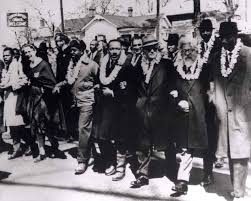
Abraham Joshua Heschel, a Polish born Rabbi who became one of the leading Jewish theologians of the twentieth century, marched arm in arm with Reverend Martin Luther King Jr at Selma in 1965. Afterwards he wrote to him – “When I marched in Selma, I felt that my feet were praying”

heschel at selma


The three Selma to Montgomery marches were a non-violent way of highlighting racial injustice in the South of the USA, and contributed to the Voting Rights Act being passed the same year.

Rabbi Heschel wrote deeply and frequently about religion and race, which he felt were antithetical positions. He wrote that “to act in the spirit of religion is to unite what lies apart, to remember that humanity as a whole is the beloved child of God. To act in the spirit of race is to sunder, to slash, to dismember the flesh of living humanity.” Such physical and visceral language about racism was reflected in his actions. Already nearing 60 years of age, he marched proudly, putting his body in the firing line for a principle he believed in deeply.

In a lecture given two years earlier he told his audience of Jews and Christians bluntly (National Conference of Christians and Jews on Religion and Race, 14 January 1963.) that

“Few of us seem to realize how insidious, how radical, how universal an evil racism is. Few of us realize that racism is man’s gravest threat to man, the maximum of hatred for a minimum of reason, the maximum of cruelty for a minimum of thinking.”

He was speaking from a deep understanding of Jewish texts. And he was speaking from a position of recognising the commonality of all human beings. When we categorise people by race we stop seeing the uniqueness of each human person. And the greatest and most redemptive human quality is to have kinship, to build relationship with others with empathy and with respect. Heschel brought a wonderful insight to the biblical story of creation. He pointed out that the text speaks of the many kinds of plants and of animals created by God, that each one was different from the others, each one was to become the progenitor of its own species. And then he pointed out that in this text the creation of the human being was very different. There were no parallel species of different colours or characteristics, genders or races. There was one human being – the ‘Adam’, made from the ground itself, fashioned in the image of God. And that human being became the progenitor of all the diverse expressions of humankind. The ur-ancestor from whom we all descend – our humanity is bound up with each other, it has to be, and if we choose to divide ourselves and to hate “the other” then truly we are causing the maximum amount of cruelty for the minimum of thinking.

Bible did not notice race per se. In the ancient world right up to the time of the Greeks and the Romans, race was not the issue that society organised around – but all of the ancient world did notice whether someone was ‘in’ or ‘out’. Whether they were citizens or aliens, whether they came from ‘other places’ or they came from ‘here’. There was always a tendency to try to create a hierarchy, where “we” are the best and “they” are inferior. Hence the power of the biblical text which is consciously addressing these attempts to order humanity by inherent superiority, and which is working to refute it. Later (rabbinic) texts take on the debate. Mishnah Sanhedrin (4:5) includes the phrase “[Only a single person was created] for the sake of peace among humankind, that one should not say to another, “My father was greater than your father”. And.. [Only a single person was created] to proclaim the greatness of the Holy Blessed One; for humans stamp many coins with one seal and they are all like one another; but the King of kings, the Holy Blessed One, has stamped every human with the seal of the first man, yet not one of them are like another. Therefore everyone must say, “For my sake was the world created.”

While the ancient Roman and Greek worlds were defining people according to geography (from here good/ not from here bad) or status (in the community good/ out of the community bad) the Rabbis of the Midrash were specifically choosing to see all human beings from wherever they came as of equal value. And especially they took on the argument from geography, making explicit that from where someone originated was of no importance in ascribing their value.   Rabbi Meir (2nd century) taught that God made Adam from the dust gathered from the whole world; and Rav (3rd century says): “His head was made of earth from the Eretz Israel; his main body formed from the dust of Babylon; and the various limbs were each fashioned with earth from different lands” .

When we look historically we can see again and again that as the host community sought to belittle and even humiliate people it saw as outsiders or foreigners, be they marked by accent or, skin colour or culture, the force of religion was pitching in the other direction. So the actions of Abraham Joshua Heschel, the Warsaw born scion of an orthodox Hasidic family, in the southern states of America in 1965, were a natural progression of Jewish tradition that begins in bible and speaks out against the human habit of ‘othering’ and of creating a hierarchy whereby some are dominant and others are subordinate, where some have more value than others.

This week in synagogues all over the world there is an extra Torah reading – Shabbat Shekalim tells of the census in the wilderness and reminds the present community of the obligation to share the costs of communal resources. The title – the Sabbath of the Shekel – comes about because the census is taken by everyone giving a half-shekel coin, and these, not the people, are what is counted. There are many reasons offered for this way of counting, but one of my favourites is that it shows that while different individuals may have a different nett worth financially, every person is of the same value before God. And why a half shekel coin rather than a full shekel? Because no one person is complete on their own, each of us relies on others to complete us.

When Abraham Joshua Heschel marched arm in arm with Martin Luther King Jr both men understood importance of these teachings. Every human being is of infinite and equal value, every human being needs others to help them reach their full potential. Racism causes us to forget both of these lessons, but they remain as true as ever they did, and it is up to us to keep teaching them in the way we live our lives.


From a talk given at Stand up to Racism event, Goldsmith College 1/3/16

Shabbat Shekalim:counting ourselves and making ourselves count

In the month of Adar there are 4 extra Torah portions read after the weekly reading each shabbat which give their names to that shabbat. The first of these, read on the shabbat after Rosh Chodesh Adar (the new moon of the month of Adar) is Shekalim.

The extra piece speaks of the census which is taken in the wilderness, where the people are to donate a half shekel each as ‘kofer nafsho’ (a ransom for his soul) and kesef hakippurim (atonement money). This offering to God, which is to be the same amount for everyone counted, regardless of their financial worth, is to fund the service of the tent of meeting.

The half-shekel tax that pays for the maintenance of the worship system is to be paid by the first day of the month of Nisan and so the extra reading at the beginning of Adar functions as a reminder to the community that the payment is about to be due. It has always been a source of amusement to me that many modern synagogues hold their AGM’s (and therefore the beginning of the subscription year) at around this time, in order to nudge their members to think about their membership payments, although now we do not suggest that such payment would effect an atonement.

The way of not counting people but instead counting the coins of identical value goes deep in the Jewish psyche. David incurred the wrath of God and an ensuing plague when he counted the Israelites (2Sam24) and while the commentators suggest it was because the census was not authorised, there has remained a fear of counting individuals in case of danger. This may have had to do with the belief that numbering people implied diminishing them in some way, or that the biblical census was usually associated with upcoming military activity in which many of the people numbered would lose their lives. To this day there is a general Jewish fear of censuses, and when counting a minyan for prayer people will either use the loophole of a negative (as in ‘not one, not two, not three etc.) or a recite a verse with ten words (such as Psalm 28 v9 which has the added benefit of acting as a prayer, translating as “save Your people and bless your inheritance and tend them and carry them forever”).

Whatever the reason for it, this method of counting identically valued coins teaches some valuable lessons. It shows us that while each person may have his or her own individual financial worth, everyone has the same value before God. And it causes us to ask about the significance of each person bringing only a half shekel rather than a whole one.’ Many explanations are offered by commentators: – that the half shekel may represent the time of day when the sin of the golden calf was committed (midday). That it is the equivalent to the penalty for those who disobey the 10 commandments and so this payment can be seen as a kind of atonement. They are all ingenious explanations, but the one I prefer is of a different order – According to Rambam, the use of a half shekel rather than a whole one teaches us that no person is complete when alone – we can only attain full spiritual completeness when we are in relationship with others, when we are in a community of shared interest. And I would add to this view that not only can we not be not be complete when alone, but that our completion is a process rather than an existential state. So that just as the world is in a state of continuing completion we too are always in the position of completing ourselves. And just as the world needs our work and our active interest for is continuation, so do we need the active interest of and participation in the community of ideas and of other people.

As each of us gives of our time and wealth to the community we are also aware of our own needs and our own lacks, we are each looking to be fulfilled by the ‘other half’ that can be found in relationship with other people.

Shabbat Shekalim begins the run up to Pesach, the time of redemption and the beginning of peoplehood rather than the collection of individuals. It is a liturgical nudge, a reminder that we are not fulfilled by ourselves, that we are a work in progress. This year it is paired with parashat vayakhel, the Torah reading that begins with assembling the whole people. The message is clear – community is our natural state however individual and singular we know ourselves to be. No person is complete on their own, but we are all of equal value to God, however much or little we materially own. And every one of us has something to offer the community, every single one of us counts.

Ki Tissa: looking back and looking forward, how do we see the presence of God.

And [Moses said to God] ‘Show me, I beg you, your glory.’ And God said: ‘I will make all My goodness pass before you, and will proclaim the name of the Eternal before you; and I will be gracious to whom I will be gracious, and will show mercy on whom I will show mercy.’ And God said: ‘You cannot see My face (panai), for humans shall not see Me and live.’ And God said: ‘Behold, there is a place by Me, and you shall stand upon the rock. And it will be, while My glory passes by I will put you in a cleft of the rock, and will cover you with My hand until I have passed by. And I will take away My hand, and you shall see My back / behind Me (achorai); but My face shall not be seen.’ (Exodus 33:18-23)

It is a very famous scene. Moses asking for reassurance, God offering an experience of staggering intimacy. But the way it is often understood as an anthropomorphic event distances us from it. It takes on a filmic or even cartoonish quality and the nature of the encounter remains unknowable.

Yet until the late middle ages it was never read like this, and to quote the New Testament Scholar John Dominic Crossan it is important to remember that it “is not that ancient people told literal stories and we are smart enough to take them symbolically but that they told them symbolically and we are dumb enough to take them literally”.

So if we are to go back and take another look at what the text is telling us Moses saw on Sinai, we should divest ourselves of the idea that the text is recording Moses literally seeing the departing back of God as the closest we can get to the divine, and look at the words again, without the gloss of modern translation. And we should be prepared to read the metaphors and resonances in the text, rather than accept a superficial literalist reading.

So what did Moses see?

The root of the word panim, (face) occurs in various forms twenty-two times in 47 verses in this passage, meaning that there is a persistent calling our attention to it. And the midrash begins to fill in some synonyms for it – as well as ‘face’, ‘aspect’ or ’existence’ it can also be “divine justice”, “divine essence”, “divine revelation” “the secret mysteries of Torah”, “the reward of the righteous”.

The root meaning of the word “achorai” is ‘behind’ or ‘after’ – hence the translation “back” but this is not the usual word for the body part (which would be ‘gav’). It is more – the thing that follows, so achorai is “what is behind me” or “what follows me”

From this we can begin to see that Moses is not meeting an incarnate God, but encountering the divine insofar as it is possible for the human being to do so. Human beings cannot fully comprehend the essence of divinity, they can only see the evidence of God with hindsight, when they see what follows after God’s presence has touched their lives.

An early midrash suggests that what Moses sees is the shadow of God, playing with the name of Bezalel who is chosen to create the symbol of God’s presence among the people, the mishkan. Others suggest that the shadow that Moses could be seeing is where God is not – in the same way that we sometimes talk about the emptiness depression and sadness that can overshadow our lives.

The first century Aramaic translation of the text by Onkelos is intriguing: He writes “And God said, ‘you cannot see the face of My shechinah (dwelling/presence); for no one can see Me and survive. And God said, Look, there is a place prepared before Me, and you will stand on the rock, and it will be that when My Glory passes by, I will put you in a cavern of the rock, and My Word will overshadow you until I have passed; and I will take away the word of My Glory, and you will see that which is after Me, but what is before Me shall not be seen”

It is an intriguing translation, for it both chooses not to read the text in any way as a physical encounter where God has even a metaphorical body, but instead it opens up the possibility of reading the text in terms of time. Panai (my face) and Achorai (my back) are now understood as before me and after me, just as we might use them today – there is a time stretching ahead of us, and there is a life we have lived stretching out behind us. So what Moses is allowed to see is ‘behind God’ ie that which has already happened, but he is not allowed a glimpse into the future, what is to “the face of God”. This makes more sense to me – we can understand a great deal more about our lives as the time passes, we can see and make sense of ‘achorai’, but we can only speculate about the future, and every science fiction time travelling story is predicated on the dangers of interfering with the future….

If wes put ourselves into the text, we begin to see that, rather like the later message of the book of Job, no one can even begin to comprehend the secrets and mysteries of divinity, but we can see where God has been. Whether we choose to see that as glimpsing a shadow or hearing an echo, or whether we choose to understand it as making sense through reflecting on what is and what has been, it makes sense to me in my own relationship with God that very often it is not clear to me in the moment that God has been present, and yet when I reflect on a particular conversation or difficult encounter or a moment of relationship I suddenly see the shadow of God in it, and know that God was there all along.

Moses asked for reassurance, and was allowed to see the presence of God in what had happened already. And it was sufficient for him to go into the future with enough confidence to take the next steps. The future is hidden from us, but the shadowy presence of God will be in it as we pass through, and as time moves on we are promised that it will be possible to recognise that God was indeed with us on the journey.