Balak: the curse of being a people who dwell alone

Balaam, the seer and professional prophet from Aram who is commissioned by Balak the king of Moab to curse the Israelites travelling through the land, says to Balak :- “[you told me] ‘come, curse me Jacob and come, defy Israel’  How shall I curse whom God has not cursed? Or how shall I disturb whom the Eternal has not disturbed?”

And then he tells him this: “For from the top of the rocks I see them, and from the hills I observe them. Behold, a people who will live alone, and with the nations they will not be reckoned”

כִּֽי־מֵרֹ֤אשׁ צֻרִים֙ אֶרְאֶ֔נּוּ וּמִגְּבָע֖וֹת אֲשׁוּרֶ֑נּוּ הֶן־עָם֙ לְבָדָ֣ד יִשְׁכֹּ֔ן וּבַגּוֹיִ֖ם לֹ֥א יִתְחַשָּֽׁב

Balaam is a seer, he is a powerful soothsayer who has a real connection with God, but none whatsoever with the people of Israel. When he sees them all his plans to curse are in disarray, he cannot curse the people protected by God, and while he continues to try to fulfil the contract as best he can he is limited in this case and he knows it. Yet he tries to offer curses – or at least ambiguous spells, and this story culminates in the verse which we have appropriated for well over a thousand years to help us into the mood for prayer:          מַה־טֹּ֥בוּ אֹֽהָלֶ֖יךָ יַֽעֲקֹ֑ב מִשְׁכְּנֹתֶ֖יךָ יִשְׂרָאֵֽל:

“How good are your tents O Jacob, your dwelling places O Israel”

It is a comic tale despite the horror of a powerful person hoping to destroy the vulnerable people of Israel while they are going about their business quite unknowing of the hatred and bile directed towards them. The comedy is underlined by our liturgical use of the final declaration. But this year one of the earlier “blessings/curses” caught my eye.  “Behold a people who will live alone, who will not be reckoned with the nations”

Tradition tells us that this is transformed into a blessing, that alone of all the nations of history, the Jews continue, uniquely indestructible, forever distinct and separate from the peoples among whom we live. This thread of Jewish peoplehood, surviving without the structures that normally support identity, moving geographically across a huge diaspora, moving through time and evolving time and again to create and accept new ritual and liturgical structures, accommodating to different cultures and political environments, living alongside other religious traditions – it is indeed unique.  Empires came and went, those of Babylon, Persia, Greece and Rome were powerful entities under which the Jews lived and often suffered, and still the Jews continue while the artefacts of the great Empires can be found in museums.

But this interpretation so beloved of the medieval commentators living under oppressive authorities and fearful of the crusading powers sweeping through Europe to the Holy Land, reads less comfortingly in modern times.

A people who will dwell alone, who will not be reckoned/counted/aligned with the other nations sounds scarily like a nationalism out of control, assuming an arrogance and an identity that does not relate to other peoples.  As I have been reading the remarks of some who voted for the UK to leave our relationship with Europe I see statements such as “I have my country back”, and “we can send the foreigners home” and “England for the English”. I see the demagoguery of UKIP, the racism that was unacceptable in British society suddenly surfacing as people feel permission to “dwell alone”. Words like ‘sovereignty’ and ‘independence’ dominate the discourse, turning the narrative into one of narrow chauvinism, bigotry and nationalism and xenophobia which appear to be segueing smoothly from the earlier arguments of more local agency and greater political autonomy.

I am chilled by the increased nationalism and jingoism I see not only in present day post referendum United Kingdom but also in other countries in Europe and in the USA. Patriotism has become a cloak for hatred of the other. Brown skinned people are being abused on public transport and told to “go home” – even though home is here, even though this island has always had many races and cultures – Angles and Saxons and Normans and Danes and Celts and  Germanic tribes and …..

I am chilled by the idea that being a people who are alone can possibly ever be a blessing, but in particular now when we live in an interconnected and interdependent world, when we can see the suffering of others at the touch of a computer or television, and we can help alleviate that suffering just as quickly and easily.  We learn from each other, we enrich each other both culturally and intellectually, we offer each other relationship while retaining the individuality we need for a real relationship to exist. As Martin Buber wrote a person (“I”) has meaning only in relation to others, what he called “I-Thou dialogue” – the same is true for peoples, for ethnicities and national identities. To separate oneself off and deny our interdependence, instead proclaiming the holy grail of absolute and total independence, is dangerous for every person, for every society, for every nation state.

The first time we have the phrase of being B.D.D. alone, comes in Genesis (2:18) Where God, having made the first human being says

וַיֹּ֨אמֶר֙ יְהוָֹ֣ה אֱלֹהִ֔ים לֹא־ט֛וֹב הֱי֥וֹת הָֽאָדָ֖ם לְבַדּ֑וֹ אֶֽעֱשֶׂה־לּ֥וֹ עֵ֖זֶר כְּנֶגְדּֽוֹ:

It is not good for the human to be alone, I will make for him a support who is equal and different to him.

We all need others, people who are different, who have equal strength of opinion and independence, who challenge us and support us and are in relationship with us.  The saddest phrase in bible is probably the one at the beginning of the book of Lamentations, read after the commemoration of the calamity of the destruction of Jerusalem:

אֵיכָ֣ה ׀ יָשְׁבָ֣ה בָדָ֗ד הָעִיר֙ רַבָּ֣תִי עָ֔ם הָיְתָ֖ה כְּאַלְמָנָ֑ה רַבָּ֣תִי בַגּוֹיִ֗ם שָׂרָ֨תִי֙ בַּמְּדִינ֔וֹת הָיְתָ֖ה לָמַֽס:

How does the city sit solitary, that was full of people. How is she become as a widow. She that was great among the nations, and princess among the provinces, how is she become tributary!

We are already in the month of Tammuz – this weekend will see the 9th Tammuz, the date when the walls of Jerusalem were breached by King Nebuchadnezzar in 586 BCE and the temple sacrifices were discontinued, and next week we will commemorate the 17th Tammuz, the date when the walls of Jerusalem were breached by the Roman army in 70CE leading to the removal of the Jewish people from their ancestral land. We may as a people have survived these historical catastrophes but the question is – have we learned from them? We need no longer fear being forcibly assimilated into a dominant power (or worse), the ‘blessing’ of being a people apart may now be less of a blessing if it blinkers us to the importance of our relationships with others.

As John Donne wrote in his meditation “

No man is an island, entire of itself; every man is a piece of the continent, a part of the main; if a clod be washed away by the sea, Europe is the less, as well as if a promontory were, as well as if a manor of thy friend’s or of thine own were;  any man’s death diminishes me, because I am involved in mankind, and therefore never send to know for whom the bell tolls; it tolls for thee.”

We should listen out for the bell tolling out its warning and push for relationship and the recognition of the reality of our interdependence with others. Or Balak’s ‘blessing’ may yet prove to be our curse.

Beha’alotecha: the silencing of Miriam and the Cushite woman

And Miriam and Aaron spoke against Moses because of the Cushite woman whom he had married; for he had married a Cushite woman.” (12:1)


She is the ultimate object, critical to the narrative but without voice or name. She exists only in passivity – the woman that Moses had taken.  Ha’Isha HaKushite, black and female, her presence in the text is enough to irritate Miriam and Aaron, but not enough to make any statement of her own.  Only her femaleness and her blackness are remarkable, and both are cause to keep her powerless. The unseen narrator sets her up against Miriam, the powerful sister of the man to whom she is married, a woman earlier described as a prophetess – yet Miriam too is demeaned and diminished in this interaction.


Framed between the story of the false prophesying of Eldad and Medad, and the divine statement that only Moses’ prophecy is entirely trusted, this is a story about real and illusory power and the two women are ciphers, literally seen in black and white, silenced .


Miriam is described as challenging Moses “on account of the Cushite woman he has taken as wife”, even while the speech reported to us is about the equal prophetic status of the triumvirate of siblings: “Has the Eternal indeed spoken only with Moses?  Has God not spoken also with us?’    And it is noticeable that Miriam alone is punished, even though Aaron had joined her in asserting their status in relation to Moses. Why does the narrator divert our attention towards race and gender when the issue is about the leadership of Moses and the relative status of his sibling co-leaders?


We never learn more about the Cushite woman, about when Moses married her, about her story and how she came to be with the Israelites and the mixed multitude leaving Egypt. We know that ancient civilisations were racially diverse and there is a buried history of black Egyptians which only now is being recognised by scholars, but our modern categories of race are not those of the ancient world. Her description as Cushite signifies only that this is not Zipporah, Moses’ Midianite wife.


It is sometimes said that the story of Miriam and the Cushite woman proves that God has a sense of humour, that Miriam who complained about this black interloper is given her comeuppance by God when her skin is turned white as snow with the impurity of tzara’at. And her anger at her relative loss of leadership status leads to her exclusion from the community, put outside of the camp until her skin heals once more. Comical reversals of fortune.


But there is a murkier thread to this tale. For now both women are silenced, both passive recipients of the narrators attention.  Aaron, who confesses their joint sin, is not only unpunished for his part in challenging Moses’ authority but joins together with him in prayer for her healing, leading the people who are anxiously awaiting her return to camp. Both women are now out of action, their skin colour and their gender apparently rendering them unsuitable for a role in the public space. The power of the men is enhanced.


A Jewish friend of mine, married to a black woman, once told me that their fights usually ended up with her telling him he could always take off his kippah and ‘pass’ in society, but she could never take off her skin, echoing Jeremiah who asks “Can an Ethiopian/Cushite person change their skin, or a leopard their spots?” (Jer13:23) Some things about us are the first thing that people see, and sometimes those people never get past that attribute. Never notice the person inhabiting that skin.  Sometimes they dismiss the person because of the characteristic, ignoring them or silencing them, putting them ‘outside the camp’, not hearing their voice or recognising their cause.

Whatever we might wish, society is neither colour nor gender blind. But noticing characteristics should not lead to disadvantaging their bearers.


The prophet Amos had God ask “Are you not like the Children of the Ethiopians to me, O Children of Israel?”  Bible reminds us that our common humanity is recognised by God who sees beyond the outer aspects. But it also reminds us that we often fail to see that shared humanity for ourselves, that we categorise and judge by gender and by race, and those who are so judged can find themselves trapped without voice or power to change the perception.


We never find out the fate of the unnamed woman from Ethiopia, but we do have one shaft of light at the end of this story. The people wait for Miriam to be healed and brought back to the camp before they move on. She may be chastened, but Miriam is back in the public space, and one day she may yet sing with her unnamed black sister, their voices raised up – and heard and responded to by all.


First published in Jerusalem Report The People and the Book 2015

image “Miriam The Leper” by Rose Rosenthal http://imajewnation.org/the-museum/past-events/freedom-imagined-freedom-lived/part-3/


Shavuot: the voice of God is heard in the voices of ALL the people. (Or women were at Sinai too, and at the kotel)

In a very few days we will be celebrating Shavuot, a festival of biblical origin which can lay claim to being  one of the most mysterious of our holy days. To begin with, it has no fixed date but instead we have to count towards it from the first day of the Omer, the bringing of a sheaf of the new barley harvest which must be offered in thanksgiving before the harvest can be used. In Leviticus 23 we read “And the Eternal said to Moses, Speak to the Children of Israel and tell them, ‘When you are come into the land which I am giving you, and you reap its harvest, then you will bring the first omer of your harvest to the priest, and he will wave the omer before the Eternal for you to be accepted, on the morrow after the Sabbath, the priest will wave it…and you will not eat bread nor parched corn nor fresh corn until this day, until you have brought the offering of God, it is a statute forever…and you will count from the morrow after the Sabbath from the day that you brought the omer of waving, seven weeks shall be complete, until the morning after the seventh week you shall count fifty days, and you shall present a new meal offering to the Eternal” (9-16)

In this opaque text a few things stand out: That we must bring from the new harvest in thanksgiving to the Creator of all before we can eat from it. That we must count a period of fifty days from the bringing of one harvest (barley) till the next harvest (wheat), and that the fiftieth day is also to be a festival with full ritual panoply.

It is a feast of harvest, a festival of first fruits – but so are other festivals. It feels like there is something missing in the text, some other layer that was either so well known as to be pointless to explain, or something so deeply mysterious as to be impossible to explain.  Its name is also problematic – in the same chapter we are told of the festival of matza called Pesach and of the festival of booths called Succot but Shavuot – it just means weeks.

The lacunae were noticed very early on and if nature abhors a vacuum, rabbinic tradition refuses to allow one too, rushing to fill any apparent jump or void in text with explanation and midrash. So to begin – what is the date of Shavuot? Should it always be a Sunday, as it would be if we really counted seven weeks from the ‘morrow after the shabbat’    הַשַּׁבָּת  מִמָּחֳרַת

The Second Temple period was one of great disruption and great creativity. Two powerful groups – the Pharisees (forerunners of the Rabbinic tradition) and the Sadducees (political and priestly elite) differed as to the date of Shavuot. The Sadducees read the text literally – the counting began the day after the Shabbat, while the Pharisees interpreted it, specifically that the word “Sabbath” was a word meaning not just the seventh day, but also “festival”, specifically in is case the festival just described before the text quoted, and therefore the omer counting would begin the day after the first day of Pesach.  At a stroke Shavuot was linked to Pesach and with a little creative accounting with the days of the journey towards Mt Sinai the Rabbis could attach the events at Sinai, the giving of the Ten Commandments and the creation of peoplehood with Torah as its powerful identifier to this date. So Exodus linked to Revelation, Freedom to Responsibility, and Shavuot stopped being simply an agricultural festival on a date that could vary and became a fixed point – a high point – in our journey to Judaism.  Shavuot became zeman matan torahteinu – the time of the giving of our Torah – the oral as well as the written – and more than that became the date of the unbreakable covenant made between God and the Jewish people.

So by extension, Shavuot became understood to be the date that we became not just a people, but God’s people. God descended far enough from the heavens to build a different kind of relationship with us, offered us a gift in order to delineate that relationship. And the language of marriage came into play – God wooed us in the desert and brought us to Sinai where the ‘wedding’ took place. God plays the part of the groom, Israel of the bride, and the words of Hosea are used “I will betroth you to me for ever, I will betroth you in righteousness and justice, In love and compassion, I will betroth you in faithfulness and you will know the Eternal (Hosea 2:2.1-2.). The mystical tradition went so far as to create a wedding liturgy within the Shavuot service, and famously Israel Najara, the poet and mystic of Sfat, created a ketubah to be read before the Torah reading in which God as bridegroom and Israel as bride are symbolically betrothed.

Some texts see the marriage as between God (groom) and Israel (bride) with the Torah as the binding contract; others see it as between Israel as groom and Torah as bride, with God as witness and the Oral Torah with Shabbat as dowry. Whichever role the participants took, the imagery of the marriage relationship is one of the most potent of the festival, and it points to the power that the rabbinic tradition saw in the marriage relationship.

The people of Israel as the bride of God, the covenant of marriage being marked with Torah, with Shabbat, with gifts that bring us closer to God – it is extraordinary in so many ways.  The position of the woman in this image – that she is Israel, that Israel is fundamentally feminine, and that the relationship is one of real love and partnership between both parties to the agreement -this is the ideal of marriage. Right from the creation stories in Genesis, where God created men and women at the same time, or where God created woman to be ezer k’negdo, a partner and help who was equal and in dynamic tension to the man, the relationship of marriage between two companions in bible and in the early rabbinic world was real partnership and both parties had their own agency and autonomy which contributed to a strong and confident enterprise.

Quite how we got to the position today from this ideal and idealised partnership to women being marginalised and disempowered in many areas of ‘traditional’ Judaism is a long and painful journey.  How has Israel, the bride of God, relegated its own women to behind a mechitza, distanced us from prayer and from learning, spun stories of idealisation that turn the Shavuot ideas on their head, (for example those about the special spirituality of women which means they don’t need to perform mitzvot). Over time there has been a persistent and incremental and continuing removal of women from the discourse of partnership, from the public space and from the partnership which is developed and rooted in the Shavuot mythology of the marriage between God and Israel.  At Sinai the mountain trembled and the people trembled and all the people stood together at the foot of the mountain and all the people answered together saying “everything that God has spoken we will do” as the voice of the shofar was heard and God answered Moses with a voice.  Voices mingling and speaking and answering – God’s voice, Moses’ voice, the voice of all the people, the voice of the shofar. But now it seems that some voices have precedence and other voices must be stilled. After generations of lying fallow and unused in Talmud the dictum of kol isha has surfaced in rabbinic thinking as a prop to their wish to remove women’s voices from their hearing.

Yesterday on Rosh Chodesh Sivan, the women of the wall (WOW)  in Jerusalem held their service for the new month early in the morning. 80 women and more prayed together from their hearts, welcoming the new month and the upcoming festival where Torah was given to ALL the people at Sinai. The prayer was respectful and peaceful and yet – Lesley Sachs, the Director of WOW was detained with the Torah scroll immediately following RH Sivan prayers. Despite a quiet prayer, Sachs was held by police for “disturbing the public order”.  The man who oversees the administration of the wall Rabbi Rabinowitz told journalists that she had smuggled the Torah scroll in under her skirt. An extraordinarily offensive accusation that was provably untrue – she was wearing trousers. But this insight into the mind of the ‘traditional’ rabbi tells us a lot as to why women’s voices are being silenced – what exists under a woman’s skirt is somehow terrifying, our sexuality must be controlled and restrained, a woman’s voice is her nakedness/lewdness in the minds of those who distort the biblical quotation (from a woman’s voice is her sweetness)

We are approaching the anniversary of what happened at Sinai when ALL the people witnessed the divine theophany and ALL the people accepted Torah.  This Shavuot it is even more important that we make sure that ALL the voices can be heard in our public spaces and places, in teaching and learning, in work and in play.  For if God chose to do to Israel what some in Israel choose to do to women, then the marriage must surely be voided on grounds of complete deviation from the agreement.  The countdown is nearly over, the last days of the omer are here. It has been a period of reflection and quietness, readying ourselves for the revelation. Let’s hope the revelation takes us back to our roots, and that the voice of women in prayer and learning will once again be heard with the voice of men doing the same.

This slideshow requires JavaScript.

Behukkotai:rebukes that remind us we must work together

Sidra Behukotai ends the book of Leviticus, and while frequently read in conjunction with sidra Behar, it differs from it substantially in the tone of the narrative. It opens by describing the blessings and rewards that the Israelites will receive if they uphold the covenant with God and follow the mitzvot that are the conditions of that covenant, and ends  with a brief series of teachings about tithing, the sanctification of voluntary gifts to the Temple, and about vows. But the centre of this short sidra is the passage known as the rebukes – tochecha – when Torah lists the tragedies that will befall us should we abandon God’s covenant and our obligation to do mitzvot.

One particular verse stands out for me as being emblematic of the tochecha: In Leviticus 26:23-24 we read:

“Ve’im b’eileh lo tivasru li, v’halachtem imi keri, v’halachti af ani imachem b’keri,v’hikeiti etchem gam ani sheva al chatoteichem.” (And if after these [punishments] you are not disciplined/corrected but [instead] will walk ‘keri’ with me, then I will walk, even I, with you in ‘keri’, and I will smite you, yes me, seven times for your sins”)

This word, which is found right at the heart of this narrative of rebuke, appears nowhere else in Torah in this grammatical form, yet in this text we find it repeated seven times within twenty sentences (vv 21,23,24,27,28,40,41) forcing us to notice and explore it. Our behaviour clearly b’keri has terrible consequences. And yet it is not clear what the writer means by it.

Many classical commentators follow Rashi and Maimonides and understand the root of the word to be k.r.h – meaning something that happens by casual chance or by accident (mikreh), though it may also be translated as being in opposition or contrary, or indeed it may come from the root k.r.r meaning to be cold.  But we also know that when used in bible, the apparent casual chance of the text is not ever quite what it seems to be on the surface, but instead is a coded phrase used to let us know that something of significance is about to happen.  So it is that Ruth meets Boaz the language of k.r.h is used to alert us to the significance of her choosing his field to glean in.   There is something curious about a phrase used to describe a chance that is not exactly chance, a casual encounter of enormous significance, but that is how the word keri is used, and to find it so definitely  emphasised in the text of the tochecha means we need to look closely at just what God means when God says “If you walk ‘keri’ with me, then most definitely I will walk ‘keri’ with you.

The three most common teachings about this are: the classical idea expressed by Rashi and Maimonides that there is a lack of interest or intention in walking God’s way – a sort of going through the motions without really caring or understanding or being principled in doing God’s will; The extension of this mechanistic approach of indifference which is developed by R.Samson Raphael Hirsch of modern orthodoxy, and which overlays on the classical understanding the idea that when we do God’s will b’keri it is essentially not simply a casual coincidence but a phenomenon that happens when our will and God’s will coincide so that while it feels we are doing God’s will with intention, in reality we are following our own self-interest and priding ourselves on acting with more righteousness than should be claimed; and thirdly the position of the founder of the ethical mussar movement R.Israel Salanter who layers in the idea of coldness to the behaviour to suggest that when we walk with God b’keri it is that we follow God’s commandments not only mechanistically but also without any warmth or passion for it – there is no possibility of our doing the mitzvot changing us or developing our relationship with the creator.

I like this idea that if we follow God’s commandments to the letter, but without any passion – without committing ourselves and our hopes and fears – that this is viewed by God as b’keri: casual indifferent and cold religion. It bespeaks irrelevance – the acting out of what is required but in no way coming from the commitment of the self.  It is act but not attitude. How do we bring God closer into the world if we do not ourselves make the effort to make the world a better place? How do we bring ourselves closer to God if we pay attention more to how things look than how things are?

The warning in the tochecha, of all the things that will go wrong if we act b’keri – is so powerful an imperative that we are told that not only will God mirror our indifference, God will go further and punish us seven fold – the designation of maximalist or absolute punishment, the other end of the spectrum from casual/chance/indifferent.  If anything is designed to catch our attention, it must be the severity of this response.

And after it all, the horror story painted so dramatically of famine and war and terror and starvation and expulsion and yearning and pain – there comes this: “Then will I remember My covenant with Jacob, and also My covenant with Isaac, and also My covenant with Abraham will I remember; and I will remember the land….And yet for all that, when they are in the land of their enemies, I will not reject them, neither will I abhor them, to destroy them utterly, and to break My covenant with them; for I am the Eternal their God. But I will for their sakes remember the covenant of their ancestors, whom I brought forth out of the land of Egypt in the sight of the nations, that I might be their God: I am the Eternal.”

God promises to remember – to actively recall the relationship of Covenant between God and the Jewish people which will never be broken no matter how badly behaved we might be. And God compounds this by naming the Avot, the three founding patriarchs of the Jewish people, and unusually lists them in reverse order, the only time this is found in bible.

This bringing in of the patriarchs leads to the concept of zechut avot, the merit of our ancestors, which we can call upon to weight our case before the heavenly court. The midrash (Vayikra Rabbah) explicates this, asking  “Why are the Avot listed backwards? To say: If the acts of Jacob are not worthy, then the acts of Isaac are worthy, and if the acts of Isaac are not worthy, then the acts of Abraham are worthy. The acts of each one is sufficiently worthy that the world can be saved for his sake.”

Rashi mitigates this a little, saying Why are they listed backwards? As if to say: Jacob, the youngest, is worthy of that; and if he is not worthy, behold, Isaac is with him, and if he is not worthy, behold, Abraham is with him and he is worthy.”

It is, I think, a little dig or reminder to the Jews of modernity – the greatest zechut/merit is that of Abraham, and as time goes on the merit is by its nature in decline. So we need to add the merit of our ancestors rather than assume any one is sufficient by itself. We, so much further away from biblical times are expected to have less merit than the founding patriarchs – so how much more do we need each other to fulfil our task. If we just do our tasks with indifference, or follow God’s will where it coincides with our self-interest, or do not attempt our holy task with all the passion and awareness we could bring to it, then we will fail. And to do our holy task well enough we must do it together, in community, with shared and common interest. We need not only the combined merit of our ancestors in tough times, we need the combined merit of our fellow human beings. Only in this way, by working together to make the world a better and holier place, by rebuking each other where necessary, by paying attention to what we do and its effect on others – only in this way will we create the blessing we yearn for.

Kedoshim: increasing kiddush hashem and diminishing hillul hashem.

It has long been the habit to refer to all the Jews who historically were killed for adhering to their faith in times of persecution as having died “al Kiddush Hashem” and this idea has also become attached to the six million Jews murdered in the Shoah – they have become kedoshim through their deaths and are  elevated to the status of martyrdom.  I understand the comfort that may be derived by those who mourn their murdered family and friends to see their status as that of kedoshim, but I have always found this slide of the terminology to be problematic. To me martyrdom should be a conscious choice. To me their murder is a Hillul Hashem, and no holiness can be found within it, only in the responses both at the time and afterwards to protest, to remember, to mourn, to live on.

I am uncomfortable also in the loss of the full name of Yom haShoah, which is actually “Yom Hashoah Ve-Hagevurah”— literally the “Day of (remembrance of) the Holocaust and the Heroism.” All choice has been removed from our remembering – both the lack of choice of those who were rounded up and unable to protest, and the powerful choices made by those who did protest, or who were partisans or who hid themselves or others from the evil around them.  By diminishing the heroism, by diminishing the choices people made from their own humanity and their ethical imperatives, it seems to be we lose out on Kiddush Hashem as people are able to bring it about. Instead we focus on the Hillul Hashem of those who mindlessly or not destroyed the hopes and lives of so many and we coat the victims in martyrdom as if to bring honour to their destinies.

Yom HaShoah was created to remember those we have defined as kedoshim either through martyrdom or through protecting God’s creation when others were trying to destroy it, and the date was chosen by the Government of Israel to remember them. It is no coincidence that the date chosen by the politicians was out of sync from the date that would have been chosen by rabbinic tradition, and instead of being placed on a traditional day of mourning such as tenth Tevet or Tisha b’Av it was placed a week before the celebration of the Israel Independence Day – Yom ha’Atzma’ut. This placing has led to a connection in the minds of many, that the outcome of the murder of the 6 million is the creation of the modern State of Israel.

For me this is deeply problematic. Not only does it submerge the many prior years of political Zionism that worked to create a Jewish state, but it builds the state on the martyrdom of the ‘kedoshim’, many of whom were not natural Zionists in life.  In so doing, it changes the nature of the contract with the land we have had since this Torah text was given – that we have the land of Israel because God has given it to us, and we have a responsibility to live on it in a way that promotes Kiddush Hashem. Sidra Kedoshim makes clear that our continued living on the land of Israel depends on our living lives of kedoshim, ethical lives where the vulnerable are protected, the land is cared for, and where a lived awareness of the focussed attention of God and the desire to behave as God would wish us to do should always be part of our daily routines. By making the idea of ‘kedoshim’ the historical foundation of the State rather than the aspiration of the contemporary society we reduce the imperative to behave in holiness. And that is dangerous, for if we are not acting to promote Kiddush Hashem we run the risk of sliding into its shadow, of Hillul Hashem. If we believe we have an entitlement not given to us by Torah but by the deaths of innocents then we can easily act from that sense of entitlement, and we forget the conditions given here in Leviticus that the land will not tolerate our bad behaviour.

The rabbis of the Talmud spoke of being kedoshim as living in such a way as to imitate the divine qualities of mercy and kindness.  They specifically ruled out imitating the parallel divine attribute of strict justice often seen as working in balance with divine mercy and which may impose conditions for the way the mercy might be applied. They are advocating undiscriminating kindness to others in order both to achieve kedoshim and to increase the presence of God in the world. I am reminded of Rabbi Abraham Joshua Heschel who wrote “when I was young I used to admire clever people, now I am older I admire kind people” and I hope that beyond admiration, we remember the vulnerable and the powerless and those who sought to help and protect them, and in remembering our own experience of helplessness and oppression we too strive to increase kindness in our world.


Shabbat Zachor: Amalek, a metaphor for cruelty, victimisation of the weak and vulnerable, arrogance

On the Shabbat before Purim we have a special extra scroll reading, and the Shabbat is named not for the weekly torah reading, but for this reading – Zachor et asher assa lecha Amalek, baderech b’tzeitchem mimitzrayim. – Remember what Amalek did to you, on the journey, as you were leaving Egypt. This week is Shabbat Zachor, the Shabbat of Remembering.

amalek soferet

On the Shabbat before Purim we read a few verses from Deuteronomy: “Remember what Amalek did to you on your journey, after you left Egypt. How, undeterred by fear of God, he surprised you on the march, when you were famished and weary, and cut down all the stragglers in your rear. Therefore when the Eternal your God grants you safety from all your enemies around you, in the land that the Eternal your God is giving you as a hereditary portion, you shall blot out the memory of Amalek from under heaven. Do not forget” and this injunction fleshes out an earlier account in the book of Exodus where the Amalakites had come to fight with Israel, and Joshua had gone into battle, only winning when Moses’ hand were physically held up high by Hur and Aaron. At that time God told Moses to inscribe the story in a document and read it aloud to Joshua, that God would utterly blot out the memory of Amalek from under the heavens, and the story ends with Moses saying “God will be at war with Amalek throughout the ages”

Who exactly is Amalek? Why is God at war for all times with Amalek and what can we understand from this story? What do we take from a command to us to effectively destroy an entire people – if this truly is the command we are given.

The Amalakites don’t seem to exist outside of biblical texts which give us very little context for them. They appear in several places in the bible right up to the book of Chronicles at the end of the book, and of course in the book of Esther Haman is said to be an Amalakite, a descendent through the Agagite tribe – hence the connection to Purim, but I think that a quasi historical understanding of the Amalakites is not especially helpful for us to understand the commandment to remember them so as to blot out their name.

Amalek seems to be not so much a people as a metaphor for cruelty, victimisation of the weak and vulnerable, arrogance. The original story tells of the group of people (Amalakites) who attack the weakest most vulnerable Israelites leaving Egypt – the ones who were at the back of the procession of ex slaves and others – and seems to speak of this attack as being entirely opportunist and without motive. Amalek hurts for the sheer pleasure of abusing power, aimlessly destroys the other for no reason or benefit. So the word becomes a synonym for everything we wish not to be, everything that religion strives to change – Amalek is the one who sees no humanity in the other, who isn’t connected as part of a shared community with the rest of the world, who rides roughshod and uncaringly over the needs and emotions of other people who are simply commodities or objects rather than reflections of the divine.

Amalek becomes the state into which we might all occasionally slide – the state of compassion fatigue, or the drive to make sure we are ok at the expense maybe of others, the closing of borders against the clamouring needy who wish to share the benefit of our world, the fundamentalist who cannot allow anyone to have a different way of seeing the world. Amalek is the one who chooses not to see a connection between us and the other, a connection which the religious person may call God; the non-religious will use other words to describe

The Amalek who is with us in every generation may not only be the traditional view of the oppressor who comes to destroy the Jewish people, it may be the inner workings of each human soul which might have the tendency to forget the humanity of others in pursuit of gratification of our own needs.

Shabbat Zachor is named after the extra torah reading about Amalek, with its imperative to remember Amalek so as to blot out Amalek, reminding us that in the coming week we will commemorate the story of Esther and read the Megillah for Purim. But as we cheer and boo, as we celebrate the gory end of those who tried to murder us, as we relieve ourselves of some of the stress of living a minority existence amongst people who resist and sometimes despise our particular difference, let’s spare a thought for the Amalek inside all of us, the characteristics of selfishness or conceit, of narrow mindedness or wilful ignorance of other’s pain. Our world contains violence and famine, slavery, hatred, refugees searching for safety, huge discrepancy between rich and poor, warfare and oppression. If that isn’t the presence of Amalek, to be thought about so that we try to change and work hard to remove it, then I don’t know what is.

Racism- the continuing struggle against ‘othering’: a talk at Stand up to Racism 1.3.16

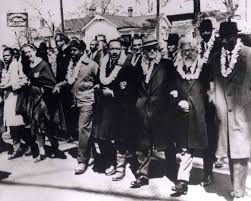
Abraham Joshua Heschel, a Polish born Rabbi who became one of the leading Jewish theologians of the twentieth century, marched arm in arm with Reverend Martin Luther King Jr at Selma in 1965. Afterwards he wrote to him – “When I marched in Selma, I felt that my feet were praying”

heschel at selma


The three Selma to Montgomery marches were a non-violent way of highlighting racial injustice in the South of the USA, and contributed to the Voting Rights Act being passed the same year.

Rabbi Heschel wrote deeply and frequently about religion and race, which he felt were antithetical positions. He wrote that “to act in the spirit of religion is to unite what lies apart, to remember that humanity as a whole is the beloved child of God. To act in the spirit of race is to sunder, to slash, to dismember the flesh of living humanity.” Such physical and visceral language about racism was reflected in his actions. Already nearing 60 years of age, he marched proudly, putting his body in the firing line for a principle he believed in deeply.

In a lecture given two years earlier he told his audience of Jews and Christians bluntly (National Conference of Christians and Jews on Religion and Race, 14 January 1963.) that

“Few of us seem to realize how insidious, how radical, how universal an evil racism is. Few of us realize that racism is man’s gravest threat to man, the maximum of hatred for a minimum of reason, the maximum of cruelty for a minimum of thinking.”

He was speaking from a deep understanding of Jewish texts. And he was speaking from a position of recognising the commonality of all human beings. When we categorise people by race we stop seeing the uniqueness of each human person. And the greatest and most redemptive human quality is to have kinship, to build relationship with others with empathy and with respect. Heschel brought a wonderful insight to the biblical story of creation. He pointed out that the text speaks of the many kinds of plants and of animals created by God, that each one was different from the others, each one was to become the progenitor of its own species. And then he pointed out that in this text the creation of the human being was very different. There were no parallel species of different colours or characteristics, genders or races. There was one human being – the ‘Adam’, made from the ground itself, fashioned in the image of God. And that human being became the progenitor of all the diverse expressions of humankind. The ur-ancestor from whom we all descend – our humanity is bound up with each other, it has to be, and if we choose to divide ourselves and to hate “the other” then truly we are causing the maximum amount of cruelty for the minimum of thinking.

Bible did not notice race per se. In the ancient world right up to the time of the Greeks and the Romans, race was not the issue that society organised around – but all of the ancient world did notice whether someone was ‘in’ or ‘out’. Whether they were citizens or aliens, whether they came from ‘other places’ or they came from ‘here’. There was always a tendency to try to create a hierarchy, where “we” are the best and “they” are inferior. Hence the power of the biblical text which is consciously addressing these attempts to order humanity by inherent superiority, and which is working to refute it. Later (rabbinic) texts take on the debate. Mishnah Sanhedrin (4:5) includes the phrase “[Only a single person was created] for the sake of peace among humankind, that one should not say to another, “My father was greater than your father”. And.. [Only a single person was created] to proclaim the greatness of the Holy Blessed One; for humans stamp many coins with one seal and they are all like one another; but the King of kings, the Holy Blessed One, has stamped every human with the seal of the first man, yet not one of them are like another. Therefore everyone must say, “For my sake was the world created.”

While the ancient Roman and Greek worlds were defining people according to geography (from here good/ not from here bad) or status (in the community good/ out of the community bad) the Rabbis of the Midrash were specifically choosing to see all human beings from wherever they came as of equal value. And especially they took on the argument from geography, making explicit that from where someone originated was of no importance in ascribing their value.   Rabbi Meir (2nd century) taught that God made Adam from the dust gathered from the whole world; and Rav (3rd century says): “His head was made of earth from the Eretz Israel; his main body formed from the dust of Babylon; and the various limbs were each fashioned with earth from different lands” .

When we look historically we can see again and again that as the host community sought to belittle and even humiliate people it saw as outsiders or foreigners, be they marked by accent or, skin colour or culture, the force of religion was pitching in the other direction. So the actions of Abraham Joshua Heschel, the Warsaw born scion of an orthodox Hasidic family, in the southern states of America in 1965, were a natural progression of Jewish tradition that begins in bible and speaks out against the human habit of ‘othering’ and of creating a hierarchy whereby some are dominant and others are subordinate, where some have more value than others.

This week in synagogues all over the world there is an extra Torah reading – Shabbat Shekalim tells of the census in the wilderness and reminds the present community of the obligation to share the costs of communal resources. The title – the Sabbath of the Shekel – comes about because the census is taken by everyone giving a half-shekel coin, and these, not the people, are what is counted. There are many reasons offered for this way of counting, but one of my favourites is that it shows that while different individuals may have a different nett worth financially, every person is of the same value before God. And why a half shekel coin rather than a full shekel? Because no one person is complete on their own, each of us relies on others to complete us.

When Abraham Joshua Heschel marched arm in arm with Martin Luther King Jr both men understood importance of these teachings. Every human being is of infinite and equal value, every human being needs others to help them reach their full potential. Racism causes us to forget both of these lessons, but they remain as true as ever they did, and it is up to us to keep teaching them in the way we live our lives.


From a talk given at Stand up to Racism event, Goldsmith College 1/3/16

Beshallach/ Shabbat Shira: the Song of Miriam

“And Miriam the prophetess, the sister of Aaron, took a timbrel in her hand; and all the women went out after her with timbrels and with dances. And Miriam sang to them: Sing ye to the Eternal for God is highly exalted: the horse and its rider God has thrown into the sea.”

Shabbat Shira, the Sabbath of Song, is named for the Song at/of the Sea (Shirat haYam) and this name takes precedence over the usual format of the first important word giving the title to the week. Shirat haYam was the song of victory sung by the Israelite slaves after they had successfully crossed the Reed Sea, and the pursuing Egyptians had drowned there following the miraculous opening and then closing of the waves to allow the Israelites safe passage but not the heavily armed Egyptians.

Along with the poem in Deuteronomy (Ha’azinu) it bookends the story of Moses and the people of Israel as they leave Egyptian slavery and journey through the wilderness to arrive at the edge of the promised land, and tradition ascribes its authorship to Moses.

But tucked into the text a little way down we are introduced for the first time by name to Miriam, described as “Miriam the prophetess, the sister of Aaron” and she takes a drum in her hand and leads the women in singing and dancing and drumming to celebrate the victory. And while apparently singing the same first line, Moses and the children of Israel sing “I will sing to the Eternal, for God is highly exalted” while Miriam sings “Sing to the Eternal, for God is highly exalted”. She uses the imperative version, whereas Moses and the Israelites use the personal pronoun.

The order of the text makes us read this as the song of Moses, but is there a clue in the wording of the text to tell us that this is the song of Miriam?

In the fragments of text found in Qumran (known as the Dead Sea Scrolls) we find a tantalising addition. Just as in the biblical text we find that “Miriam the prophetess, the sister of Aaron took a timbrel in her hand and led the women out with her with timbrels and dancing”, but then there is a break, and then the fragments of seven lines NOT found in the biblical text, followed by the narrative being picked up as the biblical verse 15:22 where Moses leads the Israelites away from the Reed Sea into the desert, and the people find no water until arriving at Marah they find undrinkably bitter (Marah) water.

Is the Qumran text a gloss on the biblical poem of Moses, answering the question of what Miriam might have sung and paralleling other songs of victory or was it the original text which took away words from Miriam and the women in order to give them to Moses and the Israelites? We know that women sang songs of victory after battles – Deborah is a prime example whose song is recorded (Judges 5), and Jephthah’s daughter (Judges 11:34) comes out with timbrel and dancing on his return home. Unnamed women come out dancing and singing with their timbrels when David returns having defeated the Philistines (1Sam 18:6-7) celebrating his success and humiliating King Saul’s record. Hannah (1Sam:2) sings when she achieves her goal of a child, and the late book Judith has her sing in the final chapter, having beheaded Holofernes…

So why not Miriam and the women singing their song? Miriam the prophetess was also Miriam the musician and song leader. Her voice and her words deserve to be heard and to be recognised.

miriams timbrel

Whatever the reason for the biblical canon to contain just the remnant of her singing with the women, apparently echoing the words of Moses and the men, so that tradition could claim her as the song leader for the women only, I think there are enough clues left for us to give her the power and place she deserves.

The first place that Moses leads the Israelites to is called by the narrator “Marah” , after the bitter and undrinkable water found there and there is much murmuring against Moses until on God’s instructions he finds a tree whose wood will sweeten the water. Moses uses this as a teaching aid to remind the people that God is their healer, and then they move on to Elim where there are twelve good water sources and seventy palm trees. Is this a veiled reference to Miriam, whose name is impossible to translate with certainty but which is often understood as coming from “Mar – yam – bitter – water/sea”? Are the people murmuring because of Miriam and her treatment by Moses that he appropriated her rightful role? And are they pacified by the oasis of plenty represented by 12 springs and seventy palm trees and so forget their indignation?

But more intriguing I think is the possibility that Miriam’s name is not derived from bitterness MRH) but comes from a rarely used root MRR to mean a flow of water, drops of water or a watercourse. In which case her name would mean the flowing of water or the directing of water – something that would come to fruition not only in the midrashic idea that wherever Miriam was there was water for the Israelites in the desert (which comes from the drought that is the first reported event after her death), but from this text about the Reed Sea, which changed direction, flowed differently and intentionally while the Israelites crossed it. The name Miriam, introduced exactly here, is I think a clue to her purpose –  we are already explicitly told that she is a prophetess, she has real and intentional meaning and understanding – it is Miriam who causes the sea to part and the miraculous redemption of the fugitive people. Her name, hiding in full view, tells us exactly that.

So the Song here attributed to Moses yet called slightly confusingly Shirat HaYam , the Song of (or at) the Sea (a name first recorded in the 2nd Century in Talmud Yerushalmi), might actually have been Shirat MirYam, the song of Miriam. And how powerfully that simple change could have affected our understanding of our foundational texts and shaped the hearing of the voices of women in our tradition.

Drop by drop as we look again at the texts, we who see Miriam as a role model, who see ourselves reflected in her life as prophetess, sister, organiser, carer for children, provider of life giving water/nourishment, song leader, drummer and dancer , as well as a hard worker behind the scenes who protested injustice done to others and the arrogating of power to the male leadership – we need to take notice of the effect that the flow of water can have – it can wear away the hardest rock. Drop by determined drop we take up her mantle and raise our voices in song and in challenge and in prophecy, and hope that this time the words will not disappear from the canon.

(Photo of Miriam’s timbrel and the reeds in Egypt/water of the Reed Sea from an embroidered Torah Wimple made by Caroline and Naomi Ingram for the author)

Miketz: the strange case of the disappearing women

Dr Ruchama Weiss points out that sidra Miketz is the first in Torah that is devoid of any stories of women : – she identifies it as the point at which bible begins to actively exclude women from the focus of the narrative. Over the fourteen years that the sidra spans in three and a half chapters of the book of Genesis, women are indeed conspicuous by their absence. The matriarchs have died, the only daughter of Jacob that we know of, the unfortunate Dina, has disappeared following her experiences with Shechem, no other daughters or indeed wives of the sons of Jacob are recorded here. They must have existed, but the biblical author does not see fit to document their presence.

There is in fact one woman who briefly makes an appearance – Asenath, the daughter of Potiphera a priest of On. Our introduction to her is laconic and almost imperceptible, she rates less than a third of the verse in which she appears, coming after the renaming of Joseph and before his status is recorded: “And Pharaoh called Joseph’s name Zaphenath-paneah; and he gave him to wife Asenath the daughter of Potiphera priest of On. And Joseph went out over the land of Egypt.—“(41:5). She reappears five verses later as mother to Joseph’s two sons: “ And to Joseph were born two sons before the year of famine came, whom Asenath the daughter of Potiphera priest of On bore unto him.” (41:50). She doesn’t get to name her sons, up till now the privilege of the mother, nor do we see her relationship with them – all we see is Joseph naming Manasseh and Ephraim in order to make statements about himself: “And Joseph called the name of the first-born Manasseh: ‘for God has made me forget all my toil, and all my father’s house. And the name of the second he called Ephraim: ‘for God has made me fruitful in the land of my affliction.’ (51,52)

Asenath

Her lonely presence in the sidra, useful only as a wife for Joseph and mother to his children, is picked up in the 6th century pseudepigraphical work “Joseph and Asenath” , though to be honest there too she is still the plaything and chattel of men. A pagan woman, she falls in love with Joseph and gives up her idolatry in a painful and protracted process in order to marry him and have his sons. Later the son of the Pharaoh tries to take her for himself but the plot is foiled, and Joseph takes the crown of Egypt. So there is not much more to her there either. She may be the daughter of a powerful priest of the Egyptian cult, the wife of the most powerful man in the country bar Pharaoh himself, the mother of the founders of the tribes of Ephraim and Menasse, but she is unknowable, mysterious and all but erased from history. Her fleeting presence in the sidra that is filled with the powerful men who control all the resources of the country only really serves to highlight the poignancy of her disappearance. And to complicate matters further, there are those who say that her presence in the sidra at all, inserted quite clumsily into the text as daughter, wife and mother, is only tolerated because she acts as a counterbalance to the physical beauty of Joseph which drives women into a sexual frenzy while he himself remains emotionally detached and essentially sexless. She is there as an answer to the questions about his sexuality, to put paid to any idea that he may not conform to the heteronormative ideal of the Hebrew bible.

This year – 2015 – is the eightieth anniversary of the private ordination of the first woman rabbi of modern times, Rabbiner Regina Jonas; and the fortieth anniversary of the ordination of the first woman to be given semicha by a European rabbinic institution (Leo Baeck College) Rabbi Dr Jackie Tabick.

One of the most shocking things about the life and times of Rabbiner Regina Jonas was how quickly she was forgotten after her death in Auschwitz in 1944. When I was studying at the Leo Baeck College in the 1980’s we knew only of rumours that there had been a woman who may or may not have been ordained Rabbi in Germany – even though some of the teachers and founders of the college had known her well. It was only with the fall of the Berlin Wall and the emergence of some of her papers and photographs from an archive that she once again became real. And now her life and name are being researched and reclaimed, yet there is so much that is lost beyond recall. She disappeared even while there were people alive to remember her. Her story is an object lesson, a cautionary tale, how quickly can the stories of people disappear if there is no interest, no will to record them and to keep them alive.

In the forty years that Rabbi Dr Jackie Tabick has been working as a rabbi the world has moved on. There is less anxiety (at least in the progressive Jewish world) about women working as rabbis, but still there are those individuals who ask for a male rabbi for a life cycle event, or synagogue search committees who worry what will happen to their community if a woman is appointed as rabbi, or as the senior rabbi.

So we should not be complacent and believe that the battle has been won. The erasing of the inconvenient from history goes on everywhere, and it is a truism history is written by the winners. If the narrator of the biblical text is not interested in the women then the stories of the women will not appear. If we don’t have a multiplicity of voices recording history as they see it, then we will have a thin and diminished version of history, seen through the narrowest of lenses. And this too has knock on effects. Because there are so few women fully described and fully voiced in our foundational texts, it is a short leap for some to believe that this must not be a function of the (lack of )interest of the narrator but a function of the divinely inspired status of women in society.

As the societal norms are impacting on Judaism, as the eightieth anniversary of the ordination of Regina Jonas and the fortieth of Jackie Tabick begin to filter into the consciousness of orthodox feminism, and as more Jewish women demand that their voice be heard, there is a corresponding kick back from some in the orthodox world. Only this week A senior haredi rabbi suggested at a conference for high school principals held in Bnei Brak that higher education for women constitutes a more severe blow to the haredi world than the Holocaust and a responsa was given to a man about letting his daughter go to university that “ to do so would be worse than stealing money since material goods may be recovered but the “spiritual damage” of permitting the young woman to achieve higher education could not be undone.”

The spiritual damage envisaged when a woman is allowed to study at a high level, to learn to think and question and understand the world around her is not to the woman herself – it is damage to the structure of a community which relies on unquestioning following of self-appointed sages. When people think for themselves, the artificial consensus breaks, and a real consensus, based on challenge and debate, logical argument and building of agreement is allowed to emerge. In sidra miketz the women are submerged in the narrative with just the flash of one woman’s presence that serves to point up all the absences. We should be warned, there is nothing new under the sun, and women are being ‘disappeared’ from public space in the Jewish world with increasing determination, just as they are in this sidra. In the book of Exodus the presence of women will reassert itself, but their silence as the book of Genesis begins to move towards its close is a telling one. And a nudge to us to take responsibility not to allow it to happen again.

Vayeshev: the crime of selling a person

“Behold, a caravan of Ishmaelites came from Gilead, with their camels bearing spicery and balm and ladanum, going to carry it down to Egypt. And Judah said to his brothers, “what profit is it if we slay our brother and conceal his blood? Come, and let us sell him to the Ishmaelites, and let not our hand be upon him; for he is our brother, our flesh.’ And his brothers listened to him.
And there passed by Midianites, merchantmen; and they drew and lifted up Joseph out of the pit, and sold Joseph to the Ishmaelites for twenty shekels of silver. And they brought Joseph into Egypt. And Reuben returned unto the pit; and, behold, Joseph was not in the pit; and he rent his clothes. And he returned unto his brethren, and said: ‘The child is not; and as for me, whither shall I go?’ (Gen 37:25-30)… And Joseph was brought down to Egypt; and Potiphar, an officer of Pharaoh’s, the captain of the guard, an Egyptian, bought him of the hand of the Ishmaelites, that had brought him down thither. (39:1)…[And Joseph said] For indeed I was stolen away out of the land of the Hebrews; and here also have I done nothing that they should put me into the dungeon.’ (40:15)

The first story of human trafficking is told here in sidra vayeshev, and sadly it is a story that resonates to this day in the lived experience of the six to eight hundred thousand people estimated to be trafficked across international boundaries each year, and the 20 – 30 million people who are currently estimated to be living in slavery.
Like many who are trafficked today, Joseph is young and vulnerable, he is (to be) sold off by family members, and while presumably sold for labour it is not impossible he could have been sold for sex (certainly Potiphar’s wife has expectations in this area). He finds himself at the mercy of a well organised people trafficking structure, sold through the agency of the Midianites to the Ishmaelites who go on to sell him in Egypt along with their other products. Today human trafficking is the third largest international crime industry (behind illegal drugs and arms trafficking). It reportedly generates a profit of over £21 billion every year of which £10 billion is made in industrialized countries. Human trafficking is big business. And it causes enormous suffering.
Bible begins by telling us that human beings are created in the image of the Divine, from which we understand the basic and absolute value of human beings. Just as God is indivisible and of infinite worth, so is humanity indivisible and of infinite worth. We might construct all kinds of models in our heads about class, ethnicity, gender, power, social status, geographical cultural and historical connections, but bible keeps reminding us of the one basic truth: human beings are one group, connected ultimately to the earth on which we live, connected deeply and irrevocably to each other.
The bible as a document is powerfully engaged with this idea, and with how it plays out in the power relationships that humans participate in, that shape our society. It knows how easy it is to abuse power, how simple to turn a blind eye to it happening in both the intimate details of our lives and in the macro environment in which we are live. It knows about the human tendency to construct realities that favour ourselves over others, to neglect or ignore what does not speak to our own self-interest or conform to our idea of reality. Bible provides the nudge, the spur to remind us that not only is there more to the world than our own experience, it repeatedly teaches us that there is an obligation on us to pay attention outside of our comfort zone, a requirement to see the world as God sees it – a fragile and beautiful place filled with fragile and beautiful creatures engaged in a process of improvement but simultaneously undermining and subverting that process out of ignorance or selfishness or thoughtlessness or greed.
We see ourselves in the texts; we recognise the themes and the motifs that play through the stories and we know that we are being prompted to respond.
So when we read the story of Joseph, defenceless in the pit after his brothers’ intervention, saved from being murdered but arguably paying the even greater price of being traded from group to group with no protection and no idea of what the end of his journey may be, powerless and frightened, a product not a person, about whom no one will care what happens – we have to pay attention and we have to respond. There are estimated to be between six and eight hundred thousand people having a similar experience ever year in our world. And we should care.
In the book of Exodus, in the legal code following the giving of the ten commandments and the covenant made between God and Israel, comes the instruction “And one who steals a person and sells them, or if a person be found in their possession (as merchandise), they shall surely be put to death. (Exodus 21:16). Deuteronomy repeats the command: “If a person be found stealing any of his brethren of the children of Israel, and he deal with him as a slave, and sell him; then that thief shall die; so shall you put away the evil from your midst.” (Deuteronomy 24:7). In the biblical world clearly people were bought and sold, seen as chattels to be profited from, and already the voice of the text is outlawing the behaviour. By the time of the Mishnah (2nd Century CE) (for e.g. Sanhedrin11:1) the death penalty for human trafficking is discussed and accepted – a mark of how seriously the crime is taken to be and this is continued in the Gemara (5th Century CE) (e.g. Sanhedrin 86a)
In the medieval period there are responsa again underlining the importance of challenging the prevalence of abducting and selling human beings – for example Maimonides (12th C) tells us that Torah views the kidnap of a person as the most serious form of theft that is strictly prohibited on pain of death under the Noachide code and in the eighth of the Ten Commandments, ( Laws of Theft 9:1-6) and also teaches that redeeming captives is more important than supporting the poor, because captives are in danger of their lives (Mishneh Torah, Hilchot Matanot Aniyyim 8:10). Rabbi Joseph Colon (1420-1480) warns that a person who has the ability to save a trafficked person yet delays doing so is “like one who sheds blood.”… the responsa can be found in every century, in every place, demonstrating that the crime of trafficking human beings can equally be found in every century and in every place – including, sadly, our own.
So what should we do? Firstly, we should not ignore the issue, not assume that it is not happening because we have not noticed it, nor that it “wouldn’t happen” in our bit of the world. Secondly we should educate ourselves on the signs, so that we are alert to the possibility of trafficking. These can be found here: http://www.stopthetraffik.org/uk/page/spot-the-signs
Community_Signs_2

And we can also think through the ways we live and the choices we make – are the clothes or food we want to buy surprisingly cheap indicating that the makers/pickers are on low wages? Is there an ethical policy in place in the financial transactions we make? Are we sufficiently educated about the real cost, the real chain by which products come to us, the reality faced by people who find themselves in economic bondage to others?
The tragedy of human trafficking is that it hides in plain sight. Bible knew that and tried to give us the tools to see. We are in need of such tools even today. Let the words of Joseph speak to us again “For indeed I was stolen away out of the land of the Hebrews; and here also have I done nothing that they should put me into the dungeon.’ And remind us that the lack of freedom for those who are trafficked is real, a dungeon from which they cannot escape and a place where no meaning can be gleaned.