Sermon for Yom Kippur Shacharit: ki vayom hazeh – on this day

Ki vayom hazeh y’chaper aley’hem, le’taher et’chem; mikol hatotey’chem lifnei adonai tit’haru. (For on this day atonement will be made for you to cleanse you, of all your sins before God, you shall be cleansed”  (Lev 16:30)

On Yom Kippur, when the High Priest entered the inner Temple, dressed in special robes and breastplate, the priestly garments including the frontlets on his head, the vestments of fine white linen, he would repeat this biblical verse in each of the three confessions he made.  And the people would crowd around outside in the temple courtyard, listening hard, and when they heard the the glorious and awesome four letter name of God we write as yod hey vav hey, the name which would be uttered only by the High Priest, only within the Holy of Holies, only on Yom Kippur, only as part of the confession ritual, then they would bow down with their faces to the ground and respond with the blessing of God’s name. This annual ritual of confession and sacrifice was a dangerous one, surrounded by mystery, perfumed by the incense, veiled from the community.  Tension mounted as the confessions grew, as the animals were sacrificed and the hopes pinned upon them being favourably received reached some form of expression.

My sympathies have always been with the high priest, upon whose shoulders rested the burden of so much expectation.  The fate of the whole people seems to have been given over to this one man on this one day – so he had better get it right.   The ritual was complicated, the choreography of washing and changing clothes, of sacrifice and prayer awesomely elaborate,  the consequences of making a mistake unthinkable.  We don’t know much from either biblical sources or first temple texts, but by the time of the Second Temple the Day for Atonement was focussed on the actions and intentions of the High Priest, and the role of the people was to listen, to be awe-struck, and to hope that he got it right.

That was then, but since the Temple days Yom Kippur has developed a different set of rituals, and while we re-enact part of the Avodah, the temple service of Yom Kippur, during the mussaf service, experiencing just the echo of the thrilling gravity and overwhelming power of that ceremony, our own liturgy and imagery takes us to a different  religious place.  Yom Kippur is no longer the Day for Atonement for the people Israel, it is by far a more personal and individual experience for we children of modern times.  The High Priest has long gone, the sacrificial system consigned to a stage post in history that no longer speaks to us of religious action, and the corporate nature of the people Israel has been changed as we have become a different category altogether – Jews, and while we consistently create community we see ourselves in the main as individuals, individual Jews.

The structure of the ritual and the philosophical underpinnings of the day have undergone a radical transformation, and so, I would posit, has the meaning of what Yom haKippurim means to us.  While we still translate this obscure name using the invented composite word ‘at-one’, we have changed both meaning and purpose of the day for our own spiritual needs.  I would even go so far as to say that the day is not really about sin and atonement any more – how would we even define those terms today? – but that Yom Kippur for us is about something quite other –  Time. Yom Kippur is about our use of time, about our location in time – it is in particular a day for us to focus on our own mortality.

Interspersed in our machzor with the major themes of sin and repentance, of forgiveness and atonement, we hear the insistently repeated motif of life and death. We talk for example about the Book of Life, we read the Martyrology, we recite a service of Yizkor, our traditional clothing for this day is to wear shrouds and we are called to abstain from the physical  pleasures of living, eating, drinking or washing.  We take a day right out of time and act as if the world outside is irrelevant to us, as if we are, for the moment, temporarily dead.

What message do we take from the prayers and texts as we sit through Yom Kippur.  It is probably true that we examine our lives and find our behaviour wanting.  It is probably the case that we make our stumbling attempts towards recognising and harnessing our own spirituality, yearning as we do for a sense of meaning, for a firm belief in a greater being.  It may well be that we feel momentarily inspired to change some part of our lives, or that we experience the satisfying of a need for connectedness which tends to be submerged during the busy weeks of the rest of our lives.  As the day rolls on, the ancient formulae about sin and loss swirl around us, as do the equally ancient phrases about return and forgiveness.  We know that we are less than perfect and we look for ways to deal with both the knowledge and the reality.   But we cannot retreat into the Yom Kippur of the Temple period and leave the whole religious business to someone else.  The Yom Kippur of our time looks us in the face and says – you are mortal, you only have a limited time on this earth – and you do not even know how limited it may be – so what are you going to do about your life?

Yom Kippur is no longer a day simply of general and ritual atonement. It is a day for us to restructure our lives, to reconcile our realities with our requirements.  Loud and clear through the prayers comes the reminder – we are mortal, we, and those around us do not have all the time in the world, and so if there are things we want to do, we should be planning to do them now, if there are things we need to change, we should be arranging to change them now, if there are things we want to say, we should be saying them now.

Nothing is so precious as time, nothing is so consistently abused. We waste time, we kill time, we fill in time – rarely do we actually use time appropriately.  Yet our tradition has been able to transform a day of communal awe and professional ritual activity, and give it to us in a new form – personal time for us to spend reconciling and reconstructing the lives we are living with the lives we already know we could be living.

As a community rabbi I have sat and listened so many times to the laments which begin ‘if only’, I have witnessed the rapprochements which have sometimes come too late, I have heard the stories of fractured relationships which have entailed years of lost possibilities;  I have met broygas individuals (note for translater – people who have taken offence)  who are determined that the other person should make the first move towards reconciliation – sometimes about an argument the reason for which is lost in history.  We don’t tend to use the word ‘sin’ for such behaviours, but surely to fail to make or maintain relationships in this way is one of the biggest sins we currently commit.   We all live within the constraints of time, we all know what is truly important to do in that time, yet most if not all of us regularly fail to acknowledge that we should be making our priorities so that when the time runs out – be it our own time in this world or the time of a loved one – we have done what was important and responded appropriately, addressing the most meaningful issues of our lives rather than reacting to what is presented as the most urgent.

On the tenth of Tishri the bible tells us to come together as a holy assembly for Yom haKippurim.   It is clearly to be a day of repentance, of hard thinking, of reconciliation and reconstruction of relationship.  We are used to the imagery that reminds us that we are to reconcile and reconstruct our relationship with God, and parts of us are able to do so. And we manage it without the intermediary of the stylised actions of the high priest.  We sit and think and pray, hear the voices inside us as they speak of loss and pain, of comfort and of peace.

But today isn’t only about our working on our relationship with God, it is about using that work and the understanding brought about by such a relationship so that we make substantial changes to our relationships with others.  As Morris Adler wrote:

‘Our prayers are answered not when we are given what we ask, but when we are challenged to be what we can be’ .

Yom Kippur has been many things for we Jews during our history.  The most solemn day of our calendar it is described as ‘shabbat shabbaton’ – the Sabbath of Sabbaths.  There is a tradition that when God had finished creating the world, God created the Sabbath, and scripture tells us “uvayom hash’vee’ee shavat va’yinafash” (Exod. 31:16-17) And on the seventh day God stopped all work and restored his soul.  This word va’yinafash is a strange one – often translated as “God rested” it really means something to do with restoring the soul.  From it comes the idea that on Shabbat we are given an extra soul or measure of soul, with which we can discern and taste the world that is more usually hidden from us, we can experience something outside of normal sensation.  If we have an extra dimension of soul on Shabbat, how much more so on shabbat shabbaton – today, Yom haKippurim?  On shabbat we use it to experience a taste of the world to come, but today we can use it for something else entirely – we can use it to understand more about this world and our place within it.  The liturgy of today reminds us about time, about the fleeting nature of our life in this world, about the end which all of us will face.  Yom Kippur gives us the time and the space to consider our part in our world, gives us the extra measure of soul we need to really consider and construct our lives as we mean to live them.  We have about another seven hours today, and the real world will begin to crowd in once more and drown out the world of prayer and thought we have created.  We do not know how much time we will have after that.  So today let’s face the time and let’s spend it wisely, rather than profligately allowing it to run away.   Who knows how many tomorrows there will be?

“Ki vayom hazeh y’chaper aley’hem, le’taher et’chem; mikol hatotey’chem lifnei adonai tit’haru. (For on this day atonement will be made for you to cleanse you, of all your sins before the lord, you shall be cleansed” says our machzor, quoting the book of Leviticus.  There is no High Priest to do the cleansing, only ourselves and our dedication and our desire, and of course this very special and holy block of time – today.

Sarah: blinded by her outward appearance we miss the person within

Deception and beauty, the bible is fascinated by the interaction of the two.

When Avram, having left Canaan because of the famine, arrived in Egypt he feared that the beauty of his wife Sarai would mean that the Egyptians would kill him in order to take her for themselves, and so he asks her to lie, to say that she is his sister “that it will be well with me for your sake, and so my soul may live because of you”. And certainly his fear is grounded, because the Egyptians see Sarai’s exceptional beauty,“ki yafah hi me’od”. The princes of Pharaoh see her, sing her praises to him, and she is taken into Pharaoh’s house. Pharoah gives a great deal of wealth to Abram as dowry, but God intervenes, plagues Pharaoh and his house on account of Sarai, until Pharaoh understands that he has taken Avram’s wife and arranges for her to go back to him, and for Avram and Sarai to go on their way with their accumulated gains.

This is the first of three wife-sister deception narratives in Genesis, the others being with Sarah and Abimelech and with Rebecca and Abimelech.  The repeated retelling seems to imply that these are not historical reportage, but a motif to give us a deeper understanding of our patriarchs and matriarchs.

Any number of questions emerge from even a cursory reading of this text. We already know that Avram married Sarai (Gen 11:29) yet surprisingly her ancestry is not given, while that of Milcah, who married Nahor Abram’s brother is given her full background. Immediately we are told that Sarai is barren, she had no child – an enormous economic disbenefit for any wife in that society and that she went with her father in Law Terach, with her husband and with Lot the son of Abram’s dead brother, from Ur Kasdim towards Canaan, leaving behind Nahor and Milcah. (Gen 11:29-31)

Sarai’s great beauty is only told to us in the following chapter – which seem surprising if it were really so extraordinary. Her passivity – travelling with the family including the heir apparent Lot – leaving Ur Kasdim to go to Canaan but settling in Haran in the interim – seems to be the expected role of women, yet clearly the family did well, making great wealth, and the plural form is used – “all the wealth THEY had gathered, and the souls THEY had made” from which the midrash develops the idea of Avram and Sarai as the great models of inclusivity and openness, who between them had converted both men and women to the one God of Judaism.

So maybe Sarai was not so passive, but was a valued working partner in the relationship. And yet, as soon as they come near to Egypt she is prevailed upon not only to lie about her relationship to Avram, but essentially to become adulterous in order both to protect his life and increase his wealth.  She does not speak, she does not seem to object, and while one can see what is in the deal for Avram it is not so clear what is in it for her – except maybe that as a widow captured after her husband’s death she may be even more unprotected and powerless than as the sister of a living and wealthy man.

She doesn’t even seem to speak to Pharaoh, who, plagued by God, realises all by himself that the cause of his troubles is that he has taken the wife of another man into his household. Clearly at the beginning if she has bought Avram’s reasoning that this will save his life it is important that she keep the secret, but what about later when it is obvious that something is deeply wrong?  She is returned, as passive as ever, into the safekeeping of Avram her husband, and they are sent on their way, greatly enriched by the whole adventure.

Yet this story, with its overtones of sexual trafficking for gain cannot be left here – there is the repeated retelling with some alterations with a different king Abimelech, and then later with her daughter in law Rebecca and Abimelech. And there is the persistent motif of great beauty and deception.

Others are described in bible in almost the same words as having extraordinary beauty, the most prominent being Sarah’s daughter in law Rebecca, described as being tovat mar’eh me’od (24:16 and 26:7), Rebecca’s daughter in law Rachel about whom we hear “V’einei Leah rakot; v’Rachel hay’ta y’fat to’ar, vi’fat mareh” – The eyes of Leah were soft/ weak,  and Rachel was beautiful of form and beautiful in appearance. (Gen 29:17, and her older son Joseph who is “y’fei to’ar vi’fei mar’eh” (Gen 39:6)

Three matriarchs and the favoured son Joseph all described in bible in terms of their exceptional beauty. And all of them recorded in bible as deceiving in ways that change the narrative profoundly. Sarah and Rebecca are the objects of the their husband’s deception in the wife-sister narratives, but Rebecca goes on to deceive her blind husband in order to gain the major blessing for her favourite son Jacob, when he intends and expects to give it to Esau.

Rachel deceives her father and husband about having taken the household gods when they left Haran, an act that will bring about her early death. And her elder son Joseph, also described as beautiful, deceives his brothers who come to buy food, putting them through a horrible ordeal as they contemplated their father’s devastated reactions.

It is strange that on the whole we don’t know much about the physical appearance of the main characters in the narrative. What does Avram look like? We are not told. Likewise Isaac and Jacob, though we are aware of the physicality of Ishmael and Esau who are earthy,  athletic and skilful hunters.

It seems that only ‘outsiders’ and women are worthy of comment about their appearance. And then, as now, such comment serves to objectify, to limit in some way, to categorise. We no longer see the person, nor do we see their abilities or potential, we see the colour, the gender, the beauty (or lack of) and we make a judgement.

Later on in the narrative we will be able to see Sarah a little better – we will see her as the strong and independently minded woman trying to give her husband his much desired heir, however problematic that intervention is. We will see her as the woman who is visited by God, who laughs on hearing God’s voice telling her and her husband that she too will bear a child, and who speaks directly to God’s challenge to her, albeit to dissemble rather than be upfront with her views. We will see her as the mother determined to protect her child even if it means asking her husband to disown his older child – and ensuring that he does. We will see that her name is changed by God along with that of her husband. We will see that she lives away from her husband after the Akedah until her death when he has to travel to organise her funeral.

Sarah is the matriarch to match Abraham’s role – the promise of the heir who would receive God’s blessing is clearly as much to her as to him – it is Isaac son of Sarah who will inherit the blessing and take on the chain of tradition. She saves Abraham’s life at least twice, she helps him to increase his wealth, she directs the family life.

What is her beauty? The deception of Sarah’s beauty seems to be not so much what she does, but that it hides the strong and independent character within, the personal connection with God that she develops, the innovative and formative life that she lives. Her antecedents are shrouded in mystery, unlike Abraham’s, but their descendants are as much hers as his.

Proverbs tells us “charm deceives and beauty fades” when describing the perfect woman (Eshet Chayil) (31:30) and we should read the narrative of lech lecha with this in mind – if we only see the outward passivity and the blinding beauty that Abraham fears Pharaoh will see, then we miss what is important about Sarah.

Yet plus ca change, plus c’est la meme chose. Those who only see the outward appearance and the gender will layer on their own perceptions, their own beliefs about what they see, and will miss the gold that lies within.

Bereishit: Leaving Eden as equals with creative work to do

One of the most difficult verses in bible comes early in the text and seems to set the scene for those who want to prove that God loves the patriarchy and that the divine ideal is that women are to be subservient to the rule of men. I have lost count of the times that men have told me that women were cursed by God because of the culpable actions of Eve in the Garden of Eden, or the times when women have told me that there is nothing we can do to remedy the role our biology has cast for us. Calling attention to the earlier creation story in which male and female are created together in the image of God as one Adam/human being doesn’t seem to have the same power as the story called by Christianity “The Fall”. Indeed this verse seems almost magically forgettable as being the original scene setter of the creation of human beings – so I thought it was time to have a look again at the text that so conveniently can be read as “the sin of a thoughtless woman has led to her and her husband being rejected by God and evicted from paradise into a miserable existence.”

Reading Genesis 3:16, after God has asked the man who had told him that he was naked, and asked directly if he had eaten of the tree that God had commanded him not to eat, the man said “the woman whom you gave to me, she gave me of the tree and I ate”. God turns to the woman and asks “what is this that you did?” and she says “the serpent beguiled me and I ate”. God doesn’t ask anything of the serpent, but instead tells it “Cursed are you among all the cattle and all the beasts of the field. Upon your belly you will go and you will eat dust all the days of your life. And I will put animosity between you and the woman and between your seed and her seed, they shall bruise your head and you shall bruise their heel”

Let us just note here some interesting moments. The serpent is described as being among the cattle and the beasts of the field – not a class we would normally associate with scaled reptiles, but definitely something we would associate with an agrarian world view.  And let’s note too that the antipathy is between

          בֵין זַרְעֲךָ וּבֵין

      זַרְעָהּ


your seed and her seed – the human descendants are described as the seed of the woman rather than of the man, obliquely but definitely introducing the idea of female childbirth in the future.

With this in mind, let’s look at the next verses.  God turns his attention to the woman, saying:

אֶל־הָֽאִשָּׁ֣ה אָמַ֗ר הַרְבָּ֤ה אַרְבֶּה֙

עִצְּבוֹנֵ֣ךְ וְהֵֽרֹנֵ֔ךְ בְּעֶ֖צֶב תֵּֽלְדִ֣י בָנִ֑ים וְאֶל־אִישֵׁךְ֙ תְּשׁ֣וּקָתֵ֔ךְ וְה֖וּא יִמְשָׁל־בָּֽךְ:   ס

Now this verse is most painful for us feminists. It is most often translated as “To the woman he said, I will greatly increase your pain and your travail. In pain you will bring forth children, your desire shall be to your husband and he shall rule over you”

But that is not the only way to translate it, and the clue is in the context of this passage. To begin, let’s look at the first half of this verse, in particular the word whose root it “etzev” ayin, tzaddi, beit and its noun form used here : itz’von. It is used only three times – twice here in relation once to Eve and once to Adam, and later about Noach.

The root has two major meanings – one is to to hurt/ to work hard and the second is to form/to fashion. The nouns are itz’von and he’ron, which look like a parallel is being used. Given that the second noun means pregnancy/forming a baby, then itz’von should also mean forming a baby/ pregnancy – in which case the phrase means “I will greatly increase your creating a baby and your pregnancy, and with hard work (labour) you will give birth to children.

Note that God does NOT curse the woman. Instead God informs her that she will be taking over the hard work of creation, it will be her seed as a result of the encounter with the serpent, so it will be her role to bring forth human beings in the future. God is done – having created everything else in the garden with the ability and seed to reproduce, now it is time for human beings to do so for themselves.

Let’s look too at the use of itz’von in relation to the man. And note too, that God does NOT curse him either.

וּלְאָדָ֣ם אָמַ֗ר כִּ֣י שָׁמַ֘עְתָּ֘ לְק֣וֹל אִשְׁתֶּ֒ךָ֒ וַתֹּ֨אכַל֙ מִן־הָעֵ֔ץ אֲשֶׁ֤ר צִוִּיתִ֨יךָ֙

לֵאמֹ֔ר לֹ֥א תֹאכַ֖ל מִמֶּ֑נּוּ אֲרוּרָ֤ה הָֽאֲדָמָה֙ בַּֽעֲבוּרֶ֔ךָ בְּעִצָּבוֹן֙ תֹּֽאכֲלֶ֔נָּה כֹּ֖ל יְמֵ֥י

חַיֶּֽיךָ

“To the man God said, because you heard the voice of your wife, and you ate from the tree which I commanded you saying ‘you shall not eat of it’, then cursed is the land on account of you, with itzavon/ (hard work/forming and creatively fashioning),  you will eat from it all the days of your life.” (3:17)

Both man and woman are now told that the hard work of creating is down to them. The serpent and the land are cursed, they are no longer going to be as they were first intended to be, the serpent loses its place in the agricultural world, the land too loses its place as a garden where growth is luxurious and abundant and does not require the hard work that any gardener or farmer will tell you is necessary today to create a crop of food or flowers.

What is the curse on the land? It is that it will bring forth weeds, thorns and thistles, the unintended and unwanted growth that any farmer or gardener will tell you comes as soon as you stop working the ground, hoeing out the weeds, protecting the young seedlings.

A curse is something that goes wrong, that is not intended in the original plan, that deviates from the ideal.  So it is particularly interesting that the human beings are not themselves cursed, their situation is not deviating from the plan. It begins to look like leaving Eden was always the plan, that creating was always going to be delegated, otherwise why put those tempting trees there?

The section ends with God telling the man that in the sweat of his face he will eat bread, until he returns to the ground he came from, and the man calling his wife Eve, because she has become the mother of all living. Both these again are references to the itz’von of each of them – she becomes creative in the area of growing children, he in the area of growing food. And God’s statement that follows “Behold, the human has become like one of us”, is then qualified in terms of knowing good and evil, but it also describes the attributes of creativity that each now have, attributes which until this point have been the dominion of the divine.

Now let’s look at the second half of the verse where the woman’s future is described. “Your passion will be to your man, and he will mashal  you (וְה֖וּא יִמְשָׁל־בָּֽךְ:  v’hu yimshol bach)”

M’sh’l is one of two words for ruling over – the more usual being m’l’ch. It too has a second meaning – to be a comparison, from which we get the idea of proverbs/parables which show us a truth by virtue of a difference. The first time we have the word is in the creation of the two great lights which will m.sh.l the day and the night in Genesis 1:16-18. Are they ruling over the day and the night or are they providing a point of comparison? Is the man ruling over the woman or does he have a comparable function of creativity? Her passion is for him, a necessary partner for the creation of children. His comparable creativity is to work the land, to bring forth food alongside the thorns and thistles that grow there.  He is not described as her master/ba’al but as her ish/man, the equal partner of her status as isha.

Can one read these verses in this way, of the passing on of the ability to create through the seriously hard work of the two protagonists?

The next (and final) time we meet the word itz’von is at the birth of Noach, ten generations after Adam and the pivot to the next stage of the story, indeed the rebirth of creation after the earth is so corrupted that God chose to destroy it by flood.

We hear that Lamech, the father of Noach says

וַיִּקְרָ֧א אֶת־שְׁמ֛וֹ נֹ֖חַ לֵאמֹ֑ר זֶ֠֞ה יְנַֽחֲמֵ֤נוּ מִֽמַּֽעֲשֵׂ֨נוּ֙ וּמֵֽעִצְּב֣וֹן יָדֵ֔ינוּ

מִן־הָ֣אֲדָמָ֔ה אֲשֶׁ֥ר אֵֽרֲרָ֖הּ יְהוָֹֽה

“And he called his name Noach (rest) saying, this one will comfort us from our work and the itz’von/ creativity/  work of our hands, (which arises) from the land which God cursed” (Gen 5:29)

It is a deliberate reminder of the story of Adam and Eve and their given roles to bring forth new life (both human and plant) with as much creativity and manipulation of the environment as they needed. It is a reminder that God changed the role of the land through the curse, which gave humanity the challenge to provide themselves with food as creatively as they could. It is a signal that another creation is about to happen, Noach will be part of that change, though quite how that was to work out was not clear to his father Lamech. He was hoping for N.CH. for rest. He was hoping for the accompanying and phonically similar comfort. But this isn’t what God was going to do, as anyone who had read the earlier chapter would know. Creativity, forming new people and working the land is not a restful or a comfortable experience. It is backbreaking work physically, it is emotionally draining and challenging. Anyone who has worked so much as a window box will know how things grow that you don’t expect, how plants carefully fostered will not necessarily flower, or even if they do may not be the one you anticipated. Anyone who has nurtured a child will find that they are no blank slate, that they have their own views and their own desires. The children of Adam and Eve provide the first fratricide in bible – surely not something their parents wanted.

So – if we read this difficult passage in the light of the first creation story in the first chapter, where it is abundantly clear that God created humanity with diverse gender, equally, at the same time, and in the image of God, and we choose not to look through the lens of the patriarchy, then we can see that neither man nor woman are cursed, that instead they are blessed with itz’von the ability to form, to fashion, to manipulate and create in their environment in the same way that God had done. We see that the hard work of bringing forth the future is both challenge and blessing. We see that there are always problems – the thistles and the thorns among the grain, the children who learn very quickly to assert their own personalities and say no – and that it is our role to negotiate these problems and grow a good crop/teach good values to the next generation. We have taken the power to form and to fashion our world, for good or for ill. And after the new creation and the covenant with Noach God is leaving us to do it for ourselves. I am pretty sure that that did not include one gender dominating the other, or one people ruling over another.  We left Eden in order to create a world where we had ability and agency. As we start the torah reading cycle once more, it is down to us to use our creativity and our agency and work hard to make our world the best place we can.

Ha’azinu – what might we say and write when we confront our own mortality?

Moses knows he is going to die.  Not in the way we all ‘know’ we are going to die, the coldly logical knowledge that doesn’t impact on our emotions in any way, but in the way that some people who are very close to death know with a certainty that no longer expresses itself as fear or self-pity but with a clarity and sense of purpose.

I have sat at many deathbeds. I have seen denial and also acceptance, whimpering pain and alert peacefulness, sudden startling requests – for toast, for touch, for people long gone, for non-existent sounds or lights to be turned off or up.  What I have learned is that we none of us know how we shall die, how our last days and hours will be, but that at many, if not most of the deathbeds I have observed where there is some time for the process to be worked through, there is an opportunity to express what is most important to the dying person, to project themselves one last time into the world.

It is human to want to survive. Life wants to continue despite pain or confusion or fear. Even when a person seems prepared and ready for death there is often a moment where there is a struggle to continue in this world. Even Hezekiah who famously “turned his face to the wall” having been told that he must set his house in order for he would die and not live, then prays to remind God that he has done God’s will with his whole heart, and weeps sorely.   His prayer (found in Isaiah 38) resonates today “In the noontide of my days I shall go to the gates of the nether world, I am deprived of the residue of my years…. O God, by these things we live, and altogether therein is the life of my spirit; so recover Thou me, and make me to live.”

It doesn’t matter at what age we come to death – we want more life, we want to go on in some meaningful way, we want to be part of the future.

We all know we will die. We share death with all who have ever lived and all who will ever be. We may fear the how or the when, but generally we get on with life as if death is not real. And we don’t plan for how we might continue to be a part of the future, for how our life may make a difference for our having lived it, or for how or what might be remembered of our existence.

Yet sometimes we are forced to confront our own mortality. And when that happens, these questions demand to be asked.

The whole period of the Days of Awe which are now coming to a close forces us to acknowledge our own transience in this world.  Be it the wearing of the kittel we shall don for the grave, the taking out of a whole day from time to focus on how we are living our lives in order to reset and readjust our behaviours, or the saying of yizkor prayers and visiting the graves of our families. Be it the autumnal edge we feel as we shiver in the sukkah, or the browning and falling of the leaves, or the daylight hours shortening perceptibly – we are viscerally aware of the darkness that is coming, the lessening outer energy alongside the power of the interior life.

Sometimes this knowledge that we will inevitably cease to be in this world brings out a search for meaning, for a sense of self that will transcend the physicality of our existence. Sometimes we become engrossed in our own personal wants and needs, sometimes we look further outwards towards our family and our relationships, sometimes we gaze further out towards our community or we look further in time to see what will be after we have gone.  I think often of the story of Moses in the yeshiva of Akiva (BT Menachot 29b), comforted by seeing that Rabbi Akiva is citing him as the source of the teaching being given, even though he does not understand anything of the  setting that is 1500 years after his own life.  It is a story of not being forgotten, of projecting values down the generations. Talmud also tells us that R. Yochanan said that when a teaching is transmitted with the name of its author, then the lips of that sage “move in the grave” (BT Sanhedrin 90b.  Rabbinic Judaism gives great honour to the idea that we live on in the teachings we offered, but also in the memories of those who choose to remember us. It is commonplace in the Jewish world to be named for a dead relative in order to honour their memory, to tell stories about them long after the hearers (or even the tellers) have a first-hand memory of the person, to fast on the day of their yahrzeit (anniversary of their death) as well as to light a 24 hour candle and to say the kaddish prayer.

So it is time for us to give serious thought about how we project ourselves into the future, what we pass on in terms of life lessons, the stories people will tell about us, how they will remember us, how they will carry on the values that we have cared about enough for them to see and for them to choose too.

All rabbis have stories of sitting with the dying as these desires clarify. One colleague has I think the ultimate cautionary tale of being asked to come out to a deathbed of a woman he barely knew, a long way out from where he lived, in terrible weather, and sent in the form of a demand. Deciding that he must go but unsure of what was wanted, he collected together a number of different prayer books to be able to offer her the spiritual succour she wanted. Her final wish was that her daughter in law would not inherit her fur coat. She was taking her feud past the grave.  I remember the woman who sat in bed in her hospice writing letters to everyone in her life, beautiful letters – but she refused to actually see any of the people she was writing to. I remember the people who made great efforts to right wrongs and those who tried to comfort the people left behind. I think with love of the woman who sent an audio file with her message that she had had a wonderful life with the right man and they were not to grieve, even though her death seemed unfairly early. I think of the woman who, having lost her fiancé in the war, proudly told me she was going back to her maker virgo intacta, and the woman who told me of her abortion while she was hiding in Nazi Germany, and her belief that the child had visited her alongside its father who died some years later.

Many a personal secret has been recounted at a deathbed, but often having been released from the power of that secret if there is time, the soul continues its journey in this world, and suddenly all sorts of things come into perspective. And it is these stories that I remember with such love and that have had such great impact on me.  The stories that people had hidden from their nearest and dearest but which explain so much of who they are and why they have done what they did. Their belief that they were not loved enough which led to them thinking they were not able to love as much as they wanted. Their umbilical connection to Judaism that they had not lived out publicly for fear of what might happen to them or their children should anti-Semitism return as virulently as they remembered in their youth.  Their subsequent horror that children and grandchildren were not connected to their Jewish roots, and their guilt at having weakened this chain. There are multiple examples but what I see again and again is the need for good relationships with others, for human connection with others , for expressing warmth and love and vulnerability, the need for living according to clear and thoughtful moral values, and for a sense of deep identity that passes from generation to generation and connects us to the other in time.

Moses in sidra Haazinu is just like any other human being, wanting his life not to be wasted but to be remembered, wanting his stories and his values to be evoked in order to pass on what is important to the generations that will come after him, however they may use them.  He needs to be present in their lives, albeit not in a physical way.  The whole of the book of Deuteronomy has been his way of reminding, of chivvying, of recalling and reimagining the history he has shared with the people of Israel. He uses both carrot and stick, he uses prose and poetry, he is both resigned and deeply angry, he is human.

There is a biblical tradition of the deathbed blessing, a blessing which describes not only what is but also what is aspirational.  Rooted in that has come the idea of the ethical will to pass on ideas, stories and thoughts to the next generation of one’s family, a tradition that has found a home also in reminiscence literature.  Sometimes we find out much more about the person who has died from their letters and diaries than they ever expressed  in life – and often we mourn that it is now too late to ask the questions that emerge from these, or to apologise or explain ourselves.

As the days grow shorter and we have spent time mulling over how we are living our lives and trying to match them to how we want our lives to have looked once we see them from the far end, we could take a leaf out of Moses’ life’s work in Deuteronomy and write our own life story, not just the facts but the stories around them, how we understood them, what we learned.  Next year we might write it differently, but what a rich choice lies in front of us, to explore what is really important to us and to ensure that it, like us, will live on.

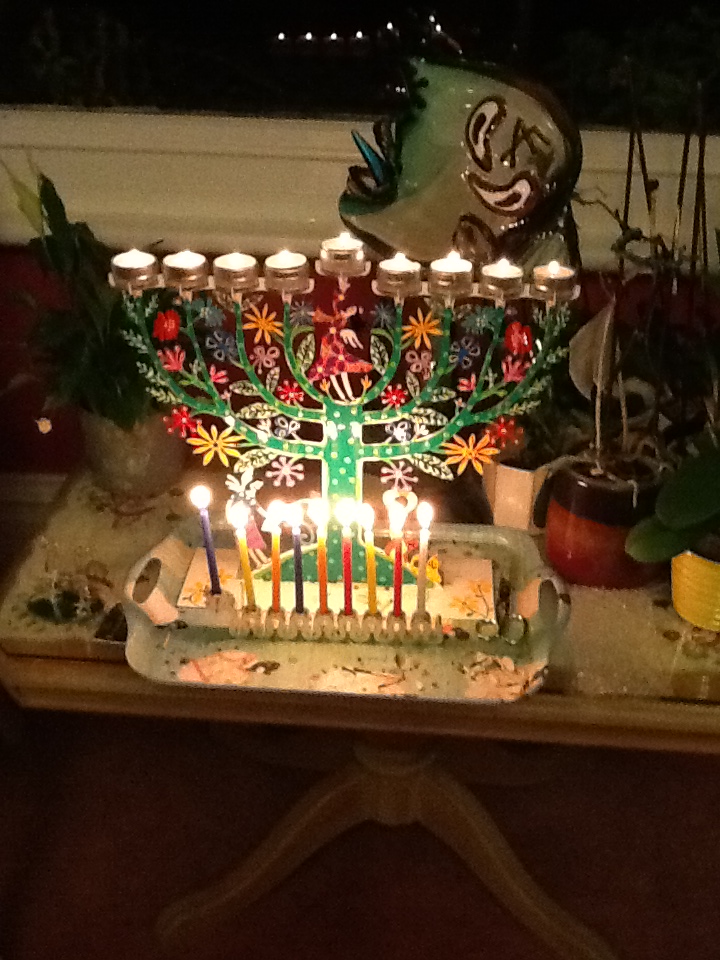
Chanukah: A time to reconnect to our values

photoSome years ago I was telephoned by a local radio station, wanting to interview me about Christmas coming so early this year. Somewhat confused I asked “Coming early? But isn’t it a fixed date?” This in turn confused the researcher. After a while I became clear about what she meant – that the shops were already full of Xmas gifts and glitter, even though it was early October. She wanted to know what I thought about it. I had to tell her that as a Rabbi I hadn’t given it much thought, and maybe she ought to be speaking to a cleric whose own tradition was being devalued and commercialised by this particular phenomenon, rather than me. She thanked me kindly and rang off. But it set me thinking.
When we Jews say “the festivals are early this year” we mean that they have taken us by surprise, and we aren’t ready and prepared for them. But Christmas ‘coming early’ means almost the opposite – people OVER preparing for it – at least in one aspect of its celebration. And by this particular type of preparation, the meaning and the message behind the festival becomes obfuscated and ignored.
It is always necessary to prepare for festivals if they are to mean anything more than the superficial enjoyment we can create around them. But the preparation has to be appropriate and considered. “Christmas coming early” is another way of saying that the meaning of the festival has been overtaken and overlaid by the trappings. The preparation has somehow gone askew. The traditions which deliberately build up to the important date (Advent colours, candles and liturgy) are disempowered by the gilt and glitz in the shops.
Rosh Hashanah or Pesach ‘coming early’ really means that we have run out of time to prepare for them, and that happen because we’ve become disengaged from our Jewish calendar. “Jewish time” nudges us with the regular cycle of Shabbat observance, our liturgy includes prayers before the new moon which reminds us monthly just how the year is passing; We read special haftarot before some of the festivals, and others that link us to calendar and time – from before Tisha b’Av to Rosh Hashanah and so on.
There are so many reminders that our tradition has worked into our routines, but only if we keep those routines in our lives. We under-prepare for our festivals each time we could make Shabbat Kiddush but don’t, we under-prepare for our festivals each time we book holidays without consulting the Jewish calendar, we under-prepare for our festivals by not living within Jewish time, and by forgetting to mark each new day and new week with reference to our ancient markers.
One of the things the religious world could learn from the commercial world is that forward planning and continual working towards the goal is the only way that the festival is made to be successful. I’m pretty sure that the Easter Egg planning is finalised by now in most confectionary factories and probably some are already made!
As the days draw in and the trees lose their leaves we may be thinking about latkes and doughnuts, the comfort food of Chanukah, and the bright lights of the menorah in our windows – but to really prepare for the festival we should be thinking of the meaning of having a festival dedicated to the rights of people to practise their religious beliefs and then move on into putting the values of those religious beliefs into action.

And as we celebrate Chanukah this year, our thoughts should also be travelling a little further down the line, thinking about Pesach, about Shavuot, about Rosh Hashanah and Yom Kippur; we should be thinking about how we plan to put our values into action at every festival, and during every ordinary day of the week. Who will you invite to your Seder this year? How will you be able to sit around the table and talk of freedom if you haven’t been considering it throughout the year, – and not only considering it but actively working to maintain important freedoms in our world.
Reconnecting with our calendar is the first step we take in order to reconnect with the meaning of our festivals, to not be taken by surprise each time a date comes round. Forward planning to make our festivals meaningful. As new diaries come into the shops and we write our important information into them ready for the new year, let’s put in the religious festivals, and some time set aside to prepare for them

Beha’alot’cha

There are some torah readings that just seem to be made for vegetarians, and Beha’alotecha is one of them.  The graphic image of the Israelites feeding upon the quail, stuffing the meat into themselves until it “came out of their nostrils” and then dying “with the meat still stuck between their teeth” is almost too repugnant to bear.  It speaks to us of overweening greed, of the desire for fleshly pleasure fulfilled to the extent of costing the life of the one who indulges too far.  It is both gross and pathetic, seedy and overwhelming. 

The people, often rather unattractive in their behaviour in the wilderness with their complaining and rebelling, their argumentative and sullen responses to Moses’ words to them, are here at their most revolting.  Their failure once again to understand what God is doing for them, their inability to comprehend ideas about freedom, communal responsibility, behavioural limits – leads them to what must be the most explicitly nauseating end in the whole of biblical narrative.

          Early on in the Exodus the newly freed slaves, terrified of what they had done in leaving the security of Egyptian society and worried about simple survival in a hostile wilderness, complained to Moses – “you saved us from slavery and brought us here to this desert to kill us all with starvation and famine?”.

God understood the narrow horizons of the people, the shrivelled imaginations and the visceral fear of a people who had forgotten how to be independent, how to have pride in themselves and the self-confidence necessary to go out and make a life. So that time God showered the Israelite refugees with quail and with the miraculous manna, the food which was said to have tasted like coriander or honey or rich cream – the food that tradition said tasted like whatever you wanted it to taste of. 

          But now, here in the book of Numbers after all the experiences of care and support by God here in the wilderness, this time the situation is different. “Who will give us meat to eat? We remember the fish we ate for free in Egypt, the cucumbers, the melons the leeks and onions and garlic. But now our soul is dried away, there is nothing at all except this manna to look at” (Num 11)

There are a number of problems in this complaint.  Are the people complaining that the diet isn’t varied enough? That manna – even tasting of different things, was still indisputably manna – and a bit boring for that? Are they desperate for something a little more solid? – they specify meat, food that tended to be eaten only on special occasions – and usually connected to the sacrificial system, when meat would be a by product of the worship of God?

Is it specifically Egypt they crave, with the system that may have been slavery but at least it was something they knew and could therefore cope with? Were they saying they didn’t want to break out into a more independent way of being?  Or is it the idea that the food in Egypt was so plentiful and all present that they could take it for free – without responsibility to its production, without obligation to others? 

The manna of course was also available to them for free, but somehow that didn’t count – there was no thought given to the deity who was providing their sustenance, no connection made in their heads between the availability of the miraculous manna and the Creator of the world who was making this every day miracle.

          Whatever the reason – and I imagine it was a combination of reasons, this time both God and Moses found the people’s complaining and self-absorption infuriating and intolerable. This time God gave them just what they said they wanted – in spades – and they died from it.

          When we first came across manna in the early part of the Exodus, we are told that God gave them it in order to test them. But what the test was is left to our imagination.  Rashi tells us the test is of obedience, that God wanted to see if the people would collect the manna in the way that God had commanded – just enough for each day, not keeping it overnight. Not going out to collect it on Shabbat but relying on what was collected before the Shabbat.  Each of these tests of course were failed – the people clearly did not trust that the manna would be there the next morning, that it could not be kept overnight in good condition, that the Shabbat would be somehow special in that no manna would be found but the manna retained would continue to be edible.  The people failed because they were frightened and because they were unimaginative – they had been in slavery too long and all they could construct was the practical concrete concepts around physical survival. 

          When Moses knew he was dying and would not continue with the people into the land he had been taking them to, he wrote a number of speeches explaining to them both the story and the meaning of their history, full of warnings and reminders. Of manna he said “Remember the path along which the eternal your God led you those forty years in the desert. God sent hardships to test you, to see what is in your heart, whether you would keep God’s commandments or not. God made life difficult for you, letting you go hungry and then feeding you manna. And manna was that which neither you nor your ancestors had ever before experienced. This was to teach you that it is not by bread alone that the human being lives, but by all that comes out of God’s mouth” (Deut 8:2-3). 

So Moses understood what the test was – it was not literally about the food, but it was about the people’s willingness to listen and to follow Gods commandments, to accept the limitations about what could and could not be done, and the food was simply the structure around which it would be seen whether or not the people were able to accept the restrictions that following God might place upon them.

 Image

Parashat Terumah – creating our own sanctuary

 “Dabeir el bnei Yisrael vayik’hu li teruma. Me’eit kol ish asher yidvennu libo, tik’hu et terumati. …. va’asu li mikdash v’shachanti betocham .And God spoke to Moses, saying:  ‘Speak to the children of Israel, that they take for Me an offering; of everyone whose heart makes him willing you shall take My offering….And let them make Me a sanctuary, that I may dwell among them.”

With this sidra we embark upon no fewer than thirteen weeks’ worth of Torah portions detailing how the Mishkan, the tabernacle, was meant to be built. One might contrast this to the narrative about the creation of the world which takes two chapters to tell two stories, or the narrative about Sinai and the revelation of Torah which takes three chapters in total.   So why is Torah focussing so narrowly and for so long? The answer can I think be found in the key word – Terumah is usually translated as an offering that is lifted up, but it is made clear in this passage that this is an offering freely given by whoever is moved to give.

There is none of the hard sell we are used to in charitable appeals, none of the slightly guilt tinged writing of cheques or pledge cards.  This is an offering that is motivated only by the desire to give. The root of the word terumah is something that is uplifted, elevated to a higher status. What we see here is the moment when human beings choose to do something extraordinary of their own free will; and then they are uplifted in some profound way. This elevation happens not because they are giving, but rather they are giving because they are in some way transcending their base selves.

What is it that causes this shift in the soul, this opening out of the awareness of the person? The narrative comes immediately after the debacle of the golden calf, when again the people gave, but that time they gave their gold and jewels in order to make for themselves an idol to worship.

 it must surely be some deep recognition that however much we make for ourselves external props and supports in order to buttress our fragile existence, true strength comes from within us. God’s words in verse 8 “va’asu li mikdash v’shachanti betocham” is a clue – “let them make for me a sacred space and I will dwell within them”.

Once the people truly understand that the space they make within themselves by stopping all their frantic activity and verbal whirlwind and just letting themselves breathe and be – once they see that that this internal mindful space is effectively a mikdash, a sanctuary that is within themselves, then it quickly becomes apparent that the resources they need to support themselves are all there, all available and accessible. Call it God, call it by any other name, once we stop and let ourselves simply be, once we make the time and space to simply notice what our heart and mind truly wants, when we stop trying to fill the space around us and within us with busy-ness and activity then we ourselves are raised above the mundane. We become Terumah – uplifted; and we offer Terumah – the gift of who we are is a gift both to God and to ourselves.

Where does God dwell? This portion reminds us of the response of the Kotsker Rebbe Menachem Mendel. “God dwells wherever we let God in”.

As we begin the long and extraordinarily detailed description of the building of the sanctuary in the desert, we may reflect on why Torah spends so many weeks on the particular descriptions and the minutiae.   It takes a long time to create such a sacred space, yet consider the mikdash which we ourselves can create – without the gold or the silver, the purple or scarlet. The mikdash which we create within ourselves comes from our taking time out of our constant activity. And when we create that space within ourselves, we may find it filled with the Terumah – the willing heart, the presence of God, the strength and support that dwells within ourselves, if only we would reach for it.


Parashat Bo

The sidra opens with a challenge – the word we use to name this narrative – Bo. God is saying to Moses “Come to Pharaoh. I have made him and his advisors stubborn in order to demonstrate my miraculous signs among them. And so you may tell in the ears of your son, and of your son’s son, what I have wrought upon Egypt, and My signs which I have done among them; that you may know that I am the Eternal.’”

In Hebrew there are two different verbs – la’lechet which means ‘to go’ and which was the imperative used when God first met Abraham – Lech Lecha! And la’vo meaning ‘to come’ which is the verb used here to Moses. Come to Pharaoh!

But at the end of the sidra last week, Moses was outside the city – so from the usage of this verb we can only understand that while Moses was outside and away from Pharaoh, God was within, and close to Pharaoh.

The thirteenth century French commentator, Rabbi Hezekiah ben Manoach, noted this strange usage, and suggested that God was saying that when Moses went to Pharaoh, God would be there with him – in effect he would not be alone as he faced the increasingly paranoid and terrifying king.  This is a lovely reassurance to Moses, but it begs the question – why at this point does Moses need the reassurance? Is he in doubt that God can do what is promised? Does he fear that he will be led into a trap from which there is no escape?

Moses knows from later in the same verse, that God has hardened the heart of Pharaoh yet again. Maybe he was holding on to the hope that Pharaoh would finally yield to the wishes of his advisors, that he would understand that he was in a battle he could not win. But God has put paid to that hope – Pharaoh would, for certain, rebuff him. And this too would be part of God’s plan.

How difficult must it have been for Moses to go through with this. How much must he have wanted God to be actively present alongside him. And then the plagues themselves when they came were all of them about darkness, isolation and terror. As we feel today feel conflicted about God strengthening Pharaoh’s resolve to take the battle between them to the ultimate conclusion, how much more so must Moses have felt, a frightened human being shuttling between the two of them?

An ancient battle is being played out – between Good and Evil, between light and dark. What is different in this rendition of the mythology is that human beings are part of the thread of the narrative, that we must witness and understand what it is we see, we must go on to remember and to tell what we saw and understood.

Those first two verses set the scene ““Come to Pharaoh. I have made him and his advisors stubborn in order to demonstrate my miraculous signs among them. And so you may tell in the ears of your child, and of your children’s children, what I have done to Egypt, and My signs which I have done among them; that you may know that I am the Eternal.’”

The final element of the battle is to happen now. And all must know for all time from the process of this battle that God is the one and only and Eternal God.

The  parashah goes on to recount the events leading up to the final night, when the Israelites prepared for their departure from Egypt, and the instructions given to ensure that this core event in our history will be recorded forever in the collective memory of the Jewish people.

The events leading up to and surrounding the exodus from Egypt are embedded in our narrative in so many ways – Kiddush at Shabbat, the Amidah, the Seder, the Hallel. These are signs and signals for us to respond to, we  must consciously understand what we are doing, and tell and retell the narrative to ourselves and others in every generation. All of this so that we may never forget nor misunderstand that God is God.

There are two big themes in Judaism – there is the universalistic one of the Creation of the World and the Creator of all Things who is God of all people;  And there is the particularistic one of the Exodus from Egypt and the particular relationship we Jews have with God. All of our tradition and theology is balanced upon these two major events, the universal and the particular, the creation and the exodus, the whole and the part, the community and the individual.  We create actions and rituals, stories and prayers, all in order to remember that the Eternal is our God, and everything flows from that remembering. But in the smaller and particularistic scale our activity also reminds us that each of us has a consciousness and lives a life of moment and value, and we should not take any part of that for granted.  Each of us makes a contribution, each of us is a witness and our stories weave into the narrative to strengthen and form it.

If we choose not to be part of the story, then everything is weakened because of that choice. We are in it together, a people, a community, who share our narrative and understanding.  We may fear, we may doubt, we may have good reason for both the doubt and the fear. But like Moses, when we take our part in the narrative we should remember the choice of verb used by God – “come – be with Me, I will be with you, you are not alone in this however terrifying it looks”, rather than the verb used in the imperative to Abraham – Go for yourself. 

 In the two imperatives that God uses to force movement, we have moved from the individual to the communal journey. We are no longer alone. However difficult we might find God to be, we have each other and we have the reassurance of our history that however dark it seems to be, the dawn will come.
 

Wearing Tallit

When I place my tallit around my body and say the blessing “lehitatef batzitzit – to wrap myself in the tallit”, a number of feelings wash through me changing my sense of self. To begin with, putting on tallit is a marker in time – with this action I am letting go of the mundane, of the worries and the niggles of my ordinary life and I am entering demarcated and focussed prayer time. Secondly, there is a marker of change in my emotional state – The feeling of being wrapped in the tallit provides a sense of warmth, comfort, separation from surroundings and connection to a different sphere, as the weight on my shoulders reminds me of the expectations and obligations I have taken upon myself as a religious Jewish person. And finally, the putting on of tallit creates a marker in space – my tallit provides a tangible boundary between my internal world and the outer one.

The tallit is so much more than a shawl traditionally worn while praying the morning service. It is a both creator and signifier of disconnection and reconnection.

I have never known a barmitzvah boy think twice about receiving and wearing his tallit. It is just something that they do, something they expect to do, for them it is a right and an obligation to wear the symbols of obligation and rights. I have never known a batmitzvah girl (or any woman) take on tallit without much soul searching and some anxiety. Are they ready to take on all that tallit means? Does the wearing of tallit give the proper statement about their religious observance and worth? Is it saying something more than they are able to do or be?

While it is often said to be that the tallit is a male garment, this view dates only from medieval times and came into being as a way of underpinning the growing move towards prohibiting women from wearing it. And women did, we know, wear tallit and they were explicitly permitted to do so in a number of early rabbinic responsa and even Talmud (Menachot 43a) tells us that “Our Rabbis taught: All must observe the law of tzitzit, priests, Levites, and Israelites, proselytes, women and slaves” and gives us two examples of Sages who attached tzitzit to the clothing of the women in their households – Rabbi Judah ( Menachot 43a) and R. Amram the pious (Sukkah 11a). The reason given for women being exempt from this mitzvah (not, note, prohibited) is that it is a positive time bound mitzvah and the rule of thumb was understood to be that women were exempt from having to perform mitzvot that were bound to fixed times – except of course, when they were not exempt, such as lighting the Shabbat candles, making Shabbat kiddush, lighting the chanukiah, prayer….. And the idea of the garment to which tzitzit are attached being strictly male – well, Bedouin to this day wear the four cornered cloak described in our texts (the abaya)– and both men and women wear it.  

Only in the thirteenth century did Rabbi Meir of Rothenberg begin to overturn the practise of generations and his view was promulgated by Isserles in the 16th Century who wrote that the wearing of tallit by women might be a sign of religious arrogance or self righteousness (Yuhara), although even he admitted that a woman could wear tztitiz, it was her intention that mattered, not the wearing per se . But since this medieval onslaught against the presence of women in the public space, the practise has dwindled to the point where it is barely remembered, until in our days a critical mass of women have once more decided to take on the wearing of tallit as a mitzvah.  

The variety of journeys that women take to adopt for themselves the mitzvah of tallit is extraordinary and salutary. I know of women who choose to wear the tallit of a deceased husband, father or grandfather as a mark of respect and love, and a desire to be close in prayer to those who gave meaning to their lives. I know of women who studied hard in order to make their own tallit and who choose to weave extraordinary moments and memories into the fabric, building a sort of physical memory of their spiritual life into the tallit. I know of women who wear the tallit of Women of the Wall as their choice of garment in order to additionally show their support for other women practising this mitzvah wherever they may be in the world. I know of women who wear ‘feminine’ tallit and women who wear ‘traditional’ designs always for particular reasons, and of women who wear both at different times in their prayer lives. I have never yet met a woman who thoughtlessly puts on tallit, or who sees it as her religious right that she must display to others, or sees the wearing of it as an act of rebellion or arrogance or in-your-face piety.

The arguments against women wearing tallit seem to hang on either it being a male garment (easily circumvented should one buy this argument by the plethora of feminine talliot that can be purchased) or that exemption should be extended to prohibition on the somewhat shaky ground that women only wear tallit to be arrogant (something that can be easily disproved by talking to -and listening to -women who choose to wear tallit.) The arguments for women wearing tallit is that we find it an aid to prayer, a ritual that increases our kavannah – our focus and concentration on our relationship with God as we pray. It creates special time, special space, a deposit of memory on which we can build and from which we can grow, a custom that deepens and warms our religious attachment. It provides a much needed boundary between the mundane and the sacred in our busy lives, it signifies our detachment from the unimportant and our attachment to our Creator in prayer.  If you haven’t yet explored the possibility of this mitzvah, I encourage you to do so. Male or female, we all have much we can gain from it.


parashat vayetzei

Vayetzei 

Every so often someone asks about the word “mizpah”, found in this sidra, because it appears on a piece of jewellery sold in a national chain of shops.

When the sidra Vayetzei begins, Jacob is effectively running for his life, leaving home and family in Beer Sheba, and going towards unknown relations in Haran.  A frightened and homesick young man, uncertain of what the future will bring, he stops alone by a roadside at night and dreams the dream which is to sustain him throughout his life – he dreams of a ladder connecting heaven to earth, and there on that ladder he encounters God.  By the time the sidra ends, much of the trickery which caused him to leave home will have been reflected into his own life – his father in law will have deceived him with his bride (the mirror image of his own deceiving of his father), the older will not be passed over for the younger (as was done when he took the blessing meant for his older brother.)    After 20 years Jacob is returning home a wealthy and confident man, no longer alone but with a substantial entourage, and of course also as a husband and father.  Relations with his father in law have been marked by abuse and mistrust, and at the end of the sidra Jacob makes good his escape, only to be chased by Laban who is searching for the stolen household gods, and who doesn’t want this young kinsman to leave and take with him both family and family wealth.  The two make a pact finally, neither of them happy about the other but both unable to do anything further about it.  The pact is marked by a mound of stones, named in both the Hebrew of  Jacob (Galeid)  and the Aramaic of Laban (y’gar sahadoota) ,  and then it is suddenly named again ‘Mitzpah’, because Laban  said  “May the Eternal watch between you and me when we are out of sight of each other,  if you ill- treat my daughters or take other wives besides my daughters  – though no one else be about, remember the Eternal God will be a witness between you and me” (31:49).

Mitzpah then is not a blessing but a warning.  Far from being a token designating eternal love, it is more a sort of token of eternal mistrust.  Yet there it is to be found on the pages of well known catalogue store under the rubric  “His and Hers split pendant set”, along with other split pendants with such inscriptions as “Our Hearts beat as One”, and even the famous speech of Ruth to Naomi “where you go I will go, where you lodge I will lodge, your people will be my people and your God my God”.

One wonders what the designers of this jewellery, and also the many people who actually buy it would think, if they realised that the apparently romantic message in fact is a barely coded warning between two known tricksters that whatever they do, even in secret when no one is around to observe them, the truth will be known to God, who will most certainly judge them.

The whole business set me wondering about the things we wear to remind us of what is important to us.

Traditionally Jews wear  certain things to remind us of the biblical commandments – tefillin in the daily morning service which contain paragraphs from bible reminding us of the obligation to love God and to teach our children to do so too;  or tallit with the corner fringes knotted to remind us of the 613 commandments said to be in Torah, many of which deal with how to behave towards others –  but even these reminders can become habitual so that we don’t really think of the meaning of these commandments which are designed to shape our behaviour to be holy – to behave against our own selfish needs or interests in favour of Imagebettering our world, developing creation along with God. We could do though with something to jolt us out of our daily existence, something to remind us that God is there in everything we do and everything we see.  The traditional system of blessings said before we do any action has much to commend it, the whole system of time bound mitzvot marking our days and our weeks, of shabbatot and festivals, they are all designed as ‘signs’ to remind us of our partnership with the Creator and our responsibilities to God, but few of us today have the kind of lives which would make all these signs meaningful.  Thinking about it, maybe we should all buy one of those pendants which say MIZPAH, not as a declaration of love for another, but to remind ourselves that all the twists and turns of our lives, all our petty temptations and deceits and actions and inactions, they may all be hidden from our fellow human beings, but will never be hidden from God, who will ultimately judge us.  Everything we say and everything we do, at home or outside, whatever time of day – we should do in the certain knowledge and fear that it will not be forgotten.  That would certainly add a different dimension to our lives!