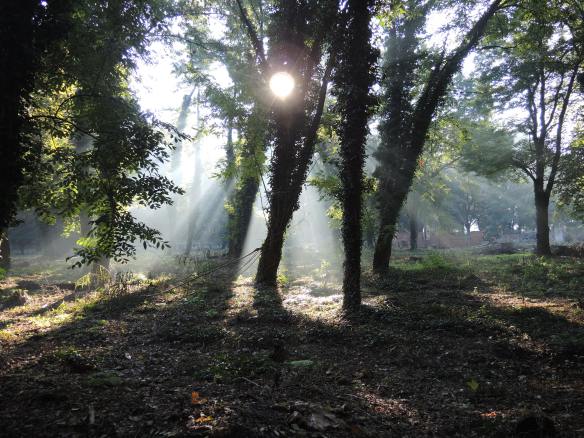
Tetzaveh: the flames that ascend on their own

אַתָּה תְּצַוֶּה אֶת-בְּנֵי יִשְׂרָאֵל, וְיִקְחוּ אֵלֶיךָ שֶׁמֶן זַיִת זָךְ כָּתִית–לַמָּאוֹר:  לְהַעֲלֹת נֵר תָּמִיד

And you shall command the children of Israel, that they bring to you pure olive oil beaten for the light, to cause a lamp to burn continually. (Ex 27:20)

For those of us who enjoy parsing bible, this very first verse of the sidra gives us a rich seam of learning. God is instructing Moses on what will happen inside the Mishkan, the portable tabernacle used for worship in the wilderness years. The sidra gives us elaborately detailed instructions for the clothing of the priests, and about the ceremony of ordination in which they will be dedicated to the service of God. The purpose of the clothes and the rituals are made clear – it is to make the priests holy.

The holiness of biblical times was not the abstract quality we think of it today, it was for them an important state of being for those who were to approach God. Holiness could be acquired through ritual and clothing, washing and the abstention from some actions, people and places. Holiness was a quality which was necessary for those who wished to serve God in the rituals of worship, as it would somehow protect them from what was understood to be a potentially dangerous and certainly unknowable presence of God.

So we have verse after verse of what they wore and when and how they wore it, what they washed and what they daubed in blood; what they ate and when and in what condition, what they slaughtered and what they sprinkled, what they burned and what they waved.

Reading it one can easily fall into a modern-minded trap of wondering how on earth they could believe that this ritual of sacrifice and incense brought people closer to God – but I think the clue is in the very first line I quoted – this is not for God, it was never for God, this is for the people.

אַתָּה תְּצַוֶּה אֶת-בְּנֵי יִשְׂרָאֵל, וְיִקְחוּ אֵלֶיךָ שֶׁמֶן זַיִת זָךְ כָּתִית–לַמָּאוֹר:  לְהַעֲלֹת נֵר תָּמִיד

And you shall command the children of Israel, that they bring to you pure olive oil beaten for the light, to cause a lamp to burn continually. (Ex 27:20)

Rabbinic commentators noticed two surprising words in this verse.

The first being that the oil that is being brought to light the lamps in the Mishkan – and to symbolise the eternal relationship between God and people – is brought not for (or to) God but Alecha – for you. The midrash is clear (Lev Rabbah 31:8) when it tells us that God already has the sun as a servant, there is already fire in the world so God does not need the light that we have burning in the Mishkan. God does not need it, we do. Bringing the olive oil into the Mishkan is an action only for our benefit; it is a way to come closer to God, a way to create relationship with the Eternal. The Midrash tells us that God gives us the mitzvot as a way to let us have as many opportunities as possible to come closer to relationship with God, even in the smallest and insignificant actions of our lives – such as providing olive oil for a lamp.

There is a second curiosity in this verse. The verb used to describe kindling the light is not the normal one for lighting a flame – lehadlik – but instead the bible talks of le’ha’alot Ner Tamid – to cause to ascend a light continually.

In the Talmud are two ideas about this verb and what we can learn from it. Rabbi Samuel bar Isaac in the Jerusalem Talmud (Sukkah 29b) deduced that the unusual word לְהַעֲלֹת, le’ha’alot, literally “to cause to ascend,” meant that the wick had to allow the flame to ascend by itself. And thus the Rabbis concluded that no material other than flax — as in the fine linen of the High Priest’s clothing — would allow the flame to ascend by itself. Similarly, in the Babylonian Talmud (Shabbat 21a) Rami bar Hama deduced from the use of word לְהַעֲלֹת, le’ha’alot, that the flame had to ascend by itself, and not through other means (such as adjustment by the priests).

Taking these comments and in particular the idea that the flame should ascend on its own, Rabbi Samson Raphael Hirsch, the famous nineteenth century founder of the school of “Torah im Derech Eretz” orthodoxy which negotiates the  relationship between traditionally observant Judaism and the modern world, wrote that “the description of the act of kindling a lamp by the term ‘ascending’ is peculiar to the service of the lamp in the sanctuary. It alludes to the action of the priest in applying the flame to the wick which is ready to be kindled until the flame ascends of its own”. The task of the teacher of Judaism is to make themselves superfluous to their pupils. It is not their function to keep the people – the ones who receive instruction from the teacher – continually dependent on them”

The statement is a beautiful distillation of what Jewish education – formal and informal – should be aiming for. That we want our children (and of course our adults) to be themselves ‘flames which ascend on their own’. The goal of Jewish community is that individually and collectively we gain the knowledge and the confidence and the inspiration to live active and thoughtful Jewish lives, that each of us is able to stand up and be a light in the world, living with Jewish values and ethics, striking out for righteousness.

There is an idiom in the English language – to pass the torch – and this is, to some extent what all of us in the Jewish world hope to be doing within our communities. However this sidra reminds us that we are not passing the torch on in order to relinquish our responsibilities, but rather that we nurture the flame of learning and identity of the next generation with our own learning and experience.

The image of Aaron each and every day nurturing a flame in order to have it stand upright and unaided, giving light through the darkness is an image that appeals to me and speaks to me of how we have kept our traditions and our teachings alive through the generations.

candles

Mishpatim: Torah MiSinai is only one half of the conversation

In parashat Yitro is the climactic coming together of God and the Israelite people as three months after the dramatic exodus from Egypt following signs and wonders, the people are encamped at the foot of Mt Sinai and Moses and God encounter each other once more in order to create the agreement that as long as the people will obey God’s voice and keep the covenant, then they will be God’s special treasure among all the peoples of the earth, and shall become a kingdom of priests to God, and a holy nation. (Exodus 19:5,6). A period of purification is followed by the majesty of the presence of God, and the words of God are declaimed amid black smoke, thunder and lightning, terrifying the people who declare their willingness to accept the covenant but ask for Moses to be their representative and for them to keep well away from whatever is going on.

The relationship is consummated with words, called in Hebrew the Asseret haDibrot, the Ten Statements, which function essentially as the paragraph headings that prescribe the boundaries and the requirements of the relationship.

Like any new relationship, each side views the other as pretty wonderful, there is no need immediately to get into the gritty details of the red lines and the expectations that will make living together successful or not. But soon of course those realities set in and the couple have to ‘talk tachlis’. Hence the detailed miscellany of laws in the following chapters, including a whole sidra named ‘mishpatim’: the laws and rules of the relationship.

This year, I was especially drawn to thinking about the authority of the rules – who gets to decide what they are, who gets to change them, and to ask – how does the relationship evolve?

In Exodus 24 we have insight into the beginning of the ‘tachlis period’. Moses is to come alone to God. There has been some etiquette about introducing the leaders of the people further up the Mountain, but now Moses tells the people all God’s words and the people answer in unified response “all the words which the Eternal spoke we will do”. Then Moses writes down all the words of God (it is not clear where he does this), after which he builds an altar representing the entire people and there is a sacrificial rite, followed by this information “And Moses took the book of the covenant, and read in the hearing of the people; and they said: ‘All that the Eternal has spoken will we do, and we will understand.’ (24:7)

What is this Book of the Covenant? Why does Moses follow his reading – and the people’s oddly worded response – with a ritual where he takes the blood of the previous sacrifice, sprinkles it on the people and tells them ‘Behold the blood of the covenant, which the Eternal has made with you in agreement with all these words.’ We now have a Book of the Covenant (Sefer ha brit) and Blood of the Covenant (dam ha brit) and then suddenly we are in a vision, as the 70 plus elders of Israel find themselves at a feast where they see God standing on a clear sapphire pavement.

Just as suddenly we are out. God tells Moses ‘Come up to Me into the mount and be there; and I will give you the tablets of stone, and the Torah (teaching) and the commandment (mitzvah)(, which I have written, that you may teach them.’ (v12)

What are these tablets of stone, the Torah and the Mitzvah that Moses is to teach? How do they fit into the covenant? Why then does Moses stay on the mountain after this for forty days and nights, hidden in cloud, leaving his people leaderless and frightened and alone?

The text, like the top of the mountain, is opaque. We cannot understand the encounter, only know that there was indeed such a moment that cemented the relationship between God and Israel, a relationship that might go through many rocky patches and many silences, but which will never actually break. We have a brit, a covenant, and we are tied to each other for eternity.

But what are the parameters of the covenant? What do we have to do? What will we come to understand? And while the existence of the covenant is unchanging, the conditions have clearly developed and altered.

The Talmud sets out the traditional position of the verse asking: What is the meaning of “And I will give you the tablets of stone and the law and the commandment, which I have written so that you can teach them”? “Tablets of stone”-these are the Ten Commandments, “the law” -this is the Torah, “the commandment”- this is the Mishnah,” which I have written”- these are the Prophets and the Writings, “that you may teach them”- this is the Gemara. And it teaches that they were all given to Moses on Sinai (TB Berachot 5a).

This passage is frequently cited as the proof text of Torah miSinai – that God gave to Moses everything that would become Rabbinic Judaism in later years. Either it was given at Sinai or it has no authenticity runs the argument. But surely this cannot be a literal reading of the biblical text, nor a complete reading of the Talmudic one.

The phrase Torah mi Sinai is found only once in Talmudic texts – in the introduction to the Mishnah of Pirkei Avot, where we are told “Moses received the Torah from Sinai and transmitted it Joshua. Joshua transmitted it to the Elders, the Elders to the Prophets, and the Prophets transmitted it to the Men of the Great Assembly. They [the Men of the Great Assembly] said three things: Be deliberate in judgment, raise many students, and make a protective fence for the Torah.”

It is found not at all in Bible, and indeed while the seeds of the idea of divine revelation encompassing the whole of what became Rabbinic/Halachic Judaism can be discerned, they are only in the later books of Chronicles and of Ezra and Nehemiah, books which are generally seen as being written only in the 5th/4th Century BCE. These books use the words haTorah / Torah while earlier books refer always to Torot, a plurality of teachings. The Book of Nehemiah even refers to Ezra reading In the book, in the Law of God, (BaSefer, b’torat Elohim) distinctly; and they gave the sense, and caused them to understand the reading. (8:8,18), and also” Ezra the scribe [was asked] to bring the book of the Law of Moses, which the Eternal had commanded to Israel”, and so clearly by the early Second Temple period there was a tradition of a Mosaic/divine book of Torah, which is variously described as being the Torah of God or the Torah of Moses, something unknown in earlier biblical texts.

This idea is seized upon by the Rabbis who took for themselves the right to decide not only what the texts would mean, but also used it to assert their authority and control over the people. Hence we have the midrashic text in Leviticus Rabbah (5th Century) ““everything an experienced pupil might ever say to his teacher was revealed to Moses at Sinai.”, and the more worrying Mishnah Sanhedrin (10:1) “…These have no share in the World to Come: One who says that [the belief of] resurrection of the dead is not from the Torah, [one who says that] that the Torah is not from Heaven, and one who denigrates the Torah..”

Why did they do this? Was it in order to emphasise the authenticity of their authority post Temple, against the Karaites and the Sadducees and those who wished to continue Priestly authority? This would certainly make sense as they were reinventing what it meant to be Jewish after the central worship authority had disappeared, and a multiplicity of rival claims may have spread the Jewish people too thinly to survive.

But we are in a different world, where literary criticism and scholarship that takes into account the context of a text mean that we can see that Torah miSinai cannot be a literal description of our foundational texts. Even Maimonides, who famously enshrined Torah miSinai into his thirteen principles of faith, would surely have framed those principles differently in modern times, (And one must also take into account the context of those principles that became Yigdal – he was responding to Islamic claims about the superiority of its revelatory texts).

Whatever the Torah of Moses /the Torah of God means, for which the shorthand remains “Torah miSinai”, it has become a barrier for the Jewish people rather than an enabler. People who have good academic understanding in the secular world find the notion of one book literally given at one time on a desert mountain to be improbable, which means that the world of scriptural literalists tries to keep modernity away from ‘their’ Jews, with terrible consequences often. People who seek to understand the text differently are shunned or worse, treated as if they are no longer Jews. And then there is the halachic process, which from being a dynamic and responsive practice has become solidified and deeply unhelpful often, simply because there is nothing ‘miSinai’ that pushes for change.

I love the idea of God speaking with Moses in the presence of the entire people, and that being an inspirational and creative moment that energised the ongoing relationship of God and the Jews. But I hate the idea that the route to the relationship is held in the hands of people with little understanding of modernity or the modern Jewish people and State, who try to excommunicate anyone who challenges or brings in modern ideas from the Covenant and the peoplehood.

It is time to reclaim Torah MiSinai, to go back to that moment where the whole people heard and said, we will do and we will understand, and while they may have deputed Moses to negotiate the contract on their behalf, did not abdicate their own responsibility for being part of the development of what the contract would mean over time.

_Moses_on_Mount_Sinai_Jean-Léon_Gérôme_-1895-1900

Beshallach/ Shabbat Shira: the Song of Miriam

“And Miriam the prophetess, the sister of Aaron, took a timbrel in her hand; and all the women went out after her with timbrels and with dances. And Miriam sang to them: Sing ye to the Eternal for God is highly exalted: the horse and its rider God has thrown into the sea.”

Shabbat Shira, the Sabbath of Song, is named for the Song at/of the Sea (Shirat haYam) and this name takes precedence over the usual format of the first important word giving the title to the week. Shirat haYam was the song of victory sung by the Israelite slaves after they had successfully crossed the Reed Sea, and the pursuing Egyptians had drowned there following the miraculous opening and then closing of the waves to allow the Israelites safe passage but not the heavily armed Egyptians.

Along with the poem in Deuteronomy (Ha’azinu) it bookends the story of Moses and the people of Israel as they leave Egyptian slavery and journey through the wilderness to arrive at the edge of the promised land, and tradition ascribes its authorship to Moses.

But tucked into the text a little way down we are introduced for the first time by name to Miriam, described as “Miriam the prophetess, the sister of Aaron” and she takes a drum in her hand and leads the women in singing and dancing and drumming to celebrate the victory. And while apparently singing the same first line, Moses and the children of Israel sing “I will sing to the Eternal, for God is highly exalted” while Miriam sings “Sing to the Eternal, for God is highly exalted”. She uses the imperative version, whereas Moses and the Israelites use the personal pronoun.

The order of the text makes us read this as the song of Moses, but is there a clue in the wording of the text to tell us that this is the song of Miriam?

In the fragments of text found in Qumran (known as the Dead Sea Scrolls) we find a tantalising addition. Just as in the biblical text we find that “Miriam the prophetess, the sister of Aaron took a timbrel in her hand and led the women out with her with timbrels and dancing”, but then there is a break, and then the fragments of seven lines NOT found in the biblical text, followed by the narrative being picked up as the biblical verse 15:22 where Moses leads the Israelites away from the Reed Sea into the desert, and the people find no water until arriving at Marah they find undrinkably bitter (Marah) water.

Is the Qumran text a gloss on the biblical poem of Moses, answering the question of what Miriam might have sung and paralleling other songs of victory or was it the original text which took away words from Miriam and the women in order to give them to Moses and the Israelites? We know that women sang songs of victory after battles – Deborah is a prime example whose song is recorded (Judges 5), and Jephthah’s daughter (Judges 11:34) comes out with timbrel and dancing on his return home. Unnamed women come out dancing and singing with their timbrels when David returns having defeated the Philistines (1Sam 18:6-7) celebrating his success and humiliating King Saul’s record. Hannah (1Sam:2) sings when she achieves her goal of a child, and the late book Judith has her sing in the final chapter, having beheaded Holofernes…

So why not Miriam and the women singing their song? Miriam the prophetess was also Miriam the musician and song leader. Her voice and her words deserve to be heard and to be recognised.

miriams timbrel

Whatever the reason for the biblical canon to contain just the remnant of her singing with the women, apparently echoing the words of Moses and the men, so that tradition could claim her as the song leader for the women only, I think there are enough clues left for us to give her the power and place she deserves.

The first place that Moses leads the Israelites to is called by the narrator “Marah” , after the bitter and undrinkable water found there and there is much murmuring against Moses until on God’s instructions he finds a tree whose wood will sweeten the water. Moses uses this as a teaching aid to remind the people that God is their healer, and then they move on to Elim where there are twelve good water sources and seventy palm trees. Is this a veiled reference to Miriam, whose name is impossible to translate with certainty but which is often understood as coming from “Mar – yam – bitter – water/sea”? Are the people murmuring because of Miriam and her treatment by Moses that he appropriated her rightful role? And are they pacified by the oasis of plenty represented by 12 springs and seventy palm trees and so forget their indignation?

But more intriguing I think is the possibility that Miriam’s name is not derived from bitterness MRH) but comes from a rarely used root MRR to mean a flow of water, drops of water or a watercourse. In which case her name would mean the flowing of water or the directing of water – something that would come to fruition not only in the midrashic idea that wherever Miriam was there was water for the Israelites in the desert (which comes from the drought that is the first reported event after her death), but from this text about the Reed Sea, which changed direction, flowed differently and intentionally while the Israelites crossed it. The name Miriam, introduced exactly here, is I think a clue to her purpose –  we are already explicitly told that she is a prophetess, she has real and intentional meaning and understanding – it is Miriam who causes the sea to part and the miraculous redemption of the fugitive people. Her name, hiding in full view, tells us exactly that.

So the Song here attributed to Moses yet called slightly confusingly Shirat HaYam , the Song of (or at) the Sea (a name first recorded in the 2nd Century in Talmud Yerushalmi), might actually have been Shirat MirYam, the song of Miriam. And how powerfully that simple change could have affected our understanding of our foundational texts and shaped the hearing of the voices of women in our tradition.

Drop by drop as we look again at the texts, we who see Miriam as a role model, who see ourselves reflected in her life as prophetess, sister, organiser, carer for children, provider of life giving water/nourishment, song leader, drummer and dancer , as well as a hard worker behind the scenes who protested injustice done to others and the arrogating of power to the male leadership – we need to take notice of the effect that the flow of water can have – it can wear away the hardest rock. Drop by determined drop we take up her mantle and raise our voices in song and in challenge and in prophecy, and hope that this time the words will not disappear from the canon.

(Photo of Miriam’s timbrel and the reeds in Egypt/water of the Reed Sea from an embroidered Torah Wimple made by Caroline and Naomi Ingram for the author)

Parashat Bo -the moon waxes and wanes and we learn to count time

The first mitzvah given to the people of Israel occurs in this sidra just before the cataclysmic tenth plague, and the people are finally freed from slavery. Moses is instructed to tell the people “This month shall be for you the beginning of months; it shall be the first month of the year to you” (12:2) from which the mitzvah of Kiddush haChodesh, the determination of the New Moon, is derived.

Of all the possible choices to be the very first commandment to the new people being formed, the declaration of the new month seems at first glance to be a surprising one. And coming as it does just before the final act that leads to their redemption, the context makes it all the more critical. So why is the very first shaper of the people Israel the requirement to notice the phases of the moon and to declare the new month?

There are, of course, any number of commentaries on this mitzvah. That as the moon does not have light of its own, but reflects the glory of the sunshine, so do Israel reflect the glory of God. That in counting the phases of the moon the people return to the awareness of the God of creation, and as the moon appears to travel with the traveller, so God too travels with us and appears wherever we are. That the moon is sometimes hidden and sometimes revealed, like the God we constantly seek. That the phases of the moon, which waxes and wanes, remind us that ‘this too will pass’, that our own fortunes come and go, but nothing is forever. That by watching the phases of the moon in order to declare the new month, we are looking up and away from our own situations. That by declaring the new month we are moving away from the Egyptian system whereby the movement of the heavenly bodies is predicated on the actions and the kingship of the Pharaoh. That declaring the new month will be a human initiative, not a divine one….

They are all good glosses as to why this mitzvah is the first given to the people, and timed just before they leave Egypt for an uncertain future, but I think there is another more powerful reason for why this is the first mitzvah for the people to learn to do.

Structuring our time is one of the most powerful ways we take control of our lives. For the Israelites leaving slavery, the idea of structuring their own time must have been both difficult to imagine and frightening to think about actually doing. The bottom line of slavery is that one is not in control of one’s own time, and the parallel bottom line of freedom is that one has to learn to use time in the best way. Having recently changed my work practise after 28 years of being a community rabbi always chasing my tail and trying to catch up with the work, with never enough time to do everything I wanted to do, I find that managing my own time is even harder when there isn’t the pattern imposed externally by ‘work’. So I may continue to write ‘to – do’ lists and doggedly work my way through them but somehow I am still chasing my tail, still trying to catch up on the day’s expected tasks, still frustrated at the amount of things to do in the time available.

Cyril Northcote Parkinson observed that “work expands so as to fill the time available for its completion” (known as Parkinson ’s Law) and this is certainly borne out by experience – both as an individual and as a society. Everyone who has worked in a pressured organisation is aware of the issue of ‘presenteeism’ – the need to look efficient to others by working many more hours than one is contracted to do. Indeed I remember being told by a congregant who worked for one of the big consultancy firms that while normally when buying a suit one would buy one jacket and two pairs of trousers (which show signs of wear more quickly), in his world it was normal to buy one pair of trousers and two jackets, one to be left on the desk chair so that it would look like you were still in the building and working.

Structuring time so as to work with efficiency and still have the opportunity to have a life outside it is one of the hardest things to do – the pressures imposed upon us by our employers or clients or congregants alongside our own needs to look busy and important and necessary mean that we are generally very bad at this skill. And when one works at home or for oneself, or when we are connected through various devices to the rest of the world almost continually, it is even harder to disconnect, to put the boundaries in place and then to keep them.

Looked at in this light, it is very clear that the one thing the people of Israel needed to become aware of is the rhythmic passing of time and that it is we who count and notice and determine the time, not some external power or internal need. Control of time is the paradigm of real freedom and it is hard to do well. But the moon, the gentle moon with its renewal and growth, with its regular phases and reminders during dark times that light will come again, and most of all with its nightly appearance that gives us hope, that helps us to keep count of the passing of time, that means we look up an out of ourselves when we might be tempted only to keep our eyes focussed on the task to be completed – the moon is the most wonderful object to follow and to see. And add to that the requirement upon us to pay attention to its monthly cycle, to requirement to make of each new moon a moment to renew ourselves and refresh ourselves, to sanctify the time we are living in – this is so obviously the most powerful commandment to give to a people embarking on freedom who will find the structuring and controlling of their time the most difficult thing to do, and possibly even a terrible burden. As we see the time pass in this most powerful and beautiful changing image in the sky each night, we can both be aware of what is not done and be refreshed and renewed to work differently in the coming days, both mark the passage of time and join its flow. The word ‘Bo’ is the command to both ‘come’ and to ‘go’. The moon is its visual representation as it comes and goes each month. And we too are able to leave behind and travel towards as we learn to use our time to best advantage.

Va’era: Does God hear prayer? Does God appear to us when we pray?

When God speaks to Moses at the beginning of the sidra, God says to him “And moreover I have heard the groaning of the children of Israel, whom the Egyptians keep in bondage; and I have remembered My covenant (6:5)

 וְגַ֣ם אֲנִ֣י שָׁמַ֗עְתִּי אֶֽת־נַֽאֲקַת֙ בְּנֵ֣י יִשְׂרָאֵ֔ל אֲשֶׁ֥ר מִצְרַ֖יִם מַֽעֲבִדִ֣ים אֹתָ֑ם וָֽאֶזְכֹּ֖ר אֶת־בְּרִיתִֽי:

In Bible, God hears prayer and frequently is recorded responding to the request. Be it Isaac’s prayer for a child for Rebecca (Genesis 25:21) or Jacob asking for deliverance from the avenging Esau (Gen 32:12), be it Moses and Aaron asking for the healing of Miriam’s skin disease (Numbers 12:13) or the desperate request for a child from Hannah. Be it David asking for God’s blessing and support (2Sam 7:18ff) or Solomon asking for wisdom (1 Kings 3:5ff) It seems that people prayed for what they wanted or needed and God reacted.

Jewish traditional texts assume that prayer comes from the heart and finds its way to a divine hearing. Later in rabbinic Judaism, prayer was more formalised, the wording more fixed (or at least the themes of the prayers, their introductions and endings were organised and prescribed) and while there was room for spontaneous prayer there was also a structure of community prayer, with the underlying assumption that the prayers of a community together would somehow strengthen the power of the words, that God would more readily listen to the combined communal prayer. Hence the minyan, the minimum of ten people for some prayers to be recited, and the extraordinary effect it has of creating community and awareness of the needs of others. Jewish tradition teaches that our communal prayer reminds us not just to think of ourselves, that our prayer must be broader, and when we pray in the right way, with our hearts and minds fully engaged and within the community of our peers, that God will hear our prayer.

But this all begs the question – does God hear all prayer? And if so does our prayer make a difference to the outcomes we seek? What does it mean for God to hear our prayer? And what does it mean if it appears that God does not hear us, or at least does not give us what we want?

The Hebrew verb le’hitapallel, from which the word for prayer –tefillah – comes, means in essence to work on oneself and to judge oneself. So the language of prayer is reflexive, we do something to or for ourselves in prayer, albeit in the gaze of the divine. Prayer is not so much for God as it is for us. In one form, alluded to in the English form of the word, prayer, it is indeed about asking for something, usually for God to influence and outcome, but tefillah is much more than this – it is about stepping outside of the normal stream of time and busyness and looking at ourselves in order to decide for ourselves.

And yet we persist in praying as if our prayer is heard by someone outside of ourselves who has the power to effect change for us. Our core texts all assume this to be true, even while our lived experience shows no real evidence. And we continue, despite everything, to pray to God as if such prayer is heard, as if it matters, as if God will be impacted by our words and the world will be different.

The later books of the Hebrew bible record many prayers uttered in desperate times. The book of Psalms can be read as a liturgical resource bank, and it is no coincidence that so many verses from this book are the building blocks of our liturgy and prayers. Prayer is seen as a natural and human response, and Maimonides reminds us in the Laws of Prayer that “It is a positive commandment to pray each day as it is stated, “And you shall serve the Eternal your God (Ex. 23:25) … They taught that “serve,” means prayer, as it is stated, “And you shall serve God with all your heart” (Deut. 11:13). The Sages asked, “What is the service of the heart? This is prayer” (Ta’anit 2a).”

Prayer is understood in tradition as being rooted in the behaviour of our founding Patriarchs, has the status of being a mitzvah, a commandment, and is one of the spiritual pillars upon which the world stands, taking the place of the sacrificial system of Temple worship that brought God closer to our world.

Right up to current responsa, prayer is seen as being the obvious and most basic demonstration of belief in God. R. Moshe Feinstein wrote that “The essence of belief in God is that only God can ultimately guarantee our livelihood or cure our diseases. And when a person does not trust in God and does not pray to God, it is as if he is denying belief in God for the sake of belief in something else…” (Igrot Moshe, Orach Chaim Vol. II, Chapter 24)

Yet if asked, many people of faith, who pray regularly and with kavannah (focus/intention) will still hesitate to sign up to such an idea that it God has such activity within our daily lives so that our livelihoods and our health are entirely at the mercy of the divine. How can we live with a God who can capriciously save some and condemn others? How can we live with a God who sees the righteous suffer, when by an act of will they would not have to do so? How can we live with a God who demands praise even while the world is in pain?

Like so much of Jewish experience, we seem able to live with two contradictory ideas both being true, to be comfortable with the cognitive dissonance of both/and, of eilu v’eilu – that many ways of being can be ways to live a righteous and blessed life. We pray because we have to pray, it is hard wired in our souls. We call to a God we don’t always believe in, a God we are sometimes uncertain might be there. We act ‘kiv’yachol’ – as if our prayer will be heard and answered, and yet at the same time we call it the act of le’hitpallel, of judging ourselves, of working upon ourselves.

Does our prayer change God’s mind? In many ways it is simply the wrong question. Our prayer is essentially the internal dialogue that keeps us true and keeps us aware of the direction our moral compass must direct us towards. Whether God hears and responds, hears and takes note, hears and ignores, or does IMG_1791not hear – who can tell? It is enough that we believe ourselves to be in God’s presence when we judge ourselves and we work to change ourselves. And sometimes, rarely, we suddenly have the encounter, we recognise the presence of God and hear the voice of slender silence resonating in our soul and we know that God is listening, that God is there. And we have the strength to go on.


Vayechi: our life is given to us so that we learn how to die

The narrative opens with the verse “And Jacob lived in the land of Egypt seventeen years; so the days of Jacob, the years of his life, were a hundred forty and seven years.

Immediately we are plunged into an end of life narrative but for the first time we have an extended view as we see Jacob begin to put his family affairs in order and to secure the succession, as a number of different conversations and scenes are recorded.

“And the time drew near that Israel must die; and he called his son Joseph, and said to him: ‘If now I have found favour in thy sight, put, I pray you, your hand under my thigh, and deal kindly and truly with me; bury me not, I pray you, in Egypt .But when I sleep with my fathers, you shall carry me out of Egypt, and bury me in their burying-place.’ And he said: ‘I will do as you have said.’ And he said: ‘Swear to me.’ And he swore to him.”

When Jacob’s father Isaac had died, the narrative was short and to the point. We are told that: “Jacob came to Isaac his father to Mamre, to Kiriat-arba–the same is Hebron–where Abraham and Isaac sojourned. And the days of Isaac were a hundred and fourscore years. And Isaac expired, and died, and was gathered unto his people, old and full of days; and Esau and Jacob his sons buried him. (Genesis 35: 27-29)

The ‘deathbed scene’ of passing on the special blessing with its accompanying promise of covenantal relationship with God had taken place many years earlier apparently, when his sons were much younger, and Isaac had seemed more concerned with getting a good meal than with the business of settling the family inheritance after his death. “And it came to pass, that when Isaac was old, and his eyes were dim, so that he could not see, he called Esau his elder son, and said to him: ‘My son’; and he said unto him: ‘Here am I.’ And he said: ‘Behold now, I am old, I know not the day of my death. Now therefore take thy weapons, thy quiver and thy bow, and go out to the field, and take me venison; and make me savoury food, such as I love, and bring it to me, that I may eat; that my soul may bless you before I die’ (Gen 27:1-4)

Isaac did not take the responsibility to ensure that things would transition smoothly after his death; he did not call both his sons to his bedside in order to deliver the blessing, but set up a complicated process that in retrospect looks almost wilfully negligent. The outcome was that the boys were set against each other, that Jacob fled and was away for at least fourteen years, and that the doubt as to his legitimacy as heir to his father’s blessing threads through the narrative as he battles angels and debates with God and we are left wondering what was Isaac’s intention in asking “who are you, my son?”

Isaac did not model himself on his own father who had many more children with Keturah after Sarah’s death, but about whom we are told “And Abraham gave all that he had to Isaac. But to the sons of the concubines that Abraham had, Abraham gave gifts; and he sent them away from Isaac his son while he yet lived, eastward, to the east country” (Gen 25:6 )Abraham protected Isaac from inheritance claims and also arranged his marriage into a powerful and protective family (Gen 24:1ff)

And now we have the deathbed arrangements of Jacob, and what a difference as he plans and calculates! First he speaks to Joseph, and he asks that he not be buried in Egypt but with his own father in the Cave of Machpela at Mamre. Then as he declines further, Joseph visits again with his own two sons, named for forgetting his past and for his successful life in Egypt. Jacob summons his strength to tell the story of the covenantal blessing, of the angel who had guarded him, of the death and burial of Joseph’s mother Rachel, adopts both the boys explicitly bringing them into the covenant blessing, and setting the younger (Ephraim) over the older (Manasseh). He gives Joseph what to all intents and purposes is his personal blessing, telling him that God will be with him and will bring him back to his ancestral land, and he offers something else that is outside of the covenant: “Moreover I have given to you one portion above your brothers, which I took out of the hand of the Amorite with my sword and with my bow.‘ (Gen:48:22)

And then finally he spoke to all the twelve sons together, twice telling them to assemble themselves together, and then offering individual blessings to each one. These are not the blessings of the covenant but clear assessments of their personalities and likely futures. Judah is singled out for praise and leadership, and Joseph is given what appears to be the major non-covenantal and personal blessing: “The blessings of your father are mighty beyond the blessings of my progenitors unto the utmost bound of the everlasting hills; they shall be on the head of Joseph, and on the crown of the head of the prince among his brethren.” And then he asks all his sons to make sure he will be buried in the ancestral graves in Machpela, and he too expires and, like Abraham and Isaac before him, he is “gathered to his people”.

It is an exemplary death. All the threads of his life are brought together – his funeral arrangements are made, and he asks ALL his children to take responsibility to take him to the burial site which will bring him – and them – back to his familial roots. He brings his two Egyptian grandchildren into the family fold, he resolves his relationship with Joseph in a number of ways not least taking the responsibility of being the parent rather than being a guest enjoying his son’s hospitality and giving his personal gift separately from the family inheritance. He brings all his sons together so that none have more information than the others, and he is absolutely clear about them and their fortunes in an open and formal setting of deathbed blessing. And having finished his speech he gets comfortably into the bed and he dies.

Many years later we are told a similar story – the death of Rabbi Judah haNasi whom we know to have been in terrible pain and discomfort in his terminal state, but whose process of dying also encompasses the resolving of the important issues of his life. In the Babylonian Talmud we read “At the time of Rabbi’s death he said: I need my sons. His sons came to him and he told them “carefully observe the honour due to your mother……He said to them “I need the sages of Israel. The sages of Israel came to him and he said to them” Do not eulogise me in the towns. But establish a session after thirty days. Simon my son shall be Hacham, Gamliel my son shall be Nasi. Hanina bar Hama shall sit at the head of the Academy.  He said to them “I need my younger son” R. Simon came to him; He transmitted to him the tradition of wisdom. He said to them I need my older son. Rabban Gamliel came to him and he transmitted to him the orders of the patriarchate. ( Ketubot 103a-b)

Rabbi’s death was less peaceful than that of Jacob, indeed it took the intervention of a compassionate maid servant to help ease him from this world when she saw just how much pain he was in, but his thoughtful planning and the passing on of the legacy of his learning and leadership owe much to the story in Genesis. Only when Jacob completes the resolution of the family tensions at his deathbed, rather than hide from the challenge as his own father had done, does the story of lethal sibling rivalry that began with the very first brothers Cain and Abel and was demonstrated down the generations of the Book of Genesis, end. Judah HaNasi faced a similar problem – there was no clear successor of sufficient stature, so he gave to both his sons as well as to R.Hanina bar Hama a role and a title to go forward with. We know that the decentralisation of the rabbinic world began at this time, along with a flowering of other academies – -the new Academy and Patriarchate at Tiberius came to supersede the one at Sepphoris over time. But Judah haNasi did his best to prevent the splintering of authority and both his life and his death contributed to a smoother shift than might otherwise have been.

Most of us will not be leaving anything so valuable an inheritance as these figures, but we will all be leaving other important gifts and it is essential that we learn the lessons of dying well from wherever we can.

The lessons in our texts are a good place to start. To confront the reality that we will die, even if we don’t know when, so that we can plan and work in order to leave behind good relationships rather than complicated or destructive feelings.

The model to avoid is that of Isaac who surprisingly thought more about fulfilling his own immediate needs than smoothing the path for the future. Jacob the trickster cast aside his deceptiveness and spoke to each son individually in the presence of the others. Rabbi spoke with both the Sages of the Academy and then to each of his sons in order to prevent unseemly battles over leadership.

We none of us know the day of our death, but we can most certainly try to live our lives in such a way that we do not leave too much of a relationship mess behind us. If we truly lived as if we might die tomorrow we might say and do the things we should say and do now, and not say or do the things we imagine we can always sort out some time in the future while we focus on our own needs.

If we try to put things right each day, as if it is our last day and this our deathbed process, then we might leave less emotional mess behind. If we tell those we love that we love them, forgive those who hurt us, let people know our wishes -be it organ donation or special bequests; if we give back what we owe and plan for the future so that we do not leave others in the lurch, then we can leave the rest up to God and to the future that we can hope will take care of itself.

Sidra Vayigash:the reassurance of God’s presence in dark times

And Israel took his journey with all that he had, and came to Beersheba, and offered sacrifices to the God of his father Isaac. And God spoke to Israel in the visions of the night, and said: ‘Jacob, Jacob.’ And he said: ‘Here am I.’ And God said: ‘I am God, the God of your father; fear not to go down into Egypt; for I will there make of you a great nation. I will go down with you into Egypt; and I will also surely bring you up again; and Joseph shall put his hand upon your eyes.’ And Jacob rose up from Beersheba; and the sons of Israel carried Jacob their father, and their little ones, and their wives, in the wagons which Pharaoh had sent to carry him. And they took their cattle, and their goods, which they had got in the land of Canaan, and came into Egypt, Jacob, and all his seed with him; his sons, and his sons’ sons with him, his daughters, and his sons’ daughters, and all his seed brought he with him into EgyptGen 46:1-6

Jacob has a number of meetings with God during the night – the first was the dream on the road out to Haran when he was running away from Esau, and a ladder appeared to him that joined heavens to earth, and God delivered a reassuring message to him. The second the dream at the ford of Yabok, when he was returning home to Canaan, wealthy and secure but also anxious about the reception he would get from Esau.  And now here, at Beersheba, God appears in order it seems to reassure him that he will return from Egypt and will become a great nation. It reads to us a little strangely – for we know that Jacob will die in Egypt, and that as a nation they will only leave in over 400 years’ time, having survived a long period of slavery, yet one might read into it that the time in Egypt will be a short respite during the famine. Why? Does God think that Jacob will not cope with the reality of what his descendants will face? Is this vision one that emanates from Jacob’s need for support rather than being a real meeting with God? Is God responding more to the Jacob God first met, the frightened young man who yet was confident enough to tell God that only if God fulfilled the promises made in the dream would he finally believe, rather than to the older man whose world is shaped by the loss of his older son by his beloved wife Rachel; who has been frozen in grief since that time.

Or is the story added into the narrative later as a story to support the enslaved Israelites and ameliorate their suffering?

We have no answers, just as we have no answer for the interchangeable use of the two names Jacob and Israel, so powerful yet so cryptic in this passage. Yet as with all the encounters Jacob has with God during night time journeys, the vision is one we are able to hold on to today – providing reassurance in times of uncertainty, reminding us that we are one link in a chain that goes back into history and will go forward into a future we cannot know.

We are most definitely the children of Jacob rather than those of Abraham or Isaac. Abraham had a stern and all-encompassing faith which seemingly left no room for doubt or anxiety, Isaac lived in the shadow of that faith and his own encounters with God are clearly shaped by it. But Jacob was his own self, a mixture of self-assurance and anxiety, wanting to believe but not being too sure about it, prepared to do a deal with God when it seemed an expedient action.  It is given to few people to believe with certainty, and to fewer still to come to belief through their own experiences, rather than to have it bred into them. Doubt is a colourful strand in the Jewish character, it threads through our narratives and our prayer. Indeed we pray in an aspirational way – hoping to be able to believe rather than asserting that we hold such a conviction.  Whether God ever speaks to Jacob in the night or whether Jacob creates the experience for himself becomes an irrelevant question – what is important is that Jacob is able and willing to create such an encounter (or to believe it when it comes). It is all that is asked of us too – to be able and willing and open to the presence of God when times are at their darkest.

Miketz: the strange case of the disappearing women

Dr Ruchama Weiss points out that sidra Miketz is the first in Torah that is devoid of any stories of women : – she identifies it as the point at which bible begins to actively exclude women from the focus of the narrative. Over the fourteen years that the sidra spans in three and a half chapters of the book of Genesis, women are indeed conspicuous by their absence. The matriarchs have died, the only daughter of Jacob that we know of, the unfortunate Dina, has disappeared following her experiences with Shechem, no other daughters or indeed wives of the sons of Jacob are recorded here. They must have existed, but the biblical author does not see fit to document their presence.

There is in fact one woman who briefly makes an appearance – Asenath, the daughter of Potiphera a priest of On. Our introduction to her is laconic and almost imperceptible, she rates less than a third of the verse in which she appears, coming after the renaming of Joseph and before his status is recorded: “And Pharaoh called Joseph’s name Zaphenath-paneah; and he gave him to wife Asenath the daughter of Potiphera priest of On. And Joseph went out over the land of Egypt.—“(41:5). She reappears five verses later as mother to Joseph’s two sons: “ And to Joseph were born two sons before the year of famine came, whom Asenath the daughter of Potiphera priest of On bore unto him.” (41:50). She doesn’t get to name her sons, up till now the privilege of the mother, nor do we see her relationship with them – all we see is Joseph naming Manasseh and Ephraim in order to make statements about himself: “And Joseph called the name of the first-born Manasseh: ‘for God has made me forget all my toil, and all my father’s house. And the name of the second he called Ephraim: ‘for God has made me fruitful in the land of my affliction.’ (51,52)

Asenath

Her lonely presence in the sidra, useful only as a wife for Joseph and mother to his children, is picked up in the 6th century pseudepigraphical work “Joseph and Asenath” , though to be honest there too she is still the plaything and chattel of men. A pagan woman, she falls in love with Joseph and gives up her idolatry in a painful and protracted process in order to marry him and have his sons. Later the son of the Pharaoh tries to take her for himself but the plot is foiled, and Joseph takes the crown of Egypt. So there is not much more to her there either. She may be the daughter of a powerful priest of the Egyptian cult, the wife of the most powerful man in the country bar Pharaoh himself, the mother of the founders of the tribes of Ephraim and Menasse, but she is unknowable, mysterious and all but erased from history. Her fleeting presence in the sidra that is filled with the powerful men who control all the resources of the country only really serves to highlight the poignancy of her disappearance. And to complicate matters further, there are those who say that her presence in the sidra at all, inserted quite clumsily into the text as daughter, wife and mother, is only tolerated because she acts as a counterbalance to the physical beauty of Joseph which drives women into a sexual frenzy while he himself remains emotionally detached and essentially sexless. She is there as an answer to the questions about his sexuality, to put paid to any idea that he may not conform to the heteronormative ideal of the Hebrew bible.

This year – 2015 – is the eightieth anniversary of the private ordination of the first woman rabbi of modern times, Rabbiner Regina Jonas; and the fortieth anniversary of the ordination of the first woman to be given semicha by a European rabbinic institution (Leo Baeck College) Rabbi Dr Jackie Tabick.

One of the most shocking things about the life and times of Rabbiner Regina Jonas was how quickly she was forgotten after her death in Auschwitz in 1944. When I was studying at the Leo Baeck College in the 1980’s we knew only of rumours that there had been a woman who may or may not have been ordained Rabbi in Germany – even though some of the teachers and founders of the college had known her well. It was only with the fall of the Berlin Wall and the emergence of some of her papers and photographs from an archive that she once again became real. And now her life and name are being researched and reclaimed, yet there is so much that is lost beyond recall. She disappeared even while there were people alive to remember her. Her story is an object lesson, a cautionary tale, how quickly can the stories of people disappear if there is no interest, no will to record them and to keep them alive.

In the forty years that Rabbi Dr Jackie Tabick has been working as a rabbi the world has moved on. There is less anxiety (at least in the progressive Jewish world) about women working as rabbis, but still there are those individuals who ask for a male rabbi for a life cycle event, or synagogue search committees who worry what will happen to their community if a woman is appointed as rabbi, or as the senior rabbi.

So we should not be complacent and believe that the battle has been won. The erasing of the inconvenient from history goes on everywhere, and it is a truism history is written by the winners. If the narrator of the biblical text is not interested in the women then the stories of the women will not appear. If we don’t have a multiplicity of voices recording history as they see it, then we will have a thin and diminished version of history, seen through the narrowest of lenses. And this too has knock on effects. Because there are so few women fully described and fully voiced in our foundational texts, it is a short leap for some to believe that this must not be a function of the (lack of )interest of the narrator but a function of the divinely inspired status of women in society.

As the societal norms are impacting on Judaism, as the eightieth anniversary of the ordination of Regina Jonas and the fortieth of Jackie Tabick begin to filter into the consciousness of orthodox feminism, and as more Jewish women demand that their voice be heard, there is a corresponding kick back from some in the orthodox world. Only this week A senior haredi rabbi suggested at a conference for high school principals held in Bnei Brak that higher education for women constitutes a more severe blow to the haredi world than the Holocaust and a responsa was given to a man about letting his daughter go to university that “ to do so would be worse than stealing money since material goods may be recovered but the “spiritual damage” of permitting the young woman to achieve higher education could not be undone.”

The spiritual damage envisaged when a woman is allowed to study at a high level, to learn to think and question and understand the world around her is not to the woman herself – it is damage to the structure of a community which relies on unquestioning following of self-appointed sages. When people think for themselves, the artificial consensus breaks, and a real consensus, based on challenge and debate, logical argument and building of agreement is allowed to emerge. In sidra miketz the women are submerged in the narrative with just the flash of one woman’s presence that serves to point up all the absences. We should be warned, there is nothing new under the sun, and women are being ‘disappeared’ from public space in the Jewish world with increasing determination, just as they are in this sidra. In the book of Exodus the presence of women will reassert itself, but their silence as the book of Genesis begins to move towards its close is a telling one. And a nudge to us to take responsibility not to allow it to happen again.

Vayeshev: the crime of selling a person

“Behold, a caravan of Ishmaelites came from Gilead, with their camels bearing spicery and balm and ladanum, going to carry it down to Egypt. And Judah said to his brothers, “what profit is it if we slay our brother and conceal his blood? Come, and let us sell him to the Ishmaelites, and let not our hand be upon him; for he is our brother, our flesh.’ And his brothers listened to him.
And there passed by Midianites, merchantmen; and they drew and lifted up Joseph out of the pit, and sold Joseph to the Ishmaelites for twenty shekels of silver. And they brought Joseph into Egypt. And Reuben returned unto the pit; and, behold, Joseph was not in the pit; and he rent his clothes. And he returned unto his brethren, and said: ‘The child is not; and as for me, whither shall I go?’ (Gen 37:25-30)… And Joseph was brought down to Egypt; and Potiphar, an officer of Pharaoh’s, the captain of the guard, an Egyptian, bought him of the hand of the Ishmaelites, that had brought him down thither. (39:1)…[And Joseph said] For indeed I was stolen away out of the land of the Hebrews; and here also have I done nothing that they should put me into the dungeon.’ (40:15)

The first story of human trafficking is told here in sidra vayeshev, and sadly it is a story that resonates to this day in the lived experience of the six to eight hundred thousand people estimated to be trafficked across international boundaries each year, and the 20 – 30 million people who are currently estimated to be living in slavery.
Like many who are trafficked today, Joseph is young and vulnerable, he is (to be) sold off by family members, and while presumably sold for labour it is not impossible he could have been sold for sex (certainly Potiphar’s wife has expectations in this area). He finds himself at the mercy of a well organised people trafficking structure, sold through the agency of the Midianites to the Ishmaelites who go on to sell him in Egypt along with their other products. Today human trafficking is the third largest international crime industry (behind illegal drugs and arms trafficking). It reportedly generates a profit of over £21 billion every year of which £10 billion is made in industrialized countries. Human trafficking is big business. And it causes enormous suffering.
Bible begins by telling us that human beings are created in the image of the Divine, from which we understand the basic and absolute value of human beings. Just as God is indivisible and of infinite worth, so is humanity indivisible and of infinite worth. We might construct all kinds of models in our heads about class, ethnicity, gender, power, social status, geographical cultural and historical connections, but bible keeps reminding us of the one basic truth: human beings are one group, connected ultimately to the earth on which we live, connected deeply and irrevocably to each other.
The bible as a document is powerfully engaged with this idea, and with how it plays out in the power relationships that humans participate in, that shape our society. It knows how easy it is to abuse power, how simple to turn a blind eye to it happening in both the intimate details of our lives and in the macro environment in which we are live. It knows about the human tendency to construct realities that favour ourselves over others, to neglect or ignore what does not speak to our own self-interest or conform to our idea of reality. Bible provides the nudge, the spur to remind us that not only is there more to the world than our own experience, it repeatedly teaches us that there is an obligation on us to pay attention outside of our comfort zone, a requirement to see the world as God sees it – a fragile and beautiful place filled with fragile and beautiful creatures engaged in a process of improvement but simultaneously undermining and subverting that process out of ignorance or selfishness or thoughtlessness or greed.
We see ourselves in the texts; we recognise the themes and the motifs that play through the stories and we know that we are being prompted to respond.
So when we read the story of Joseph, defenceless in the pit after his brothers’ intervention, saved from being murdered but arguably paying the even greater price of being traded from group to group with no protection and no idea of what the end of his journey may be, powerless and frightened, a product not a person, about whom no one will care what happens – we have to pay attention and we have to respond. There are estimated to be between six and eight hundred thousand people having a similar experience ever year in our world. And we should care.
In the book of Exodus, in the legal code following the giving of the ten commandments and the covenant made between God and Israel, comes the instruction “And one who steals a person and sells them, or if a person be found in their possession (as merchandise), they shall surely be put to death. (Exodus 21:16). Deuteronomy repeats the command: “If a person be found stealing any of his brethren of the children of Israel, and he deal with him as a slave, and sell him; then that thief shall die; so shall you put away the evil from your midst.” (Deuteronomy 24:7). In the biblical world clearly people were bought and sold, seen as chattels to be profited from, and already the voice of the text is outlawing the behaviour. By the time of the Mishnah (2nd Century CE) (for e.g. Sanhedrin11:1) the death penalty for human trafficking is discussed and accepted – a mark of how seriously the crime is taken to be and this is continued in the Gemara (5th Century CE) (e.g. Sanhedrin 86a)
In the medieval period there are responsa again underlining the importance of challenging the prevalence of abducting and selling human beings – for example Maimonides (12th C) tells us that Torah views the kidnap of a person as the most serious form of theft that is strictly prohibited on pain of death under the Noachide code and in the eighth of the Ten Commandments, ( Laws of Theft 9:1-6) and also teaches that redeeming captives is more important than supporting the poor, because captives are in danger of their lives (Mishneh Torah, Hilchot Matanot Aniyyim 8:10). Rabbi Joseph Colon (1420-1480) warns that a person who has the ability to save a trafficked person yet delays doing so is “like one who sheds blood.”… the responsa can be found in every century, in every place, demonstrating that the crime of trafficking human beings can equally be found in every century and in every place – including, sadly, our own.
So what should we do? Firstly, we should not ignore the issue, not assume that it is not happening because we have not noticed it, nor that it “wouldn’t happen” in our bit of the world. Secondly we should educate ourselves on the signs, so that we are alert to the possibility of trafficking. These can be found here: http://www.stopthetraffik.org/uk/page/spot-the-signs
Community_Signs_2

And we can also think through the ways we live and the choices we make – are the clothes or food we want to buy surprisingly cheap indicating that the makers/pickers are on low wages? Is there an ethical policy in place in the financial transactions we make? Are we sufficiently educated about the real cost, the real chain by which products come to us, the reality faced by people who find themselves in economic bondage to others?
The tragedy of human trafficking is that it hides in plain sight. Bible knew that and tried to give us the tools to see. We are in need of such tools even today. Let the words of Joseph speak to us again “For indeed I was stolen away out of the land of the Hebrews; and here also have I done nothing that they should put me into the dungeon.’ And remind us that the lack of freedom for those who are trafficked is real, a dungeon from which they cannot escape and a place where no meaning can be gleaned.

Parashat Vayishlach: a bite or a kiss? a messenger or an apology?

In parashat vayishlach we see the moment where Jacob the trickster, the one focussed only on himself and his own needs and aspirations, is able to change. He is on his journey home, a wealthy and powerful man. However he must first encounter his estranged brother Esau whom he had dispossessed from his birthright and from whose terrible pain and murderous anger he had fled all those years ago.

In preparation for the encounter he sent out messengers in order to both impress Esau with his power and wealth, and in order to try to find out what was likely to be ahead of him. The messengers’ report on their return distressed him – they had met Esau on his way to meet Jacob, accompanied by four hundred men. His response – to try to save what he could of his family and possessions by dividing them into two groups, and then he prayed for help, invoking the merit of his ancestors and the promises God had made to him regarding his descendants. Following this, he began selecting groups of animals that he could send ahead as gifts to Esau, in order to appease him before their meeting. Then he says a particularly curious sentence, given what is about to happen:

וְאַֽחֲרֵי־כֵן֙ אֶרְאֶ֣ה פָנָ֔יו אוּלַ֖י יִשָּׂ֥א פָנָֽי”

And after this, I will see his face, perhaps he will raise my face/accept me”

Having taken his family, divided into two camps, across the ford of Jabok and over the stream, Jacob was left alone, yet in the same sentence that tells us  וַיִּוָּתֵ֥ר יַֽעֲקֹ֖ב לְבַדּ֑וֹ that he had been left behind and was completely and utterly alone, we are also told

     וַיֵּֽאָבֵ֥ק אִישׁ֙ עִמּ֔וֹ עַ֖ד עֲל֥וֹת הַשָּֽׁחַר:

And a man wrestled with him until the morning dawned.

He was alone, but he was not alone. He was in the dark of the night. He was wrestling. His struggles through the dark night of his soul changes him forever. He is in liminal transitional time after which he will be transformed and given a new name – though not so transformed that he would lose his old name forever….

Who is Jacob wrestling? The narrator of the text tells us it is “ish- a man.”

The wrestler himself is more complex telling Jacob that he has struggled with God and with men and has prevailed:

כִּֽי־שָׂרִ֧יתָ עִם־אֱלֹהִ֛ים וְעִם־אֲנָשִׁ֖ים וַתּוּכָֽל:

Later in the text Jacob seems to believe the fight was with God, as he names the place Peniel, the face of God:

וַיִּקְרָ֧א יַֽעֲקֹ֛ב שֵׁ֥ם הַמָּק֖וֹם פְּנִיאֵ֑ל כִּֽי־רָאִ֤יתִי אֱלֹהִים֙ פָּנִ֣ים אֶל־פָּנִ֔ים וַתִּנָּצֵ֖ל נַפְשִֽׁי:

And he continues “for I have seen God face to face and my soul is preserved”

Traditional explanations are that Jacob is fighting an angel, in particular the guardian angel of Esau who is attempting to weaken Jacob before the meeting, or that ‘the’man’ was Jacob himself, struggling with himself and his own feelings and needs, with the two inclinations all humanity possess – the yetzer ha’ra and the yetzer ha’tov, the inclination to be motivated primarily for one’s own self-interest versus the inclination to be motivated for the good of the community and of others, battling it out for charge of his soul.

There is, I think, a clue to this critical and iconic night of struggle in another part of the sidra. When Jacob meets Esau we find that Esau was coming with a welcoming party not a gang of ‘heavies’, and we are told that far from there being a clash between the brothers there is instead from Esau’s side real emotion and warmth at their reconciliation. We are told that he ran to Jacob and embraced him and fell upon his neck and kissed him:

 וַיָּ֨רָץ עֵשָׂ֤ו לִקְרָאתוֹ֙ וַֽיְחַבְּקֵ֔הוּ וַיִּפֹּ֥ל עַל־צַוָּארָ֖ו [צַוָּארָ֖יו] וַיִּשָּׁקֵ֑הוּ וַיִּבְכּֽוּ:

But written in the Masoretic text over the words “and he kissed him” וַיִּשָּׁקֵ֑הוּ are dots, and these are understood in the midrash to be there to draw attention to the word and to add to its meaning. Rashi quotes midrash (Sifrei) and comments that the dots are there to show that the kiss, while it seemed whole hearted, was actually insincere. But the weight of rabbinic tradition goes even further. In Midrash Genesis Rabbah (78:9) we are told that R.Yannai plays on the word ‘vayeshakei’hu’ and by changing just one letter in the word while keeping the sound, one can translate it as Esau biting Jacob. From this midrash comes the stream of Rabbinic traducing of the biblical Esau, to develop him into an enemy of the Jewish people, eventually becoming Edom, the code for the Roman oppression.


I do not like this interpretation, being in fact a big fan of the biblical Esau who just couldn’t somehow get it right, but who clearly loved his parents and who wanted to be the son they wanted. However, I would suggest that what was good enough for R.Yannai is good enough for us – so let us look at another word that could be available to the midrashic technique of creating a homophone with a meaning that can alter our understanding of what is happening. ‘Vayishlach’, the name of the sidra, comes from the root שָׁלַח ‘to send’

One homophone, a letter different, is the root סָלַח ‘to pardon or to forgive’

When Jacob then is sending out messengers, maybe we could see that he is in the beginning of the process of searching out for forgiveness, something he clearly needs to do as he has achieved so much of the material possessions he has desired but has not yet matched this achievement with the facing of what he did that had brought him to Laban as a young and frightened boy, alone in the world after having betrayed his father and brother, effectively excluded from his father’s house and inheritance.

So what happens if we bring this word play back into the text? When Jacob wrestles with a man while all alone, while he recognises that the man is in some way both God and human, he is indeed wrestling with himself and his own inclinations. But what he is wrestling with is not so much his two natures but his desire for pardon and his desire not to have to ask for it, not to have to climb down from his arrogance and his power and admit his wrong doing. In Jungian terms, Jacob is fighting with his Shadow side, the darker side of his own self, the irrational and instinctive and unknown aspect of his personality where a perceived personal inferiority is recognised as a perceived moral deficiency in someone else.


We all know the phrase that ‘sorry seems to be the hardest word’. For some people it is so hard that they will do almost anything not to have to say it. They will pass on the blame to others, project their feelings so that they see the reconciler as the attacker, reconstruct their narratives of the past so that they will appear the blameless ones, or even the victims of others. They will blacken the name of someone else in preference to owning up to their own mistakes. They will put obstacles in the way of meeting and encountering the other, so as not to have to face up to the humanity and reality of the person whom they have wronged. They will see the ‘admission’ of an apology as something that makes them vulnerable, lose power, or lose their status and become in some way the loser. Saying sorry might mean taking some responsibility for a problem, diminish them in some way, give others the right to judge…


We see this everywhere, from individual human interactions to workplace politics to the way that nations in conflict will absolve themselves from the problem and blame it all on the other side. The midrash that claims that Esau bites Jacob rather than kisses him is a manifestation of it. So the idea that Jacob is wrestling in order to say ‘selicha: I am sorry, please forgive me’, is a nice counterpoint.


It takes him the whole night and he is physically damaged in the encounter, leaving it with a permanent limp to remind him of both the struggle and the outcome. He is also changed – he can become Israel, the one who struggles with God- while sometimes reverting to Jacob, the heel and the trickster. Saying sorry isn’t a one-time thing – we can find it hard to repeat the word, or to say it in the next situation we should be saying it having made another mistake.


And yet apologising when we are at fault is the beginning of redemption. It is about recognising the effect of our actions and taking responsibility for them in order to change our selves and out behaviours. It is at the root of the idea of teshuva, of return to God, of return to the right behaviour that we would want and expect from ourselves.

It is the moment we can turn from Jacob to Israel, the moment when we stop focussing on our pride in our possessions and begin focussing with empathy on others and their needs.


Saying sorry is the pivotal moment when we change, when we notice our negative impact and begin to heal it. It is a lifetime process, a skill we need to practise again and again, the moment when we stop being obsessed with our own power and status and rightness and look around us with empathy and compassion and try to care more about others than about ourselves.

When Jacob wrestles and the dawn breaks, he realises that his struggle has meant that his soul is preserved, the sun comes up, the dark night of the soul is over. How did he preserve his soul? He learned of the importance of recognising his own responsibility in what he had done, he said ‘selicha’ he made his peace with the part of him that didn’t want to admit to any flaw or vulnerability. He took his place in the world and limped out, damaged by the encounter but also blessed by it, into the future.