Vayetzei: The Importance of Awe

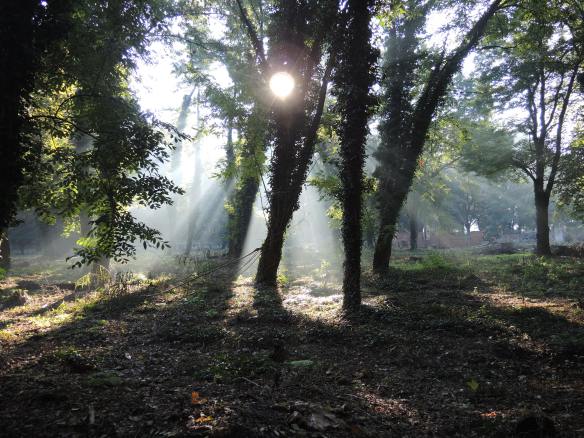
Jacob awoke from his sleep and said “Surely God is in this place and I, I did not know”. He has a sense of wonder, and he expresses it:  “How full of awe is this place. This is none other than the house of God, and this is the gate of heaven”

The phrase “Ma nora ha’makom ha’zeh, ein zeh ki im beit Elohim” (How full of awe is this place, this is none other than the house of God”) is part of the stonework on the exterior of the synagogue I   grew  up in, and as one walked in and looked up, that is the sentiment one felt – even though it is situated in what is now inner city Bradford, on a less than salubrious road.

The religious message I received as a child was bound up in this synagogue, in the community of people and in the building they worshipped in. It was a two-fold message- Firstly that we can encounter God wherever we are, for God is always ‘in this place’ as are we, and often we do not notice how close God can be to us.

Secondly it was made clear that awe is a necessary instinct;  God is beyond our comprehension or reason, and we must respect that reality. We have to live with not being able to control God or demand from God or expect to understand God.

When we pray, what are we really doing?

Abraham Joshua Heschel (1907-1972) was a scholar, theologian and social activist. He wrote “the predicament of prayer is twofold: not only do we not know how to pray, we do not know what to pray for.  We have lost the ability to be shocked.”

Heschel also suggested that we have overemphasized intellectual ideas when we think about religion, and that we also overemphasise religious belief; For Heschel religion is more like a way of being in the world, a way of facing life and dealing with it.

In Judaism, ‘Believing’ is not the most important thing for a religious Jew, but Awe, or the ability to be shocked is the fundamental requirement.  The bible talks of the religious person as one who is yirat Adonai, or yirat shamayim – in awe of God or in awe of heaven. Without a sense of awe, without the ability to be shocked or moved by what we see around us, we can never really move on to encounter God, or develop a sense of faith.

I have lost count of the number of times that I have been told in my rabbinate that someone doesn’t really believe in God;  the number of apologies that somehow come my way. I never quite know as a rabbi how to help people to believe in God if that is what they think they want, but what I am sure of is that the beginning of such a journey is Awe.

When Jacob first encounters God he notices how the place is filled with Awe, and he had not understood it. It takes time, and possibly even a certain vulnerability for us to open ourselves to noticing God.

Many of our services begin with the phrase “v’ani tefilati lecha Adonai eit ratzon” usually translated as “and as for me, let my prayer come before you God at a favourable time”, but it is more complex than that, meaning something more like and I am my prayer to you God at a favourable time”. We are in fact our own prayers – if only we would let ourselves be so. Rabbi Lionel Blue once wrote “Meeting God can be simple, but nothing can happen if we do not will it. If we seek God then God can be found. God will allow us to find God if we seek with all our will” (RSGB Machzor p 312)


One of the lessons from this sidra is how easy it is not to notice how close God can be to us if we do not choose to open ourselves to the possibility.  And we sometimes need help to do this. Beautiful places, whether natural or built by human beings, can help us catch the numinous. Too narrow a focus on what we are doing, our goals and aspirations, our desire not to look back – all can stop us being aware and in the moment.

The ability to be shocked, to notice and to understand the implications of what has become normalised – this is the skill we need to nurture. The ability to be moved by what we see and hear, rather than to blot it out or cover it with our own inner monologue. Jacob left his comfort zone when he left his home, and only then did he meet God. We may not need to leave our homes, but we too need to go out as he did – vayetzei – and begin to pay attention to all we have ignored.bradford interior


Sermon for Yom Kippur Shacharit: ki vayom hazeh – on this day

Ki vayom hazeh y’chaper aley’hem, le’taher et’chem; mikol hatotey’chem lifnei adonai tit’haru. (For on this day atonement will be made for you to cleanse you, of all your sins before God, you shall be cleansed”  (Lev 16:30)

On Yom Kippur, when the High Priest entered the inner Temple, dressed in special robes and breastplate, the priestly garments including the frontlets on his head, the vestments of fine white linen, he would repeat this biblical verse in each of the three confessions he made.  And the people would crowd around outside in the temple courtyard, listening hard, and when they heard the the glorious and awesome four letter name of God we write as yod hey vav hey, the name which would be uttered only by the High Priest, only within the Holy of Holies, only on Yom Kippur, only as part of the confession ritual, then they would bow down with their faces to the ground and respond with the blessing of God’s name. This annual ritual of confession and sacrifice was a dangerous one, surrounded by mystery, perfumed by the incense, veiled from the community.  Tension mounted as the confessions grew, as the animals were sacrificed and the hopes pinned upon them being favourably received reached some form of expression.

My sympathies have always been with the high priest, upon whose shoulders rested the burden of so much expectation.  The fate of the whole people seems to have been given over to this one man on this one day – so he had better get it right.   The ritual was complicated, the choreography of washing and changing clothes, of sacrifice and prayer awesomely elaborate,  the consequences of making a mistake unthinkable.  We don’t know much from either biblical sources or first temple texts, but by the time of the Second Temple the Day for Atonement was focussed on the actions and intentions of the High Priest, and the role of the people was to listen, to be awe-struck, and to hope that he got it right.

That was then, but since the Temple days Yom Kippur has developed a different set of rituals, and while we re-enact part of the Avodah, the temple service of Yom Kippur, during the mussaf service, experiencing just the echo of the thrilling gravity and overwhelming power of that ceremony, our own liturgy and imagery takes us to a different  religious place.  Yom Kippur is no longer the Day for Atonement for the people Israel, it is by far a more personal and individual experience for we children of modern times.  The High Priest has long gone, the sacrificial system consigned to a stage post in history that no longer speaks to us of religious action, and the corporate nature of the people Israel has been changed as we have become a different category altogether – Jews, and while we consistently create community we see ourselves in the main as individuals, individual Jews.

The structure of the ritual and the philosophical underpinnings of the day have undergone a radical transformation, and so, I would posit, has the meaning of what Yom haKippurim means to us.  While we still translate this obscure name using the invented composite word ‘at-one’, we have changed both meaning and purpose of the day for our own spiritual needs.  I would even go so far as to say that the day is not really about sin and atonement any more – how would we even define those terms today? – but that Yom Kippur for us is about something quite other –  Time. Yom Kippur is about our use of time, about our location in time – it is in particular a day for us to focus on our own mortality.

Interspersed in our machzor with the major themes of sin and repentance, of forgiveness and atonement, we hear the insistently repeated motif of life and death. We talk for example about the Book of Life, we read the Martyrology, we recite a service of Yizkor, our traditional clothing for this day is to wear shrouds and we are called to abstain from the physical  pleasures of living, eating, drinking or washing.  We take a day right out of time and act as if the world outside is irrelevant to us, as if we are, for the moment, temporarily dead.

What message do we take from the prayers and texts as we sit through Yom Kippur.  It is probably true that we examine our lives and find our behaviour wanting.  It is probably the case that we make our stumbling attempts towards recognising and harnessing our own spirituality, yearning as we do for a sense of meaning, for a firm belief in a greater being.  It may well be that we feel momentarily inspired to change some part of our lives, or that we experience the satisfying of a need for connectedness which tends to be submerged during the busy weeks of the rest of our lives.  As the day rolls on, the ancient formulae about sin and loss swirl around us, as do the equally ancient phrases about return and forgiveness.  We know that we are less than perfect and we look for ways to deal with both the knowledge and the reality.   But we cannot retreat into the Yom Kippur of the Temple period and leave the whole religious business to someone else.  The Yom Kippur of our time looks us in the face and says – you are mortal, you only have a limited time on this earth – and you do not even know how limited it may be – so what are you going to do about your life?

Yom Kippur is no longer a day simply of general and ritual atonement. It is a day for us to restructure our lives, to reconcile our realities with our requirements.  Loud and clear through the prayers comes the reminder – we are mortal, we, and those around us do not have all the time in the world, and so if there are things we want to do, we should be planning to do them now, if there are things we need to change, we should be arranging to change them now, if there are things we want to say, we should be saying them now.

Nothing is so precious as time, nothing is so consistently abused. We waste time, we kill time, we fill in time – rarely do we actually use time appropriately.  Yet our tradition has been able to transform a day of communal awe and professional ritual activity, and give it to us in a new form – personal time for us to spend reconciling and reconstructing the lives we are living with the lives we already know we could be living.

As a community rabbi I have sat and listened so many times to the laments which begin ‘if only’, I have witnessed the rapprochements which have sometimes come too late, I have heard the stories of fractured relationships which have entailed years of lost possibilities;  I have met broygas individuals (note for translater – people who have taken offence)  who are determined that the other person should make the first move towards reconciliation – sometimes about an argument the reason for which is lost in history.  We don’t tend to use the word ‘sin’ for such behaviours, but surely to fail to make or maintain relationships in this way is one of the biggest sins we currently commit.   We all live within the constraints of time, we all know what is truly important to do in that time, yet most if not all of us regularly fail to acknowledge that we should be making our priorities so that when the time runs out – be it our own time in this world or the time of a loved one – we have done what was important and responded appropriately, addressing the most meaningful issues of our lives rather than reacting to what is presented as the most urgent.

On the tenth of Tishri the bible tells us to come together as a holy assembly for Yom haKippurim.   It is clearly to be a day of repentance, of hard thinking, of reconciliation and reconstruction of relationship.  We are used to the imagery that reminds us that we are to reconcile and reconstruct our relationship with God, and parts of us are able to do so. And we manage it without the intermediary of the stylised actions of the high priest.  We sit and think and pray, hear the voices inside us as they speak of loss and pain, of comfort and of peace.

But today isn’t only about our working on our relationship with God, it is about using that work and the understanding brought about by such a relationship so that we make substantial changes to our relationships with others.  As Morris Adler wrote:

‘Our prayers are answered not when we are given what we ask, but when we are challenged to be what we can be’ .

Yom Kippur has been many things for we Jews during our history.  The most solemn day of our calendar it is described as ‘shabbat shabbaton’ – the Sabbath of Sabbaths.  There is a tradition that when God had finished creating the world, God created the Sabbath, and scripture tells us “uvayom hash’vee’ee shavat va’yinafash” (Exod. 31:16-17) And on the seventh day God stopped all work and restored his soul.  This word va’yinafash is a strange one – often translated as “God rested” it really means something to do with restoring the soul.  From it comes the idea that on Shabbat we are given an extra soul or measure of soul, with which we can discern and taste the world that is more usually hidden from us, we can experience something outside of normal sensation.  If we have an extra dimension of soul on Shabbat, how much more so on shabbat shabbaton – today, Yom haKippurim?  On shabbat we use it to experience a taste of the world to come, but today we can use it for something else entirely – we can use it to understand more about this world and our place within it.  The liturgy of today reminds us about time, about the fleeting nature of our life in this world, about the end which all of us will face.  Yom Kippur gives us the time and the space to consider our part in our world, gives us the extra measure of soul we need to really consider and construct our lives as we mean to live them.  We have about another seven hours today, and the real world will begin to crowd in once more and drown out the world of prayer and thought we have created.  We do not know how much time we will have after that.  So today let’s face the time and let’s spend it wisely, rather than profligately allowing it to run away.   Who knows how many tomorrows there will be?

“Ki vayom hazeh y’chaper aley’hem, le’taher et’chem; mikol hatotey’chem lifnei adonai tit’haru. (For on this day atonement will be made for you to cleanse you, of all your sins before the lord, you shall be cleansed” says our machzor, quoting the book of Leviticus.  There is no High Priest to do the cleansing, only ourselves and our dedication and our desire, and of course this very special and holy block of time – today.
Terumah: the Shechinah dwells amongst us but are we driving Her away?

There is no woman in parashat Terumah. Indeed there is barely any human presence at all as the bible instructs the people via Moses about the materials needed to build the tabernacle that will travel with them in the wilderness – the mishkan, and all its vessels and accoutrements.

There is no woman, but there is God, and it is this aspect of God that I would like to focus upon.

In Chapter 25 v8 we read

וְעָ֥שׂוּ לִ֖י מִקְדָּ֑שׁ וְשָֽׁכַנְתִּ֖י בְּתוֹכָֽם:

And they shall make me a mikdash/special place and I will dwell among them/in them.

The notion of God dwelling among/within the people of Israel is a powerful one, one that removes God from any ties to geography or history, but allows God to move freely wherever the people may be. And this idea of God is given a name, one not found in bible itself but found extensively in rabbinic literature post 70CE – Shechinah.

The Shechinah is an explicitly feminine aspect of God. Whereas many of our other names for God imply transcendence, a God-beyond us, the Shechinah dwells right here where we are. Talmud reminds us that “When ten gather for prayer, there the Shechinah rests” (Sanhedrin 39a, Berachot 6a). That “The Shechinah dwells over the head of the bed of the person who is ill” (Shabbat 12b).  It tells us that wherever we go, this aspect of God goes with us – “wherever they were exiled, the Shechinah went with them” (Meg 29a), and yet this aspect of God also remains in Israel waiting for our return “The Shechinah never departs from the Western Wall” (Ex.Rabbah 2:2)

The Shechinah is experienced by people engaged in study or prayer together, and by people who engage in mitzvot such as caring for the poor and giving tzedakah. It is said that She is the driver that caused prophets to prophesy, that enabled David to write his Psalms. She is the enabler of translating our feelings into words and actions, a conduit to relationship with the immanent God. She is associated with joy and with security. It is no accident She makes an appearance in the bedtime prayer for children – the four angels Michael, Gavriel, Uriel and Raphael invoked to protect the four directions, and the Shechinah to be at the head of the sleeping child.

The Shechinah is the constant presence, the nurturer of the Jewish soul. She is with us in times of joy and she is with us in times of suffering and pain. She connects Creation with Revelation – the universal with the particularly Jewish, the sacred with the mundane.

This week as I was mulling over the sacred feminine embodied in the Talmudic and mystical traditions, I joined in the prayer of the Women at the Wall for Rosh Chodesh Adar, albeit by ipad from thousands of miles away. I sang with them and followed the prayers as best I could, for there was a terrible cacophony picked up by the technology that sometimes threatened to overwhelm this joyful female prayer. Some in the men’s side of the area had turned their loudspeakers directly towards the praying women in order to drown out their song. Some in the women’s side (an artificially inflated crowd of seminary and high school girls bussed in for the morning by their institutions in order to prevent the Women of the Wall getting anywhere near the Wall itself) were blowing whistles loudly in the direction of the women – including the young batmitzvah – who were praying with grace and with joy.

The spectacle – for it was a spectacle – was painful in the extreme. Jews were determinedly drowning out the voices of other Jews in prayer and seemed to think that this was authentic religion, rather than a particularly vile form of sectarianism with little if any connection to any Jewish custom or law.

And it made me think of the Shechinah who never leaves that Western Wall, the remaining stones of the Temple. The Wall itself was built as part of the expansion of the area surrounding the second Temple in order to artificially create a larger flattened area for the sacred buildings above.

According to the Babylonian Talmud (Yoma 21b), the Second Temple lacked five things which had been in Solomon’s Temple, namely, the Ark, the cherubim, the sacred fire, the Shechinah and the Urim and Tummim.

It is easy to see that the Ark of the Covenant, the Cherubim, the sacred fire, the Priestly and mysterious Urim and Tummim were lost by the time of the second Temple – they were artefacts which could disappear. But the Shechinah – that fascinates me. The redactor of Talmud, clearly anxious about the statement, continues the narrative by saying that they were not gone, just less present than before.

It is clear to me that the artefacts are gone and lost to history, replaced by our system of prayer and study. But I wonder so about the Shechinah in the light of the events that are now almost normal at the base of the remaining Western Wall.  For while the midrash may tell us that the Shechinah is there, waiting for us to return from our exile; While it may say that She is waiting to be among us, to welcome us, never departing from the Western Wall, waiting to connect us to our deepest selves, to link us to a God of comfort and compassion – if she was, she must have had her head in her hands and been close to despair at what She saw.

When people pray and study together, when they enact law to help the society, when they are sick and frightened and when they are doing mitzvot that bring joy and comfort, there the Shechinah will be. But when they abuse their power, ignore the other, hold only disdain and triumphalism as their values, it is no wonder that the Shechinah finds it hard to hang around. She wasn’t there in the Second Temple, rife as it was with political machinations and abuses of power. And I only caught a glimpse of her yesterday at Rosh Chodesh Adar when so many Jews were at the Wall, but so few were there to pray from the depths of their hearts in joy. I saw her flee from the shrieking women and men determined to drown out prayer. I saw her flee from the passivity of a police force refusing to intervene to protect those who needed their help.

But I saw her in the faces of the group of women celebrating a bat mitzvah together in song and dedication, in the sounds of a young girl reading Torah with grace and mature sensitivity.

Hundreds of yeshiva, seminary students disrupt Women of the Wall service

Ha’azinu – what might we say and write when we confront our own mortality?

Moses knows he is going to die.  Not in the way we all ‘know’ we are going to die, the coldly logical knowledge that doesn’t impact on our emotions in any way, but in the way that some people who are very close to death know with a certainty that no longer expresses itself as fear or self-pity but with a clarity and sense of purpose.

I have sat at many deathbeds. I have seen denial and also acceptance, whimpering pain and alert peacefulness, sudden startling requests – for toast, for touch, for people long gone, for non-existent sounds or lights to be turned off or up.  What I have learned is that we none of us know how we shall die, how our last days and hours will be, but that at many, if not most of the deathbeds I have observed where there is some time for the process to be worked through, there is an opportunity to express what is most important to the dying person, to project themselves one last time into the world.

It is human to want to survive. Life wants to continue despite pain or confusion or fear. Even when a person seems prepared and ready for death there is often a moment where there is a struggle to continue in this world. Even Hezekiah who famously “turned his face to the wall” having been told that he must set his house in order for he would die and not live, then prays to remind God that he has done God’s will with his whole heart, and weeps sorely.   His prayer (found in Isaiah 38) resonates today “In the noontide of my days I shall go to the gates of the nether world, I am deprived of the residue of my years…. O God, by these things we live, and altogether therein is the life of my spirit; so recover Thou me, and make me to live.”

It doesn’t matter at what age we come to death – we want more life, we want to go on in some meaningful way, we want to be part of the future.

We all know we will die. We share death with all who have ever lived and all who will ever be. We may fear the how or the when, but generally we get on with life as if death is not real. And we don’t plan for how we might continue to be a part of the future, for how our life may make a difference for our having lived it, or for how or what might be remembered of our existence.

Yet sometimes we are forced to confront our own mortality. And when that happens, these questions demand to be asked.

The whole period of the Days of Awe which are now coming to a close forces us to acknowledge our own transience in this world.  Be it the wearing of the kittel we shall don for the grave, the taking out of a whole day from time to focus on how we are living our lives in order to reset and readjust our behaviours, or the saying of yizkor prayers and visiting the graves of our families. Be it the autumnal edge we feel as we shiver in the sukkah, or the browning and falling of the leaves, or the daylight hours shortening perceptibly – we are viscerally aware of the darkness that is coming, the lessening outer energy alongside the power of the interior life.

Sometimes this knowledge that we will inevitably cease to be in this world brings out a search for meaning, for a sense of self that will transcend the physicality of our existence. Sometimes we become engrossed in our own personal wants and needs, sometimes we look further outwards towards our family and our relationships, sometimes we gaze further out towards our community or we look further in time to see what will be after we have gone.  I think often of the story of Moses in the yeshiva of Akiva (BT Menachot 29b), comforted by seeing that Rabbi Akiva is citing him as the source of the teaching being given, even though he does not understand anything of the  setting that is 1500 years after his own life.  It is a story of not being forgotten, of projecting values down the generations. Talmud also tells us that R. Yochanan said that when a teaching is transmitted with the name of its author, then the lips of that sage “move in the grave” (BT Sanhedrin 90b.  Rabbinic Judaism gives great honour to the idea that we live on in the teachings we offered, but also in the memories of those who choose to remember us. It is commonplace in the Jewish world to be named for a dead relative in order to honour their memory, to tell stories about them long after the hearers (or even the tellers) have a first-hand memory of the person, to fast on the day of their yahrzeit (anniversary of their death) as well as to light a 24 hour candle and to say the kaddish prayer.

So it is time for us to give serious thought about how we project ourselves into the future, what we pass on in terms of life lessons, the stories people will tell about us, how they will remember us, how they will carry on the values that we have cared about enough for them to see and for them to choose too.

All rabbis have stories of sitting with the dying as these desires clarify. One colleague has I think the ultimate cautionary tale of being asked to come out to a deathbed of a woman he barely knew, a long way out from where he lived, in terrible weather, and sent in the form of a demand. Deciding that he must go but unsure of what was wanted, he collected together a number of different prayer books to be able to offer her the spiritual succour she wanted. Her final wish was that her daughter in law would not inherit her fur coat. She was taking her feud past the grave.  I remember the woman who sat in bed in her hospice writing letters to everyone in her life, beautiful letters – but she refused to actually see any of the people she was writing to. I remember the people who made great efforts to right wrongs and those who tried to comfort the people left behind. I think with love of the woman who sent an audio file with her message that she had had a wonderful life with the right man and they were not to grieve, even though her death seemed unfairly early. I think of the woman who, having lost her fiancé in the war, proudly told me she was going back to her maker virgo intacta, and the woman who told me of her abortion while she was hiding in Nazi Germany, and her belief that the child had visited her alongside its father who died some years later.

Many a personal secret has been recounted at a deathbed, but often having been released from the power of that secret if there is time, the soul continues its journey in this world, and suddenly all sorts of things come into perspective. And it is these stories that I remember with such love and that have had such great impact on me.  The stories that people had hidden from their nearest and dearest but which explain so much of who they are and why they have done what they did. Their belief that they were not loved enough which led to them thinking they were not able to love as much as they wanted. Their umbilical connection to Judaism that they had not lived out publicly for fear of what might happen to them or their children should anti-Semitism return as virulently as they remembered in their youth.  Their subsequent horror that children and grandchildren were not connected to their Jewish roots, and their guilt at having weakened this chain. There are multiple examples but what I see again and again is the need for good relationships with others, for human connection with others , for expressing warmth and love and vulnerability, the need for living according to clear and thoughtful moral values, and for a sense of deep identity that passes from generation to generation and connects us to the other in time.

Moses in sidra Haazinu is just like any other human being, wanting his life not to be wasted but to be remembered, wanting his stories and his values to be evoked in order to pass on what is important to the generations that will come after him, however they may use them.  He needs to be present in their lives, albeit not in a physical way.  The whole of the book of Deuteronomy has been his way of reminding, of chivvying, of recalling and reimagining the history he has shared with the people of Israel. He uses both carrot and stick, he uses prose and poetry, he is both resigned and deeply angry, he is human.

There is a biblical tradition of the deathbed blessing, a blessing which describes not only what is but also what is aspirational.  Rooted in that has come the idea of the ethical will to pass on ideas, stories and thoughts to the next generation of one’s family, a tradition that has found a home also in reminiscence literature.  Sometimes we find out much more about the person who has died from their letters and diaries than they ever expressed  in life – and often we mourn that it is now too late to ask the questions that emerge from these, or to apologise or explain ourselves.

As the days grow shorter and we have spent time mulling over how we are living our lives and trying to match them to how we want our lives to have looked once we see them from the far end, we could take a leaf out of Moses’ life’s work in Deuteronomy and write our own life story, not just the facts but the stories around them, how we understood them, what we learned.  Next year we might write it differently, but what a rich choice lies in front of us, to explore what is really important to us and to ensure that it, like us, will live on.

Ki Tavo: creating our own narrative by our own actions. What we do becomes what we are.

“When you enter the land that the Eternal your God is giving you as a heritage, and you possess it and settle in it, you shall take some of every first fruit of the soil, …, put it in a basket and go to the place where the Eternal your God will choose… You shall go to the priest in charge at that time and say to him; “I acknowledge this day before the Eternal your God that I have entered the land that the Eternal swore to our ancestors to assign us.” …. “My father was a fugitive Aramean. He went down to Egypt with meagre numbers and sojourned there; but there he became a great and very populous nation. The Egyptians dealt harshly with us and oppressed us; they imposed heavy labour upon us. We cried to the Eternal, the God of our ancestors, and the Eternal heard our plea and saw our plight, our misery, and our oppression. The Eternal freed us from Egypt by a mighty hand, by an outstretched arm and awesome power, and by signs and portents, bringing us to this place and giving us this land, a land flowing with milk and honey. So I now bring the first fruits of the soil which You, Eternal One, have given me.” ….. And you shall rejoice in all the good which the Eternal your God has given to you, and to your house, you, and the Levite, and the stranger that is in the midst of you. (Deut 26:1–3, 5-10, 26:11)

The commandment at the beginning of the sidra is familiar to us, reminding us to tell our story in such a way that we do not just focus on harvest, or on our good fortune, nor even to tell it while recognising that our good fortune is not simply the result of our own effort, but to create a narrative that puts our experience into the context of the historical experience of the Jewish people.

Telling our story is how all of us make sense of our lives. Each of us has a narrative running through our consciousness, each of us notices most easily what fits into that narrative, manages to ignore that which cannot be meshed into the story.  The theme of these days of preparation for Rosh Hashanah – that of opening and reading to book of our lives, emerges in part from the awareness of the stories we construct about our everyday experience.  But while each of us may be the centre of our own continuous narrative, Jewish teaching does not allow us to become self-absorbed. Instead we are expected to see ourselves as part of a whole that is greater than ourselves. We are part of a people. We live beyond this moment – we live in the span of the whole experience of our people.  And the way we express ourselves religiously is woven into our internal and external narrative. We have to become aware not only of the immanent God with whom we can create some form of relationship of “I – Thou”; The God we worship is the God of history, the God who has no limits of time or space. Ever since we accepted Torah, Jews have been taught to see God at work in the world around us, in the historical experience of our people, and in the humanity of others.

Each of us, like the Israelite farmer bringing his first fruits, is required to tell a story, to render an account – before God and to our innermost selves, of who and what we are – a narrative that explains just what it is that spurs us on to action in this world. In telling his story, that farmer was commanded to look beyond his immediate reality to a vision of what his life was to be about. So, we too, are asked, when telling our story, not to ignore the “real world” but to transcend it, to direct our attention away from the concrete trivialities of our material existence and toward those goals, however exalted and “unrealistic,” that God would have us set for our lives.

The liturgical formula that is preserved in the verses at the beginning of ki tavo is a rare example of the prayer life of ancient Israel.  We use it in a number of settings – from the Pesach Haggadah to the liturgy of bikkurim, and its familiarity speaks to us and reminds us that the story of the redemption from slavery which led to the covenant at Sinai is a foundational one for us as Jews. Without it our stories are in danger of sentimentality. But it isn’t just the words that teach us.  We are moved from words to actions. The ritual begins with our declaration to proclaim our understanding and our faith. Then we go beyond the declaration into action – the tachlis.  Having acknowledged the Source of our blessing – God – and told the story of our own historical vulnerability, remembering our impotence and pain, we go on to do something intensely practical – to share the offering with the Levite/ priest and the ger–“the sojourner/stranger that is in your midst.” (Deuteronomy 26:11)

The ger, (Sojourner/stranger) is almost a synonym for the idea of the vulnerable, the one who does not have land or resource, the one without the support of family or landsmen, the person who is quintessentially alone. Today the closest equivalent is likely to be the refugee or the asylum seeker, washed up without possessions in a foreign environment. Torah requires us not only to acknowledge our own good fortune, but to behave directly out of that acknowledging, to routinely share with those who do not have the same good fortune as us.  The act of thanksgiving commanded at the beginning of the sidra leads us to act even before thinking about the action, getting us to do a good thing, to perform a mitzvah, that will shape our understanding of the world, that will shape us.  The requirement to care for the vulnerable enters into the narrative we live by each day, we cannot disregard it.  It is no surprise therefore that tradition teaches that “In the future age, all sacrifices and prayers will be abolished, except that of thanksgiving”. (Menachem of Gallia, in Vayikra Rabbah 9:7).

In this month of Elul as we approach the High Holy Days and we think about what we have done and what we have not done, what we should do and what we fear we will never do, it is important to remember that these days are the white fast, they are days of Awe but they are also days of thanksgiving for all we have, for knowing that God will not desert us, that God will let us find our way if we search. They remind us that we should not forget our past nor think only of our present. They remind us that we have to find the words to tell the story that is true for us, that gives meaning and shape to our lives. And even before we really understand, we have to act.


Balak: the curse of being a people who dwell alone

Balaam, the seer and professional prophet from Aram who is commissioned by Balak the king of Moab to curse the Israelites travelling through the land, says to Balak :- “[you told me] ‘come, curse me Jacob and come, defy Israel’  How shall I curse whom God has not cursed? Or how shall I disturb whom the Eternal has not disturbed?”

And then he tells him this: “For from the top of the rocks I see them, and from the hills I observe them. Behold, a people who will live alone, and with the nations they will not be reckoned”

כִּֽי־מֵרֹ֤אשׁ צֻרִים֙ אֶרְאֶ֔נּוּ וּמִגְּבָע֖וֹת אֲשׁוּרֶ֑נּוּ הֶן־עָם֙ לְבָדָ֣ד יִשְׁכֹּ֔ן וּבַגּוֹיִ֖ם לֹ֥א יִתְחַשָּֽׁב

Balaam is a seer, he is a powerful soothsayer who has a real connection with God, but none whatsoever with the people of Israel. When he sees them all his plans to curse are in disarray, he cannot curse the people protected by God, and while he continues to try to fulfil the contract as best he can he is limited in this case and he knows it. Yet he tries to offer curses – or at least ambiguous spells, and this story culminates in the verse which we have appropriated for well over a thousand years to help us into the mood for prayer:          מַה־טֹּ֥בוּ אֹֽהָלֶ֖יךָ יַֽעֲקֹ֑ב מִשְׁכְּנֹתֶ֖יךָ יִשְׂרָאֵֽל:

“How good are your tents O Jacob, your dwelling places O Israel”

It is a comic tale despite the horror of a powerful person hoping to destroy the vulnerable people of Israel while they are going about their business quite unknowing of the hatred and bile directed towards them. The comedy is underlined by our liturgical use of the final declaration. But this year one of the earlier “blessings/curses” caught my eye.  “Behold a people who will live alone, who will not be reckoned with the nations”

Tradition tells us that this is transformed into a blessing, that alone of all the nations of history, the Jews continue, uniquely indestructible, forever distinct and separate from the peoples among whom we live. This thread of Jewish peoplehood, surviving without the structures that normally support identity, moving geographically across a huge diaspora, moving through time and evolving time and again to create and accept new ritual and liturgical structures, accommodating to different cultures and political environments, living alongside other religious traditions – it is indeed unique.  Empires came and went, those of Babylon, Persia, Greece and Rome were powerful entities under which the Jews lived and often suffered, and still the Jews continue while the artefacts of the great Empires can be found in museums.

But this interpretation so beloved of the medieval commentators living under oppressive authorities and fearful of the crusading powers sweeping through Europe to the Holy Land, reads less comfortingly in modern times.

A people who will dwell alone, who will not be reckoned/counted/aligned with the other nations sounds scarily like a nationalism out of control, assuming an arrogance and an identity that does not relate to other peoples.  As I have been reading the remarks of some who voted for the UK to leave our relationship with Europe I see statements such as “I have my country back”, and “we can send the foreigners home” and “England for the English”. I see the demagoguery of UKIP, the racism that was unacceptable in British society suddenly surfacing as people feel permission to “dwell alone”. Words like ‘sovereignty’ and ‘independence’ dominate the discourse, turning the narrative into one of narrow chauvinism, bigotry and nationalism and xenophobia which appear to be segueing smoothly from the earlier arguments of more local agency and greater political autonomy.

I am chilled by the increased nationalism and jingoism I see not only in present day post referendum United Kingdom but also in other countries in Europe and in the USA. Patriotism has become a cloak for hatred of the other. Brown skinned people are being abused on public transport and told to “go home” – even though home is here, even though this island has always had many races and cultures – Angles and Saxons and Normans and Danes and Celts and  Germanic tribes and …..

I am chilled by the idea that being a people who are alone can possibly ever be a blessing, but in particular now when we live in an interconnected and interdependent world, when we can see the suffering of others at the touch of a computer or television, and we can help alleviate that suffering just as quickly and easily.  We learn from each other, we enrich each other both culturally and intellectually, we offer each other relationship while retaining the individuality we need for a real relationship to exist. As Martin Buber wrote a person (“I”) has meaning only in relation to others, what he called “I-Thou dialogue” – the same is true for peoples, for ethnicities and national identities. To separate oneself off and deny our interdependence, instead proclaiming the holy grail of absolute and total independence, is dangerous for every person, for every society, for every nation state.

The first time we have the phrase of being B.D.D. alone, comes in Genesis (2:18) Where God, having made the first human being says

וַיֹּ֨אמֶר֙ יְהוָֹ֣ה אֱלֹהִ֔ים לֹא־ט֛וֹב הֱי֥וֹת הָֽאָדָ֖ם לְבַדּ֑וֹ אֶֽעֱשֶׂה־לּ֥וֹ עֵ֖זֶר כְּנֶגְדּֽוֹ:

It is not good for the human to be alone, I will make for him a support who is equal and different to him.

We all need others, people who are different, who have equal strength of opinion and independence, who challenge us and support us and are in relationship with us.  The saddest phrase in bible is probably the one at the beginning of the book of Lamentations, read after the commemoration of the calamity of the destruction of Jerusalem:

אֵיכָ֣ה ׀ יָשְׁבָ֣ה בָדָ֗ד הָעִיר֙ רַבָּ֣תִי עָ֔ם הָיְתָ֖ה כְּאַלְמָנָ֑ה רַבָּ֣תִי בַגּוֹיִ֗ם שָׂרָ֨תִי֙ בַּמְּדִינ֔וֹת הָיְתָ֖ה לָמַֽס:

How does the city sit solitary, that was full of people. How is she become as a widow. She that was great among the nations, and princess among the provinces, how is she become tributary!

We are already in the month of Tammuz – this weekend will see the 9th Tammuz, the date when the walls of Jerusalem were breached by King Nebuchadnezzar in 586 BCE and the temple sacrifices were discontinued, and next week we will commemorate the 17th Tammuz, the date when the walls of Jerusalem were breached by the Roman army in 70CE leading to the removal of the Jewish people from their ancestral land. We may as a people have survived these historical catastrophes but the question is – have we learned from them? We need no longer fear being forcibly assimilated into a dominant power (or worse), the ‘blessing’ of being a people apart may now be less of a blessing if it blinkers us to the importance of our relationships with others.

As John Donne wrote in his meditation “

No man is an island, entire of itself; every man is a piece of the continent, a part of the main; if a clod be washed away by the sea, Europe is the less, as well as if a promontory were, as well as if a manor of thy friend’s or of thine own were;  any man’s death diminishes me, because I am involved in mankind, and therefore never send to know for whom the bell tolls; it tolls for thee.”

We should listen out for the bell tolling out its warning and push for relationship and the recognition of the reality of our interdependence with others. Or Balak’s ‘blessing’ may yet prove to be our curse.

Shelach Lecha: nudged along the path to beyond ourselves

“And the ETERNAL spoke to Moses, saying:  ‘Speak to the children of Israel, and bid them that they make them throughout their generations fringes in the corners of their garments, and that they put with the fringe of each corner a thread of blue.  And it shall be to you for a fringe, that ye may look upon it, and remember all the commandments of the ETERNAL, and do them; and that ye go not about after your own heart and your own eyes, after which ye use to go astray;  that ye may remember and do all My commandments, and be holy to your God.   I am the ETERNAL your God, who brought you out of the land of Egypt, to be your God: I am the ETERNAL your God.”

It is, maybe, one of the earliest educational strategies – a visual aid to constantly remind one of something important, to teach a constant and immediate awareness of God and of the covenant relationship we have whose conditions – mitzvot – inform every aspect of our lives.

The thread of colour commanded in the mitzvah of tzitzit has long since gone in most ritual garments, since we cannot be sure exactly how to make the dye to create this tekhelet, the blue colour (although in recent years it has made a partial return as some think they have cracked the identity of the chilazon, source of the most expensive colour dye of the ancient world). But the fringes remain – though for most Jews not on their everyday garments, but on the shawls we wear, the tallitot, when we want to make space in our life for prayer.

The idea of the fringes on our clothing is that we will always have with us a reminder of God and of the commandments that we are obliged to fulfil – indeed the fringes are knotted in a particular way to remind us of the number 613, to echo the idea that there are 613 commandments said to be in Torah, so that every time we see them we will remember the covenant and our part in it.  Judaism is a religion of the every day, it is through ordinary mundane quotidian activities that we create the Jewish people, develop Jewish identity.  The fringes on the corners of the garments, the tzitzit, were designed to reinforce this. Whatever we see, whatever we do, there is a Jewish edge to the action, a perspective of obligation and commandment. We are reminded always of the foundation of who we are – we are a covenanted people whose life and behaviour is shaped by the encounter at Sinai, when we agreed to a relationship with God that was to be expressed in how we act in the world.

In the Talmud in a discussion on tzitzit, and on the tekhelet colour mandated in bible, we are told that: “Rabbi Meir used to say: How is tekhelet different from all other colours?  Because tekhelet is like the sea, and the sea is like the sky, and the sky is like [God’s] throne of glory as it says: “Under God’s feet was the likeness of sapphire brickwork, and it was like the essence of heaven in purity.” (Shemot 24:10)  (Menachot 43b). 

It is a curious teaching. For Rabbi Meir is linking the reminder of the tzitzit not only to the commandments, but also to a sense of God. And he does so by inserting stages of a journey so to speak – He doesn’t talk about tekhelet only as colour, but as the colour first of the sea and then of the sky, and only then of the hidden place of God. He seems to want us not just to associate the colour with God, but to think about the connections between us and God – the sea is a place we can reach and touch, a huge swathe of our world, but ultimately finite. The sky though is untouchable for us, and apparently infinite, and only then do we move on to the “throne of glory” – the exaltedness of God. By making us work, stage by stage, Rabbi Meir is teaching us that we can reach up beyond ourselves to gain some sense of connection – not making a comment on the colour of the universe, or a simple mechanistic connection between the colour on the tallit and the strange description of the sapphire pavement found in the book of Exodus. By making us think, by moving us from the tangible and visible, to the intangible visible, to the invisible infinite, we are being taken on a process and a progression that allows us to think beyond ourselves, beyond even what we can normally imagine.

There is in our tradition another version of this statement of Rabbi Meir’s, which makes the idea of progression even clearer. In Midrash Tehillim we read that the tekhelet “resembles the sea and the sea is like the grasses, and the grasses are like the trees, and the trees are like the firmament, and the firmament is like the radiance, and the radiance is like the rainbow, and the rainbow is like the [divine] image” (90:18).

I like this version because it causes us to not only reach beyond ourselves and our world, but to do so slowly, taking our time, looking from sea level to ground level to tree level to sky and beyond. And in this account there is a punch line:  “Rabbi Hezekiah taught: When the children of Israel are wrapped in their prayer shawls, let them not think that they are clothed merely in ordinary blue. Rather, let the children of Israel look upon their prayer shawls as though the glory of the Presence were covering them.” (Midrash Tehillim 90:18).

When we look at the fringes of the tallit, and we remember the original instruction here in parashat Shelach Lecha, we begin to understand the powerful effect of that colour of tekhelet (which has, incidentally remained with us in a sort of echo form in the variant colours of the stripes of the tallit which can range from almost black to a turquoise-ey sky blue, as can the dye from the chilazon, dependent on the age of the mollusc), and which has progressed from the tallit to the flag of Israel.  By using the thread of tekhelet – and then by using a reminder of the thread and the colour and what it makes us think about– we are bridging a gap between our world and the heavens, between ourselves and God. The radiance we are encouraged to think towards becomes like a rainbow – the perpetual sign between God and us that we are under divine protection – takes us to an almost magical link between the worlds.

When we put on our tallit for prayer and wrap ourselves in the fringes we are, so to speak, putting on the seatbelts, checking the mirrors – readying ourselves for a journey towards God. We are land animals, made of earth, adamah – which root is the origin of the word for the colour red – edom. We are physical beings made from the stuff of our ground says the bible, yet our souls yearn for more – the look to connect to more than the material physical world of now. The tekhelet prescribed in our tradition is a recognition of that yearning, and the offer of a way towards what we want – we can look through the natural world around us and from studying it and appreciating it, we can find a way to the creator of all that we see.

This is how Jewish tradition shapes us and forms us – it takes the everyday and makes us notice more. We are asked not to skim through our lives but to examine them, to consider what we are doing, to aspire for more.  It expects mindfulness and it gives us methods and tools for us to achieve this. But on the way to mindfulness it gives us a more pragmatic approach – the commandments are sets of behaviour that will shape us without us even thinking about it – in effect if we behave like a mensch even without thinking about the ethical imperatives or the spiritual growth, but just because that is what is expected from us, we can live our lives and look back and realise we have become a mensch.  The spiritual journey does not have to be too self reflective, we are nudged along the path with reminders to do, to be, to act – and so, in time, to understand and to become.

Shavuot: the voice of God is heard in the voices of ALL the people. (Or women were at Sinai too, and at the kotel)

In a very few days we will be celebrating Shavuot, a festival of biblical origin which can lay claim to being  one of the most mysterious of our holy days. To begin with, it has no fixed date but instead we have to count towards it from the first day of the Omer, the bringing of a sheaf of the new barley harvest which must be offered in thanksgiving before the harvest can be used. In Leviticus 23 we read “And the Eternal said to Moses, Speak to the Children of Israel and tell them, ‘When you are come into the land which I am giving you, and you reap its harvest, then you will bring the first omer of your harvest to the priest, and he will wave the omer before the Eternal for you to be accepted, on the morrow after the Sabbath, the priest will wave it…and you will not eat bread nor parched corn nor fresh corn until this day, until you have brought the offering of God, it is a statute forever…and you will count from the morrow after the Sabbath from the day that you brought the omer of waving, seven weeks shall be complete, until the morning after the seventh week you shall count fifty days, and you shall present a new meal offering to the Eternal” (9-16)

In this opaque text a few things stand out: That we must bring from the new harvest in thanksgiving to the Creator of all before we can eat from it. That we must count a period of fifty days from the bringing of one harvest (barley) till the next harvest (wheat), and that the fiftieth day is also to be a festival with full ritual panoply.

It is a feast of harvest, a festival of first fruits – but so are other festivals. It feels like there is something missing in the text, some other layer that was either so well known as to be pointless to explain, or something so deeply mysterious as to be impossible to explain.  Its name is also problematic – in the same chapter we are told of the festival of matza called Pesach and of the festival of booths called Succot but Shavuot – it just means weeks.

The lacunae were noticed very early on and if nature abhors a vacuum, rabbinic tradition refuses to allow one too, rushing to fill any apparent jump or void in text with explanation and midrash. So to begin – what is the date of Shavuot? Should it always be a Sunday, as it would be if we really counted seven weeks from the ‘morrow after the shabbat’    הַשַּׁבָּת  מִמָּחֳרַת

The Second Temple period was one of great disruption and great creativity. Two powerful groups – the Pharisees (forerunners of the Rabbinic tradition) and the Sadducees (political and priestly elite) differed as to the date of Shavuot. The Sadducees read the text literally – the counting began the day after the Shabbat, while the Pharisees interpreted it, specifically that the word “Sabbath” was a word meaning not just the seventh day, but also “festival”, specifically in is case the festival just described before the text quoted, and therefore the omer counting would begin the day after the first day of Pesach.  At a stroke Shavuot was linked to Pesach and with a little creative accounting with the days of the journey towards Mt Sinai the Rabbis could attach the events at Sinai, the giving of the Ten Commandments and the creation of peoplehood with Torah as its powerful identifier to this date. So Exodus linked to Revelation, Freedom to Responsibility, and Shavuot stopped being simply an agricultural festival on a date that could vary and became a fixed point – a high point – in our journey to Judaism.  Shavuot became zeman matan torahteinu – the time of the giving of our Torah – the oral as well as the written – and more than that became the date of the unbreakable covenant made between God and the Jewish people.

So by extension, Shavuot became understood to be the date that we became not just a people, but God’s people. God descended far enough from the heavens to build a different kind of relationship with us, offered us a gift in order to delineate that relationship. And the language of marriage came into play – God wooed us in the desert and brought us to Sinai where the ‘wedding’ took place. God plays the part of the groom, Israel of the bride, and the words of Hosea are used “I will betroth you to me for ever, I will betroth you in righteousness and justice, In love and compassion, I will betroth you in faithfulness and you will know the Eternal (Hosea 2:2.1-2.). The mystical tradition went so far as to create a wedding liturgy within the Shavuot service, and famously Israel Najara, the poet and mystic of Sfat, created a ketubah to be read before the Torah reading in which God as bridegroom and Israel as bride are symbolically betrothed.

Some texts see the marriage as between God (groom) and Israel (bride) with the Torah as the binding contract; others see it as between Israel as groom and Torah as bride, with God as witness and the Oral Torah with Shabbat as dowry. Whichever role the participants took, the imagery of the marriage relationship is one of the most potent of the festival, and it points to the power that the rabbinic tradition saw in the marriage relationship.

The people of Israel as the bride of God, the covenant of marriage being marked with Torah, with Shabbat, with gifts that bring us closer to God – it is extraordinary in so many ways.  The position of the woman in this image – that she is Israel, that Israel is fundamentally feminine, and that the relationship is one of real love and partnership between both parties to the agreement -this is the ideal of marriage. Right from the creation stories in Genesis, where God created men and women at the same time, or where God created woman to be ezer k’negdo, a partner and help who was equal and in dynamic tension to the man, the relationship of marriage between two companions in bible and in the early rabbinic world was real partnership and both parties had their own agency and autonomy which contributed to a strong and confident enterprise.

Quite how we got to the position today from this ideal and idealised partnership to women being marginalised and disempowered in many areas of ‘traditional’ Judaism is a long and painful journey.  How has Israel, the bride of God, relegated its own women to behind a mechitza, distanced us from prayer and from learning, spun stories of idealisation that turn the Shavuot ideas on their head, (for example those about the special spirituality of women which means they don’t need to perform mitzvot). Over time there has been a persistent and incremental and continuing removal of women from the discourse of partnership, from the public space and from the partnership which is developed and rooted in the Shavuot mythology of the marriage between God and Israel.  At Sinai the mountain trembled and the people trembled and all the people stood together at the foot of the mountain and all the people answered together saying “everything that God has spoken we will do” as the voice of the shofar was heard and God answered Moses with a voice.  Voices mingling and speaking and answering – God’s voice, Moses’ voice, the voice of all the people, the voice of the shofar. But now it seems that some voices have precedence and other voices must be stilled. After generations of lying fallow and unused in Talmud the dictum of kol isha has surfaced in rabbinic thinking as a prop to their wish to remove women’s voices from their hearing.

Yesterday on Rosh Chodesh Sivan, the women of the wall (WOW)  in Jerusalem held their service for the new month early in the morning. 80 women and more prayed together from their hearts, welcoming the new month and the upcoming festival where Torah was given to ALL the people at Sinai. The prayer was respectful and peaceful and yet – Lesley Sachs, the Director of WOW was detained with the Torah scroll immediately following RH Sivan prayers. Despite a quiet prayer, Sachs was held by police for “disturbing the public order”.  The man who oversees the administration of the wall Rabbi Rabinowitz told journalists that she had smuggled the Torah scroll in under her skirt. An extraordinarily offensive accusation that was provably untrue – she was wearing trousers. But this insight into the mind of the ‘traditional’ rabbi tells us a lot as to why women’s voices are being silenced – what exists under a woman’s skirt is somehow terrifying, our sexuality must be controlled and restrained, a woman’s voice is her nakedness/lewdness in the minds of those who distort the biblical quotation (from a woman’s voice is her sweetness)

We are approaching the anniversary of what happened at Sinai when ALL the people witnessed the divine theophany and ALL the people accepted Torah.  This Shavuot it is even more important that we make sure that ALL the voices can be heard in our public spaces and places, in teaching and learning, in work and in play.  For if God chose to do to Israel what some in Israel choose to do to women, then the marriage must surely be voided on grounds of complete deviation from the agreement.  The countdown is nearly over, the last days of the omer are here. It has been a period of reflection and quietness, readying ourselves for the revelation. Let’s hope the revelation takes us back to our roots, and that the voice of women in prayer and learning will once again be heard with the voice of men doing the same.

This slideshow requires JavaScript.

Va’era: Does God hear prayer? Does God appear to us when we pray?

When God speaks to Moses at the beginning of the sidra, God says to him “And moreover I have heard the groaning of the children of Israel, whom the Egyptians keep in bondage; and I have remembered My covenant (6:5)

 וְגַ֣ם אֲנִ֣י שָׁמַ֗עְתִּי אֶֽת־נַֽאֲקַת֙ בְּנֵ֣י יִשְׂרָאֵ֔ל אֲשֶׁ֥ר מִצְרַ֖יִם מַֽעֲבִדִ֣ים אֹתָ֑ם וָֽאֶזְכֹּ֖ר אֶת־בְּרִיתִֽי:

In Bible, God hears prayer and frequently is recorded responding to the request. Be it Isaac’s prayer for a child for Rebecca (Genesis 25:21) or Jacob asking for deliverance from the avenging Esau (Gen 32:12), be it Moses and Aaron asking for the healing of Miriam’s skin disease (Numbers 12:13) or the desperate request for a child from Hannah. Be it David asking for God’s blessing and support (2Sam 7:18ff) or Solomon asking for wisdom (1 Kings 3:5ff) It seems that people prayed for what they wanted or needed and God reacted.

Jewish traditional texts assume that prayer comes from the heart and finds its way to a divine hearing. Later in rabbinic Judaism, prayer was more formalised, the wording more fixed (or at least the themes of the prayers, their introductions and endings were organised and prescribed) and while there was room for spontaneous prayer there was also a structure of community prayer, with the underlying assumption that the prayers of a community together would somehow strengthen the power of the words, that God would more readily listen to the combined communal prayer. Hence the minyan, the minimum of ten people for some prayers to be recited, and the extraordinary effect it has of creating community and awareness of the needs of others. Jewish tradition teaches that our communal prayer reminds us not just to think of ourselves, that our prayer must be broader, and when we pray in the right way, with our hearts and minds fully engaged and within the community of our peers, that God will hear our prayer.

But this all begs the question – does God hear all prayer? And if so does our prayer make a difference to the outcomes we seek? What does it mean for God to hear our prayer? And what does it mean if it appears that God does not hear us, or at least does not give us what we want?

The Hebrew verb le’hitapallel, from which the word for prayer –tefillah – comes, means in essence to work on oneself and to judge oneself. So the language of prayer is reflexive, we do something to or for ourselves in prayer, albeit in the gaze of the divine. Prayer is not so much for God as it is for us. In one form, alluded to in the English form of the word, prayer, it is indeed about asking for something, usually for God to influence and outcome, but tefillah is much more than this – it is about stepping outside of the normal stream of time and busyness and looking at ourselves in order to decide for ourselves.

And yet we persist in praying as if our prayer is heard by someone outside of ourselves who has the power to effect change for us. Our core texts all assume this to be true, even while our lived experience shows no real evidence. And we continue, despite everything, to pray to God as if such prayer is heard, as if it matters, as if God will be impacted by our words and the world will be different.

The later books of the Hebrew bible record many prayers uttered in desperate times. The book of Psalms can be read as a liturgical resource bank, and it is no coincidence that so many verses from this book are the building blocks of our liturgy and prayers. Prayer is seen as a natural and human response, and Maimonides reminds us in the Laws of Prayer that “It is a positive commandment to pray each day as it is stated, “And you shall serve the Eternal your God (Ex. 23:25) … They taught that “serve,” means prayer, as it is stated, “And you shall serve God with all your heart” (Deut. 11:13). The Sages asked, “What is the service of the heart? This is prayer” (Ta’anit 2a).”

Prayer is understood in tradition as being rooted in the behaviour of our founding Patriarchs, has the status of being a mitzvah, a commandment, and is one of the spiritual pillars upon which the world stands, taking the place of the sacrificial system of Temple worship that brought God closer to our world.

Right up to current responsa, prayer is seen as being the obvious and most basic demonstration of belief in God. R. Moshe Feinstein wrote that “The essence of belief in God is that only God can ultimately guarantee our livelihood or cure our diseases. And when a person does not trust in God and does not pray to God, it is as if he is denying belief in God for the sake of belief in something else…” (Igrot Moshe, Orach Chaim Vol. II, Chapter 24)

Yet if asked, many people of faith, who pray regularly and with kavannah (focus/intention) will still hesitate to sign up to such an idea that it God has such activity within our daily lives so that our livelihoods and our health are entirely at the mercy of the divine. How can we live with a God who can capriciously save some and condemn others? How can we live with a God who sees the righteous suffer, when by an act of will they would not have to do so? How can we live with a God who demands praise even while the world is in pain?

Like so much of Jewish experience, we seem able to live with two contradictory ideas both being true, to be comfortable with the cognitive dissonance of both/and, of eilu v’eilu – that many ways of being can be ways to live a righteous and blessed life. We pray because we have to pray, it is hard wired in our souls. We call to a God we don’t always believe in, a God we are sometimes uncertain might be there. We act ‘kiv’yachol’ – as if our prayer will be heard and answered, and yet at the same time we call it the act of le’hitpallel, of judging ourselves, of working upon ourselves.

Does our prayer change God’s mind? In many ways it is simply the wrong question. Our prayer is essentially the internal dialogue that keeps us true and keeps us aware of the direction our moral compass must direct us towards. Whether God hears and responds, hears and takes note, hears and ignores, or does IMG_1791not hear – who can tell? It is enough that we believe ourselves to be in God’s presence when we judge ourselves and we work to change ourselves. And sometimes, rarely, we suddenly have the encounter, we recognise the presence of God and hear the voice of slender silence resonating in our soul and we know that God is listening, that God is there. And we have the strength to go on.


Thoughts for Rosh Hashanah and the coming year: believing in the aspiration to goodness.

I was asked to write my thoughts in a booklet to be sent to the Movement for Reform Judaism’s constituent congregations on “What inspires you, how you will change and what you will change in the coming year?”  and I share my contribution here.

Rabbi Joseph, Morris2

Rabbi Morris Joseph is by way of a hero of mine. A man who had journeyed in his life from service as rabbi of orthodox communities, to the West London Synagogue, his published writings belie the fact that he was essentially a man of the 19th century and have much to say to us in the 21st. In his sermon on “Reform and Reformers” he challenges his listeners to think about why they are in a Reform community at all. Dealing with those who joined for the laxity of “Judaism lite” or who enjoyed the aspect of revolt against established authority he admits the difference between the ideal theology and its less than ideal practitioners. He says “If the religious tone of our congregation is unsatisfactory, it is simply because so large a number of our members do not realize the responsibilities which their membership imposes upon them. They either attach no meaning to Reform, or they attach a wrong meaning to it.”. He goes on to remind us that the relaxation of some laws is done to free us for the meaning behind the law: “..because we are less bound, ritually and ceremonially, than other Jews. We are more free in one sense ; shall we accept that freedom without giving something in return, or, worse still, make it a pretext for stealing a wider and far less desirable freedom ? Why has the yoke of the Ceremonial Law been lightened for us ? Surely in order to place us under the yoke of a higher law, to set our energies free for the truly religious life. If we do not believe this, then we degrade Reform to the level of mere convenience and selfishness. We make it a force acting not on the side of Religion, but against it.”

Morris Joseph believed in the progressive nature of Judaism. He thought that in order to
live, Judaism had to adapt itself to the shifting ideas of successive ages. But that did not mean that he did not also believe in the eternal nature of the Jewish message, and he preached wonderful sermons that set out a theology of high ideals and the importance of trying to live up to them. Ultimately, his measure of a person as not their theology, but the way they lived their lives. The point of Reform Judaism was to free our energies not to focus on the finest ritual details but to become the best, most honourable person we could become. His hope was that all who joined his synagogue would do so under “a strong and solemn sense of ethical and religious responsibility”.

Growing up in the Bradford Synagogue, one of the earliest Reform Communities in the country after West London and Manchester, the influence of Morris Joseph could still be felt. His call not for Judaism lite but for an ethical Judaism connected to its history and covenant with God still echoed within that beautiful building. The Jewish world has altered unimaginably since his death in 1930, and the wartime influx of German Jews to Britain changed and energised Reform synagogues in this country. The establishment of the State of Israel has also impacted on what it means to be Jewish. Yet his words continue to inspire me – his belief in the goodness of humanity, in the striving to be a better person expressed as our religious obligation, in his love of prayer and liturgy and his writing of new prayers for his community.

So what will be my change in the coming year? After more than eleven years successfully pioneering a job sharing model with Rabbi Sybil Sheridan, her retirement means it is time for me also to move on. At the time of writing I do not know what this will mean, but I shall be accompanied as always by the words and the teaching of Morris Joseph who believed in religion, in humanity, in community, in the Jewish people and in the aspiration to goodness.

What about myself will I change? I will once again search my heart and mind in order to identify how I can work this year towards becoming my best self, even though I know that this endeavour will never be fully achieved – and I will neither give up nor despair because I know this. And I will aspire to his ideal of becoming one of “those who have helped to form anew the moral life of Israel and to vitalize it afresh as a world-wide force.”